Undercounter –20 °C Laboratory Freezer
台下式 –20 °C 实验室冷冻箱
- SKU CFR-0001
- -20°C Freezers
- CE (to be confirmed)
- ISO 9001 manufacturing (to be confirmed)
Price on request — FOB / CIF quoted per order
Prices depend on configuration, quantity and destination port.
Key specifications
| Temperature range | –10 to –25 °C |
|---|---|
| Net volume | 100–150 L |
| Cooling method | Static or fan-assisted |
| Defrost | Manual (static) or automatic (fan-assisted) |
| Refrigerant | R600a |
| Drawers | 3–4, transparent front |
Request a quote Download brochure · to be provided
By Lab Manufacturers China Technical TeamLast reviewed Standards: IEC 61010-1, IEC 61010-2-011, IEC 61326-1
What is the Undercounter –20 °C Laboratory Freezer?
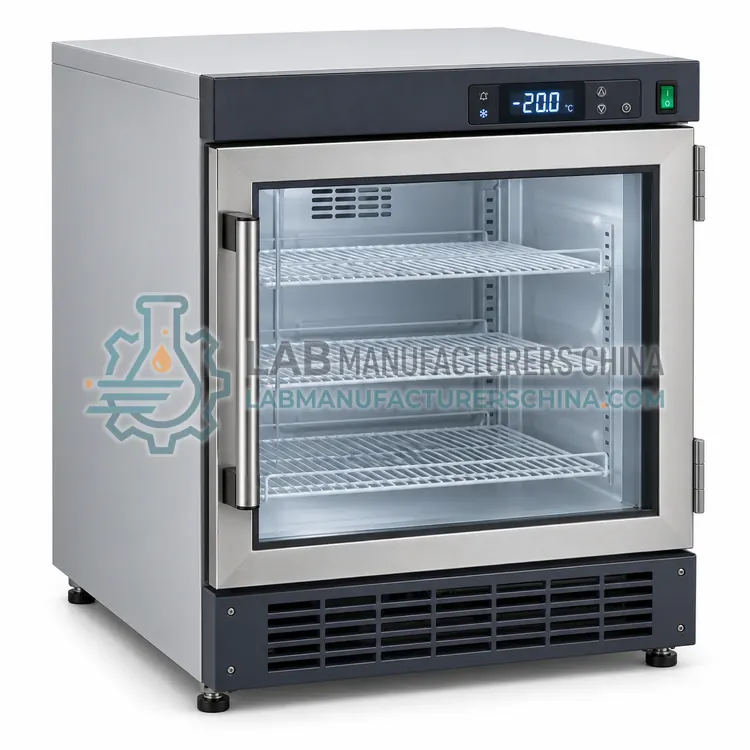
A compact freezer of about 100–150 L that holds –10 to –25 °C beneath a laboratory bench. It suits small laboratories, clinics and pharmacies that need limited frozen storage for reagents, enzymes, kits and samples but have little floor space.
What is the Undercounter –20 °C Laboratory Freezer?
A compact freezer of about 100–150 L that holds –10 to –25 °C beneath a laboratory bench. It suits small laboratories, clinics and pharmacies that need limited frozen storage for reagents, enzymes, kits and samples but have little floor space.
Overview
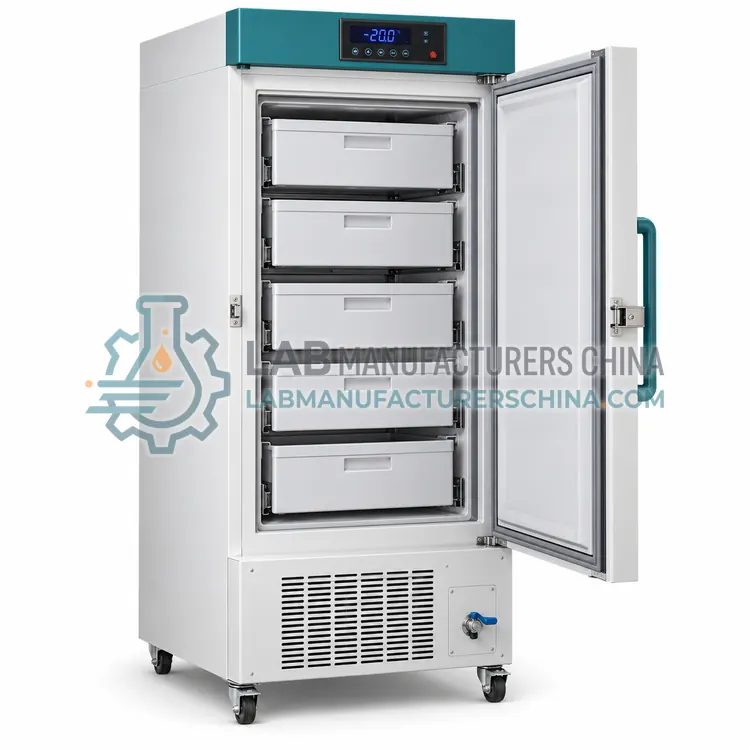
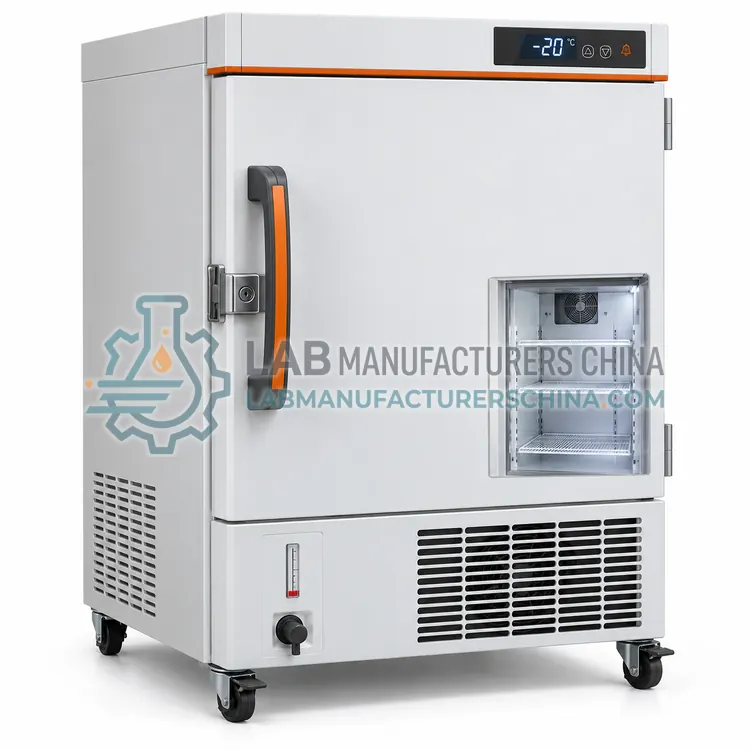
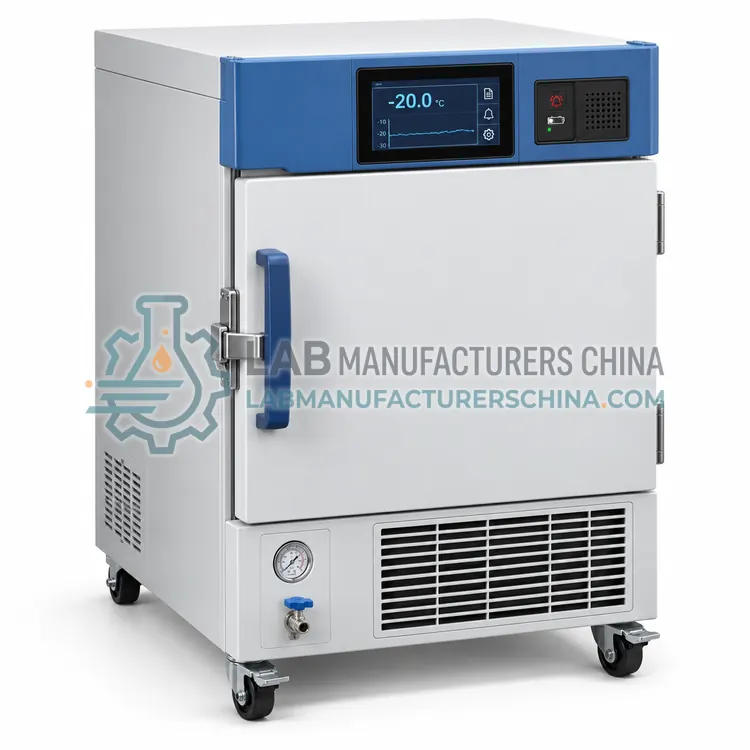
The undercounter freezer has a height of about 820–870 mm and a net volume of 100–150 L, so it fits beneath a standard worktop. Cooling is either static, with evaporator plates lining the compartment, or fan-assisted. Static designs hold temperature well but require manual defrosting two or three times a year, while fan-assisted models remove frost automatically at the cost of larger temperature swings. Drawers with transparent fronts organise small items, and a lockable door restricts access. A digital controller displays temperature and sounds an alarm for high temperature, door ajar and power failure. The freezer generally uses R600a and runs from a single-phase supply. With small thermal mass, recovery after door opening is faster than in large units, but hold-over during a power cut is short.
How does it work?
A –20 °C freezer uses a single-stage vapour-compression circuit with hydrocarbon refrigerant such as R600a or R290. The evaporator either lines the compartment as plates, giving static cooling with high stability and manual defrost, or sits behind a panel with a fan, giving forced-air cooling and automatic defrost. Polyurethane foam of 60–80 mm provides insulation, and magnetic gaskets limit air leakage. A microprocessor controller reads a sensor, sets the temperature between –10 and –25 °C and drives alarms. Higher-specification models add an independent alarm probe, battery backup and a data logger. Spark-free models relocate controls outside the compartment for flammable storage. The temperature reached is sufficient to slow chemical degradation and enzyme activity but does not stop them entirely.
What are the key features?
- Height of 820–870 mm fits below standard laboratory worktops
- Transparent-front drawers keep small reagent boxes organised
- Static or fan-assisted cooling depending on defrost preference
- Digital display with high-temperature, door-ajar and power-failure alarms
- Lockable door for controlled access to stored materials
What are the technical specifications?
A typical undercounter –20 °c laboratory freezer configuration offers temperature range of –10 to –25 °C, net volume of 100–150 L, cooling method of Static or fan-assisted, defrost of Manual (static) or automatic (fan-assisted), refrigerant of R600a and drawers of 3–4, transparent front. Values are indicative of the product class; the exact figures for each configuration are confirmed on the quotation and the calibration documents supplied with the instrument.
Which applications is it used for?
The Undercounter –20 °C Laboratory Freezer is used in small laboratory reagent storage, enzyme and kit storage, clinic and pharmacy frozen stock and teaching laboratories. Across the wider -20°C Freezers class, laboratories also deploy it for enzyme and reagent storage, diagnostic kit storage and culture media and supplements.
Which standards and certifications apply?
Relevant standards and methods include IEC 61010-1, IEC 61010-2-011, IEC 61326-1, ISO 15189, NFPA 45 and ISO 9001. Certification candidates for this model are CE and ISO 9001 manufacturing; each is to be confirmed for the specific configuration before shipment, and certificates are supplied only where they have been issued.
Place the freezer on a level floor with clearance for ventilation as specified, away from heat and sunlight, and allow it to run for several hours before loading. Avoid overloading and block-free airflow in fan-assisted models. Defrost static units when frost reaches about 5 mm, and clean the condenser every few months. Calibrate probes and alarms at least annually, and map temperature where storage is regulated. Keep an emergency plan for power failure, including backup freezer space or a generator-backed circuit. Do not store flammable liquids unless the unit is specifically built for it.
How do I select the right Undercounter –20 °C Laboratory Freezer?
Choose the undercounter freezer when frozen stock is small and bench space is the constraint. Specify volume, height limit, defrost type, door lock and alarm needs. For larger stock, long hold-over or validated storage, select an upright or chest model instead.
How does it compare with other -20°C Freezers variants?
Choose by what is stored and how it tolerates temperature change. Enzymes and sensitive reagents favour static, manual-defrost cabinets, while general chemicals and media suit frost-free models. Regulated kits and calibrators need independent alarms and logging. Flammable materials require spark-free or explosion-proof designs. Then select capacity, from 100 L undercounter to 600 L upright, and compare temperature uniformity, recovery, drawer layout and lock. Check ambient range, electrical supply and noise. Consider whether –20 °C is sufficient, because many biological samples, nucleic acids and tissues are kept at –80 °C for long-term stability, and some vaccines need different storage.
Full specifications
| Temperature range | –10 to –25 °C |
|---|---|
| Net volume | 100–150 L |
| Cooling method | Static or fan-assisted |
| Defrost | Manual (static) or automatic (fan-assisted) |
| Refrigerant | R600a |
| Drawers | 3–4, transparent front |
| Controller | Digital display |
| Alarms | High temperature, door ajar, power failure |
| Height | 820–870 mm |
| Power supply | 220–240 V, 50 Hz |
Indicative values for this product class. Final specifications are confirmed on the quotation and in the calibration documents supplied with the instrument.
Applications
- Small laboratory reagent storage
- Enzyme and kit storage
- Clinic and pharmacy frozen stock
- Teaching laboratories
Key features
- Height of 820–870 mm fits below standard laboratory worktops
- Transparent-front drawers keep small reagent boxes organised
- Static or fan-assisted cooling depending on defrost preference
- Digital display with high-temperature, door-ajar and power-failure alarms
- Lockable door for controlled access to stored materials
Frequently asked questions about Undercounter –20 °C Laboratory Freezer
Static freezers cool through plates or walls and need manual defrosting but hold temperature stably. Fan-assisted freezers circulate air and defrost automatically, which adds convenience but allows larger temperature swings, sometimes affecting sensitive enzymes during defrost cycles.
Most restriction enzymes and many reagents are stored at –20 °C, so it is suitable. Avoid frost-free cycles that warm the contents, store enzymes in cold blocks during use, and keep them in a stable interior position rather than in the door.
Static models need manual defrosting when frost reaches about 5 mm, typically two to three times a year. Move stock to another freezer during defrost, wipe the interior dry and allow temperature to recover before reloading.
A –20 °C laboratory freezer is a cabinet that holds contents at about –10 to –25 °C. It stores enzymes, reagents, kits, media and samples that need sub-zero storage but not the –80 °C used for long-term biological samples.
Typical contents are restriction enzymes, polymerases, antibiotics, reagent kits, media supplements, antibodies for short-term use and frozen chemical standards. Always follow the manufacturer's label, since some reagents require –80 °C or refrigeration.
Manual-defrost freezers hold temperature more stably, so they suit enzymes and sensitive reagents. Frost-free models are more convenient and uniform, but cycle temperature during defrost, which can harm sensitive contents. Choose according to what is stored.
Related models
Biomedical –20 °C Freezer with Backup Alarm and Data Logging
带备用报警和数据记录的生物医学 –20 °C 冷冻箱
- CE (to be confirmed)
- +2