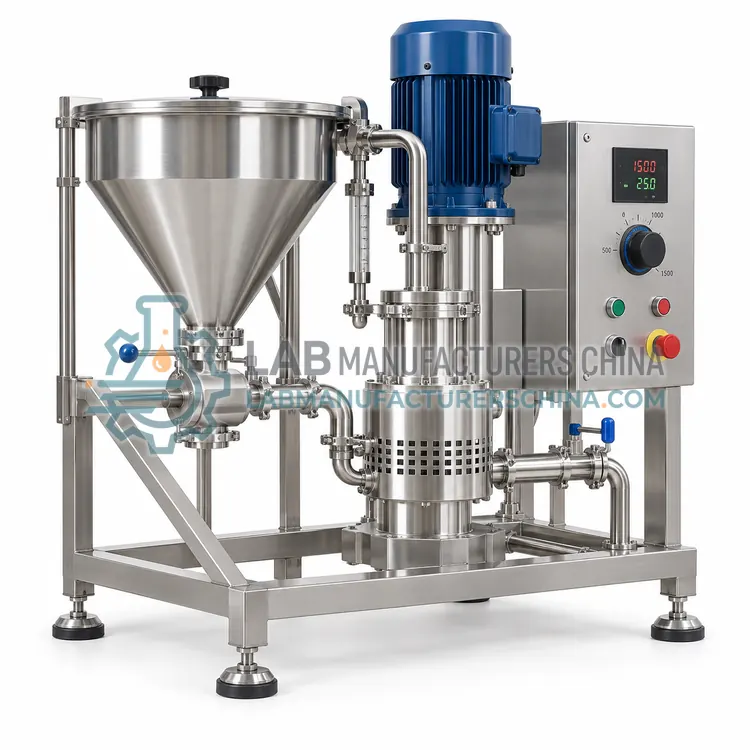
How do High-Shear Mixers work?
A high-shear mixer rotates a rotor at high tip speed, commonly 10 to 40 m/s, inside or next to a fixed stator. Fluid is drawn axially into the rotor, accelerated outward, and forced through the narrow gap between rotor and stator, typically 0.2 to 1 mm, and through slots or holes in the stator. In the gap the fluid experiences very high shear rates, often above 20,000 s⁻¹, plus turbulence and cavitation, which break droplets and particles and wet powders. Disperser-type heads use a toothed or saw-tooth blade in an open vessel. Main components are the motor and drive, the mixing head with interchangeable generators, a shaft with seals, a vessel or inline housing, and speed control. Results depend on tip speed, gap, generator geometry, viscosity and batch time.
Which High-Shear Mixers variants are available?
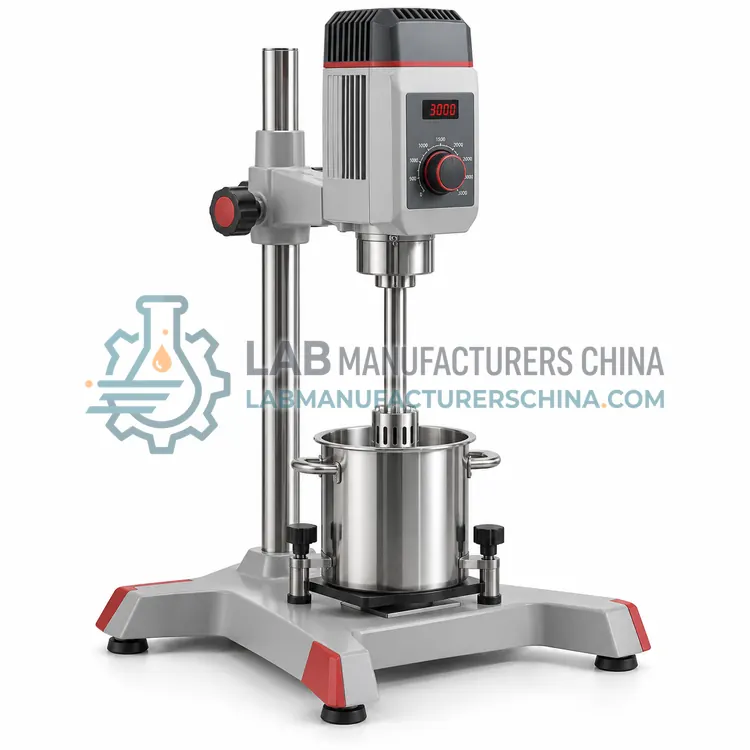
- Batch Rotor-Stator High-Shear Mixer — A batch rotor-stator high-shear mixer immerses a rotating head in an open vessel to emulsify, disperse and wet powders in volumes from 0.1 to 100 L.
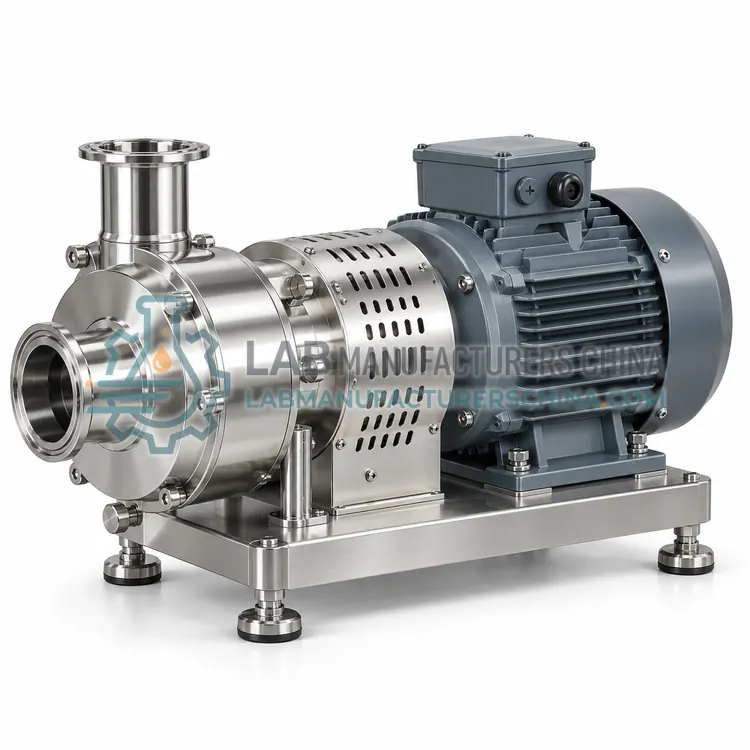
- Inline High-Shear Mixer — An inline high-shear mixer places a rotor-stator head in a pipeline housing so that product passes through the shear zone in a single or recirculating loop.
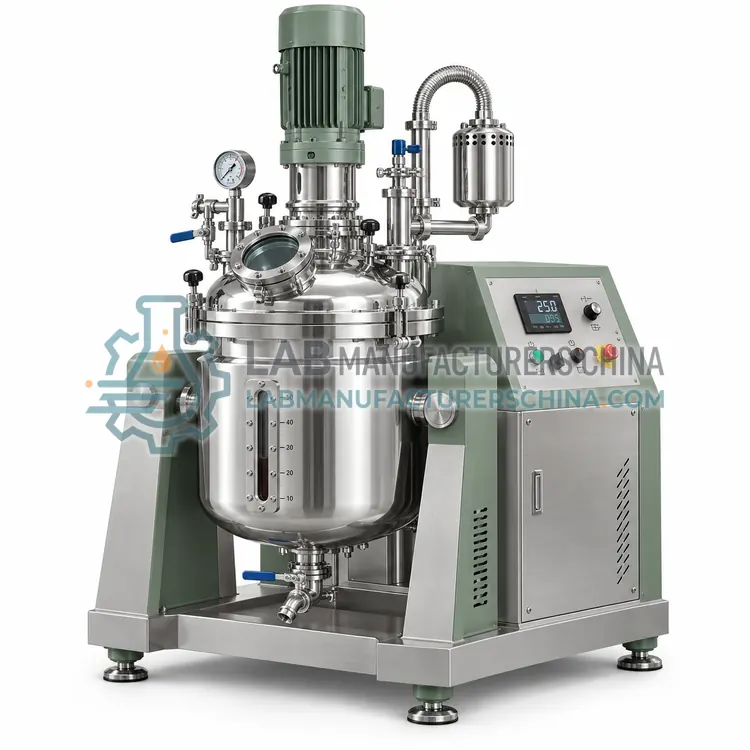
- Vacuum High-Shear Emulsifying Mixer — A vacuum high-shear emulsifying mixer combines a rotor-stator head, scraper agitator, vacuum and heating in one closed vessel.
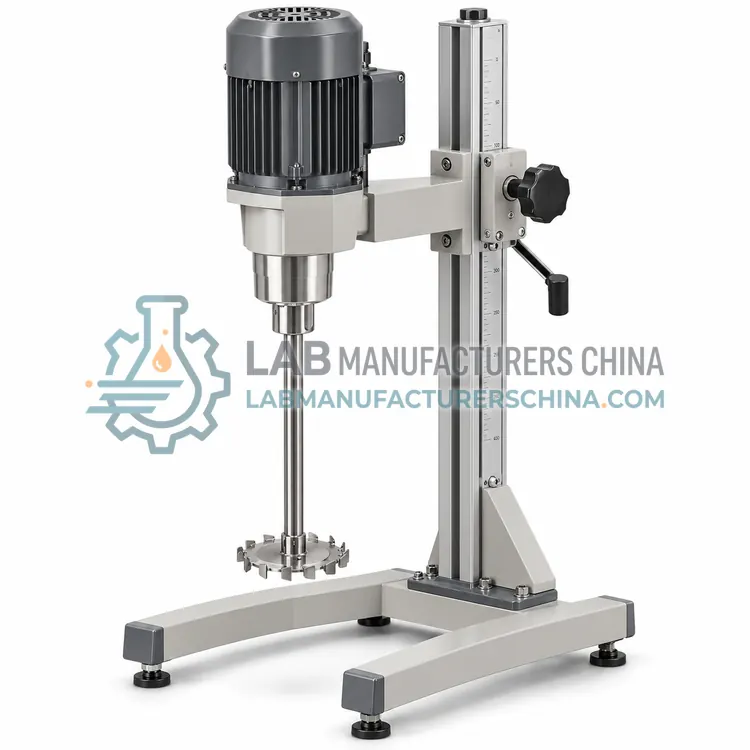
- High-Shear Disperser with Saw-Tooth Blade — A high-shear disperser uses a toothed or saw-tooth disc rotating at high speed in an open vessel to wet and disperse pigments, fillers and powders in viscous liquids.
- Powder-Induction High-Shear Mixer — A powder-induction high-shear mixer uses the vacuum created by the rotor-stator to draw powders directly into the liquid below the surface.
How do I choose the right variant?
Select a high-shear mixer by batch size, viscosity, target particle or droplet size and process type. Batch rotor-stator mixers suit volumes from 0.1 to 100 L and offer interchangeable generator heads. Inline models process continuous or recirculated flow and give narrower size distributions. Vacuum emulsifiers combine shear with degassing and heating for cosmetics and ointments. Dispersers suit pigment and filler wetting in coatings and inks. Powder-induction designs draw powders into the liquid to prevent lumps. Check tip speed, motor power, generator options such as coarse, medium and fine slots, and materials of construction such as 316L stainless steel. Consider cleanability, sanitary design and seals if the products are pharmaceutical or food grade. Verify noise levels and safety guarding, and ask for trials if particle size specifications are critical.
Where are High-Shear Mixers used?
High-Shear Mixers are specified in emulsion and cream preparation, pigment and filler dispersion, pharmaceutical suspension development, food sauce and beverage emulsions, nanoparticle and particle size reduction and chemical slurry homogenization.
Which standards and certifications apply?
Work with High-Shear Mixers is commonly governed by IEC 61010-1, EN ISO 12100, ISO 13320, ASTM E2651 and GB 4793.1. Instrument certifications such as CE marking are confirmed per configuration and never assumed.
What are the key considerations before purchase?
Secure the mixer on a stable stand or clamp and keep the head fully immersed before start-up to avoid air entrainment and dry running of the seal. Use guards and emergency stops, and never operate with loose hair or clothing near the shaft. Keep the gap between rotor and stator clean, since worn generators lose shear efficiency and should be inspected regularly. Flush or clean-in-place between batches to avoid cross-contamination. Control temperature, since shear heats the product, and use jacketed vessels or cooling where needed. Sanitary seals and polished surfaces are important for pharmaceutical and food work. Comply with IEC 61010-1 and machinery safety standards, and record speed, time and temperature for batch documentation.