Summary
Specify centrifugation in relative centrifugal force (RCF, ×g), not RPM, because the same RPM gives different force in rotors of different radius. Convert with RCF = 1.118 × 10⁻⁵ × r × RPM². Then choose the centrifuge by rotor type, tube capacity, refrigeration, maximum speed and safety features.
Why is RCF more meaningful than RPM?
RPM counts how many revolutions the rotor makes per minute. It says nothing about the force the sample experiences. That force, the relative centrifugal force (RCF, expressed in multiples of gravitational acceleration, ×g), depends on both the rotational speed and the distance of the sample from the axis of rotation.
The relationship is RCF = 1.118 × 10⁻⁵ × r × RPM², where r is the radius in millimeters measured from the rotor axis to the point of interest, and the constant 1.118 × 10⁻⁵ applies when radius is in millimeters. For example, a rotor with a maximum radius of 100 mm running at 5,000 RPM produces about 2,795 ×g. A rotor of 150 mm radius at the same speed produces about 4,193 ×g.
This is why a protocol written in RPM cannot be reproduced on another centrifuge unless the rotor radius is identical. Published methods, pharmacopoeial procedures and kit instructions should state ×g. When a protocol gives only RPM, find the rotor radius from the manufacturer and convert.
For reproducible work, record the RCF, the rotor model, the run time, the temperature and the acceleration and deceleration settings in the laboratory notebook.
Which centrifuge class suits which application?
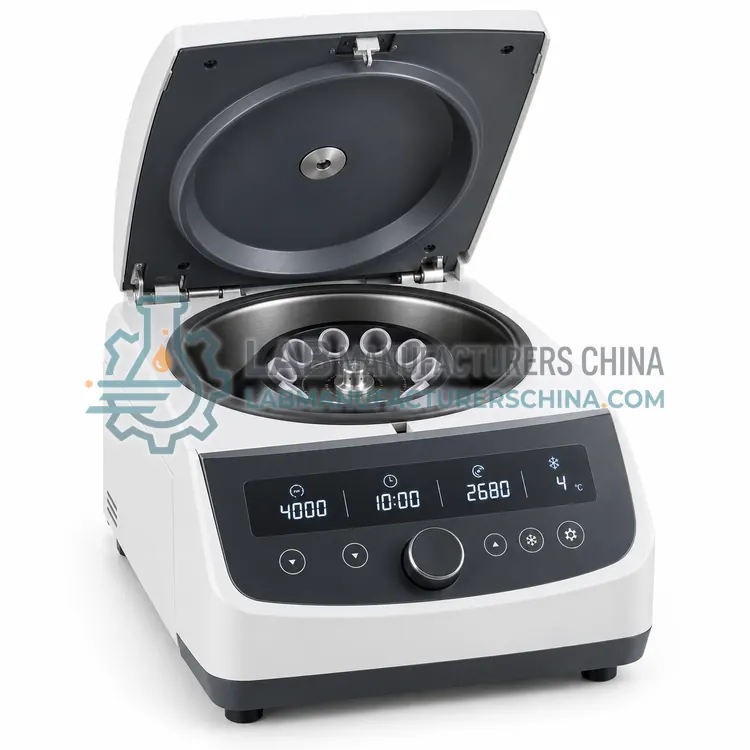
Laboratory centrifuges fall into several classes by speed and capacity.
- Benchtop and clinical centrifuges, usually up to about 6,000 RPM, handle blood tubes, urine sediment and routine separations in tubes from 5 to 100 mL.
- Microcentrifuges hold 0.2 to 2.0 mL tubes and reach about 15,000 to 21,000 ×g, used for nucleic-acid and protein preparation.
- High-speed refrigerated centrifuges reach roughly 20,000 to 30,000 ×g with capacities from tubes to 6 × 1 L bottles, used for cell harvesting, organelle isolation and large-volume clarification.
- Ultracentrifuges run at 50,000 to 150,000 RPM, generating up to about 1,000,000 ×g in a vacuum chamber, for subcellular fractionation, lipoprotein and virus work and density-gradient separations.
- Specialty units include cytocentrifuges, plate centrifuges, concentrators, and continuous-flow machines.
Matching the class to the work avoids two errors: buying a high-speed unit that is used mostly at low speed, and buying a benchtop machine that cannot reach the required force. Note that a higher maximum speed also brings higher rotor cost, stricter maintenance and more safety requirements.
How do rotor type and capacity affect the choice?
The rotor often matters more than the centrifuge body. Two basic designs exist.
Fixed-angle rotors hold tubes at a fixed angle, commonly 25 to 45 degrees. Particles travel a short distance to the tube wall and slide down, so pelleting is fast and the maximum RCF is higher. They suit pelleting cells, precipitates and nucleic acids.
Swing-out (swinging-bucket) rotors let the buckets swing to horizontal during the run, so the pellet forms at the bottom of the tube and layers stay flat. They suit density-gradient work, blood separation with gel tubes and microplates, though their maximum RCF is lower.
Vertical and near-vertical rotors are used mainly in ultracentrifugation for short run times in gradients.
When comparing quotations, check the following: maximum RCF and radius of each rotor, the number and size of tubes, whether adapters are available for smaller tubes, rotor material (aluminum, titanium or carbon fiber), sealed or aerosol-tight lids for biohazard samples, and the rated lifetime. Some rotors have a service life counted in runs or years, after which they must be retired. Confirm the rotor is interchangeable within the model series so one centrifuge can serve several workflows.
When is refrigeration needed, and what else affects the sample?
Friction between the rotor and the air heats the chamber, particularly at high speed. Samples containing enzymes, cells, proteins or volatile analytes usually need temperature control, typically set between 0 and 4 °C, and some cell work requires 20 or 37 °C. A refrigerated centrifuge should state its minimum temperature at maximum speed, for example 4 °C at full RPM, and its pull-down time from ambient. Benchtop non-refrigerated machines are adequate for blood tubes and short runs at moderate speed.
Other parameters that affect the result are the following.
- Acceleration and deceleration profiles: soft braking prevents resuspension of loose pellets and disturbance of gradients.
- Run-time accuracy and speed accuracy, commonly ±10 RPM.
- Balance tolerance: imbalance limits, usually expressed in grams between opposing tubes, and an imbalance detector that stops the run.
- Tube and bottle ratings: each tube carries its own maximum RCF. Using a tube above its rating risks breakage and contamination.
- Noise level and heat output if the unit is installed in a shared room.
For pharmaceutical and clinical work, programmable storage of methods and a run log help with traceability.
What safety and compliance features should be checked?
A centrifuge stores a large amount of rotational energy, so safety features are not optional. The general electrical safety requirement is IEC 61010-1, and the particular requirements for laboratory centrifuges are in IEC 61010-2-020. Machines sold in some markets also follow regional standards such as GB 4793.1 or UL 61010 series.
Look for these features.
- Lid interlock that prevents opening until the rotor stops, and prevents starting with the lid open.
- Rotor identification so the control limits speed to the rotor rating.
- Imbalance detection and over-speed protection.
- Armor ring or containment designed to retain rotor fragments in the event of failure.
- Emergency lid release for power failure, with a documented procedure.
- Aerosol-tight rotors or buckets with lids for pathogenic or hazardous samples; these should be opened in a biosafety cabinet.
For regulated laboratories, ask whether the supplier supplies IQ/OQ documents, calibration certificates for speed, time and temperature, and a maintenance plan. Any CE or other certification should be confirmed from documents. Operators should be trained in balancing, loading and rotor care, since many incidents are caused by incorrect loading, corrosion or use of a rotor beyond its service life.
What should be included in a centrifuge RFQ?
A complete request helps a supplier configure the right model and rotor set. Include the following.
- Application and sample type, including any biohazard or flammable content.
- Required RCF and tube or bottle sizes, with the number of samples per run.
- Preferred rotor types, for example one fixed-angle and one swing-out, and whether aerosol-tight lids are required.
- Temperature range and whether refrigeration is needed.
- Speed, timer, acceleration and braking profile requirements, and program memory.
- Space limits, including bench dimensions, weight limit and ceiling height for floor-standing models.
- Electrical supply, voltage and frequency, plus any need for an uninterruptible supply.
- Documentation: manual language, declaration of conformity, IQ/OQ and calibration certificates.
- Spares and service: warranty period, rotor life, preventive maintenance and local support.
Submit the details through the quote form. A sales engineer will return a configured offer with the rotor and adapter list so that you can check each protocol's RCF against the rotor radius before ordering.