Summary
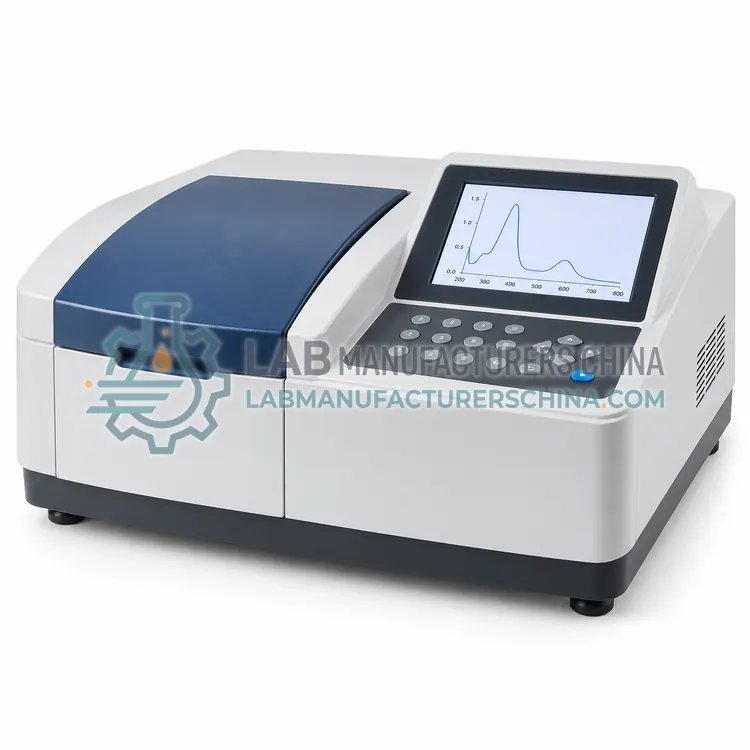
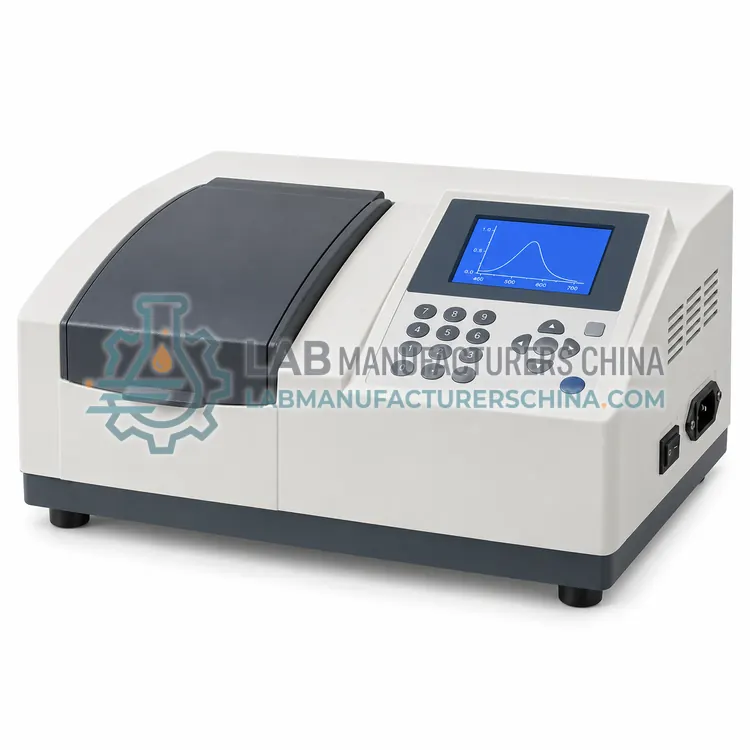
Choose a UV-Vis spectrophotometer by the measurement it must support, not by the catalogue wavelength range. Decide first on beam geometry (single, double, diode-array, microvolume), then verify bandwidth, stray light, photometric accuracy, software compliance and accessories against the method or pharmacopoeia you must follow.
What does a UV-Vis spectrophotometer actually measure?
A UV-Vis spectrophotometer measures how much light a sample absorbs or transmits at wavelengths from the ultraviolet into the near-infrared, typically 190 to 1100 nm. The result is reported as absorbance or percent transmittance. Under the Beer–Lambert law, absorbance is proportional to the concentration of the absorbing species and to the path length of the cuvette, which is why the technique is used for quantitative assay work as well as for qualitative spectral comparison.
The instrument has four functional blocks: a light source (usually a deuterium lamp for the ultraviolet and a tungsten-halogen lamp for the visible range), a wavelength selector (a monochromator with a diffraction grating, or a polychromatic design where dispersion occurs after the sample), a sample compartment, and a detector such as a photomultiplier tube or a silicon photodiode or array.
Before comparing models, write down the measurement you need: a single-wavelength assay, a full spectral scan, a kinetic run, or a nucleic-acid or protein reading from a few microliters. The answer narrows the choice of instrument type faster than any other decision.
Which beam geometry suits which job?
Four designs cover most purchases.
- Single-beam instruments pass light through either the reference or the sample in sequence. They are compact and economical and suit routine concentration measurements, teaching laboratories and water-quality checks where the baseline is re-zeroed often.
- Double-beam instruments split the beam and measure sample and reference almost simultaneously, which compensates for lamp drift. They are the usual choice for long scans, kinetic runs and regulated assays where baseline stability matters.
- Diode-array instruments use a polychromatic beam and a detector array, capturing the full spectrum in about a second. They suit fast kinetics, HPLC detection and high sample throughput, with some trade-off in stray-light performance compared with scanning double-beam designs.
- Microvolume instruments measure 0.5 to 2 microliters on a pedestal or fiber interface without a cuvette. They suit nucleic-acid and protein quantitation when sample is scarce.
Portable units exist for field work, but their optical specifications are generally narrower than benchtop designs.
Which optical specifications decide data quality?
Five specifications separate instruments that look similar on a datasheet.
Spectral bandwidth is the width of the wavelength band reaching the sample. Fixed 2 nm is adequate for many routine assays, while a variable 0.5 to 5 nm slit is needed to resolve narrow absorption peaks. Pharmacopoeial resolution checks often call for a bandwidth of 2 nm or less.
Stray light is unwanted radiation outside the selected wavelength. It limits the highest absorbance you can trust; a stray-light value below 0.05 %T at 220 nm and 340 nm is a common requirement for regulated work, and double-monochromator designs go lower.
Photometric accuracy and noise determine how close a reading is to the true value. Request accuracy at stated absorbance levels, for example ±0.002 A at 1 A, and the noise at 0 A.
Wavelength accuracy and repeatability, typically ±0.3 nm and ±0.1 nm, matter when you identify compounds from peak position.
Finally, check the photometric range. A range of -4 to 4 A is useful only if stray light allows it.
How do light sources, detectors and sample handling affect running cost?
Lamp life is the main consumable cost. Deuterium lamps are commonly rated for about 1,000 to 2,000 hours, and tungsten-halogen lamps for about 2,000 hours or more. Pulsed xenon lamps, used in many diode-array and some scanning designs, have long service intervals and no warm-up time, but their energy output and noise profile differ, so check the specification at the wavelengths you use.
Detector type affects sensitivity. Silicon photodiodes are robust and adequate for most absorbance work up to about 3 A. Photomultiplier tubes give better sensitivity and dynamic range at the ultraviolet end and in low-light conditions.
Sample handling deserves as much attention as optics. Decide whether you need a single cell holder or a multi-cell changer, a thermostatted holder (Peltier control, for example 15 to 60 °C), a long-path or short-path cell, a flow cell, or an integrating sphere for turbid or solid samples. Quartz cuvettes are required below about 340 nm; glass and plastic absorb in the ultraviolet.
Ask the supplier to list consumable part numbers and typical replacement intervals in the quotation.
Which standards and compliance features apply?
Regulated laboratories qualify UV-Vis instruments against published performance tests. USP <857> and Ph. Eur. 2.2.25 describe checks for wavelength accuracy, absorbance accuracy, stray light and resolution, typically using holmium oxide or didymium filters, potassium dichromate solutions and potassium chloride or sodium iodide solutions for stray light. JP general information and GB/T standards for ultraviolet-visible spectrophotometers define comparable tests in other jurisdictions. ASTM E275 covers the description and measurement of performance of spectrophotometers in the ultraviolet, visible and near-infrared ranges. The instrument itself should meet IEC 61010-1 for electrical safety.
For pharmaceutical and other regulated users, software matters as much as optics. Look for role-based user accounts, audit trails, electronic signatures consistent with 21 CFR Part 11 principles, and data export that does not allow silent edits. Ask whether the supplier can provide installation and operational qualification protocols (IQ/OQ) and performance-verification procedures.
Certifications held by a manufacturer should be confirmed from documents before purchase. Request copies of declarations of conformity and calibration certificates rather than relying on a catalogue statement.
What should an RFQ for a UV-Vis spectrophotometer specify?
A precise request for quotation avoids mismatched offers and speeds comparison. Include the following.
- Application and method: assay, scan, kinetics, nucleic-acid quantitation, and the pharmacopoeia or standard that applies.
- Instrument type: single-beam, double-beam, diode-array or microvolume.
- Wavelength range and bandwidth: for example 190 to 1100 nm with 1 nm or variable bandwidth.
- Performance limits: stray light, photometric accuracy and noise, wavelength accuracy, with the test conditions.
- Accessories: cell holders, Peltier temperature control, autosampler, flow cell, integrating sphere, cuvettes and their material and path length.
- Software: operating system, language, audit trail and user-management requirements, export formats.
- Power and environment: supply voltage and frequency for your country, operating temperature and humidity range.
- Documentation: manual language, declaration of conformity, factory calibration certificate, IQ/OQ support.
- Commercial terms: lead time, warranty period, spare lamp supply, training and after-sales support.
Send the request through the quote form, and the sales engineer will return a configured offer for review.