Summary
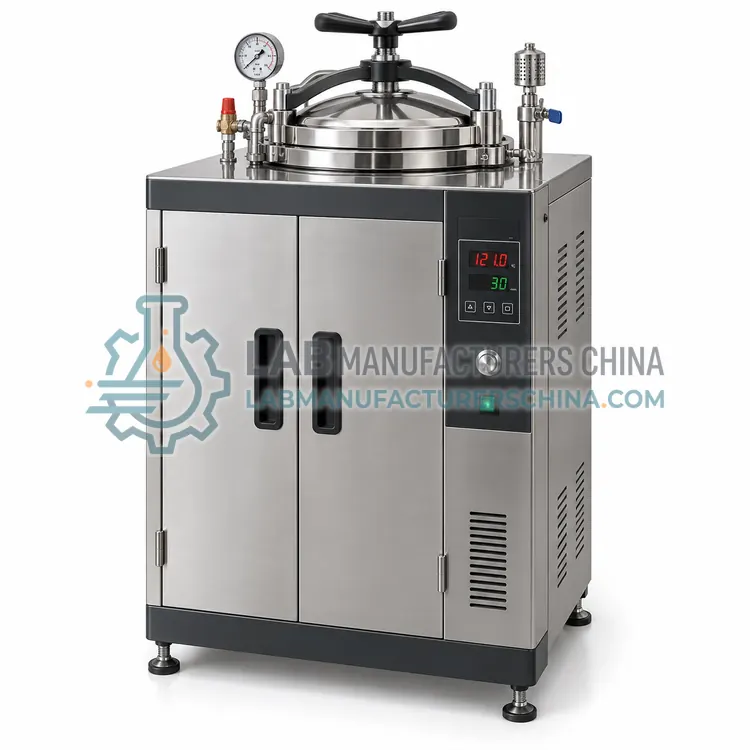
Autoclave validation proves that a steam sterilizer delivers the required temperature, pressure and time to every part of a defined load. It follows three stages: installation qualification, operational qualification and performance qualification, supported by calibrated probes, biological indicators and documented routine monitoring under EN 285, ISO 17665 or the standard you apply.
What is autoclave validation and why is it required?
An autoclave sterilizes by exposing items to saturated steam, typically at 121 °C for 15 to 20 minutes or 134 °C for 3 to 5 minutes. Sterility cannot be confirmed by testing every item after the cycle, because sterility testing is destructive and statistically limited. Validation therefore replaces end-product testing with evidence that the process is capable and controlled.
Validation demonstrates three things. First, the equipment is installed correctly and operates as designed. Second, the cycle reaches and holds the specified conditions throughout the chamber and load. Third, the defined load is sterilized consistently and repeatedly, with a known safety margin.
The requirement applies wherever sterilization outcome affects safety or data integrity: pharmaceutical manufacturing and QC laboratories, hospital sterile services, microbiology laboratories that decontaminate waste, and research facilities handling biological agents. The depth of validation depends on risk and on the regulatory framework, but the logic is the same in each case.
Treat validation as a lifecycle activity. It is performed at commissioning, repeated after major repair or relocation, revalidated at defined intervals, and supported by daily or per-cycle monitoring.
Which standards govern steam sterilizer performance?
Several standards are commonly cited, and the correct one depends on the application.
EN 285 specifies requirements and tests for large steam sterilizers used for healthcare products, where a large sterilizer is one able to hold at least one sterilization module of 300 mm × 300 mm × 600 mm. It addresses chamber performance, steam quality, air removal, drying and temperature tolerance.
EN 13060 covers small steam sterilizers, those with a chamber volume below 60 liters, and classifies cycles as B, N or S according to their ability to handle different load types.
ISO 17665 describes the development, validation and routine control of moist-heat sterilization processes for healthcare products. ISO 17665-1 sets out the process requirements, and the accompanying technical specification gives guidance. ISO 11138 covers biological indicators and ISO 11140 covers chemical indicators.
For pharmaceutical use, the PDA Technical Report 1 and regional GMP guidance such as EU GMP Annex 1 and WHO guidance are also consulted. Laboratory waste autoclaves are frequently validated to an internal protocol built on these references. Specify the applicable standard in the purchase order, since it determines the vacuum system, steam quality and documentation supplied.
What do IQ, OQ and PQ involve?
Installation qualification (IQ) documents that the autoclave and its utilities are as specified and installed correctly. Typical IQ records include the equipment model and serial number, drawings, materials of construction, pressure vessel documentation, electrical and steam supply connections, drain and water quality, calibration certificates for the instruments on the unit, and software version.
Operational qualification (OQ) confirms that the machine works across its operating range without a load or with a test load. Typical tests are a leak test and air-removal (Bowie-Dick or helix) test for pre-vacuum machines, verification of control and safety interlocks, alarm checks, temperature and pressure sensor verification, and an empty chamber heat distribution study. For EN 285 machines, steam quality checks for non-condensable gases, dryness and superheat are also performed.
Performance qualification (PQ) shows that the process is effective for the actual loads. Calibrated thermocouples are placed in the most difficult locations of the load, and the cycle is run at least three consecutive times. The acceptance criteria usually require that the coldest point reaches the sterilization temperature for the set hold time, with biological indicators showing no growth after incubation.
Define loads, load patterns and maximum weights in the protocol. A validated pattern is the only pattern covered by the validation.
How are temperature, pressure and time verified?
Steam sterilization depends on the relationship between pressure, temperature and time. Saturated steam at 121 °C is at about 205 kPa absolute (roughly 1.05 bar gauge), and at 134 °C about 304 kPa absolute. If the chamber contains trapped air, the temperature at a given pressure is lower, so pressure alone is not proof of sterilizing conditions. Validation therefore relies on temperature measurement inside the load.
Sensors and data loggers used in validation must themselves be calibrated against traceable references before and after the study, typically to an accuracy of ±0.5 °C or better. The number of probes depends on chamber size; EN 285 test loads use defined thermocouple positions, while lab protocols commonly use at least 10 probes distributed across the chamber and in the worst-case load items.
Acceptance for the hold period commonly requires that all probes stay within a window such as 121 to 124 °C for the set time, and that the spread between probes stays within about 2 °C. The F0 value, which expresses lethality as equivalent minutes at 121.1 °C, is often calculated for liquid cycles. Liquid loads need special attention because the liquid temperature lags the chamber, and load probes in containers give the real value.
Keep the raw data, the calibration certificates and the calculations together in the validation report.
How do biological and chemical indicators support validation?
Physical measurements show that conditions were reached. Biological indicators show that the lethal effect was achieved. For steam sterilization, the standard organism is Geobacillus stearothermophilus spores, manufactured and labeled under ISO 11138-3. After the cycle, the indicator is incubated, usually at 55 to 60 °C, together with an unexposed control. Growth in the exposed indicator means the cycle failed at that location.
During PQ, biological indicators are placed with the thermocouples in the worst-case positions. Many protocols also include an overkill or half-cycle approach, in which a reduced exposure still inactivates the indicators, demonstrating a safety margin.
Chemical indicators, defined by ISO 11140-1 in classes 1 to 6, change color when exposed to specified conditions. Class 1 process indicators show that a pack has been through a cycle. Class 2 indicators, such as the Bowie-Dick test, check air removal. Class 5 integrating and Class 6 emulating indicators respond to several variables and give a closer correlation to biological results.
Neither indicator replaces the other. Use biological indicators for qualification and periodic checks, and chemical indicators in every load for release decisions, in line with your quality system.
What routine monitoring and revalidation are needed?
After initial validation, routine control keeps the process in its validated state. Common practice includes the following.
- Daily or per-cycle review of printed or electronic records for temperature, pressure and time against set limits.
- A daily air-removal test on pre-vacuum machines, recorded and signed.
- A chemical indicator in or on every load or pack.
- Biological indicator testing at a defined frequency, often weekly for healthcare work, or as set by your risk assessment.
- Scheduled preventive maintenance covering door gaskets, steam traps, safety valves, strainers and vacuum pump, with calibration of sensors at least annually.
- Periodic pressure vessel inspection as required by local law.
Revalidation is typically carried out annually, using a reduced version of the PQ with loads representing the normal range. It is also needed after a significant change: a new load type, a modified cycle, a repaired control system, relocation, or a repeated failure of indicators.
When a cycle fails, quarantine the load, investigate, and do not release it. Record the deviation and corrective action. Keep training records for operators, because human error in loading is a frequent cause of failed cycles.
What should buyers ask a supplier about validation support?
A supplier can reduce your validation effort if the machine is designed for it. Ask these questions before ordering.
- Which standard does the sterilizer meet, for example EN 285 or EN 13060, and what documentary evidence exists?
- Are IQ and OQ protocols and factory acceptance test results supplied in your working language?
- Does the unit have validation ports for extra thermocouples, and what sensors and recorder are fitted?
- Is the controller software versioned, password-protected and capable of an audit trail and data export?
- What are the chamber material, steam supply or generator requirements, and water quality limits?
- Are the pressure vessel certificate and declaration of conformity available, and are local pressure equipment regulations addressed?
- What calibration certificates, spare parts list and preventive maintenance schedule come with the machine?
- What training and on-site commissioning support is available in your region?
Any certification claimed, such as CE or ISO 13485, should be confirmed from documents before purchase. Include these points in your RFQ so that quotations can be compared on equal terms.