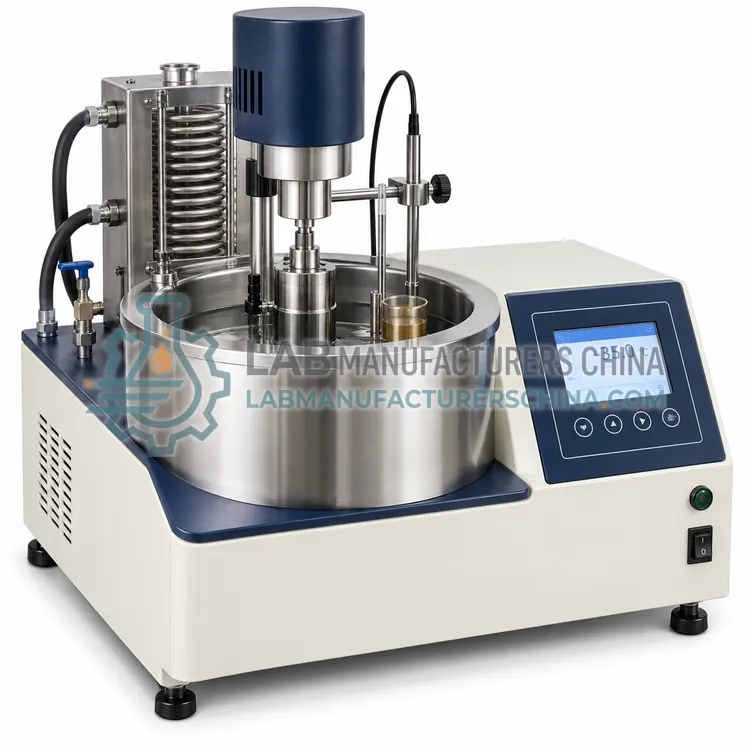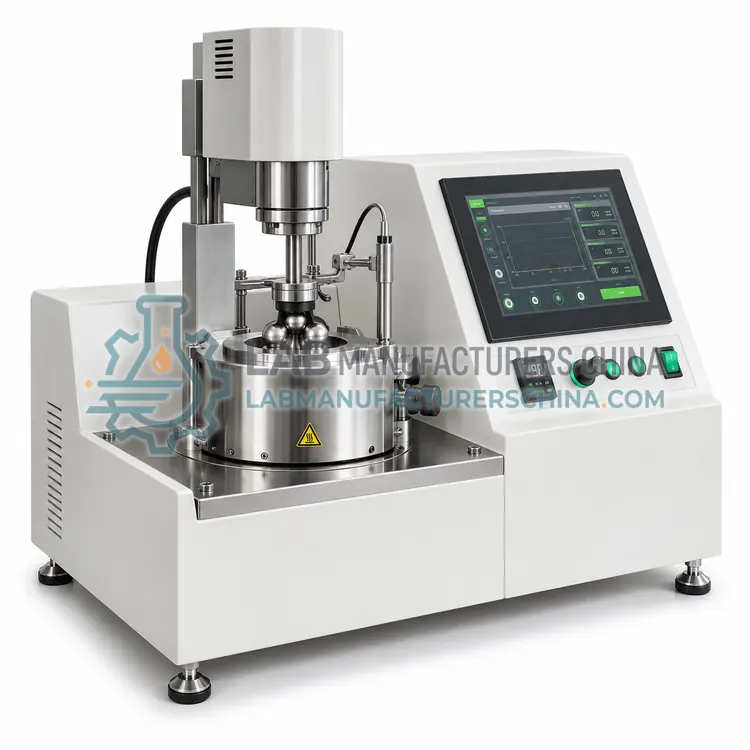
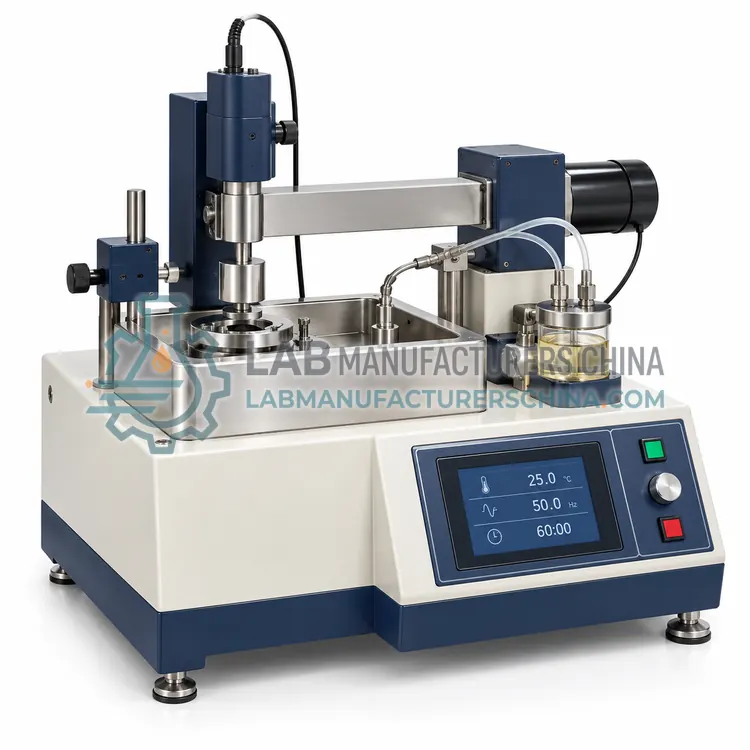
High-Frequency Reciprocating Rig (HFRR)
高频往复试验机(HFRR)
- SKU WEA-0003
- Wear Analysis
- CE (to be confirmed)
- ISO 9001 manufacturing (to be confirmed)
Price on request — FOB / CIF quoted per order
Prices depend on configuration, quantity and destination port.
Key specifications
| Stroke length | 1 mm |
|---|---|
| Frequency | 10–200 Hz (50 Hz standard) |
| Applied load | 2 N (200 g) |
| Fuel temperature | 25–150 °C (60 °C standard) |
| Temperature stability | ± 1 °C |
| Test duration | 75 min |
Request a quote Download brochure · to be provided
By Lab Manufacturers China Technical TeamLast reviewed Standards: ASTM D4172, ASTM D2783, ASTM D2266
What is the High-Frequency Reciprocating Rig (HFRR)?
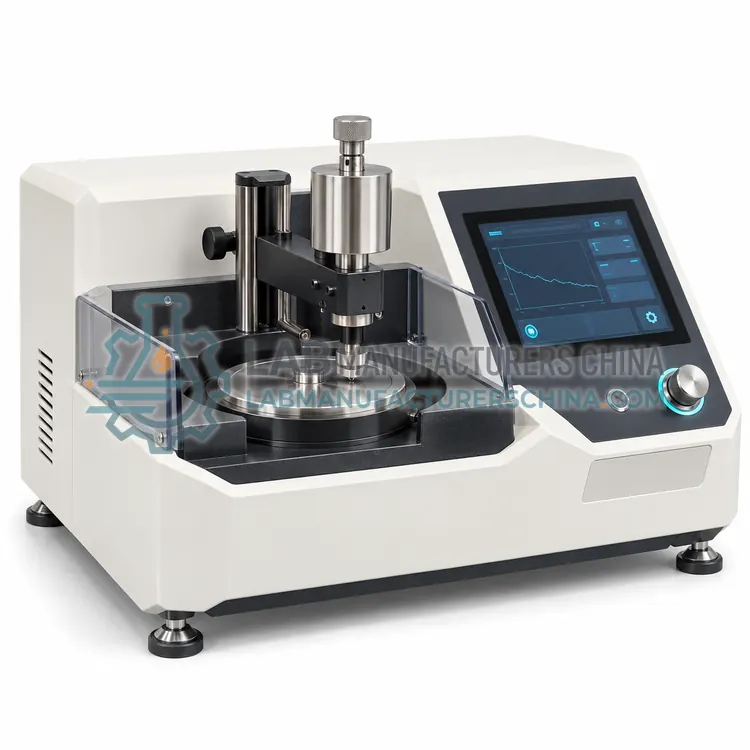
A high-frequency reciprocating rig oscillates a steel ball against a fixed disk in a small fuel or oil sample at controlled temperature. It measures wear scar diameter to assess the lubricity of diesel fuel and thin-film lubricants under ISO 12156-1 and ASTM D6079.
What is the High-Frequency Reciprocating Rig (HFRR)?
A high-frequency reciprocating rig oscillates a steel ball against a fixed disk in a small fuel or oil sample at controlled temperature. It measures wear scar diameter to assess the lubricity of diesel fuel and thin-film lubricants under ISO 12156-1 and ASTM D6079.
Overview
A 6 mm steel ball is loaded against a steel disk at 2 N and oscillated with a 1 mm stroke at 50 Hz for 75 minutes. Both specimens are immersed in a 2 mL fuel sample held at 60 °C in a temperature-controlled reservoir, with air humidity held at a defined level. Low-sulfur diesel has reduced natural lubricity, so this test shows whether additive treatment is sufficient to protect fuel pumps and injectors. The operator measures the wear scar on the ball and corrects for humidity. Electromagnetic drive and a load sensor also report friction and contact resistance. The small scale makes the test sensitive to cleanliness, so specimen handling and humidity control are important for repeatability.
How does it work?
Wear analysis in lubricant laboratories follows two approaches. Tribometers place two surfaces in contact under a defined load, speed, temperature and lubricant film, then quantify friction force and the wear produced, usually as a scar diameter, track depth or mass loss. Contact geometry varies: point contact in four-ball and ball-on-disc tests, line contact in block-on-ring and Timken tests, and reciprocating sliding in high-frequency rigs. Debris analysis instead examines particles already suspended in used oil. Ferrography deposits ferrous particles magnetically on a slide for microscope classification, while quantitative sensors measure particle mass and size ranges. Load cells, torque sensors, temperature control and displacement transducers provide repeatable data, which is interpreted against standard limits or against a reference oil.
What are the key features?
- Oscillating stroke 1 mm at 50 Hz
- Fuel reservoir controlled to 60 °C with humidity control
- Only 2 mL sample per test
- Friction and contact-resistance recording
- Automatic test timing and wear scar image capture option
What are the technical specifications?
A typical high-frequency reciprocating rig (hfrr) configuration offers stroke length of 1 mm, frequency of 10–200 Hz (50 Hz standard), applied load of 2 N (200 g), fuel temperature of 25–150 °C (60 °C standard), temperature stability of ± 1 °C and test duration of 75 min. Values are indicative of the product class; the exact figures for each configuration are confirmed on the quotation and the calibration documents supplied with the instrument.
Which applications is it used for?
The High-Frequency Reciprocating Rig (HFRR) is used in diesel fuel lubricity testing, biodiesel and additive evaluation and thin-film lubricant screening. Across the wider Wear Analysis class, laboratories also deploy it for anti-wear additive evaluation, extreme-pressure oil and grease screening and friction coefficient research.
Which standards and certifications apply?
Relevant standards and methods include ASTM D4172, ASTM D2783, ASTM D2266, ASTM D5183, ASTM D2714, ASTM D2509 and ASTM D6079. Certification candidates for this model are CE and ISO 9001 manufacturing; each is to be confirmed for the specific configuration before shipment, and certificates are supplied only where they have been issued.
Tribological tests are sensitive to specimen quality, so use certified steel balls, rings and blocks with specified hardness and surface finish, and clean them with the solvent sequence the method requires. Check load and speed calibration with a known reference oil periodically. Fit guarding around rotating parts and use ventilation when testing heated oil. Keep room temperature stable, because ambient conditions influence friction. Measure wear scars with a calibrated microscope and record at least two orthogonal diameters per specimen. For debris analysis, take oil samples under consistent conditions and from the same point. Maintain records of calibration and reference checks, and report results with the method's precision limits in mind.
How do I select the right High-Frequency Reciprocating Rig (HFRR)?
Select an HFRR for fuel lubricity acceptance or when only small samples are available. It does not replace four-ball tests for greases or heavy-duty oils. Specify humidity control, temperature range, whether a scar-imaging microscope is required, and the standard, ISO 12156-1 or ASTM D6079.
How does it compare with other Wear Analysis variants?
Select the instrument from the property and specification being tested. Four-ball machines are the standard for anti-wear and extreme-pressure ranking of oils and greases, and most product specifications cite them. Pin-on-disk and block-on-ring rigs suit research into friction coefficient and material pairs, and allow flexible speed and load. Reciprocating rigs reproduce diesel fuel and thin-film lubricity. Timken testers screen heavy-duty greases and gear oils. Wear debris analyzers serve maintenance programs rather than product qualification. Compare load range, speed range, temperature capability, specimen cost, data acquisition and the ability to follow the exact standard. Consider operator safety around rotating parts and heated lubricant, and confirm supply of test balls, rings and blocks. In the RFQ, list methods, maximum load, temperature and any humidity or atmosphere control.
Full specifications
| Stroke length | 1 mm |
|---|---|
| Frequency | 10–200 Hz (50 Hz standard) |
| Applied load | 2 N (200 g) |
| Fuel temperature | 25–150 °C (60 °C standard) |
| Temperature stability | ± 1 °C |
| Test duration | 75 min |
| Sample volume | 2 mL |
| Ball specimen | 6 mm AISI 52100 |
| Humidity control | ≈ 30–80 % RH, 50 % standard |
Indicative values for this product class. Final specifications are confirmed on the quotation and in the calibration documents supplied with the instrument.
Applications
- Diesel fuel lubricity testing
- Biodiesel and additive evaluation
- Thin-film lubricant screening
Key features
- Oscillating stroke 1 mm at 50 Hz
- Fuel reservoir controlled to 60 °C with humidity control
- Only 2 mL sample per test
- Friction and contact-resistance recording
- Automatic test timing and wear scar image capture option
Frequently asked questions about High-Frequency Reciprocating Rig (HFRR)
It is the ability of diesel fuel to lubricate pumps and injectors. Hydrotreating to remove sulfur also removes natural lubricating compounds, so fuel standards limit HFRR wear scar to about 460 micrometers.
Water vapor in the air changes the oxide film on steel surfaces and affects wear. The method specifies a defined water vapor pressure and corrects the wear scar to standard conditions.
Yes, it can screen oils and additives at adjustable temperature, stroke and load, though such tests are not standardized specifications. Use them for comparative ranking rather than absolute limits.
It measures friction and the wear produced between two loaded surfaces, usually as wear scar diameter or friction coefficient. The result ranks how well an anti-wear or extreme-pressure additive protects metal contact.
Anti-wear tests run at moderate load for a fixed time and measure wear scar. Extreme-pressure tests increase load in steps until the lubricant film fails and surfaces weld, giving weld point and load-wear index.
A four-ball anti-wear test lasts 60 minutes, plus cleaning and scar measurement, so one machine typically completes 4 to 6 tests a day. Extreme-pressure series take longer because each load stage is repeated.