
Wall Bench with Vibration-Damped Balance Station
带防振天平工位的靠墙实验台
- SKU WAB-0005
- Wall Benches
- ISO 9001 manufacturing (to be confirmed)
- SEFA 8 test report (to be confirmed)
- CE (electrical services, where fitted) (to be confirmed)
Price on request — FOB / CIF quoted per order
Prices depend on configuration, quantity and destination port.
Key specifications
| Slab size | 500 × 400 × 50 mm or larger |
|---|---|
| Slab material | Granite / marble / steel |
| Slab mass | ≈25–60 kg |
| Damping pads | Elastomer or rubber-cork, Shore A 40–60 |
| Leveling accuracy | ≤ 1 mm per metre |
| Bench depth | 750 mm |
Request a quote Download brochure · to be provided
By Lab Manufacturers China Technical TeamLast reviewed Standards: SEFA 8 (laboratory grade casework), EN 13150 (laboratory workbenches), GB 24820 (laboratory furniture)
What is the Wall Bench with Vibration-Damped Balance Station?
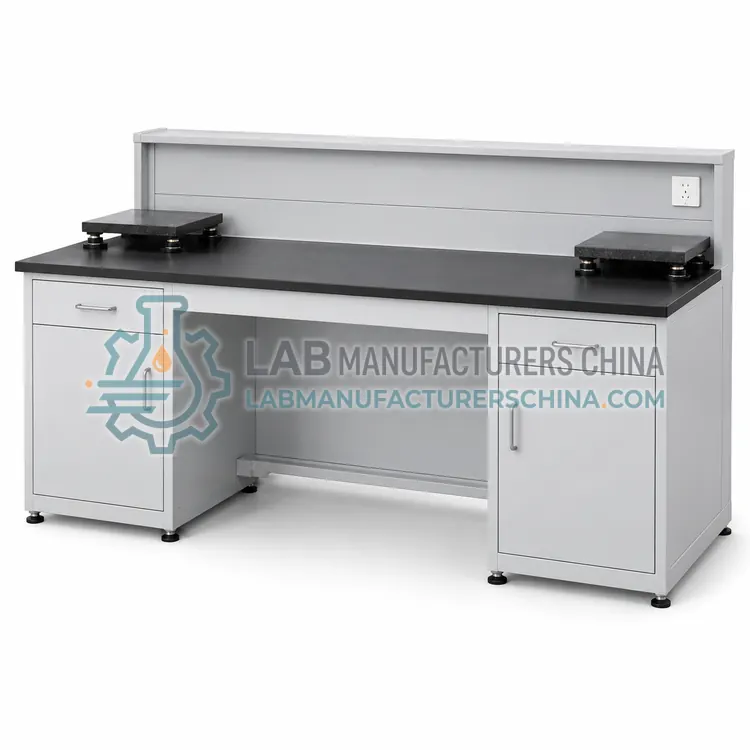
This wall bench includes a dedicated balance station with a stone or steel slab on vibration-damping pads, isolated from the main worktop. It gives analytical balances a stable weighing surface within a standard laboratory bench run, without buying a separate floor-standing balance table.
What is the Wall Bench with Vibration-Damped Balance Station?
This wall bench includes a dedicated balance station with a stone or steel slab on vibration-damping pads, isolated from the main worktop. It gives analytical balances a stable weighing surface within a standard laboratory bench run, without buying a separate floor-standing balance table.
Overview
The balance station uses a granite, marble or thick steel slab, typically 500 × 400 × 50 mm or larger, that rests on elastomer pads or is carried on a separate rigid frame that does not touch the surrounding worktop. The surface is leveled to within 1 mm per metre, and the bench section is often positioned away from doors, fume hoods and air vents to limit drafts. Anti-static finishes and a dedicated socket avoid interference. A wall-fixed bracket frame reduces floor-borne vibration compared with long unsupported cantilevers. The station suits analytical balances of 0.1 mg to 0.01 mg readability, though draft shields, temperature stability and correct calibration procedures still influence weighing results significantly.
How does it work?
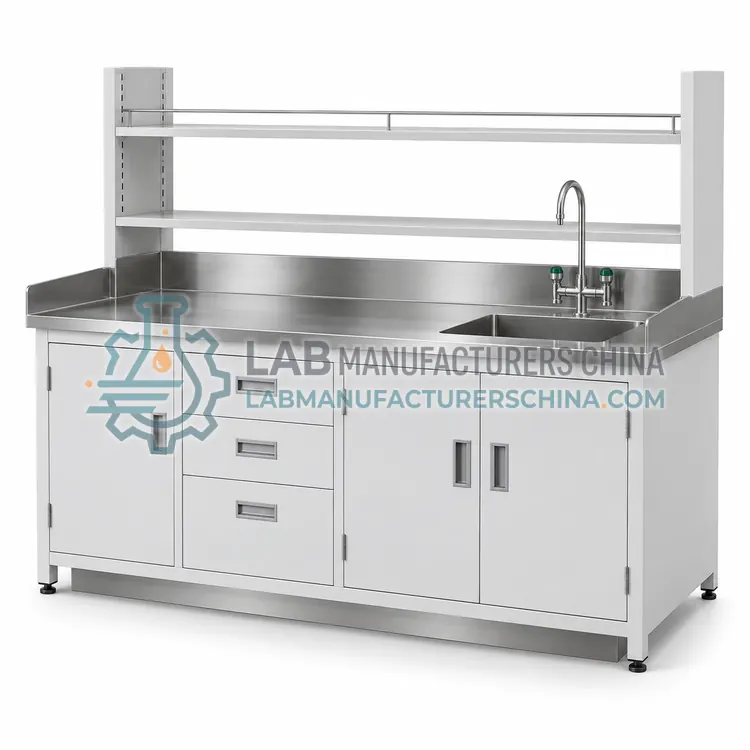
A wall bench consists of a worktop supported by base cabinets, a frame or cantilever brackets, and is fixed to the wall to prevent tipping. Services are delivered through wall-mounted panels, service strips or pipe-chase ducts running behind the bench, and accessed via sockets and taps above the worktop. Standard depth is 650–750 mm, length in 600 mm modules, with an upstand or splashback at the rear. Reagent shelves, glazed wall cabinets and instrument shelves may be mounted above. The wall construction must carry the fixing loads, and the rear void should permit pipework access. Worktops are chosen from epoxy resin, phenolic resin, stainless steel or ceramic according to chemical exposure and cleanliness requirements.
What are the key features?
- Granite, marble or steel slab isolated on damping pads
- Separate rigid frame independent of main worktop
- Leveled to within 1 mm per metre
- Dedicated anti-static finish and socket
- Positioned away from drafts and doors
- Compatible with draft shield and weighing accessories
What are the technical specifications?
A typical wall bench with vibration-damped balance station configuration offers slab size of 500 × 400 × 50 mm or larger, slab material of Granite / marble / steel, slab mass of ≈25–60 kg, damping pads of Elastomer or rubber-cork, Shore A 40–60, leveling accuracy of ≤ 1 mm per metre and bench depth of 750 mm. Values are indicative of the product class; the exact figures for each configuration are confirmed on the quotation and the calibration documents supplied with the instrument.
Which applications is it used for?
The Wall Bench with Vibration-Damped Balance Station is used in analytical weighing, pharmaceutical QC, standard preparation and material testing. Across the wider Wall Benches class, laboratories also deploy it for chemistry laboratories, quality control laboratories and instrument rooms.
Which standards and certifications apply?
Relevant standards and methods include SEFA 8 (laboratory grade casework), EN 13150 (laboratory workbenches), GB 24820 (laboratory furniture), EN 14056 (laboratory furniture design and installation) and IEC 61010-1 (electrical safety, room services). Certification candidates for this model are ISO 9001 manufacturing, SEFA 8 test report and CE (electrical services, where fitted); each is to be confirmed for the specific configuration before shipment, and certificates are supplied only where they have been issued.
Check the wall before installation: masonry or concrete can take direct fixings, while stud or plasterboard walls need reinforcement. Mark and isolate services behind the bench, and provide access panels so that valves and cables can be reached without removing worktops. Seal the worktop to the wall with chemical-resistant silicone, and fit an upstand where spill containment matters. Verify electrical protection, including RCDs on socket circuits, and keep gas shut-off valves accessible. Inspect fixings, hinges, drawer runners and seals every six months, and clean surfaces with neutral detergents after chemical contact.
How do I select the right Wall Bench with Vibration-Damped Balance Station?
Select this variant when analytical or semi-micro balances must sit in a perimeter bench without a separate balance table. It reduces vibration transmission but does not replace environmental control. Specify slab size and material, balance model weight and readability, nearby equipment and the location of drafts.
How does it compare with other Wall Benches variants?
Choose the wall bench type by the room perimeter and the services available. Base-cabinet benches suit storage-heavy labs, cantilever benches leave floor space for cleaning and mobile units, and benches with integrated sinks or fume hood interfaces create complete wet stations. Decide on the depth: 650 mm saves space, while 750 mm holds larger instruments. Check wall construction, service duct access and ceiling height when planning wall cabinets. Select the worktop material from the chemical list and temperature exposure, and set load ratings for balances, ovens and centrifuges. Confirm that the layout leaves aisles of at least 1.2 m along the bench and respects egress routes.
Full specifications
| Slab size | 500 × 400 × 50 mm or larger |
|---|---|
| Slab material | Granite / marble / steel |
| Slab mass | ≈25–60 kg |
| Damping pads | Elastomer or rubber-cork, Shore A 40–60 |
| Leveling accuracy | ≤ 1 mm per metre |
| Bench depth | 750 mm |
| Working height | 850 mm |
| Balance readability | 0.01 mg–1 mg |
| Wall fixing | Bolted to masonry or concrete |
| Anti-static finish | Surface resistance ≈10^6–10^9 Ω |
Indicative values for this product class. Final specifications are confirmed on the quotation and in the calibration documents supplied with the instrument.
Applications
- Analytical weighing
- Pharmaceutical QC
- Standard preparation
- Material testing
Key features
- Granite, marble or steel slab isolated on damping pads
- Separate rigid frame independent of main worktop
- Leveled to within 1 mm per metre
- Dedicated anti-static finish and socket
- Positioned away from drafts and doors
- Compatible with draft shield and weighing accessories
Frequently asked questions about Wall Bench with Vibration-Damped Balance Station
A heavy, rigid, level surface reduces vibration and improves stability. Granite is common but not mandatory, and thick steel on damping pads can work. Follow the balance manufacturer's installation guidance and verify performance through routine calibration.
Place it away from doors, air-conditioning vents, fume hoods and heavy foot traffic, preferably on a wall bench over a load-bearing wall. Stable temperature and low air movement improve weighing repeatability.
Yes, isolation prevents vibration from other activities reaching the balance. The slab should rest on damping pads or a separate frame and not touch the main worktop, leaving a small gap filled with flexible sealant.
A wall bench is a laboratory work surface installed against a wall, using wall-mounted services and overhead shelving. It provides sample preparation, instrument and storage space, and is the most space-efficient arrangement for rooms with perimeter utilities.
Wall benches are typically 650 or 750 mm deep, and 850–900 mm high. The 750 mm depth suits larger analytical instruments, while 650 mm saves floor space in narrow rooms and leaves more aisle width.
Yes, wall benches are normally fixed to the wall or structure to prevent tipping, particularly when wall cabinets or heavy instruments are installed. The fixing type depends on wall material, and stud walls may need backing plates.
Related models
Wall Bench with Reagent Shelf and Service Panel
带试剂架和管线面板的靠墙实验台
- ISO 9001 manufacturing (to be confirmed)
- +2
Double-Sided Island Bench with Central Service Spine
带中央管线立柱的双面中央实验台
- ISO 9001 manufacturing (to be confirmed)
- +2