Vacuum Coating Chamber
真空镀膜腔体
- SKU VAC-0003
- Vacuum Chambers
- CE (to be confirmed)
- ISO 9001 manufacturing (to be confirmed)
- PED compliance (to be confirmed)
Price on request — FOB / CIF quoted per order
Prices depend on configuration, quantity and destination port.
Key specifications
| Working pressure | 10⁻³–10⁻⁷ mbar |
|---|---|
| Chamber volume | 20–500 L |
| Material | Stainless steel 304 or 316L |
| Flange standard | CF or ISO KF |
| Substrate stage | Rotating or heated |
| Targets | 1–4 sputtering targets |
Request a quote Download brochure · to be provided
By Lab Manufacturers China Technical TeamLast reviewed Standards: IEC 61010-1, ISO 21360, ISO 27893
What is the Vacuum Coating Chamber?
A vacuum coating chamber provides a clean high-vacuum environment with feedthroughs and fixtures for sputtering, evaporation or ion coating. It is used to deposit thin films on substrates for research and production.
What is the Vacuum Coating Chamber?
A vacuum coating chamber provides a clean high-vacuum environment with feedthroughs and fixtures for sputtering, evaporation or ion coating. It is used to deposit thin films on substrates for research and production.
Overview
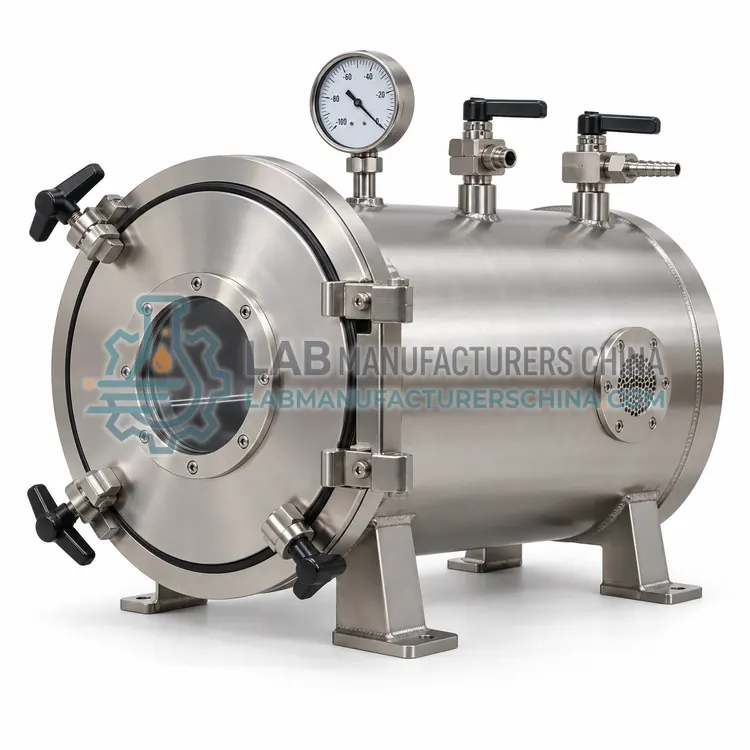
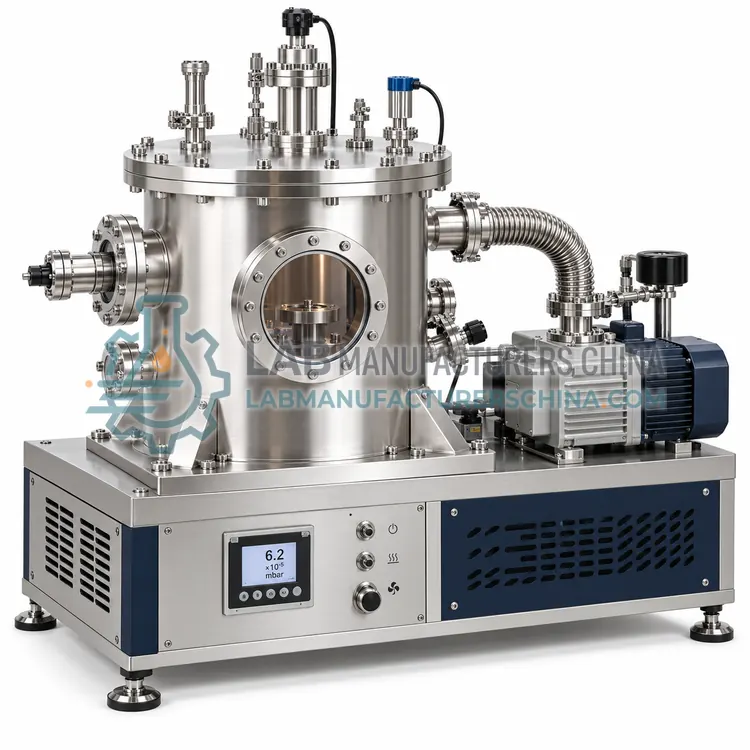
The coating chamber is a stainless steel vessel with ports for a high-vacuum pump, a gauge, a vent valve and instrumentation, plus flanges for electrodes, targets, feedthroughs and a substrate stage. It is designed for low outgassing, with electropolished or clean-machined internal surfaces, and often includes water-cooled shields and a load lock. Typical working pressure is 10⁻³ to 10⁻⁷ mbar, and the chamber is sized for the substrate and the deposition source geometry. The stage may rotate or heat the substrate for uniformity. View ports allow process observation, and a quartz crystal monitor measures film thickness. Because the process is sensitive to contamination, cleaning procedures, materials and leak-tightness are critical, and the chamber is often integrated with a pumping station and process controller.
How does it work?
A vacuum chamber provides the sealed volume from which a pump removes gas. Its walls and seals must resist the pressure difference, which at full vacuum is about one bar acting inward on every square centimeter. Chamber materials, usually stainless steel, aluminum, acrylic or glass, determine strength, chemical resistance and outgassing behavior. Seals in O-ring grooves, gaskets or flat flanges keep air out, and the sealing method sets the achievable vacuum and the ease of opening. Ports allow connection to a pump, gauge, vent valve and feedthroughs for electrical, fluid or optical access. Internal features such as shelves, heating platens, electrodes or sample holders adapt the chamber to its task. The pump-down rate depends on chamber volume, pump speed and the conductance of the connecting line, so the chamber and pump must be matched.
What are the key features?
- Stainless steel vessel with low-outgassing internal surfaces
- Working pressure of about 10⁻³–10⁻⁷ mbar
- Flanges for targets, electrodes and feedthroughs
- Rotating or heated substrate stage
- View port and quartz crystal thickness monitor
- Water-cooled shields and optional load lock
What are the technical specifications?
A typical vacuum coating chamber configuration offers working pressure of 10⁻³–10⁻⁷ mbar, chamber volume of 20–500 L, material of Stainless steel 304 or 316L, flange standard of CF or ISO KF, substrate stage of Rotating or heated and targets of 1–4 sputtering targets. Values are indicative of the product class; the exact figures for each configuration are confirmed on the quotation and the calibration documents supplied with the instrument.
Which applications is it used for?
The Vacuum Coating Chamber is used in sputter and evaporation coating, optical thin films, conductive and barrier layers, research prototype deposition and small-batch production coating. Across the wider Vacuum Chambers class, laboratories also deploy it for sample drying and desiccation, degassing of liquids and resins and vacuum coating and evaporation.
Which standards and certifications apply?
Relevant standards and methods include IEC 61010-1, ISO 21360, ISO 27893, ISO 9001 and GB 4793.1. Certification candidates for this model are CE, ISO 9001 manufacturing and PED compliance; each is to be confirmed for the specific configuration before shipment, and certificates are supplied only where they have been issued.
Never use a chamber above its rated pressure difference, and fit a relief valve or rupture disc where a pump could over-pressurize it or where a process generates gas. Keep sealing surfaces clean and free of scratches, and replace O-rings that are cut, swollen or hardened. Apply vacuum grease sparingly, because excess grease traps particles and can contaminate samples. Support heavy doors safely and check hinges and clamps regularly, especially on large chambers. Verify thermal uniformity if the chamber is heated, and use compatible feedthroughs for electrical or fluid lines. Follow IEC 61010-1 for associated electrical equipment and local pressure vessel rules where applicable. Record base pressure and leak-up rate during commissioning so changes can be detected later.
How do I select the right Vacuum Coating Chamber?
Choose a coating chamber when you need controlled high vacuum with deposition hardware and feedthroughs. For drying or storage, a simpler chamber suffices. In the RFQ, state target pressure, substrate size, deposition method, number of sources and pumping package.
How does it compare with other Vacuum Chambers variants?
Start with the volume needed for your samples or components, and the pressure you must reach. A desiccator-style chamber works for storage and gentle drying at rough vacuum, while ovens and coating chambers need deeper vacuum and often heating or electrode feedthroughs. Choose the material for the process: stainless steel for strength, chemical resistance and cleanability; acrylic or glass for visibility and non-magnetic work; aluminum for light weight. Confirm the pressure rating with a safety factor and check whether a relief device is needed. Select the sealing method, typically an O-ring or gasket, for the vacuum level and opening frequency, and list the ports you need for pump, gauge, vent and feedthroughs. Consider internal fixtures, door or lid access, window size and how the chamber will be cleaned and mounted.
Full specifications
| Working pressure | 10⁻³–10⁻⁷ mbar |
|---|---|
| Chamber volume | 20–500 L |
| Material | Stainless steel 304 or 316L |
| Flange standard | CF or ISO KF |
| Substrate stage | Rotating or heated |
| Targets | 1–4 sputtering targets |
| View ports | 1–3 |
| Thickness monitor | Quartz crystal |
| Load lock | Optional |
| Cooling | Water-cooled shields |
Indicative values for this product class. Final specifications are confirmed on the quotation and in the calibration documents supplied with the instrument.
Applications
- Sputter and evaporation coating
- Optical thin films
- Conductive and barrier layers
- Research prototype deposition
- Small-batch production coating
Key features
- Stainless steel vessel with low-outgassing internal surfaces
- Working pressure of about 10⁻³–10⁻⁷ mbar
- Flanges for targets, electrodes and feedthroughs
- Rotating or heated substrate stage
- View port and quartz crystal thickness monitor
- Water-cooled shields and optional load lock
Frequently asked questions about Vacuum Coating Chamber
Residual gas from walls, seals and fixtures limits the achievable vacuum and contaminates films. Electropolished surfaces, metal seals and clean handling reduce outgassing and improve film quality.
It lets substrates be loaded without venting the whole chamber to atmosphere, which saves time and keeps the main chamber clean. Throughput and film quality both improve.
A quartz crystal monitor tracks deposition rate and thickness in real time, and the controller stops the process at the set value. Calibration with a profilometer improves accuracy.
It depends on the material, wall thickness and design, but the limit is the pressure difference it can safely withstand, normally about one bar for a sealed vessel evacuated to rough vacuum. Follow the manufacturer rating on the label.
Stainless steel for strength, chemical resistance and cleanability; acrylic or glass for visibility and non-magnetic use; aluminum to save weight. Match the material to your samples and cleaning agents.
Common causes are a dirty or damaged O-ring, a loose flange, a poor hose connection or trapped solvent. Clean and reseal, check every joint and measure the leak-up rate with the pump isolated.
Related models