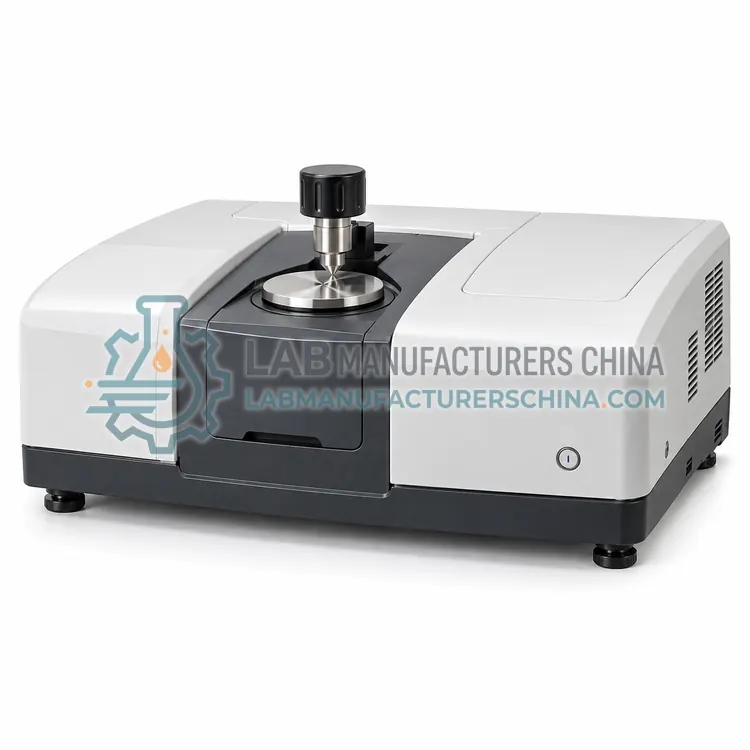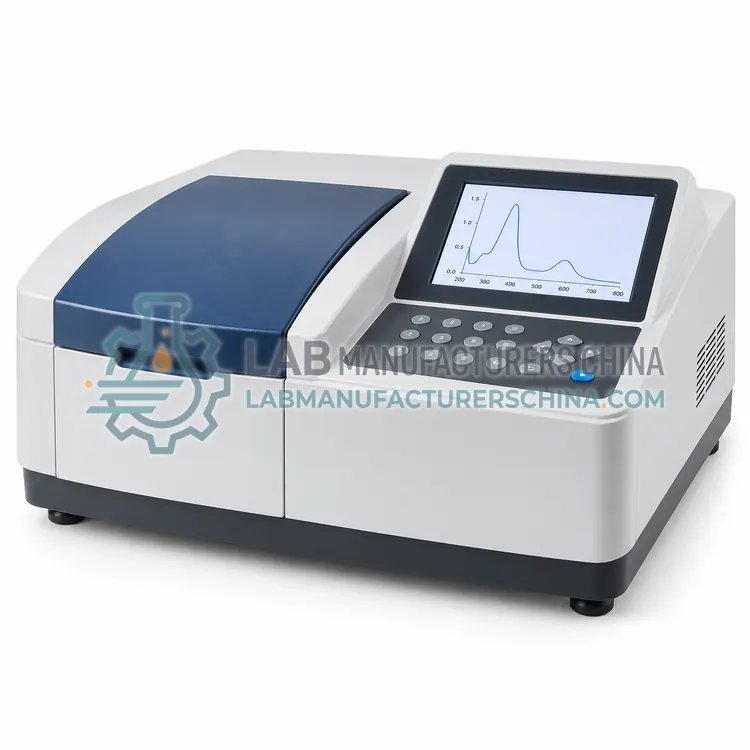
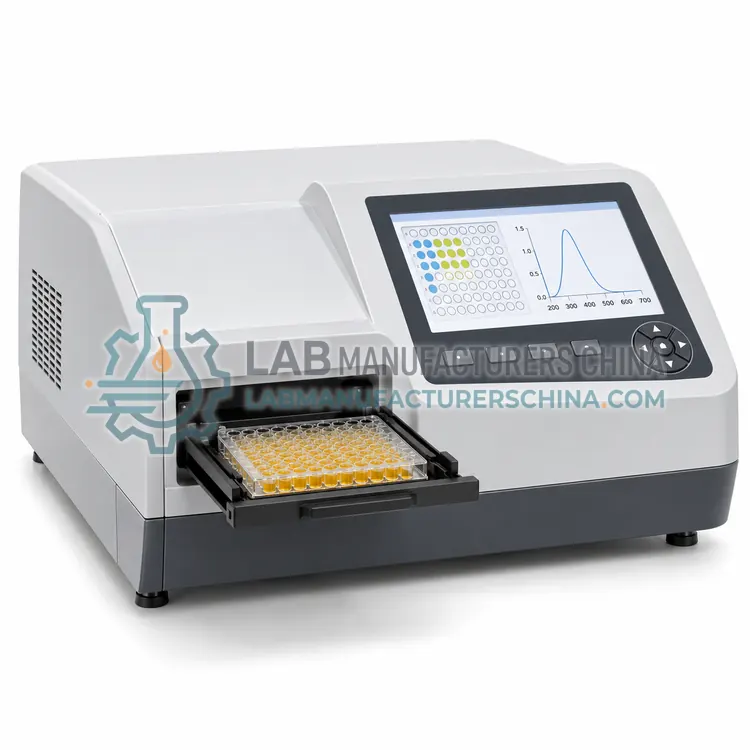
Microplate UV-Vis Absorbance Spectrophotometer
微孔板紫外可见吸光光度计
- SKU UVV-0005
- UV-Vis
- CE (to be confirmed)
- ISO 9001 manufacturing (to be confirmed)
- IVD Regulation 2017/746 where applicable (to be confirmed)
Price on request — FOB / CIF quoted per order
Prices depend on configuration, quantity and destination port.
Key specifications
| Wavelength range | 230–1000 nm |
|---|---|
| Wavelength selection | Monochromator, 1 nm steps |
| Plate formats | 6- to 384-well |
| Photometric range | 0–4.0 A |
| Photometric accuracy | ±1% at 1.0 A (±0.010 A) |
| Read time (96-well) | ≤60 s (single wavelength) |
Request a quote Download brochure · to be provided
By Lab Manufacturers China Technical TeamLast reviewed Standards: ASTM E275, ASTM E925, ASTM E958
What is the Microplate UV-Vis Absorbance Spectrophotometer?
A microplate UV-Vis absorbance spectrophotometer reads 96- or 384-well plates at selectable wavelengths from about 230 to 1000 nm in seconds. It is used for high-throughput assays such as ELISA, protein quantification, cell viability and enzymatic screening.
What is the Microplate UV-Vis Absorbance Spectrophotometer?
A microplate UV-Vis absorbance spectrophotometer reads 96- or 384-well plates at selectable wavelengths from about 230 to 1000 nm in seconds. It is used for high-throughput assays such as ELISA, protein quantification, cell viability and enzymatic screening.
Overview
A microplate absorbance reader illuminates each well from above or below with light from a xenon flash lamp filtered by a monochromator or set of interference filters. Monochromator models cover 230–1000 nm in 1 nm steps and support full spectrum scans per well, while filter-based readers are lower cost and limited to fixed wavelengths such as 405, 450, 492 and 620 nm. A 96-well plate is read in 5–60 seconds, and pathlength correction normalizes readings to 1 cm. Linear range up to 3.0 A and accuracy of ±1% at 1.0 A are typical. Orbital shaking, incubation to 45 °C and an integrated plate stacker for automation are common options. Software performs standard curves, four-parameter curve fitting, and Z-factor statistics for screening. Edge effects and meniscus variations require careful plate handling and uniform dispensing.
How does it work?
UV-Vis instruments pass light of selected wavelength through or onto a sample and measure the ratio of transmitted or reflected intensity to a reference. Sources are typically a deuterium lamp for ultraviolet and a tungsten-halogen lamp for visible and near-infrared, often replaced by xenon flash lamps or LEDs in compact designs. Wavelength selection uses a scanning monochromator with a holographic grating, or a fixed grating that disperses light onto a diode-array or CCD detector so the whole spectrum is captured at once. Photomultiplier tubes, silicon photodiodes or InGaAs detectors convert the light to an electrical signal. Absorbance is calculated as −log10 of transmittance and relates to concentration by the Beer–Lambert law. Stray light, bandwidth and photometric linearity define performance at high absorbance, while integrating spheres and fiber probes adapt the same principle to solids, films and in-situ measurements.
What are the key features?
- Monochromator selects any wavelength from 230 to 1000 nm in 1 nm steps.
- Reads a 96-well plate in under 60 seconds with low well-to-well variation.
- Pathlength correction normalizes absorbance to a 1 cm equivalent.
- Orbital shaking and incubation to 45 °C support kinetic assays.
- Full spectrum scan per well for assay development.
- Four-parameter curve fit and Z-factor statistics for screening analysis.
What are the technical specifications?
A typical microplate uv-vis absorbance spectrophotometer configuration offers wavelength range of 230–1000 nm, wavelength selection of Monochromator, 1 nm steps, plate formats of 6- to 384-well, photometric range of 0–4.0 A, photometric accuracy of ±1% at 1.0 A (±0.010 A) and read time (96-well) of ≤60 s (single wavelength). Values are indicative of the product class; the exact figures for each configuration are confirmed on the quotation and the calibration documents supplied with the instrument.
Which applications is it used for?
The Microplate UV-Vis Absorbance Spectrophotometer is used in ELISA and immunoassays, protein quantification by BCA and Bradford, cell viability assays such as MTT, enzyme activity screening and nucleic acid quantification in microplates. Across the wider UV-Vis class, laboratories also deploy it for reaction kinetics and enzyme assays, nanoparticle plasmon resonance characterization and thin-film and coating optical properties.
Which standards and certifications apply?
Relevant standards and methods include ASTM E275, ASTM E925, ASTM E958, USP <857>, Ph. Eur. 2.2.25, ISO 8655-7 and GB/T 26798. Certification candidates for this model are CE, ISO 9001 manufacturing and IVD Regulation 2017/746 where applicable; each is to be confirmed for the specific configuration before shipment, and certificates are supplied only where they have been issued.
Allow lamps to warm up for 15–30 minutes and perform a baseline correction before every measurement session. Verify performance periodically using holmium oxide or didymium filters for wavelength accuracy, potassium dichromate solutions for photometric accuracy and sodium iodide or potassium chloride solutions for stray light. Use matched quartz cuvettes for the UV and keep optical surfaces clean and free of fingerprints. Replace the deuterium lamp after its rated life of around 2000 hours. Control ambient temperature and vibration, and keep dust and solvent vapors away from the optics. For regulated laboratories, schedule IQ/OQ/PQ and use software with audit trails and access control.
How do I select the right Microplate UV-Vis Absorbance Spectrophotometer?
Select a microplate absorbance reader for batch processing of dozens to hundreds of samples. For spectral research or high absorbance, use a cuvette-based spectrophotometer. In an RFQ, specify wavelength selection type, plate formats, incubation, shaking, stacker compatibility and software features for assay analysis.
How does it compare with other UV-Vis variants?
Choose a UV-Vis spectroscopy instrument according to spectral speed, wavelength range, sample type and accessory needs. Diode-array and CCD instruments capture a full spectrum in under a second and suit kinetics or unstable samples, but stray light is higher than in scanning double-beam systems that remain the choice for high-absorbance work. Extending to 3300 nm with a PbS or InGaAs detector requires a UV-Vis-NIR system. Solid films, powders and coatings need an integrating sphere. Modular fiber-optic spectrometers fit process lines and OEM use, while microplate readers serve high-throughput assays. Compare bandwidth, stray light at 220 and 340 nm, photometric range, baseline flatness and software features. Specify temperature control if thermodynamic or enzyme kinetic measurements are planned.
Full specifications
| Wavelength range | 230–1000 nm |
|---|---|
| Wavelength selection | Monochromator, 1 nm steps |
| Plate formats | 6- to 384-well |
| Photometric range | 0–4.0 A |
| Photometric accuracy | ±1% at 1.0 A (±0.010 A) |
| Read time (96-well) | ≤60 s (single wavelength) |
| Bandwidth | ≤5 nm |
| Incubation | Ambient +4 °C to 45 °C |
| Shaking | Linear or orbital, adjustable |
| Light source | Xenon flash lamp |
Indicative values for this product class. Final specifications are confirmed on the quotation and in the calibration documents supplied with the instrument.
Applications
- ELISA and immunoassays
- Protein quantification by BCA and Bradford
- Cell viability assays such as MTT
- Enzyme activity screening
- Nucleic acid quantification in microplates
Key features
- Monochromator selects any wavelength from 230 to 1000 nm in 1 nm steps.
- Reads a 96-well plate in under 60 seconds with low well-to-well variation.
- Pathlength correction normalizes absorbance to a 1 cm equivalent.
- Orbital shaking and incubation to 45 °C support kinetic assays.
- Full spectrum scan per well for assay development.
- Four-parameter curve fit and Z-factor statistics for screening analysis.
Frequently asked questions about Microplate UV-Vis Absorbance Spectrophotometer
Filter-based readers use fixed interference filters and are lower cost, suited to standard assays at set wavelengths. Monochromator readers select any wavelength in 1 nm steps and scan spectra, which suits assay development and multiple applications, at higher cost.
Absorbance scales with liquid pathlength, which depends on well volume and meniscus shape, unlike a fixed 10 mm cuvette. Pathlength correction using water absorbance near 977 nm normalizes the reading to a 1 cm equivalent for comparing across plates.
Monochromator readers reaching 230 nm can measure DNA and protein in UV-transparent microplates. Standard polystyrene plates absorb UV, so cyclic olefin copolymer or quartz plates are needed, and accuracy is lower than a dedicated microvolume instrument.
A diode-array instrument disperses all wavelengths onto a detector array and records the whole spectrum in under a second, which suits kinetics. A scanning system steps a monochromator through wavelengths one at a time, giving lower stray light and wider photometric range for demanding samples.
Standard UV-Vis instruments cover roughly 190–1100 nm, spanning deep ultraviolet to short-wave near infrared. UV-Vis-NIR versions extend to 2500 or 3300 nm using PbS or InGaAs detectors, which is needed for glass, optical coatings and some polymers.
Most instruments give best linearity between about 0.1 and 1.0 absorbance units, and high-quality double-beam systems remain linear up to 3 A or more. Above 2 A, stray light can cause deviations, so dilute samples or use shorter path cuvettes when possible.
Related models
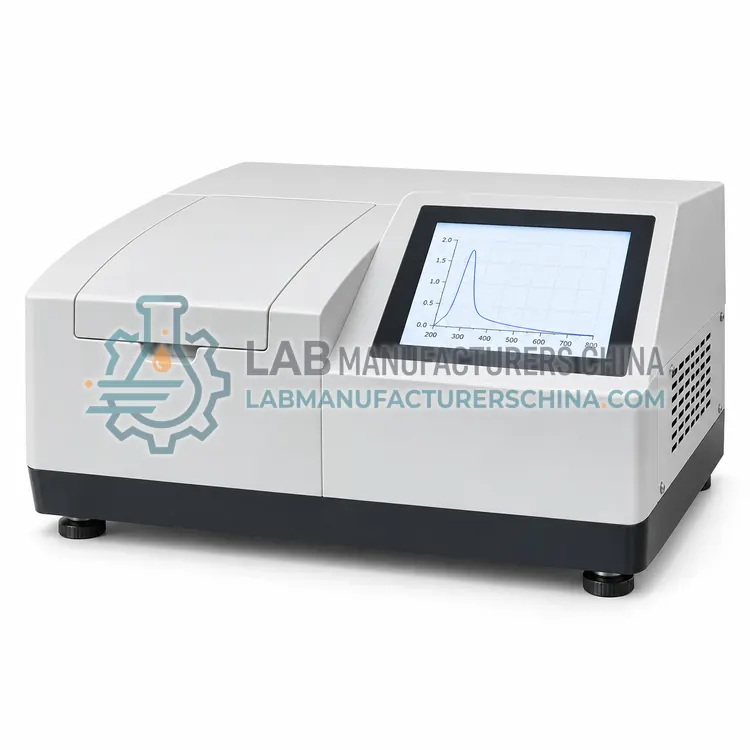
UV-Vis Spectrophotometer with Peltier Multi-Cell Kinetics System
带帕尔贴多池动力学系统的紫外可见分光光度计
- CE (to be confirmed)
- +1