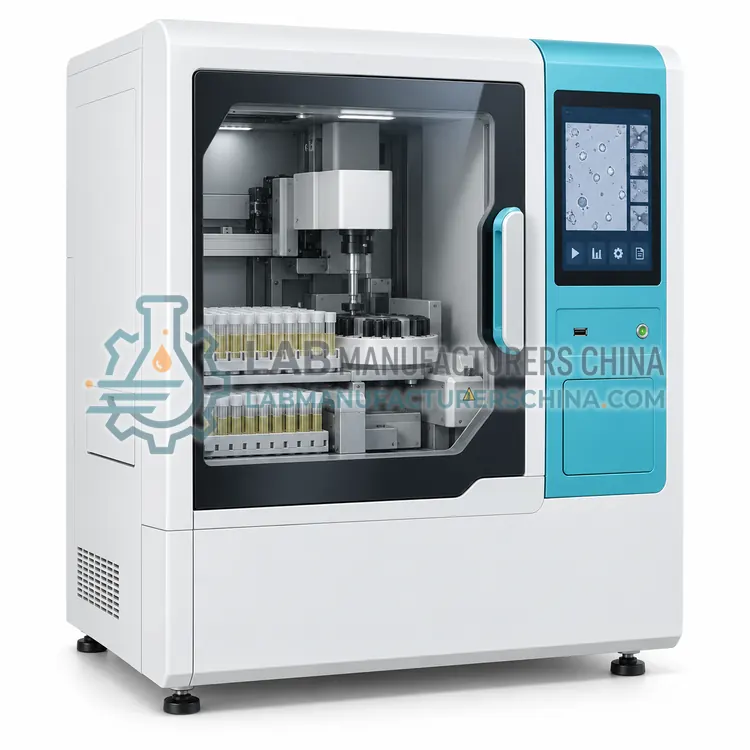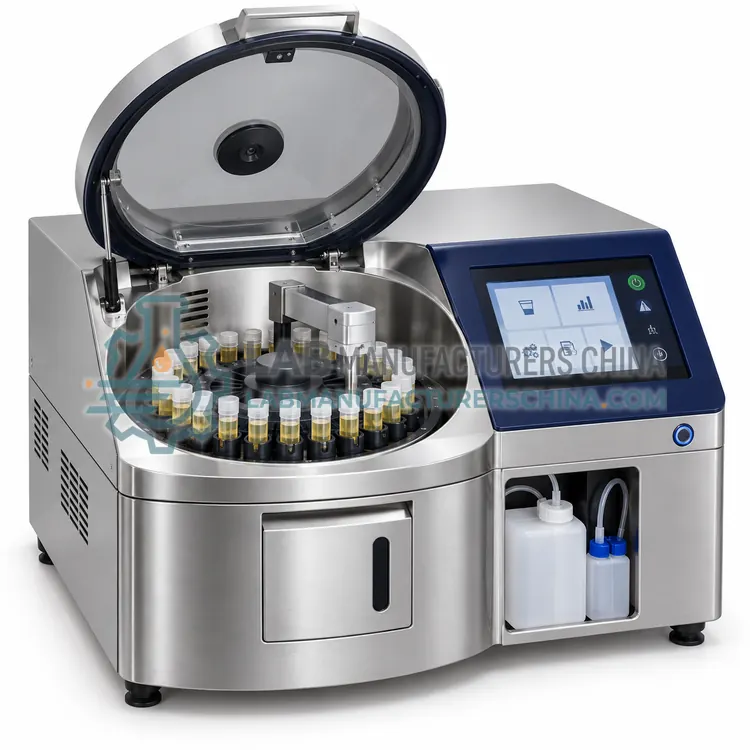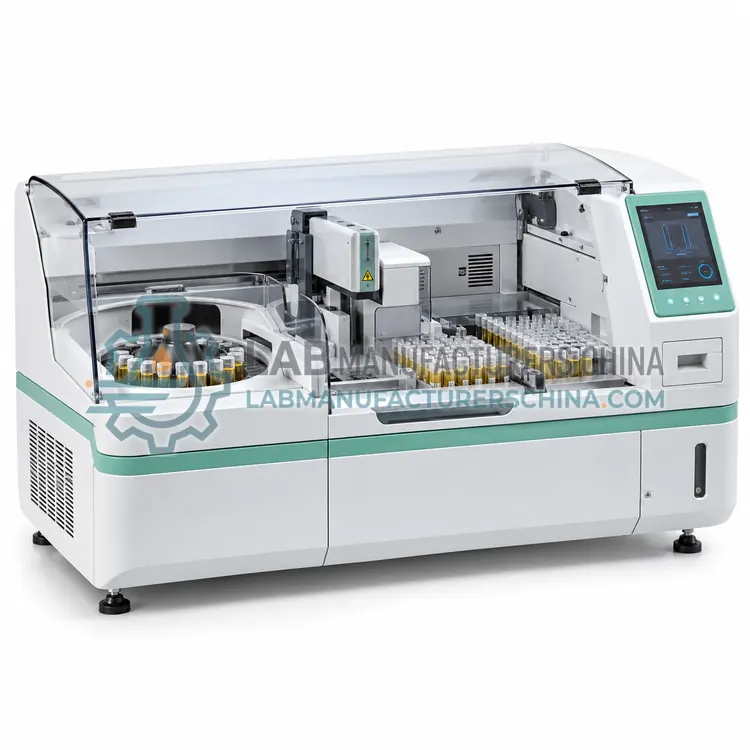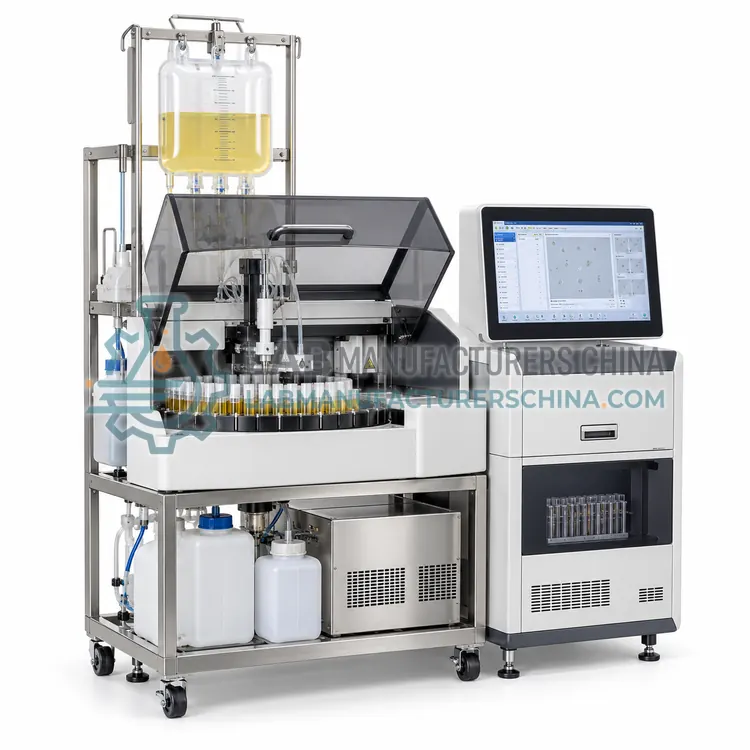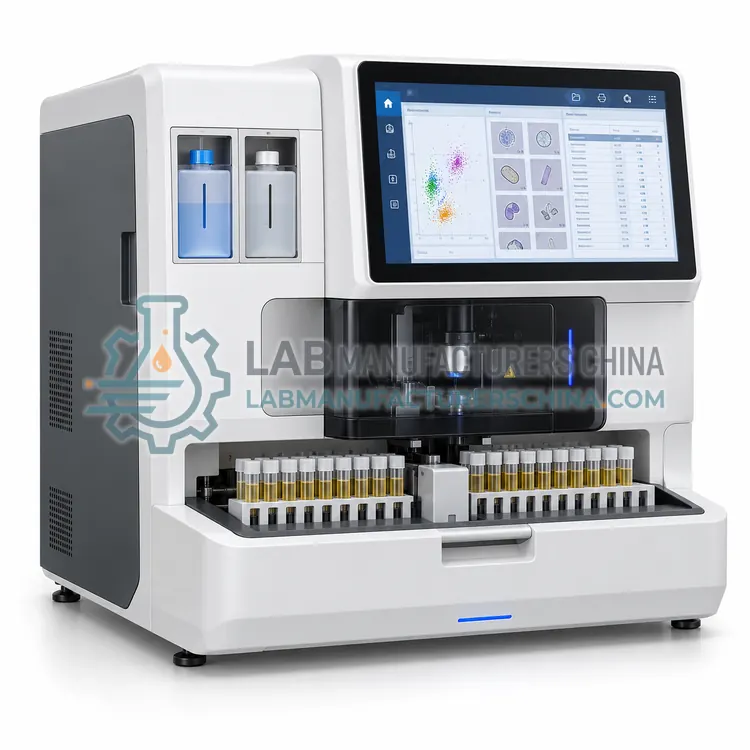
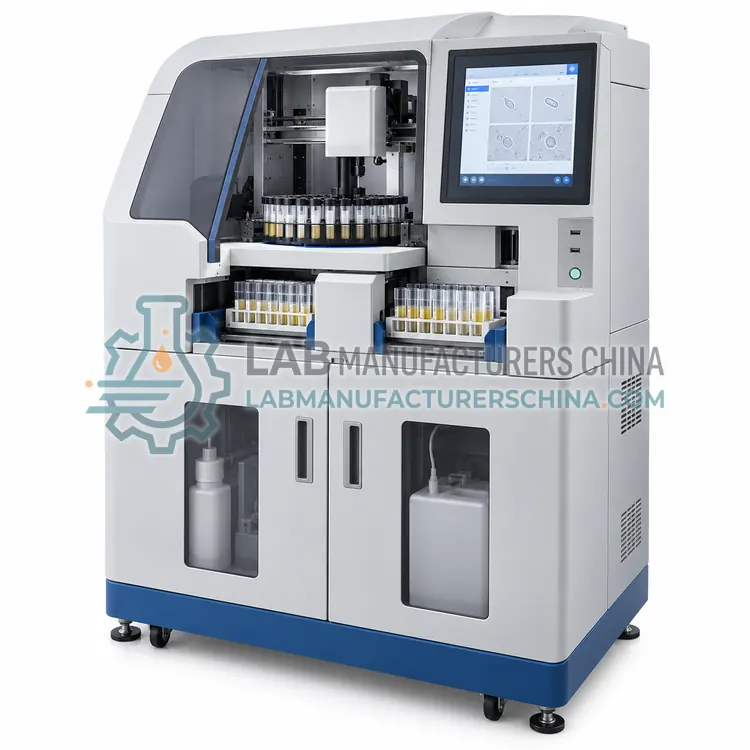
Benchtop Urine Sediment Analyzer with Autosampler
带自动进样器的台式尿沉渣分析仪
- SKU USA-0005
- Urine Sediment Analyzers
- CE (to be confirmed)
- ISO 13485 manufacturing (to be confirmed)
- NMPA class II registration (to be confirmed)
Price on request — FOB / CIF quoted per order
Prices depend on configuration, quantity and destination port.
Key specifications
| Autosampler capacity | 40–80 tubes with barcode identification |
|---|---|
| Throughput | 60–120 samples/h |
| Detection principle | Flow cytometry or digital imaging |
| Sample volume | 0.5–1.5 mL per sample |
| Carryover | < 1 % for red and white cell counts |
| Reported particles | RBC, WBC, epithelial cells, casts, crystals, bacteria, yeast |
Request a quote Download brochure · to be provided
By Lab Manufacturers China Technical TeamLast reviewed Standards: ISO 15189, CLSI GP16, CLSI EP05
What is the Benchtop Urine Sediment Analyzer with Autosampler?
This benchtop analyzer adds a sample carousel to the sediment analysis module, so a batch of urine tubes is processed without individual handling. It suits mid-size laboratories that need sediment counts on hundreds of samples per day in a compact footprint.
What is the Benchtop Urine Sediment Analyzer with Autosampler?
This benchtop analyzer adds a sample carousel to the sediment analysis module, so a batch of urine tubes is processed without individual handling. It suits mid-size laboratories that need sediment counts on hundreds of samples per day in a compact footprint.
Overview
The instrument provides automated loading and mixing of up to forty to eighty urine tubes, dilutes and analyses each sample with either flow cytometry or imaging, and reports counts with review flags. Because tubes remain in the carousel until analysis, sample identification by barcode can be linked to the worklist, and results are transmitted automatically. Between samples the fluidic path is washed to control carryover, which is specified as a percentage for the cell counts most affected. Throughput is typically 60 to 120 samples per hour, and the benchtop footprint allows installation in laboratories without track automation. Urgent samples can usually be prioritised by a STAT position, and reagent and waste handling is designed for a shift of work.
How does it work?
Urine sediment contains formed elements that indicate renal or urinary tract disease. Automated analyzers detect them in one of two ways. Flow cytometry dilutes urine, stains nucleic acids and cell membranes with a fluorescent dye, and passes the particles through a flow cell where forward scatter indicates size, side scatter indicates granularity and fluorescence indicates nucleic acid content; clustering software classifies the particles and reports counts per volume. Digital imaging introduces a diluted sample into a thin chamber, photographs the particles and applies pattern recognition to classify them, storing images for review. Either method reports counts per microlitre or per high-power field, together with flags when the result requires confirmation. Some instruments include a centrifugation step, and all of them depend on adequate sample mixing, correct dilution and clean optical or fluidic paths.
What are the key features?
- Sample carousel holding 40 to 80 urine tubes
- Automatic mixing before aspiration for cell resuspension
- Barcode identification linked to the worklist
- Washing between samples with specified carryover limits
- Throughput of 60 to 120 samples per hour
- STAT position for urgent sediment analysis
What are the technical specifications?
A typical benchtop urine sediment analyzer with autosampler configuration offers autosampler capacity of 40–80 tubes with barcode identification, throughput of 60–120 samples/h, detection principle of Flow cytometry or digital imaging, sample volume of 0.5–1.5 mL per sample, carryover of < 1 % for red and white cell counts and reported particles of RBC, WBC, epithelial cells, casts, crystals, bacteria, yeast. Values are indicative of the product class; the exact figures for each configuration are confirmed on the quotation and the calibration documents supplied with the instrument.
Which applications is it used for?
The Benchtop Urine Sediment Analyzer with Autosampler is used in mid-size hospital urinalysis batches, outpatient laboratory sediment testing, combined chemistry and sediment workflows and veterinary laboratory urine analysis. Across the wider Urine Sediment Analyzers class, laboratories also deploy it for urinary tract infection assessment, glomerular and non-glomerular haematuria differentiation and renal disease monitoring and transplant follow-up.
Which standards and certifications apply?
Relevant standards and methods include ISO 15189, CLSI GP16, CLSI EP05, CLSI EP15, IEC 61010-1 and IEC 61010-2-101. Certification candidates for this model are CE, ISO 13485 manufacturing and NMPA class II registration; each is to be confirmed for the specific configuration before shipment, and certificates are supplied only where they have been issued.
Verify performance at installation by comparing results with manual microscopy on a defined number of samples spanning low, normal and high particle counts, and document the agreement, since counts per volume and per high-power field are not directly interchangeable. Run control material or stabilised particle suspensions at the recommended frequency, and clean the flow cell or imaging chamber as instructed, because deposits create artefacts or block the sample path. Maintain the sheath fluid supply where used, and check that it is within its expiry date. Define and document review rules, train staff to interpret the images or counts, and keep records linking stored images to patient results for the retention period required locally.
How do I select the right Benchtop Urine Sediment Analyzer with Autosampler?
Specify this variant when batches of urine arrive together and staff cannot present tubes individually, but track automation is not available or justified. In the RFQ confirm carousel capacity, the maximum wait before a tube is analysed, carryover specifications and the behaviour of the STAT position during a running batch.
How does it compare with other Urine Sediment Analyzers variants?
Choose the detection method according to what your clinicians need. Flow cytometry gives fast counts of the main particle classes with minimal labour but limited morphological detail, while digital imaging provides images and better distinction between similar particles such as casts and crystals. Decide whether the analyzer must work with urine that has not been centrifuged, because some instruments require a pre-centrifuged or specially prepared sample. Check the reported particle classes, the counting units, the sample volume and the review rules, and confirm that the instrument can be integrated with the chemistry analyzer so that results appear in one report. Plan for periodic comparison with manual microscopy, and for external quality assessment covering urine sediment.
Full specifications
| Autosampler capacity | 40–80 tubes with barcode identification |
|---|---|
| Throughput | 60–120 samples/h |
| Detection principle | Flow cytometry or digital imaging |
| Sample volume | 0.5–1.5 mL per sample |
| Carryover | < 1 % for red and white cell counts |
| Reported particles | RBC, WBC, epithelial cells, casts, crystals, bacteria, yeast |
| Footprint | 0.8–1.2 m² on a bench |
| Data storage | 30,000 results with quality control records |
| Interfaces | LAN with HL7 or ASTM, USB |
Indicative values for this product class. Final specifications are confirmed on the quotation and in the calibration documents supplied with the instrument.
Applications
- Mid-size hospital urinalysis batches
- Outpatient laboratory sediment testing
- Combined chemistry and sediment workflows
- Veterinary laboratory urine analysis
Key features
- Sample carousel holding 40 to 80 urine tubes
- Automatic mixing before aspiration for cell resuspension
- Barcode identification linked to the worklist
- Washing between samples with specified carryover limits
- Throughput of 60 to 120 samples per hour
- STAT position for urgent sediment analysis
Frequently asked questions about Benchtop Urine Sediment Analyzer with Autosampler
Because cells and casts degrade over time, samples should be analysed within the suitable stability window, generally within two hours. Carousel capacity should match hourly throughput rather than the whole day's workload, and scheduled runs should be used when samples arrive in waves.
Gentle inversion or rocking resuspends cells without significant disruption, and it is necessary because cells settle quickly in stored urine. Vigorous mixing, however, can lyse red cells and reduce casts, so the instrument's mixing profile should not be altered without validation.
Run a sample with high particle counts followed by two samples with low counts, and express the difference between the low samples as a percentage of the high value. Verification is repeated after fluidic service, and the specification applies to the cell counts most affected, usually red and white cells.
Yes, many benchtop sediment analyzers can be linked to a strip chemistry analyzer so that both result sets merge into one urinalysis report. Confirm that a single worklist and one accession number are used, which simplifies reporting and traceability.
Typical reports include red blood cells, white blood cells, epithelial cells, casts, crystals, bacteria and yeast, and some instruments add squamous epithelial cells, hyaline casts or pathological casts separately, together with a flag when the pattern suggests infection or renal disease.
Agreement is good for red cells, white cells and epithelial cells in the normal to high range, but casts and crystals are harder to classify automatically, and low counts near the detection limit are less precise. Laboratories must verify agreement locally and define when microscopy is required.
Yes. Microscope examination is required when automated results are abnormal, when the clinical picture suggests a discrepancy, when atypical or unclassified particles appear, and when a specific morphology such as dysmorphic red cells is requested. Most laboratories keep microscopy for these reflex situations.