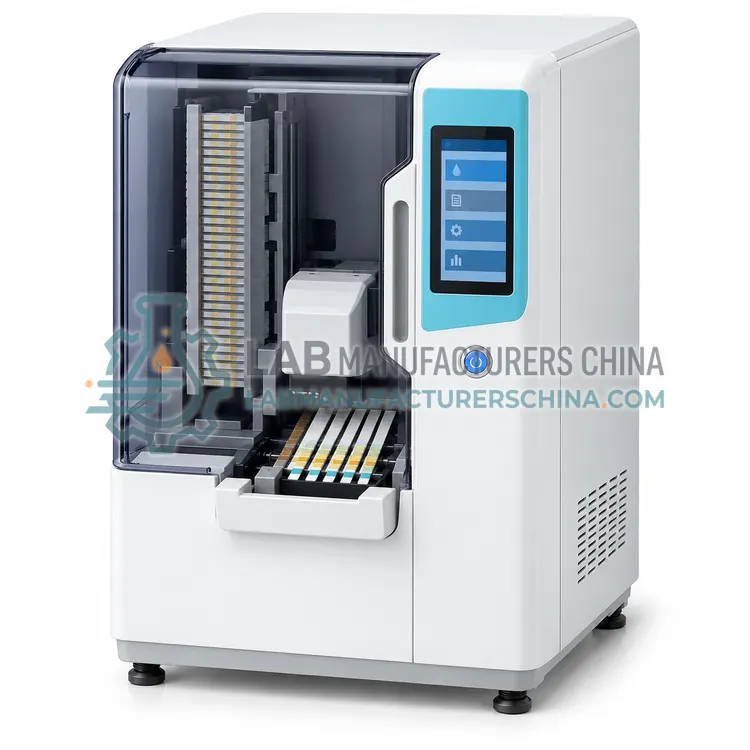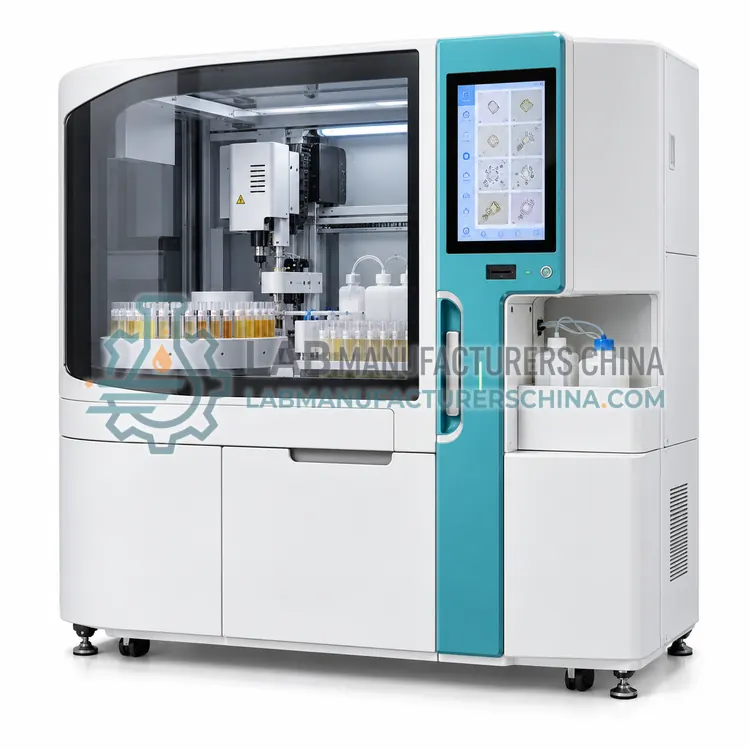
Fully Automated Urinalysis Analyzer with Flow Imaging Sediment Module
带流动成像沉渣模块的全自动尿液分析仪
- CE (to be confirmed)
- +2
Welcome to Lab Manufacturers China — laboratory instruments direct from a Chinese manufacturer
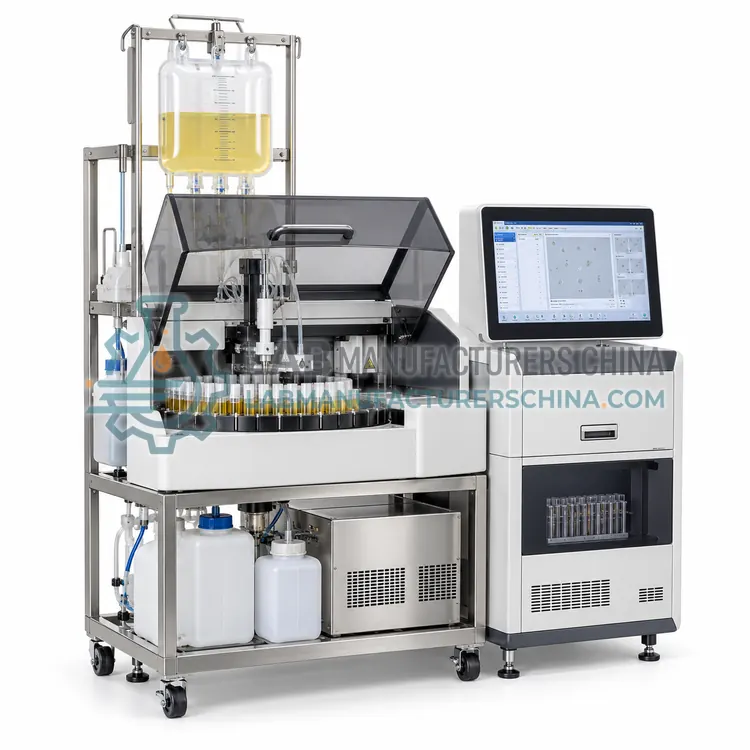
全自动尿液分析工作站
Price on request — FOB / CIF quoted per order
Prices depend on configuration, quantity and destination port.
| Combined throughput | 60–120 samples/h |
|---|---|
| Chemistry parameters | 10–14 parameters per sample |
| Sediment method | Flow cytometry or digital imaging |
| Sediment particles reported | RBC, WBC, epithelial cells, casts, crystals, bacteria, yeast |
| Sample volume | 1–3 mL fresh urine |
| Sample positions | 40–80 with continuous loading |
By Lab Manufacturers China Technical TeamLast reviewed Standards: ISO 15189, CLSI GP16, CLSI EP05
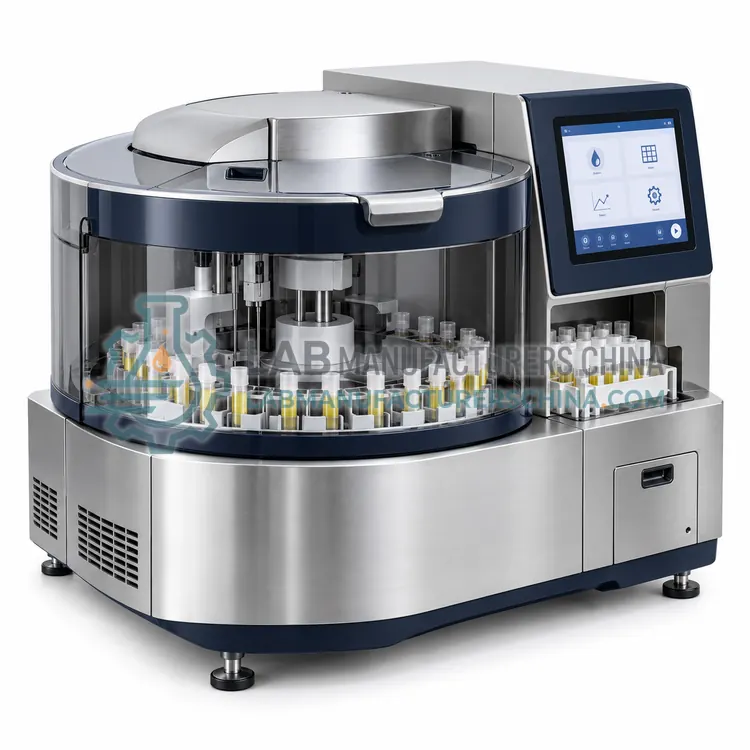
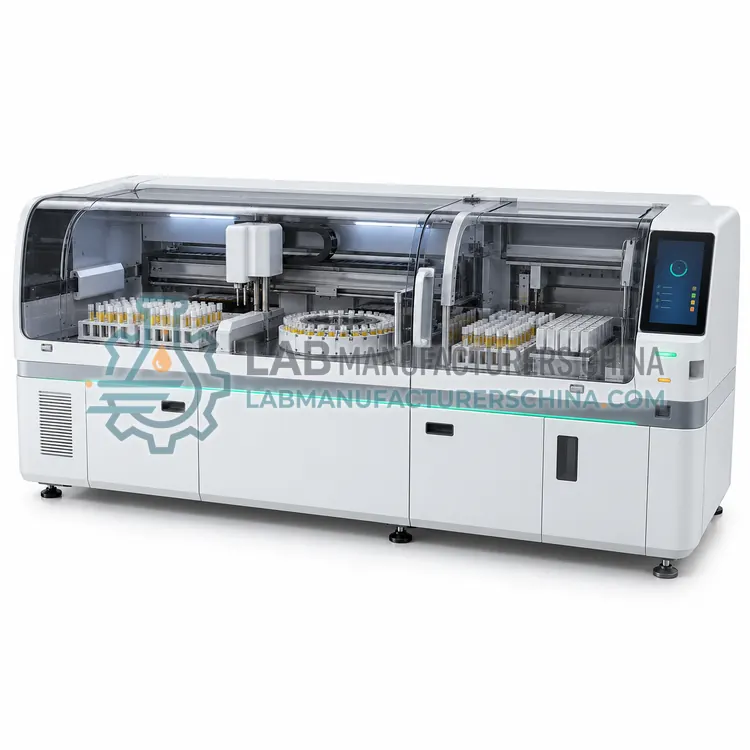
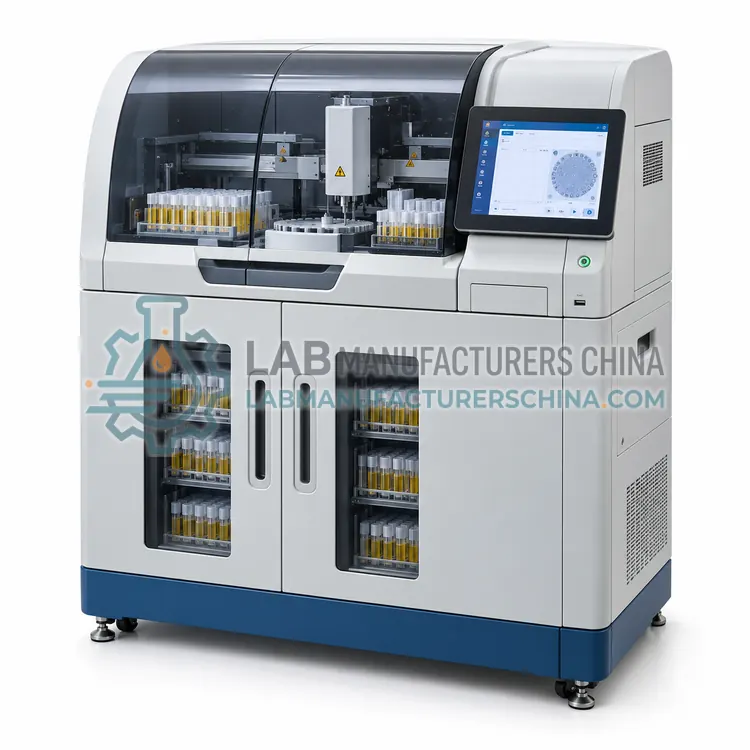
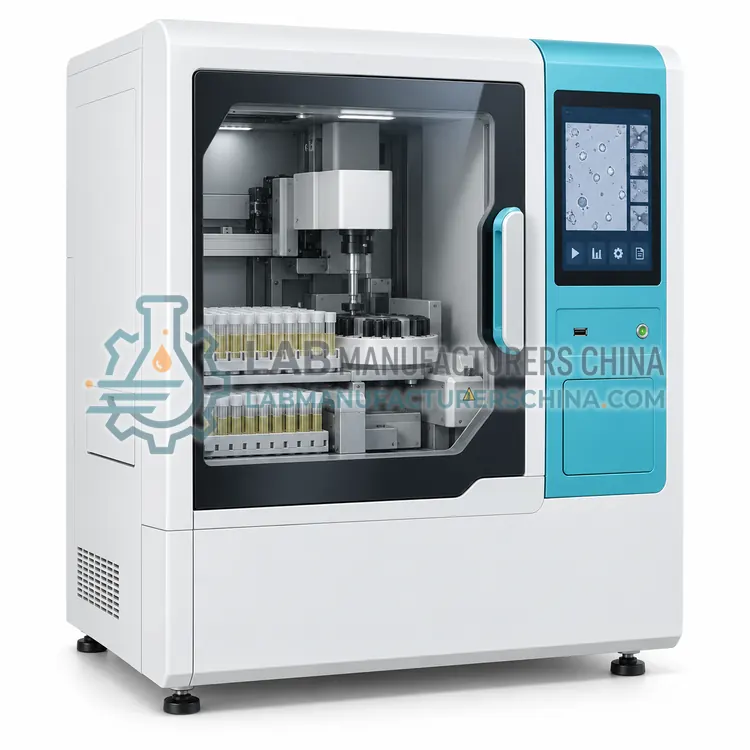
An automated urinalysis workstation combines strip chemistry and sediment analysis in one instrument with a shared sample path and single report. It suits hospital laboratories that report chemistry and microscopy results together for several hundred samples per day.
An automated urinalysis workstation combines strip chemistry and sediment analysis in one instrument with a shared sample path and single report. It suits hospital laboratories that report chemistry and microscopy results together for several hundred samples per day.
The workstation holds a sample rack, dips and reads reagent strips in the chemistry section and processes the same sample in the sediment section, which may use flow cytometry or digital imaging. A single software application merges the two result sets, applies review rules and communicates with the laboratory information system through one interface. Sample identification is by barcode, and mixing before analysis is performed automatically to resuspend cells. Combined throughput is typically 60 to 120 samples per hour for chemistry with sediment analysis, lower when many samples are flagged for manual review. The operator loads samples and consumables, reviews flagged cases and handles any reflex microscopy, which reduces the manual handling that separate instruments would require.
The platform links two analytical modules through one sample and one worklist. The chemistry module dips a reagent strip, reads the pads by reflectance photometry at defined wavelengths, applies colour and ascorbate compensation and reports semiquantitative categories. The sediment module either uses flow cytometry with a nucleic acid stain and scatter signals to classify particles by size, granularity and fluorescence, or images a sediment chamber or centrifuged slide and classifies particles by pattern recognition. The software merges both result sets into one report, applies review rules such as reflex microscopy for flagged samples, and transmits results to the laboratory information system. Sample barcode reading, mixing before aspiration and automatic washing between samples reduce operator handling and improve traceability, while quality control records and reagent lot tracking support accreditation.
A typical automated urinalysis workstation configuration offers combined throughput of 60–120 samples/h, chemistry parameters of 10–14 parameters per sample, sediment method of Flow cytometry or digital imaging, sediment particles reported of RBC, WBC, epithelial cells, casts, crystals, bacteria, yeast, sample volume of 1–3 mL fresh urine and sample positions of 40–80 with continuous loading. Values are indicative of the product class; the exact figures for each configuration are confirmed on the quotation and the calibration documents supplied with the instrument.
The Automated Urinalysis Workstation is used in hospital routine urinalysis reporting, outpatient urine testing at volume, nephrology and urology sample review and antenatal and emergency urine screening. Across the wider Automated Urinalysis Systems class, laboratories also deploy it for hospital routine urinalysis with combined reporting, nephrology and urology outpatient testing and emergency department urine screening.
Relevant standards and methods include ISO 15189, CLSI GP16, CLSI EP05, CLSI AUTO10, CLSI POCT04, IEC 61010-1 and IEC 61010-2-101. Certification candidates for this model are CE, ISO 13485 manufacturing and NMPA class II registration; each is to be confirmed for the specific configuration before shipment, and certificates are supplied only where they have been issued.
Install the system on a level bench with controlled temperature, stable power and enough space for reagent and waste containers, and verify each module separately before validating the combined workflow with a set of normal and abnormal samples compared against manual microscopy. Define the review rules and test them before go-live, since rule errors affect which results are released automatically. Daily work includes running chemistry control strips and sediment control material, checking reagent and strip status and inspecting the flow cell or imaging chamber for deposits. Wash solutions, cuvettes and flow cells require scheduled cleaning, and results flagged by the system should be reviewed according to documented criteria. Treat all urine samples and waste as potentially infectious.
Specify this variant when combined chemistry and sediment reporting is required for a few hundred samples per day and space allows a single workstation. In the RFQ confirm the sediment technology, the particle classes reported, whether images are retained for review, and the reflex rules the software supports.
Choose an automated urinalysis system when sediment results are required routinely and the daily sample number exceeds a few hundred, or when manual microscopy cannot keep up with the workload. Compare systems by which sediment technology is used, the particle classes reported, whether a microscope image is available for review, and the review rules offered. Check the chemistry parameters, cross-contamination control between samples, barcode handling and the combined report format. Confirm the throughput on a realistic mixture of normal and abnormal samples, since flagged samples take longer, and the sample volume needed for both modules. Verify LIS integration and the traceability features, and plan a downtime procedure because a single platform carries both chemistry and sediment reporting.
| Combined throughput | 60–120 samples/h |
|---|---|
| Chemistry parameters | 10–14 parameters per sample |
| Sediment method | Flow cytometry or digital imaging |
| Sediment particles reported | RBC, WBC, epithelial cells, casts, crystals, bacteria, yeast |
| Sample volume | 1–3 mL fresh urine |
| Sample positions | 40–80 with continuous loading |
| Data storage | 50,000 combined records |
| Interfaces | LAN with HL7 or ASTM two-way communication |
| Footprint | 1.5–2.5 m² including consumables |
Indicative values for this product class. Final specifications are confirmed on the quotation and in the calibration documents supplied with the instrument.
The software marks results that meet review criteria, such as positive blood with a low red cell count, and holds them for technologist review of stored images or for manual microscopy. The laboratory defines which flags require review and documents the outcome for each case.
Yes, one urine aliquot is processed in both sections, which avoids splitting samples and reduces labelling errors. The sample must be well mixed before aspiration, and dilution applied for one module must not affect the other, which the software manages by tracking the fractions used.
Chemistry usually continues on the same platform, so urinalysis screening results can still be reported. Sediment results would then require manual microscopy or a backup instrument, and the laboratory should document this partial-downtime procedure in advance.
Most workstations need only a waste container and cleaning solutions, because reagent strip chemistry uses no water and sediment modules use sheath fluid or imaging without a continuous water supply. Confirm the sheath fluid consumption and disposal requirements before installation.
Chemistry parameters such as glucose, protein, blood, leukocyte esterase, nitrite, ketones, bilirubin, urobilinogen, pH and specific gravity, together with sediment counts for red cells, white cells, epithelial cells, casts, crystals, bacteria and yeast, usually with semiquantitative categories.
It reduces manual microscopy substantially but does not eliminate it. Guidelines expect microscopical confirmation when the automated result is abnormal, when the clinical picture suggests a discrepancy, or when the sediment includes particles the system cannot classify, so a microscope and trained staff remain necessary.
Rules are usually based on chemistry flags such as positive blood, protein or leukocyte esterase, on sediment counts above defined limits, and on clinical requests for specific patients. Each rule should be documented, tested against known samples and reviewed after any software update.
带流动成像沉渣模块的全自动尿液分析仪