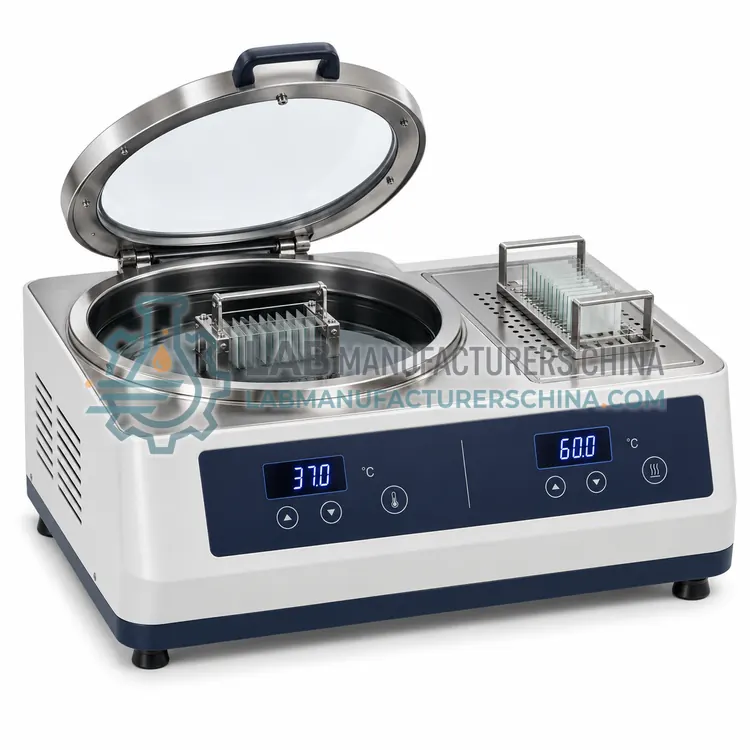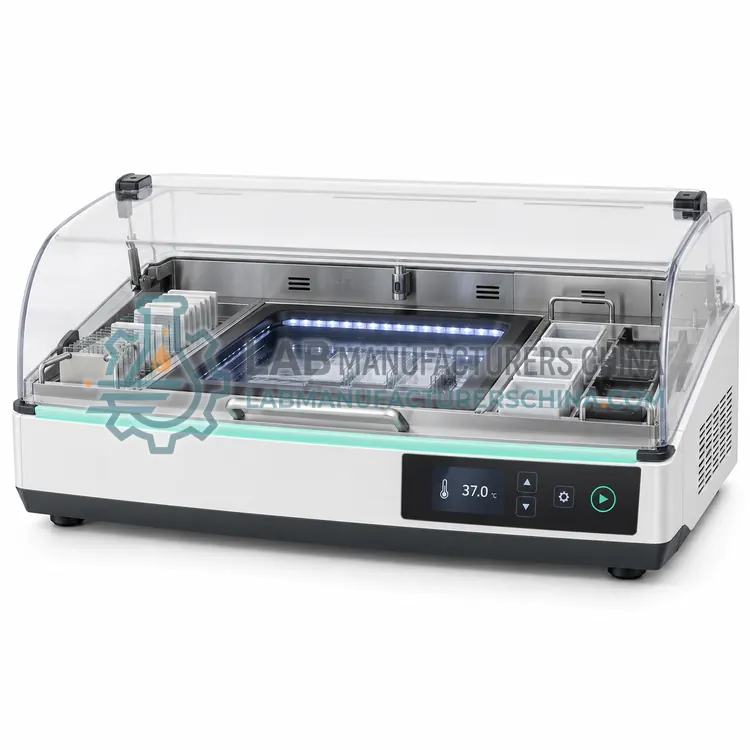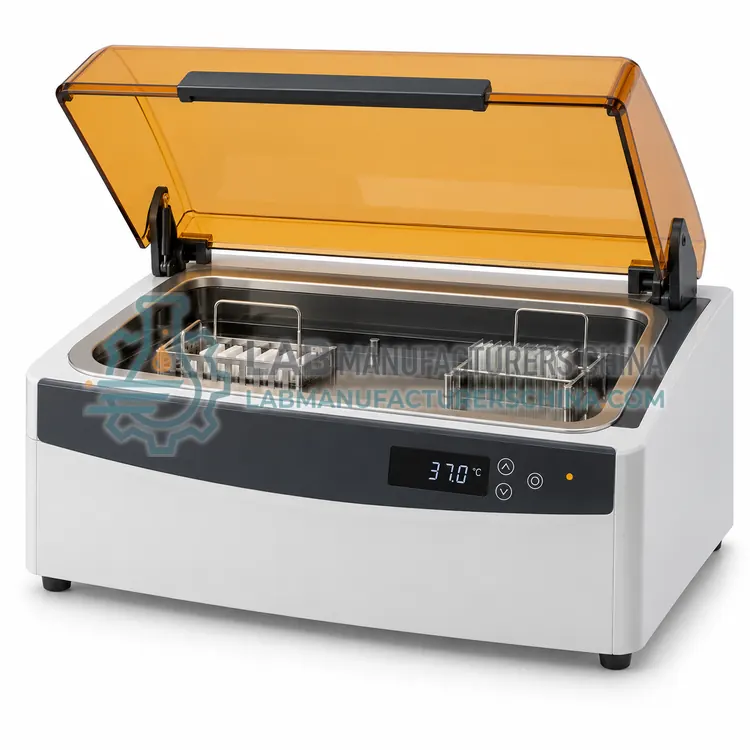

Large-Volume Tissue Flotation Bath
大容量展片水浴
- SKU TFB-0005
- Tissue Float Baths
- CE (to be confirmed)
- IEC 61010-1 compliance (to be confirmed)
- ISO 13485 manufacturing (to be confirmed)
Price on request — FOB / CIF quoted per order
Prices depend on configuration, quantity and destination port.
Key specifications
| Temperature range | ambient to 90 °C |
|---|---|
| Temperature stability | ±1 °C |
| Bath volume | about 6–10 L |
| Working area | about 300 × 200 mm or larger |
| Water depth | 80–100 mm |
| Warm-up time | about 40–60 min |
Request a quote Download brochure · to be provided
By Lab Manufacturers China Technical TeamLast reviewed Standards: IEC 61010-1, IEC 61010-2-010, IEC 61326-1
What is the Large-Volume Tissue Flotation Bath?
A large-volume tissue flotation bath provides a wide, deep basin for long ribbons and large sections. It is chosen by laboratories that section whole-mount specimens, large resection blocks or long serial ribbons.
What is the Large-Volume Tissue Flotation Bath?
A large-volume tissue flotation bath provides a wide, deep basin for long ribbons and large sections. It is chosen by laboratories that section whole-mount specimens, large resection blocks or long serial ribbons.
Overview
Standard flotation baths are sized for typical biopsy ribbons, but large-format histology needs more water surface. A large-volume bath may offer a working area of 300 by 200 mm or more and a depth of 80 to 100 mm, enough to float long continuous ribbons from whole-mount prostate, breast or brain sections, or ribbons produced during long serial sectioning. Greater water mass also makes the temperature more stable when a batch of slides is dipped, and a larger surface lets several ribbons float simultaneously without tangling. These baths often include digital control, a drain valve for quick emptying and a cover to reduce evaporation and heat loss. Stronger construction is needed because a full basin is heavy, so check the bench load and drain location.
How does it work?
A tissue float bath is a thermostatted shallow basin, usually stainless steel or coated aluminium, heated by a resistive element under the base. Water is held at about 40 to 45 °C, comfortably above the paraffin melting point of roughly 56 to 58 °C when the water is only warming and below it when the surface is cooler, so the wax softens just enough to relax. The technician releases the section ribbon onto the water surface, where surface tension and gentle heat stretch it flat. Sections are then floated onto a clean, often albumin or polylysine-coated slide and drained. Because paraffin expands slightly on melting, the ribbon appears to relax, and gentle agitation with a brush helps remove trapped folds without tearing. Temperature stability and water purity determine whether sections spread evenly.
What are the key features?
- Wide working area of 300 × 200 mm or more
- Deep basin of about 80 to 100 mm
- Stable temperature from large water mass
- Capacity for several long ribbons at once
- Drain valve for quick emptying
- Cover to reduce evaporation and heat loss
What are the technical specifications?
A typical large-volume tissue flotation bath configuration offers temperature range of ambient to 90 °C, temperature stability of ±1 °C, bath volume of about 6–10 L, working area of about 300 × 200 mm or larger, water depth of 80–100 mm and warm-up time of about 40–60 min. Values are indicative of the product class; the exact figures for each configuration are confirmed on the quotation and the calibration documents supplied with the instrument.
Which applications is it used for?
The Large-Volume Tissue Flotation Bath is used in whole-mount and large section histology, long serial ribbon handling, prostate and breast whole-mount work and neuroscience large sections. Across the wider Tissue Float Baths class, laboratories also deploy it for paraffin section flattening, routine histology and research histology.
Which standards and certifications apply?
Relevant standards and methods include IEC 61010-1, IEC 61010-2-010, IEC 61326-1 and ISO 15189. Certification candidates for this model are CE, IEC 61010-1 compliance and ISO 13485 manufacturing; each is to be confirmed for the specific configuration before shipment, and certificates are supplied only where they have been issued.
Fill with purified or demineralised water, because mineral deposits stain sections and leave residue on slides. Change water daily or more often if many sections are floated, and clean the basin to prevent biofilm and carryover. Verify the setpoint with a calibrated thermometer at defined intervals, since a drift of a few degrees can wrinkle or melt sections. Place the bath on a stable bench away from draughts and keep the cable away from water. Record temperature checks, water changes and cleaning, and do not use the bath for other laboratory purposes where cross-contamination could occur.
How do I select the right Large-Volume Tissue Flotation Bath?
Specify a large-volume bath when ribbon length or section size exceeds the capacity of a standard unit, or when several ribbons must float at once. Confirm the working area and depth against your largest sections, plus warm-up time, bench load and drainage. For routine biopsy work the extra volume only increases warm-up time.
How does it compare with other Tissue Float Baths variants?
Select a float bath mainly by control type, size and how it will be used alongside other histology equipment. Digital models hold temperature within about ±1 °C and suit laboratories that must document controlled conditions; analog dial models cost less but need more attention. Choose a bath deep enough to submerge the ribbon fully, typically 40 to 70 mm of water, and wide enough for your largest sections. Illuminated black or blue backgrounds make pale ribbons easier to see. If space is limited or the workflow is high-throughput, a combination unit that pairs a float bath with a slide warmer saves bench space. Check warm-up time, wetted-material corrosion resistance, drain design and whether a lid is needed to limit evaporation.
Full specifications
| Temperature range | ambient to 90 °C |
|---|---|
| Temperature stability | ±1 °C |
| Bath volume | about 6–10 L |
| Working area | about 300 × 200 mm or larger |
| Water depth | 80–100 mm |
| Warm-up time | about 40–60 min |
| Drain | Valve with hose connection |
| Safety features | Over-temperature cut-out, low-water alarm |
| Power supply | 220 V, 50 Hz, about 1 kW |
Indicative values for this product class. Final specifications are confirmed on the quotation and in the calibration documents supplied with the instrument.
Applications
- Whole-mount and large section histology
- Long serial ribbon handling
- Prostate and breast whole-mount work
- Neuroscience large sections
Key features
- Wide working area of 300 × 200 mm or more
- Deep basin of about 80 to 100 mm
- Stable temperature from large water mass
- Capacity for several long ribbons at once
- Drain valve for quick emptying
- Cover to reduce evaporation and heat loss
Frequently asked questions about Large-Volume Tissue Flotation Bath
A working area of 300 by 200 mm suits most whole-mount prostate, breast and brain sections and long serial ribbons. Measure your largest block and add a margin, because a ribbon needs room to extend without touching the basin walls.
Yes. The greater water mass resists temperature drops when cold slides or ribbons are introduced, so the setpoint recovers faster. The trade-off is a longer warm-up time and a heavier basin that needs a suitably strong bench.
Yes, because the open surface area is large and evaporation can be significant over a working day. A cover also slows heat loss between sessions, shortens the next warm-up and reduces the risk of dust or debris landing on the water.
Most laboratories set the bath between 40 and 45 °C, which softens the paraffin enough to relax the ribbon without melting it away. If sections spread poorly the water is too cool, while sections that disintegrate or show holes usually mean the water is too warm.
Use purified or demineralised water. Tap water leaves mineral deposits that can stain sections, contaminate slides and encourage biofilm in the basin. Change the water daily, and more often when many ribbons are floated.
Mount them promptly, usually within a minute or two. Prolonged floating lets the section hydrate and swell, causing folds, holes or loss of detail, and increases the risk of cross-contamination between specimens if water is not changed.
Related models