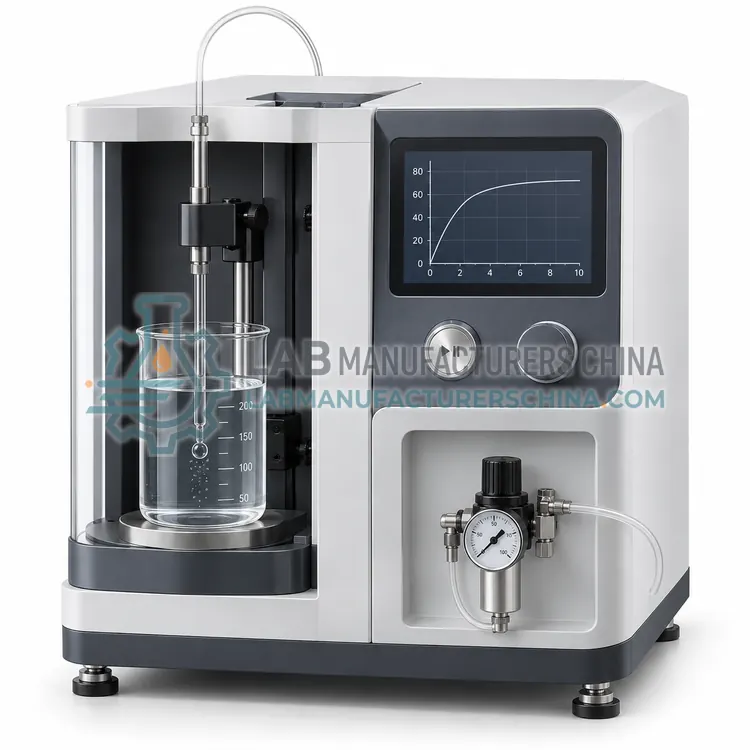
Maximum Bubble Pressure Tensiometer for Dynamic Surface Tension
动态表面张力用最大气泡压力张力仪
- SKU STM-0004
- Surface Tension Meters
- CE (to be confirmed)
- ISO 9001 manufacturing (to be confirmed)
Price on request — FOB / CIF quoted per order
Prices depend on configuration, quantity and destination port.
Key specifications
| Surface age range | 5 ms–100 s |
|---|---|
| Surface tension range | 10–100 mN/m |
| Accuracy | ±0.1 mN/m |
| Resolution | 0.01 mN/m |
| Capillary radius | 0.1–0.3 mm |
| Pressure sensor range | 0–10 kPa |
Request a quote Download brochure · to be provided
By Lab Manufacturers China Technical TeamLast reviewed Standards: ISO 304, ASTM D1331, ASTM D971
What is the Maximum Bubble Pressure Tensiometer for Dynamic Surface Tension?
An instrument that blows gas bubbles at a capillary tip and records the maximum pressure at varying bubble frequencies to give dynamic surface tension at surface ages from about 5 ms to 100 s. It suits inks, coatings, cleaning and wetting agents where surfaces form rapidly.
What is the Maximum Bubble Pressure Tensiometer for Dynamic Surface Tension?
An instrument that blows gas bubbles at a capillary tip and records the maximum pressure at varying bubble frequencies to give dynamic surface tension at surface ages from about 5 ms to 100 s. It suits inks, coatings, cleaning and wetting agents where surfaces form rapidly.
Overview
A bubble pressure tensiometer pumps gas at a controlled rate through a capillary immersed in the liquid. Pressure inside the capillary increases as a bubble grows, reaching a maximum when the bubble is a hemisphere with radius equal to that of the capillary, and surface tension follows from the Young–Laplace relation. Varying bubble frequency changes the surface age, which is the time since the surface formed, from roughly 5 milliseconds to 100 seconds. Plotting tension against surface age shows how fast surfactant diffuses to a fresh interface, directly relevant to spraying, foaming, printing and high-speed coating. The measurement is independent of contact angle, needs no calibration beyond the capillary radius and works with viscous and opaque liquids. Sample volumes are 20 to 50 mL.
How does it work?
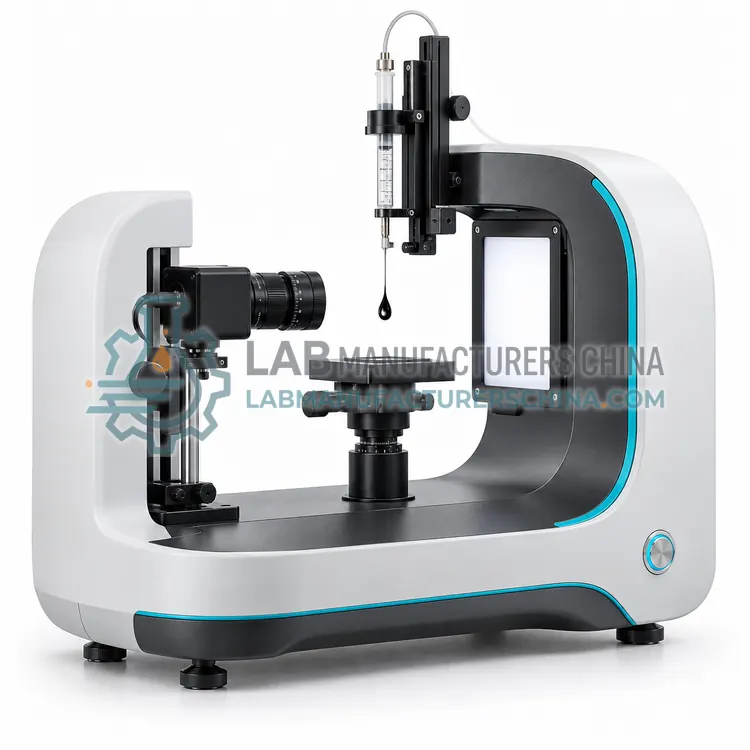
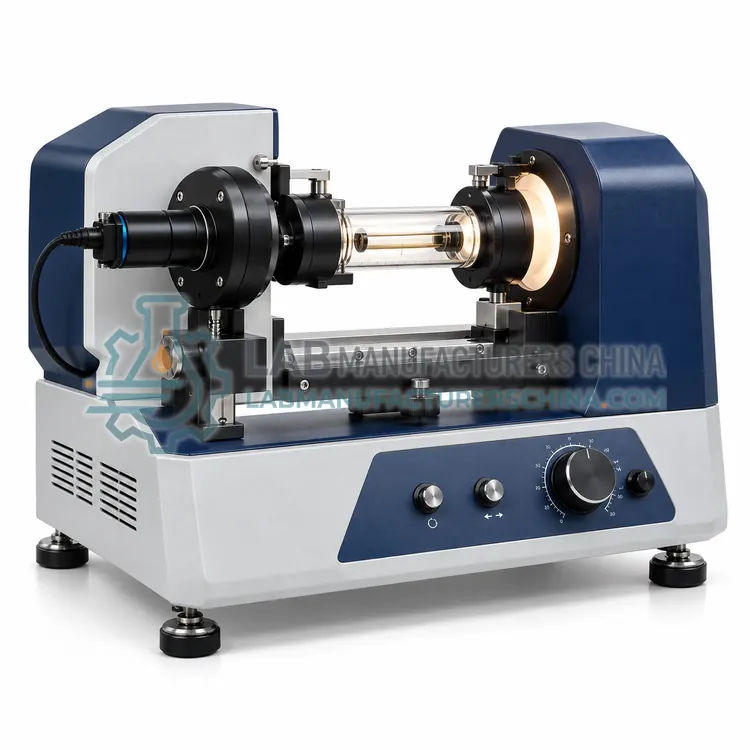
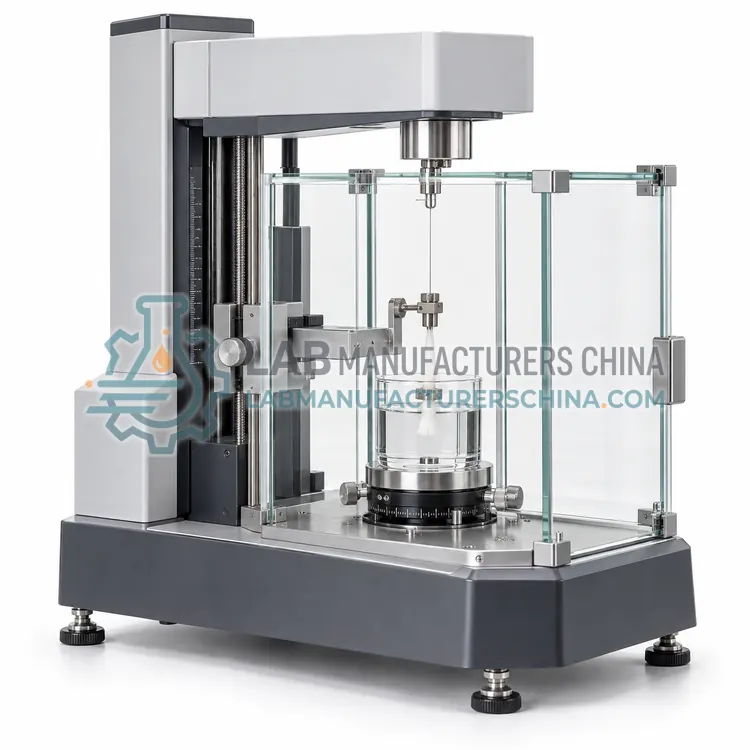
Surface tension arises from the cohesive energy imbalance of molecules at a liquid surface. Force tensiometers measure the force needed to detach a platinum ring (du Noüy) from the surface, or the pull exerted on a fully wetted platinum plate (Wilhelmy), and convert it to tension using a correction factor or geometry. Pendant drop analyzers photograph a hanging drop and fit its shape with the Young–Laplace equation, where gravity elongates the drop in proportion to tension. Bubble pressure tensiometers measure the maximum pressure required to form a bubble at a capillary tip, which gives dynamic surface tension at controlled surface age from milliseconds to seconds. Spinning drop tensiometers measure ultra-low interfacial tension from the elongation of a drop in a rotating capillary.
What are the key features?
- Surface age range from about 5 ms to 100 s
- Capillaries with various radii for different viscosity ranges
- Independent of contact angle and sample turbidity
- Temperature-controlled vessel with stirrer
- Automated bubble frequency sequences and curve fitting
- Fast measurement of a full dynamic curve in minutes
What are the technical specifications?
A typical maximum bubble pressure tensiometer for dynamic surface tension configuration offers surface age range of 5 ms–100 s, surface tension range of 10–100 mN/m, accuracy of ±0.1 mN/m, resolution of 0.01 mN/m, capillary radius of 0.1–0.3 mm and pressure sensor range of 0–10 kPa. Values are indicative of the product class; the exact figures for each configuration are confirmed on the quotation and the calibration documents supplied with the instrument.
Which applications is it used for?
The Maximum Bubble Pressure Tensiometer for Dynamic Surface Tension is used in inkjet ink and printing formulations, spray coating wetting agents, foaming and cleaning products and surfactant adsorption kinetics. Across the wider Surface Tension Meters class, laboratories also deploy it for surfactant CMC determination, ink and coating formulation and petroleum interfacial tension.
Which standards and certifications apply?
Relevant standards and methods include ISO 304, ASTM D1331, ASTM D971, ASTM D1590 and OECD 115. Certification candidates for this model are CE and ISO 9001 manufacturing; each is to be confirmed for the specific configuration before shipment, and certificates are supplied only where they have been issued.
Cleanliness dominates accuracy: clean platinum rings and plates by flaming to red heat after solvent rinsing, use borosilicate vessels cleaned with chromic acid alternatives, and avoid touching surfaces with fingers. Control temperature within ±0.1 °C, because surface tension changes by roughly 0.1 to 0.2 mN/m per degree for many liquids. Level the instrument and protect it from drafts and vibration. Calibrate the balance with weights and check the system with ultrapure water, which should read about 72.0 mN/m at 25 °C. For surfactant solutions, allow equilibration time or use dynamic methods and report measurement time.
How do I select the right Maximum Bubble Pressure Tensiometer for Dynamic Surface Tension?
Select this variant when fast surface formation governs performance, for example in inkjet, spraying or foaming, or when samples are turbid or viscous. It does not replace equilibrium plate measurements. In an RFQ, specify surface age range, capillary sets, temperature control and viscosity limits.
How does it compare with other Surface Tension Meters variants?
Choose by what must be measured and the sample. Equilibrium surface and interfacial tension of pure liquids, solvents and most formulations suit a plate or ring tensiometer, with the plate preferred for time-dependent or interfacial work because it needs no correction. Small volumes, high temperature, high pressure or opaque liquids suit pendant drop. Fast surfactant adsorption and inks, where new surfaces form in milliseconds, need a bubble pressure instrument. Interfacial tension below 0.1 mN/m, common in enhanced oil recovery and microemulsions, needs a spinning drop instrument. Check the measuring range, resolution, temperature control, automation, and standards such as ISO 304, ASTM D1331, ASTM D971 or ASTM D1590 for the procedure you must follow.
Full specifications
| Surface age range | 5 ms–100 s |
|---|---|
| Surface tension range | 10–100 mN/m |
| Accuracy | ±0.1 mN/m |
| Resolution | 0.01 mN/m |
| Capillary radius | 0.1–0.3 mm |
| Pressure sensor range | 0–10 kPa |
| Temperature range | 5–80 °C |
| Sample volume | 20–50 mL |
| Bubble frequency | 0.01–100 Hz |
| Gas | Dry air or nitrogen |
Indicative values for this product class. Final specifications are confirmed on the quotation and in the calibration documents supplied with the instrument.
Applications
- Inkjet ink and printing formulations
- Spray coating wetting agents
- Foaming and cleaning products
- Surfactant adsorption kinetics
Key features
- Surface age range from about 5 ms to 100 s
- Capillaries with various radii for different viscosity ranges
- Independent of contact angle and sample turbidity
- Temperature-controlled vessel with stirrer
- Automated bubble frequency sequences and curve fitting
- Fast measurement of a full dynamic curve in minutes
Frequently asked questions about Maximum Bubble Pressure Tensiometer for Dynamic Surface Tension
Surface age is the time elapsed from formation of a fresh liquid surface to the measurement. In bubble pressure tensiometry it is set by the bubble frequency, and dynamic tension approaches the equilibrium value as surface age increases.
Surfactant molecules need time to diffuse to and orient at a new surface. At short surface ages the coverage is incomplete, so dynamic tension is higher than the equilibrium value measured after minutes or hours.
Moderately. Viscous liquids need larger capillaries and slower bubble rates to avoid hydrodynamic pressure errors. Manufacturers usually state a maximum viscosity, commonly up to a few hundred mPa·s.
Surface tension is reported in millinewtons per meter, mN/m, which equals dyn/cm. Water is about 72 mN/m at 25 °C, most organic solvents lie between 20 and 40 mN/m, and surfactant solutions can fall below 30 mN/m.
The Wilhelmy plate is widely used for equilibrium measurements and CMC determination, while bubble pressure tensiometry measures fast dynamic adsorption. Choose by whether equilibrium or time-dependent values are required.
Surface tension decreases with temperature, about 0.15 mN/m per °C for water. A uncontrolled difference of a few degrees can exceed the tolerance of a specification, so a thermostatted sample vessel is recommended.
Related models
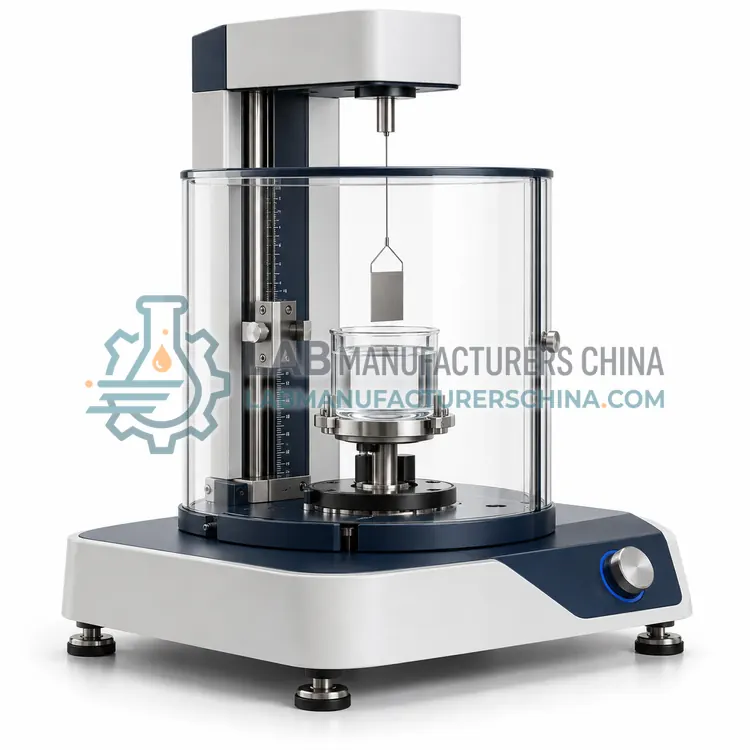
Wilhelmy Plate Tensiometer for Equilibrium and Interfacial Tension
平衡与界面张力用 Wilhelmy 板法张力仪
- CE (to be confirmed)
- +1