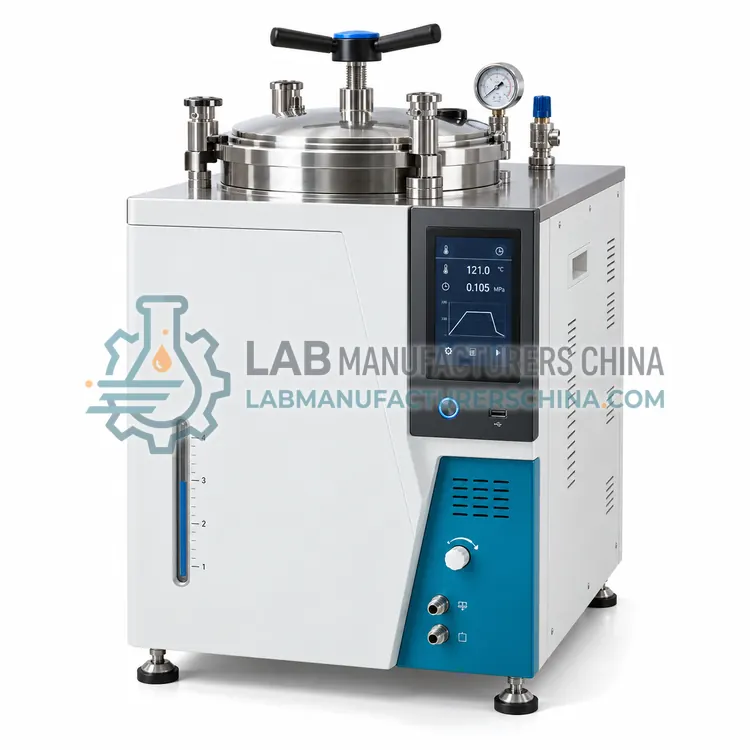
Vertical Autoclave
立式高压灭菌器
- SKU STE-0002
- Sterilization Equipment
- CE (to be confirmed)
- ISO 9001 manufacturing (to be confirmed)
- Pressure vessel compliance (to be confirmed)
Price on request — FOB / CIF quoted per order
Prices depend on configuration, quantity and destination port.
Key specifications
| Chamber volume | 50–100 L (larger options available) |
|---|---|
| Sterilization temperature | 105–134 °C selectable |
| Maximum pressure | 0.22–0.25 MPa |
| Air removal | Gravity; pre-vacuum optional |
| Loading | Top-loading with basket |
| Control | Microprocessor, programmable cycles |
Request a quote Download brochure · to be provided
By Lab Manufacturers China Technical TeamLast reviewed Standards: ISO 17665-1, EN 285, ISO 11138-1
What is the Vertical Autoclave?
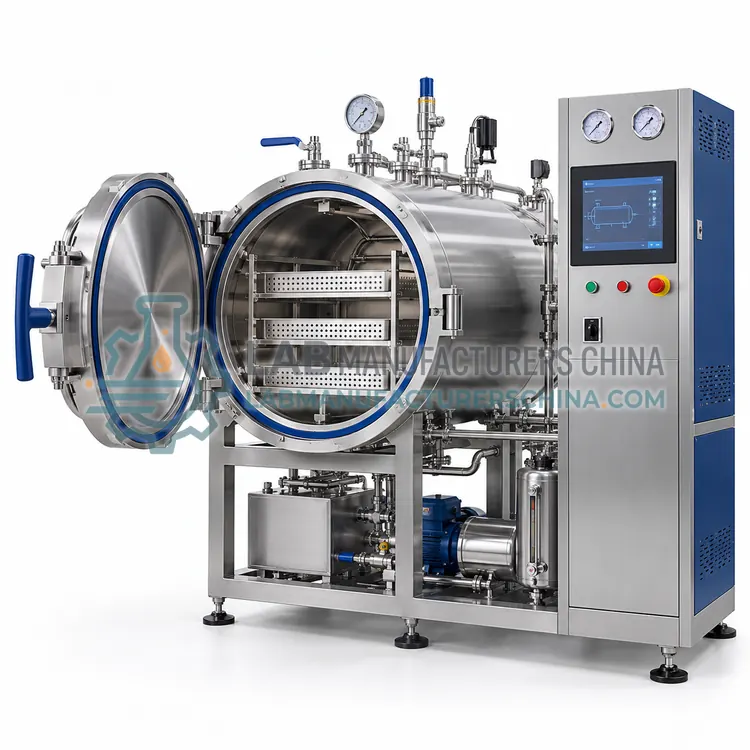
A vertical autoclave is a top-loading steam sterilizer with a larger chamber than a benchtop unit. It handles bigger batches of media, glassware and waste in a modest floor footprint for its capacity.
What is the Vertical Autoclave?
A vertical autoclave is a top-loading steam sterilizer with a larger chamber than a benchtop unit. It handles bigger batches of media, glassware and waste in a modest floor footprint for its capacity.
Overview
A vertical autoclave loads from the top through a hinged or radial lid and typically has a chamber of 50 to 100 litres or more. It uses a built-in or external steam source and a gravity displacement cycle with a drain, and many models offer a pre-vacuum option and programmable cycles for media, instruments, liquids and waste. Because the chamber is taller relative to its diameter, baskets and containers are lifted in and out, which suits tall items, but also means operators must handle hot loads carefully with lifting tools. Controls include temperature and time settings, pressure gauges, a safety valve and often a printer for validation records. Vertical units are common in food, environmental and clinical microbiology laboratories where throughput exceeds what a bench-top autoclave can provide.
How does it work?
Moist-heat sterilization kills organisms by coagulating and denaturing proteins and nucleic acids in the presence of saturated steam. The decisive conditions are temperature, pressure and time: at 121 degrees Celsius and about 1 bar gauge a standard cycle holds for 15 to 20 minutes, while 134 degrees Celsius achieves quicker cycles typical of clinical waste. Steam must contact every surface, so the chamber is purged of air by gravity displacement in simple units or by repeated vacuum pulses in more advanced ones. Dry heat kills by oxidation and requires higher temperature or longer time, often 160 to 180 degrees Celsius for one to two hours. Media preparators combine mixing, heating and in-vessel sterilization so that agar is prepared and sterilized in one vessel rather than in bottles.
What are the key features?
- Top-loading chamber of 50 to 100 litres or more
- Gravity and optional pre-vacuum cycles
- Programmable settings for media, liquids and waste
- Pressure gauge, safety valve and overtemperature cut-out
- Cycle printer for validation records
What are the technical specifications?
A typical vertical autoclave configuration offers chamber volume of 50–100 L (larger options available), sterilization temperature of 105–134 °C selectable, maximum pressure of 0.22–0.25 MPa, air removal of Gravity; pre-vacuum optional, loading of Top-loading with basket and control of Microprocessor, programmable cycles. Values are indicative of the product class; the exact figures for each configuration are confirmed on the quotation and the calibration documents supplied with the instrument.
Which applications is it used for?
The Vertical Autoclave is used in medium to large media batches, waste decontamination, glassware sterilization and food and environmental laboratory use. Across the wider Sterilization Equipment class, laboratories also deploy it for sterilization of culture media and glassware, decontamination of microbiological waste and sterilization of instruments and labware.
Which standards and certifications apply?
Relevant standards and methods include ISO 17665-1, EN 285, ISO 11138-1, ISO 14937, ISO 7218 and IEC 61010-1. Certification candidates for this model are CE, ISO 9001 manufacturing and Pressure vessel compliance; each is to be confirmed for the specific configuration before shipment, and certificates are supplied only where they have been issued.
Operators must be trained in safe loading, correct cycle selection and the risks of hot liquids and pressurized steam. Load items so that steam circulates freely; do not overfill baskets, and loosen closures on bottles and containers. Verify each cycle with physical indicators and temperature records, and confirm performance periodically with biological indicators such as Geobacillus stearothermophilus spores. Drain and clean the chamber, check the door gasket and strainer, and descale the generator on a schedule. Record maintenance and requalification, including chamber temperature mapping. Ensure adequate ventilation and drainage, and confirm that the electrical installation meets the manufacturer's requirements and IEC 61010-1.
How do I select the right Vertical Autoclave?
Choose a vertical autoclave when bench-top capacity is too small but a horizontal unit is not justified. In an RFQ specify chamber volume, loading height, cycle programs, air removal method, data recording and floor and utility requirements.
How does it compare with other Sterilization Equipment variants?
Begin with the load and the required throughput. Small volumes of media, glassware and instruments suit a bench-top autoclave of 20 to 50 L, while a busy laboratory sterilizing large batches or waste may need a vertical or horizontal unit of 50 to 200 L or more. Confirm that the chamber size and basket arrangement fit your largest items and that the cycle type, gravity or pre-vacuum, removes air from porous loads and liquids. For media, a preparator reduces handling and improves consistency. Choose dry heat when steam would corrode instruments, wet powders or damage glassware. Check safety features such as door interlocks, pressure relief, overtemperature cut-out and cycle recording, and confirm that validation, biological indicators and service support are available.
Full specifications
| Chamber volume | 50–100 L (larger options available) |
|---|---|
| Sterilization temperature | 105–134 °C selectable |
| Maximum pressure | 0.22–0.25 MPa |
| Air removal | Gravity; pre-vacuum optional |
| Loading | Top-loading with basket |
| Control | Microprocessor, programmable cycles |
| Safety | Safety valve, door interlock, low-water cut-out |
| Data | Printer and memory log |
| Power supply | 380 V three-phase (model dependent) |
Indicative values for this product class. Final specifications are confirmed on the quotation and in the calibration documents supplied with the instrument.
Applications
- Medium to large media batches
- Waste decontamination
- Glassware sterilization
- Food and environmental laboratory use
Key features
- Top-loading chamber of 50 to 100 litres or more
- Gravity and optional pre-vacuum cycles
- Programmable settings for media, liquids and waste
- Pressure gauge, safety valve and overtemperature cut-out
- Cycle printer for validation records
Frequently asked questions about Vertical Autoclave
Vertical units load from the top and are compact and economical, which suits taller items and moderate batches. Horizontal units load from the front at convenient height, allow longer baskets and often include sliding trays, making heavy or bulky loads easier to handle.
Operators should wait for the chamber to depressurize and the temperature to fall, wear heat-resistant gloves and use lifting tools rather than reaching into the chamber. Liquids need extra standing time to cool, because they can boil over or shatter containers if moved too soon.
A drain removes condensate and the air displaced during the gravity cycle, and it discharges steam at the end of the cycle. Proper drainage protects the load from recontamination by standing water and prevents pressure from building in the chamber.
It sterilizes culture media, glassware, instruments and waste so that only the intended organisms are present in a culture. Autoclaves use saturated steam, dry heat sterilizers use hot air, and media preparators sterilize agar in the vessel in which it is prepared.
Saturated steam at 121 degrees Celsius and about 1 bar gauge kills organisms quickly by denaturing their proteins, and a 15 to 20 minute hold gives a safety margin for typical loads. Higher temperatures such as 134 degrees Celsius shorten cycles but need better air removal.
A gravity cycle lets steam push air out through a drain, which is simple but leaves air pockets in porous or wrapped loads. A pre-vacuum cycle removes air with vacuum pulses before admitting steam, giving faster and more reliable penetration for such loads.
Related models