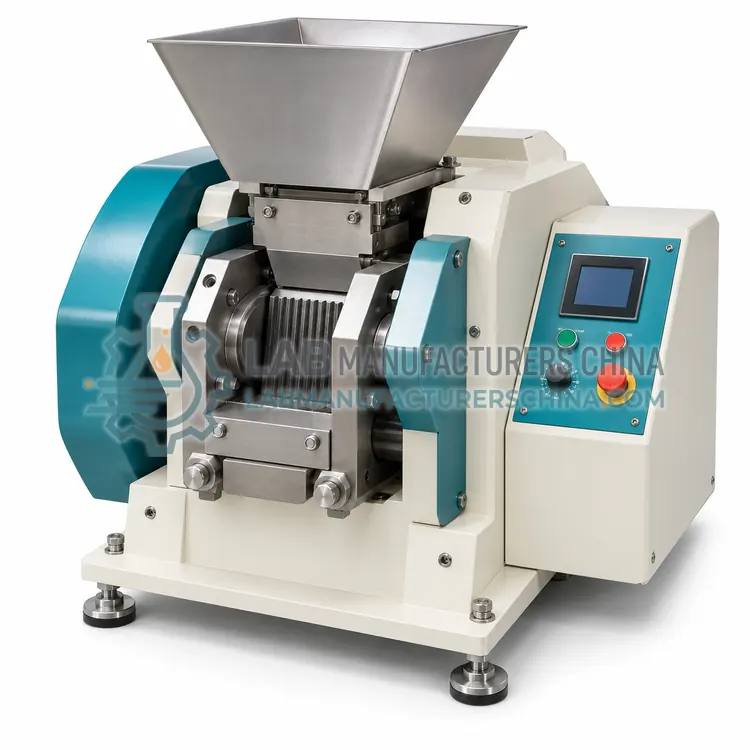
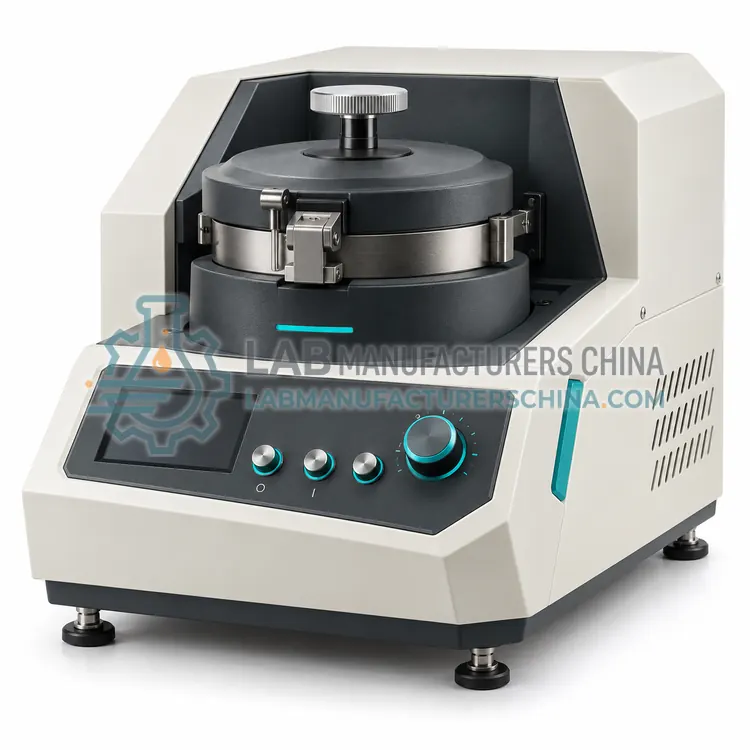
Vibratory Disc Mill for Sample Homogenization
制样均质用振动盘式研磨仪
- SKU SAT-0002
- Sample Preparation
- CE (to be confirmed)
- ISO 9001 manufacturing (to be confirmed)
Price on request — FOB / CIF quoted per order
Prices depend on configuration, quantity and destination port.
Key specifications
| Max feed size | ≤ 10 mm |
|---|---|
| Final fineness | 20–75 µm, material dependent |
| Grinding set volume | 50 / 100 / 250 mL |
| Grinding set material | Hardened steel, tungsten carbide, zirconia, agate |
| Vibration frequency | Approx. 700–1500 rpm equivalent |
| Typical grinding time | 1–3 min |
Request a quote Download brochure · to be provided
By Lab Manufacturers China Technical TeamLast reviewed Standards: ISO 3082, ASTM D2013, ASTM E877
What is the Vibratory Disc Mill for Sample Homogenization?
A vibratory disc mill grinds brittle materials to analytical fineness in one to three minutes by vibrating a ring and puck inside a closed grinding set. It is the standard choice when a laboratory needs fast, reproducible powder below 75 µm for XRF, ICP or wet chemical analysis.
What is the Vibratory Disc Mill for Sample Homogenization?
A vibratory disc mill grinds brittle materials to analytical fineness in one to three minutes by vibrating a ring and puck inside a closed grinding set. It is the standard choice when a laboratory needs fast, reproducible powder below 75 µm for XRF, ICP or wet chemical analysis.
Overview
In a vibratory disc mill the grinding set, a ring and a puck, is shaken radially at high frequency inside a sealed bowl, so the sample is crushed by impact and friction against the ring wall and between ring and puck. Because the sample stays enclosed, losses and contamination are limited, and grinding sets are available in hardened steel, tungsten carbide, zirconia, agate and chromium-free steel. Typical final fineness is 20–75 µm depending on material and grinding time, with capacities from about 50 mL to 250 mL per batch. Mills designed for industrial QC usually offer programmable grinding time, automatic clamping of the grinding set, and a lid interlock. Very soft, fibrous or elastic materials are better handled by cutting or rotor mills, so material type should be checked before selection.
How does it work?
Industrial sample preparation reduces a bulk lot to a small test portion without changing its composition. Crushing and milling lower particle size by compressive, impact or shear forces, and representative splitting follows each size-reduction step so the sub-sample still reflects the original lot. Disc mills and ring mills grind to below 75 µm for pressed pellets or fusion, where the sample is melted with a borate flux to dissolve refractory minerals into a homogeneous glass bead. Microwave digestion dissolves samples in acid at elevated temperature and pressure in closed vessels for ICP or atomic absorption measurement. Throughout, materials that touch the sample are chosen to avoid contamination: tungsten carbide for hard ores, zirconia for trace-element work, agate for soft or brittle materials.
What are the key features?
- Final fineness down to 20 µm in 1–3 minutes
- Sealed grinding sets in tungsten carbide, zirconia or agate
- Programmable grinding time from 1 s to 99 min
- Automatic clamping and lid interlock for operator safety
- Interchangeable 50, 100 and 250 mL grinding sets
- Low dead volume for small samples down to a few grams
What are the technical specifications?
A typical vibratory disc mill for sample homogenization configuration offers max feed size of ≤ 10 mm, final fineness of 20–75 µm, material dependent, grinding set volume of 50 / 100 / 250 mL, grinding set material of Hardened steel, tungsten carbide, zirconia, agate, vibration frequency of Approx. 700–1500 rpm equivalent and typical grinding time of 1–3 min. Values are indicative of the product class; the exact figures for each configuration are confirmed on the quotation and the calibration documents supplied with the instrument.
Which applications is it used for?
The Vibratory Disc Mill for Sample Homogenization is used in XRF pressed pellet and fusion sample preparation, ICP and atomic absorption sample preparation, cement, clinker and raw meal grinding, ore, slag and mineral homogenization and coal and coke analysis powder preparation. Across the wider Sample Preparation class, laboratories also deploy it for ore and concentrate assay laboratories, cement, clinker and raw meal quality control and coal and coke sample preparation for ash and sulfur analysis.
Which standards and certifications apply?
Relevant standards and methods include ISO 3082, ASTM D2013, ASTM E877, ISO 3310-1, ISO 2758 and IEC 61010-1. Certification candidates for this model are CE and ISO 9001 manufacturing; each is to be confirmed for the specific configuration before shipment, and certificates are supplied only where they have been issued.
Install crushing and milling equipment on a rigid floor with dust extraction and hearing protection, because noise commonly exceeds 80 dB(A). Sieve checks and, for trace analysis, blank grinds with quartz sand keep cross-contamination low; grinding sets wear and should be inspected for cracks. Verify press force and die condition at intervals, and re-check pellet quality after any change of powder supplier. Crucibles, dies and digestion vessels are consumables that must meet the method's contamination specification. Balance calibration, temperature records and traceable reference materials support method validation and laboratory accreditation.
How do I select the right Vibratory Disc Mill for Sample Homogenization?
Choose the vibratory disc mill when samples are brittle and the target is powder below 75 µm. Match grinding set material to the elements under study and grinding set volume to the sample mass, keeping powder volume below about one third of the bowl. Specify how many samples per shift you run, because one set per sample avoids contamination but slows throughput; a second set allows parallel cleaning.
How does it compare with other Sample Preparation variants?
Choose by the physical form of the material and the analytical technique that follows. Hard, brittle ores, clinker and ferroalloys need a jaw crusher for primary reduction, then a disc or ring mill for fine grinding; soft polymers and coal may need only a cutting mill. Fusion bead preparation is required when the sample is measured by XRF or ICP and total dissolution is difficult, while pressed pellets are faster and cheaper when only major oxides are sought. Microwave digestion is the quickest route to a clear solution for trace-metal measurement. Specify final particle size, contamination limits for the elements of interest, batch size per shift, cleaning between samples, and whether a method standard demands a defined splitting scheme.
Full specifications
| Max feed size | ≤ 10 mm |
|---|---|
| Final fineness | 20–75 µm, material dependent |
| Grinding set volume | 50 / 100 / 250 mL |
| Grinding set material | Hardened steel, tungsten carbide, zirconia, agate |
| Vibration frequency | Approx. 700–1500 rpm equivalent |
| Typical grinding time | 1–3 min |
| Timer range | 1 s – 99 min |
| Motor power | 0.75–1.5 kW |
| Power supply | 220 V, 50/60 Hz |
| Weight | 80–120 kg |
Indicative values for this product class. Final specifications are confirmed on the quotation and in the calibration documents supplied with the instrument.
Applications
- XRF pressed pellet and fusion sample preparation
- ICP and atomic absorption sample preparation
- Cement, clinker and raw meal grinding
- Ore, slag and mineral homogenization
- Coal and coke analysis powder preparation
Key features
- Final fineness down to 20 µm in 1–3 minutes
- Sealed grinding sets in tungsten carbide, zirconia or agate
- Programmable grinding time from 1 s to 99 min
- Automatic clamping and lid interlock for operator safety
- Interchangeable 50, 100 and 250 mL grinding sets
- Low dead volume for small samples down to a few grams
Frequently asked questions about Vibratory Disc Mill for Sample Homogenization
Keep the powder volume below roughly a third of the grinding bowl volume. Overloading reduces the free path of the ring and puck, so grinding becomes slower and less uniform, while very small loads may be difficult to recover. For a 100 mL bowl, 30–50 g of typical mineral powder is reasonable.
Use agate or zirconia for trace work, since steel sets add iron and chromium and tungsten carbide sets add tungsten and cobalt. Agate is suitable for soft to medium-hard brittle material but wears faster; zirconia is denser and suits harder samples. Whichever set is used, run a blank grind before the first analytical sample.
Longer grinding lowers particle size and improves homogeneity, but also increases wear of the grinding set and any resulting contamination and can cause agglomeration of fine particles. Most methods therefore fix a grinding time, and the laboratory should verify that its own time reproduces the required fineness by sieve or laser analysis.
A test portion of a few grams must represent a lot of many tonnes, so any inhomogeneity, particle-size effect or contamination introduced during crushing, splitting or grinding is carried into the result. Sampling and preparation errors are added to, not averaged out by, the measurement, which makes a documented, repeatable procedure essential.
Fusion beads suit refractory or mineralogically complex materials such as ores, cement and ceramic powders, because the borate flux dissolves the sample and removes particle-size and mineralogy effects. Pressed pellets are adequate for routine major-oxide screening, are much faster, and avoid the platinum crucibles, flux and high-temperature furnace that fusion requires.
Between samples, grind a quartz sand or pure material blank and discard it, then brush and if permitted wipe the grinding set. Match the grinding material to the elements of interest: tungsten carbide adds cobalt and tungsten, steel adds iron and chromium, and agate or zirconia is preferred for trace analysis. Sieving the ground powder checks that the target fineness was reached.
Related models