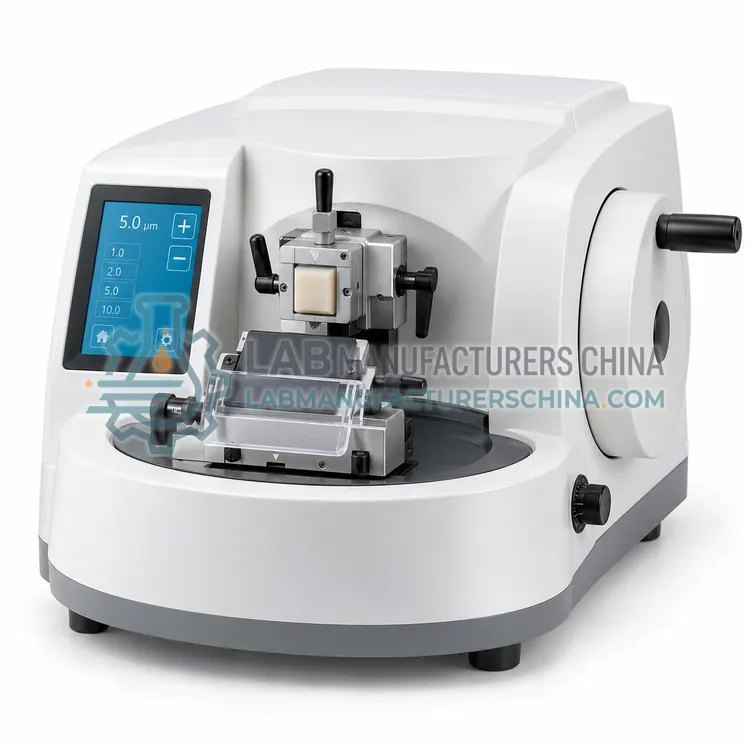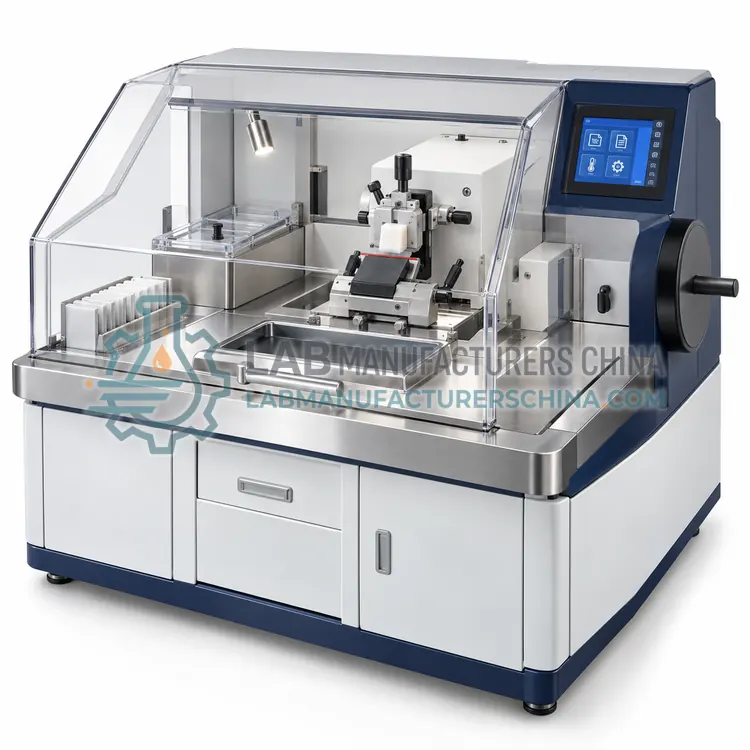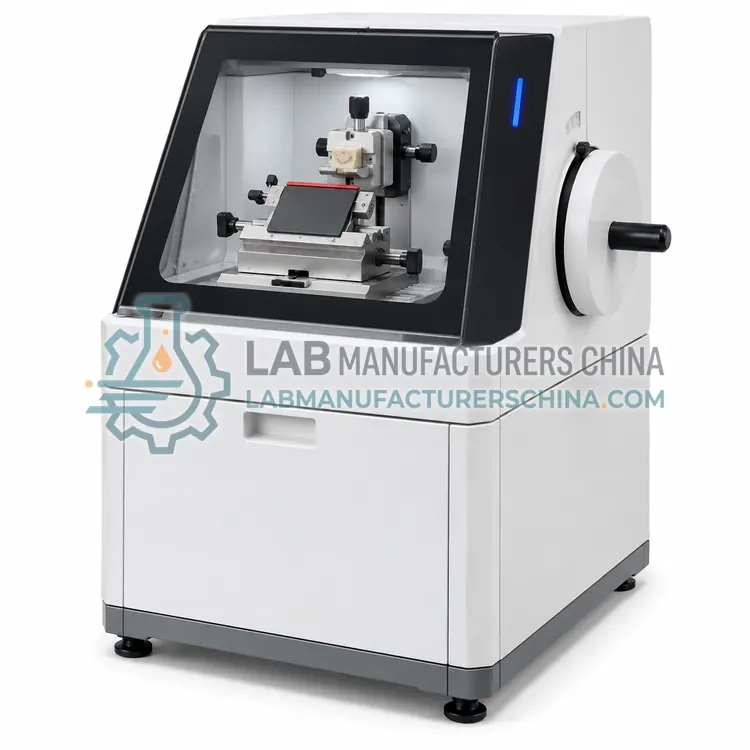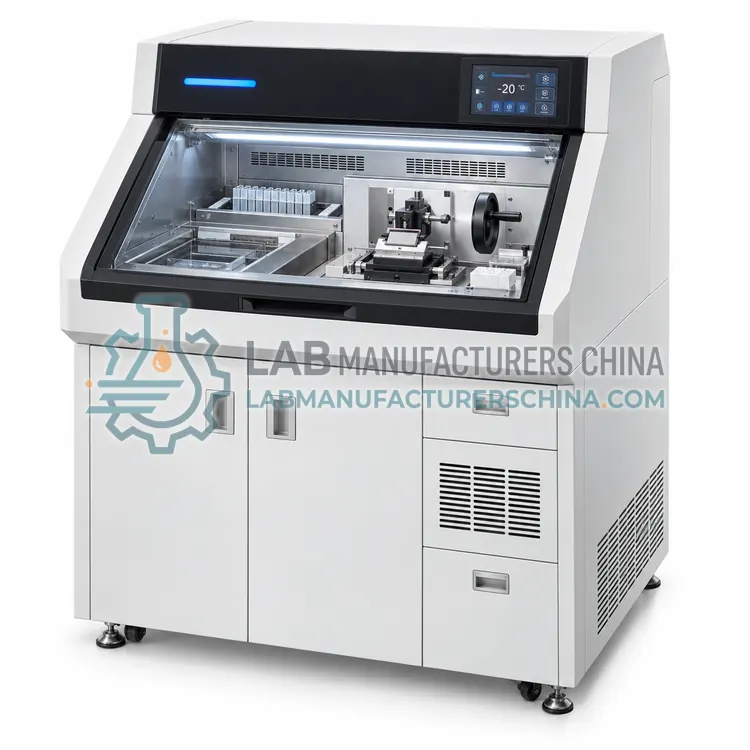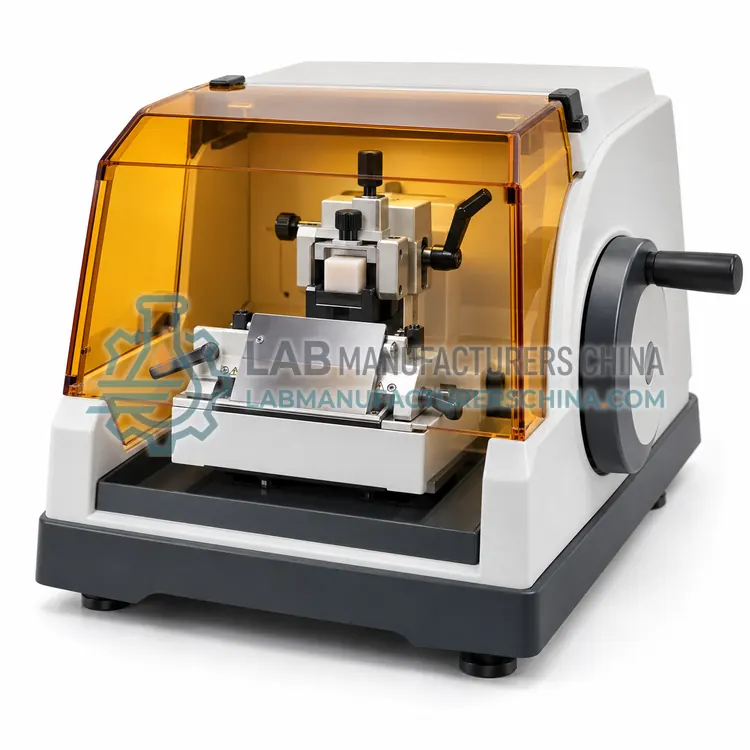
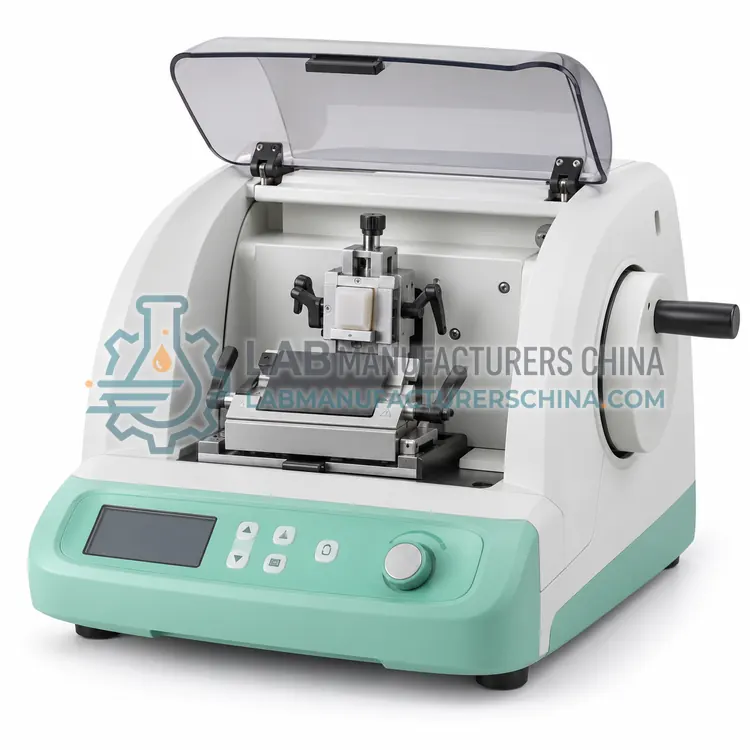
Motorized Rotary Microtome
电动轮转式切片机
- SKU RMI-0004
- Rotary Microtomes
- CE (to be confirmed)
- IEC 61010-1 compliance (to be confirmed)
- IEC 61326-1 EMC (to be confirmed)
Price on request — FOB / CIF quoted per order
Prices depend on configuration, quantity and destination port.
Key specifications
| Section thickness range | 0.5–100 µm |
|---|---|
| Thickness increment | 0.5 µm below 5 µm; 1 µm above |
| Cutting speed | 0–400 mm/s, selectable |
| Cutting modes | Rotary and rocking |
| Maximum specimen size | about 55 × 45 mm |
| Specimen stroke | about 70 mm |
Request a quote Download brochure · to be provided
By Lab Manufacturers China Technical TeamLast reviewed Standards: IEC 61010-1, IEC 61010-2-101, IEC 61326-1
What is the Motorized Rotary Microtome?
A motorized rotary microtome uses motors for both the cutting stroke and the specimen feed, with foot or button control, and is often positioned as an instrument for heavy daily use and precise serial sectioning in histology laboratories.
What is the Motorized Rotary Microtome?
A motorized rotary microtome uses motors for both the cutting stroke and the specimen feed, with foot or button control, and is often positioned as an instrument for heavy daily use and precise serial sectioning in histology laboratories.
Overview
The motorized rotary microtome sits above the semi-automatic class: the built-in motor drives the cutting cycle and also advances the specimen, so long series can be produced with minimal operator effort. Control is usually by foot pedal or front panel buttons with selectable speed. Section thickness ranges commonly span 0.5 to 100 µm with finer increments at low settings. Trimming feed, programmable retraction and a section counter are standard. Some models offer both rotary and rocking cutting modes, and an emergency stop and two-hand safety control protect the operator. These instruments are chosen where a single operator must cut many blocks per day, where repetitive strain injuries are a concern, or where protocols require that cutting speed and thickness be identical across a study. They share the same blade systems and block holders as manual instruments.
How does it work?
A rotary microtome clamps a paraffin block in a cassette holder mounted on a feed mechanism and advances it toward a fixed blade as the operator turns a handwheel or a motor drives a cutting cycle. Each revolution advances the block by the set section thickness, usually adjustable from 1 to 60 µm in 1 µm steps, while a retraction mechanism pulls the block slightly back on the return stroke to protect the block face. Cut sections join into a continuous ribbon that is floated onto a warm water bath. Precision depends on rigid castings, low-backlash feed screws or stepper motors, a sharp disposable blade held at a fixed clearance angle and vibration-free installation. Blade angle, block orientation, ambient temperature and paraffin hardness also influence section quality, and coarse feed is used only for trimming.
What are the key features?
- Motor drive for both cutting stroke and specimen feed
- Foot pedal or push-button control with selectable speed
- Section thickness from about 0.5 to 100 µm
- Programmable retraction and section counter
- Emergency stop and two-hand safety control
- Optional rocking mode for difficult blocks
What are the technical specifications?
A typical motorized rotary microtome configuration offers section thickness range of 0.5–100 µm, thickness increment of 0.5 µm below 5 µm; 1 µm above, cutting speed of 0–400 mm/s, selectable, cutting modes of Rotary and rocking, maximum specimen size of about 55 × 45 mm and specimen stroke of about 70 mm. Values are indicative of the product class; the exact figures for each configuration are confirmed on the quotation and the calibration documents supplied with the instrument.
Which applications is it used for?
The Motorized Rotary Microtome is used in heavy routine histology workloads, long serial section series, ergonomic sectioning programmes and research requiring identical sections. Across the wider Rotary Microtomes class, laboratories also deploy it for surgical pathology, research histology and immunohistochemistry preparation.
Which standards and certifications apply?
Relevant standards and methods include IEC 61010-1, IEC 61010-2-101, IEC 61326-1, ISO 15189 and ISO 13485. Certification candidates for this model are CE, IEC 61010-1 compliance and IEC 61326-1 EMC; each is to be confirmed for the specific configuration before shipment, and certificates are supplied only where they have been issued.
Install the microtome on a rigid bench away from vibration and drafts, in a room kept near 20 to 24 °C, because warm paraffin cuts poorly. Keep blades in a locked dispenser and dispose of used blades in a sharps container. Clean debris from the blade holder and block clamp after each session, lubricate guides as recommended, and check section thickness with a calibrated gauge or test block at defined intervals. Send instruments for professional service yearly. Record maintenance, calibration and training, and validate section quality through routine quality control blocks.
How do I select the right Motorized Rotary Microtome?
Specify a motorized microtome when a single operator must process many blocks daily or when the laboratory wants to limit repetitive strain. It differs from a fully automatic unit mainly in control philosophy and protocol programmability. Confirm speed range, cutting modes, retraction, safety interlocks, block holder options and blade compatibility before ordering.
How does it compare with other Rotary Microtomes variants?
Choose rotary microtomes mainly by throughput and operator workload. Manual units are economical for low-volume laboratories that value tactile control. Semi-automatic models motorise the cutting stroke while leaving block advance to the operator, reducing fatigue at moderate volumes. Fully automatic instruments program cutting speed, thickness and section count for high-throughput or repetitive work. Motorised models with motorised specimen advance suit serial sectioning and hard tissue. When blocks are dense, such as undecalcified bone or calcified material, specify a version with reinforced feed and a tungsten carbide blade holder. In an RFQ state the thickness range, maximum block size, retraction, trimming function, blade system and whether a cooling stage is required.
Full specifications
| Section thickness range | 0.5–100 µm |
|---|---|
| Thickness increment | 0.5 µm below 5 µm; 1 µm above |
| Cutting speed | 0–400 mm/s, selectable |
| Cutting modes | Rotary and rocking |
| Maximum specimen size | about 55 × 45 mm |
| Specimen stroke | about 70 mm |
| Retraction | 0–150 µm, programmable |
| Control | Foot pedal and front panel |
| Power supply | 220 V, 50 Hz, about 0.3 kW |
Indicative values for this product class. Final specifications are confirmed on the quotation and in the calibration documents supplied with the instrument.
Applications
- Heavy routine histology workloads
- Long serial section series
- Ergonomic sectioning programmes
- Research requiring identical sections
Key features
- Motor drive for both cutting stroke and specimen feed
- Foot pedal or push-button control with selectable speed
- Section thickness from about 0.5 to 100 µm
- Programmable retraction and section counter
- Emergency stop and two-hand safety control
- Optional rocking mode for difficult blocks
Frequently asked questions about Motorized Rotary Microtome
Both motorise stroke and feed. Motorized models are usually controlled by pedal or buttons with preset speeds, while fully automatic models add programmable protocols, stored methods and often closed-loop thickness control. For many laboratories the practical difference is protocol flexibility.
In rocking mode the block moves through a curved path rather than a straight stroke, which can suit some decalcified or brittle specimens by altering the cutting angle through the section. It is an option on selected models rather than a general substitute for correct block preparation.
Yes, it leaves both hands free to guide the ribbon, adjust orientation and manage the water bath. In high-volume work this improves speed and reduces awkward hand positions that contribute to strain during long sectioning sessions.
It cuts thin, uniform paraffin sections for light microscopy in histology. Sections are typically 1 to 60 µm thick and are used for routine H&E staining, special stains, immunohistochemistry and research, forming the basis of most pathology diagnosis.
Choose manual for low volumes and fine tactile control, semi-automatic when cutting stroke fatigue is a concern, and fully automatic for high throughput or repetitive serial sectioning. Automatic models also give more reproducible speed and thickness, which supports consistent section quality.
Curling and wrinkling usually come from a blunt or dirty blade, a wrong clearance angle, paraffin that is too cold or too soft, or too fast a cutting stroke. Check blade angle, block temperature and cutting speed, and float sections on a water bath at about 40 to 45 °C.
Related models