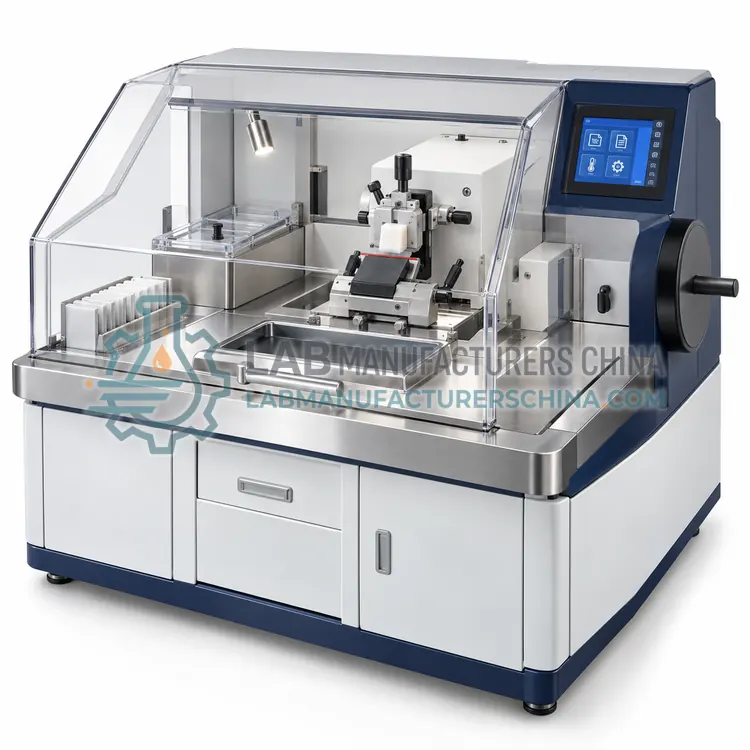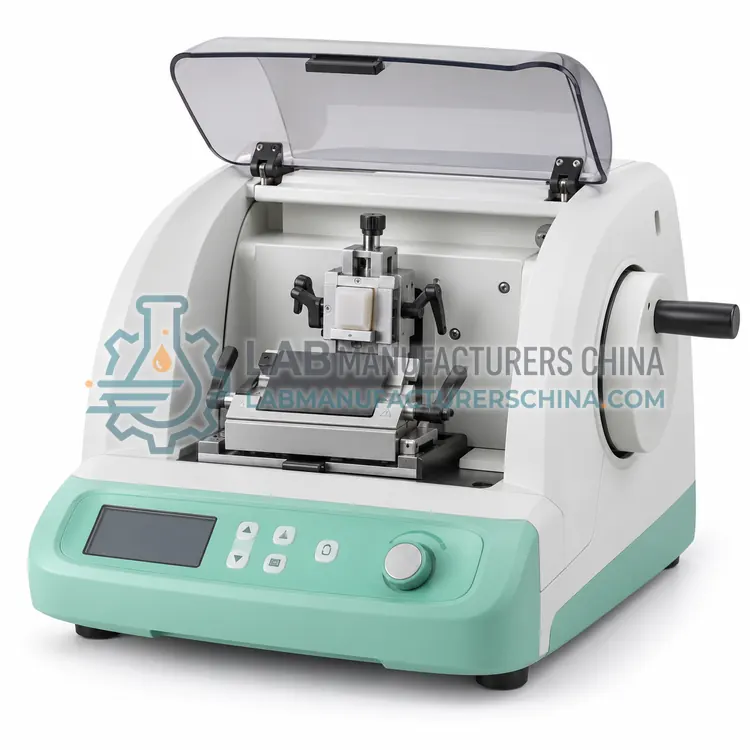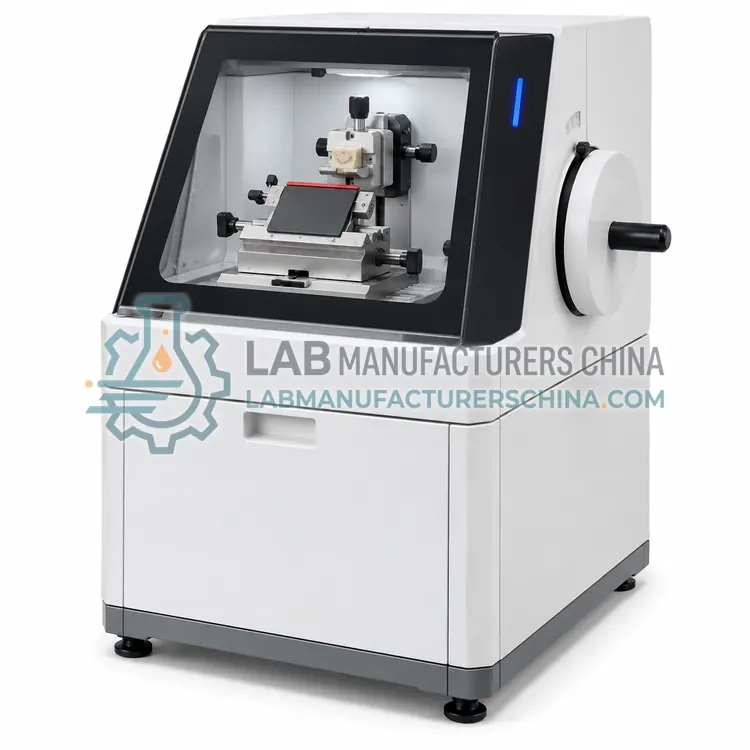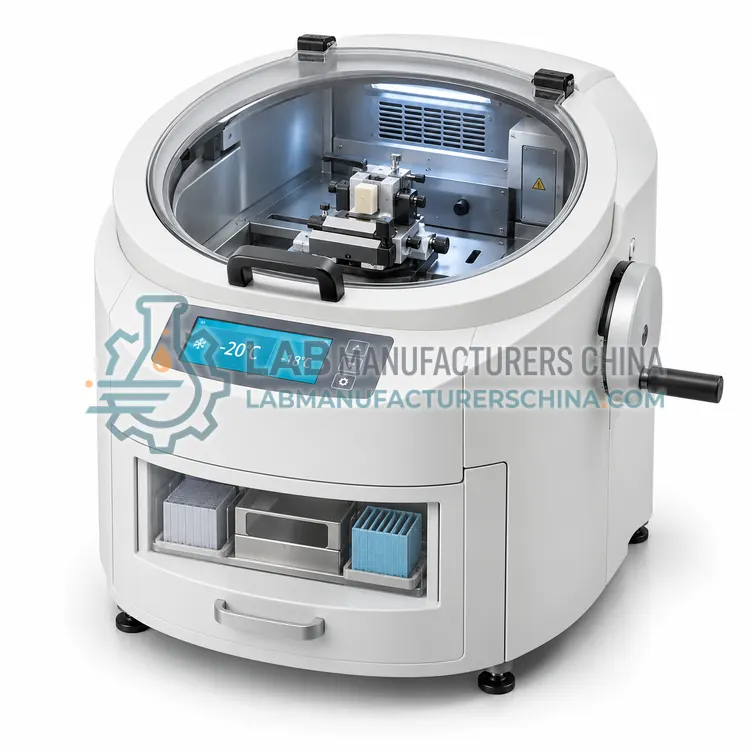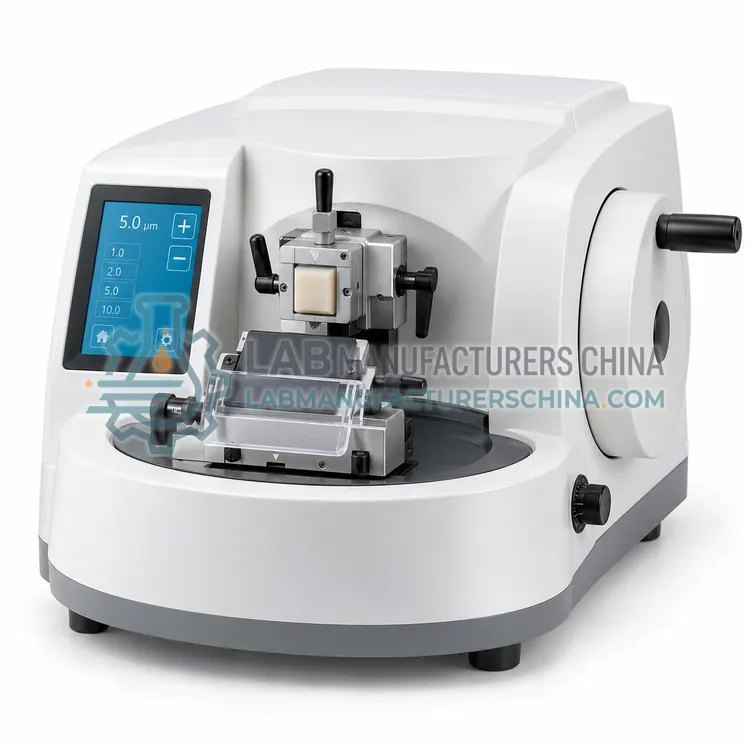
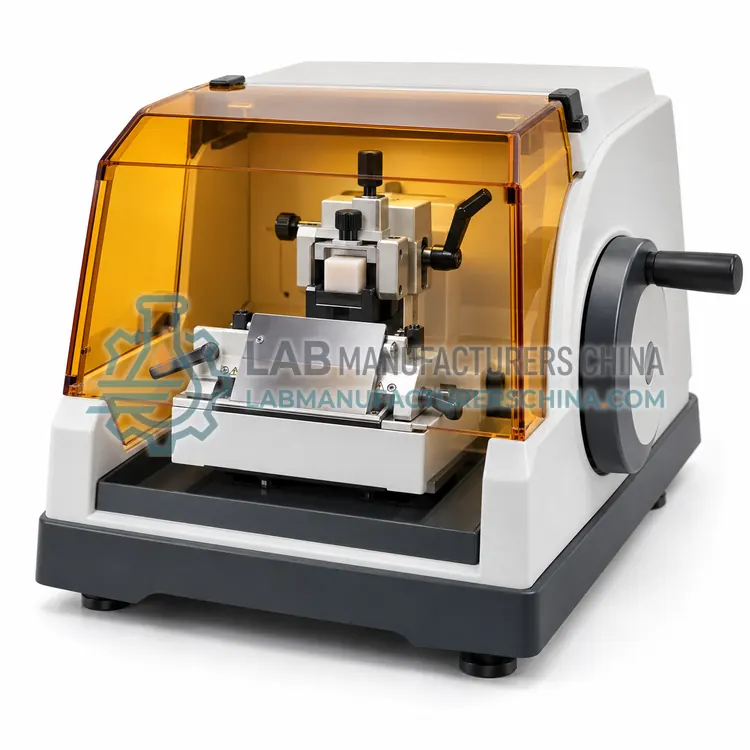
Manual Rotary Microtome
手动轮转式切片机
- SKU RMI-0001
- Rotary Microtomes
- CE (to be confirmed)
- IEC 61010-1 compliance (to be confirmed)
- ISO 13485 manufacturing (to be confirmed)
Price on request — FOB / CIF quoted per order
Prices depend on configuration, quantity and destination port.
Key specifications
| Section thickness range | 1–60 µm |
|---|---|
| Thickness increment | 1 µm |
| Trimming feed | 10 µm and 30 µm |
| Maximum specimen size | about 50 × 40 mm |
| Specimen stroke | about 60 mm |
| Retraction | about 60 µm per stroke |
Request a quote Download brochure · to be provided
By Lab Manufacturers China Technical TeamLast reviewed Standards: IEC 61010-1, IEC 61010-2-101, IEC 61326-1
What is the Manual Rotary Microtome?
A manual rotary microtome advances the block by handwheel only, giving the operator direct feel for tissue hardness and cutting resistance. It suits low-volume histology and training laboratories that prefer a robust, economical sectioning instrument.
What is the Manual Rotary Microtome?
A manual rotary microtome advances the block by handwheel only, giving the operator direct feel for tissue hardness and cutting resistance. It suits low-volume histology and training laboratories that prefer a robust, economical sectioning instrument.
Overview
The manual rotary microtome is the classic histology workhorse. A large balanced handwheel turns a crank that moves the block holder through a vertical stroke past a fixed blade, while a micrometer or mechanical feed advances the block by the set thickness on each return. Section thickness is typically adjustable from 1 to 60 µm in 1 µm steps, with coarse feed for trimming. Most models accept standard cassettes and low-profile or high-profile blades, and supplies are inexpensive and widely available. Because the operator controls stroke speed and rhythm, skilled users can adjust to difficult tissue. Ergonomics matter: look for a comfortable handwheel position, a lockable wheel for safe block changing, a wrist rest and a clear view of the block face.
How does it work?
A rotary microtome clamps a paraffin block in a cassette holder mounted on a feed mechanism and advances it toward a fixed blade as the operator turns a handwheel or a motor drives a cutting cycle. Each revolution advances the block by the set section thickness, usually adjustable from 1 to 60 µm in 1 µm steps, while a retraction mechanism pulls the block slightly back on the return stroke to protect the block face. Cut sections join into a continuous ribbon that is floated onto a warm water bath. Precision depends on rigid castings, low-backlash feed screws or stepper motors, a sharp disposable blade held at a fixed clearance angle and vibration-free installation. Blade angle, block orientation, ambient temperature and paraffin hardness also influence section quality, and coarse feed is used only for trimming.
What are the key features?
- Handwheel-driven cutting stroke with manual feed control
- Section thickness range about 1 to 60 µm with 1 µm steps
- Coarse feed for rapid block trimming
- Accepts standard cassettes and disposable low-profile blades
- Handwheel lock and blade guard for safer block handling
- Simple mechanical design with low maintenance cost
What are the technical specifications?
A typical manual rotary microtome configuration offers section thickness range of 1–60 µm, thickness increment of 1 µm, trimming feed of 10 µm and 30 µm, maximum specimen size of about 50 × 40 mm, specimen stroke of about 60 mm and retraction of about 60 µm per stroke. Values are indicative of the product class; the exact figures for each configuration are confirmed on the quotation and the calibration documents supplied with the instrument.
Which applications is it used for?
The Manual Rotary Microtome is used in routine paraffin histology, teaching and training laboratories, small biopsy and research workloads and veterinary pathology. Across the wider Rotary Microtomes class, laboratories also deploy it for surgical pathology, research histology and immunohistochemistry preparation.
Which standards and certifications apply?
Relevant standards and methods include IEC 61010-1, IEC 61010-2-101, IEC 61326-1, ISO 15189 and ISO 13485. Certification candidates for this model are CE, IEC 61010-1 compliance and ISO 13485 manufacturing; each is to be confirmed for the specific configuration before shipment, and certificates are supplied only where they have been issued.
Install the microtome on a rigid bench away from vibration and drafts, in a room kept near 20 to 24 °C, because warm paraffin cuts poorly. Keep blades in a locked dispenser and dispose of used blades in a sharps container. Clean debris from the blade holder and block clamp after each session, lubricate guides as recommended, and check section thickness with a calibrated gauge or test block at defined intervals. Send instruments for professional service yearly. Record maintenance, calibration and training, and validate section quality through routine quality control blocks.
How do I select the right Manual Rotary Microtome?
Select the manual microtome when volume is modest, budget is limited and operators are experienced. It is not the best choice for high throughput or for users who tire from repeated strokes. In an RFQ specify thickness range, maximum block size, retraction distance, blade system, accessories such as a cooling stage and the required electrical supply.
How does it compare with other Rotary Microtomes variants?
Choose rotary microtomes mainly by throughput and operator workload. Manual units are economical for low-volume laboratories that value tactile control. Semi-automatic models motorise the cutting stroke while leaving block advance to the operator, reducing fatigue at moderate volumes. Fully automatic instruments program cutting speed, thickness and section count for high-throughput or repetitive work. Motorised models with motorised specimen advance suit serial sectioning and hard tissue. When blocks are dense, such as undecalcified bone or calcified material, specify a version with reinforced feed and a tungsten carbide blade holder. In an RFQ state the thickness range, maximum block size, retraction, trimming function, blade system and whether a cooling stage is required.
Full specifications
| Section thickness range | 1–60 µm |
|---|---|
| Thickness increment | 1 µm |
| Trimming feed | 10 µm and 30 µm |
| Maximum specimen size | about 50 × 40 mm |
| Specimen stroke | about 60 mm |
| Retraction | about 60 µm per stroke |
| Blade type | Disposable low-profile or high-profile |
| Drive | Manual handwheel |
| Weight | about 30–40 kg |
Indicative values for this product class. Final specifications are confirmed on the quotation and in the calibration documents supplied with the instrument.
Applications
- Routine paraffin histology
- Teaching and training laboratories
- Small biopsy and research workloads
- Veterinary pathology
Key features
- Handwheel-driven cutting stroke with manual feed control
- Section thickness range about 1 to 60 µm with 1 µm steps
- Coarse feed for rapid block trimming
- Accepts standard cassettes and disposable low-profile blades
- Handwheel lock and blade guard for safer block handling
- Simple mechanical design with low maintenance cost
Frequently asked questions about Manual Rotary Microtome
Yes, cutting speed depends on the operator, and repeated strokes can be tiring. For routine blocks the difference is modest, but for hundreds of blocks per day an automatic model completes sections faster and with more consistent stroke speed.
Not normally. Frozen sections need a cryostat that keeps the chamber near –20 °C, or a separate freezing stage for thick sections. A manual rotary microtome is intended for paraffin-embedded tissue at room temperature.
Low-profile disposable blades are standard for routine paraffin work, while high-profile blades suit harder blocks. A tungsten carbide blade is used for dense tissue. The blade and holder must match, and the correct clearance angle must be set for the wax hardness.
It cuts thin, uniform paraffin sections for light microscopy in histology. Sections are typically 1 to 60 µm thick and are used for routine H&E staining, special stains, immunohistochemistry and research, forming the basis of most pathology diagnosis.
Choose manual for low volumes and fine tactile control, semi-automatic when cutting stroke fatigue is a concern, and fully automatic for high throughput or repetitive serial sectioning. Automatic models also give more reproducible speed and thickness, which supports consistent section quality.
Curling and wrinkling usually come from a blunt or dirty blade, a wrong clearance angle, paraffin that is too cold or too soft, or too fast a cutting stroke. Check blade angle, block temperature and cutting speed, and float sections on a water bath at about 40 to 45 °C.
Related models