Inline Process Refractometer
在线过程折光仪
- SKU REF-0003
- Refractometers
- CE (to be confirmed)
- ISO 9001 manufacturing (to be confirmed)
Price on request — FOB / CIF quoted per order
Prices depend on configuration, quantity and destination port.
Key specifications
| Refractive index range | 1.3200–1.5300 nD |
|---|---|
| Brix range | 0–100 % |
| Accuracy, nD | ±0.0002 |
| Accuracy, Brix | ±0.1 % |
| Process temperature | −20 to 140 °C |
| Process pressure | Up to 16 bar |
Request a quote Download brochure · to be provided
By Lab Manufacturers China Technical TeamLast reviewed Standards: USP <831>, Ph. Eur. 2.2.6, ASTM D1218
What is the Inline Process Refractometer?
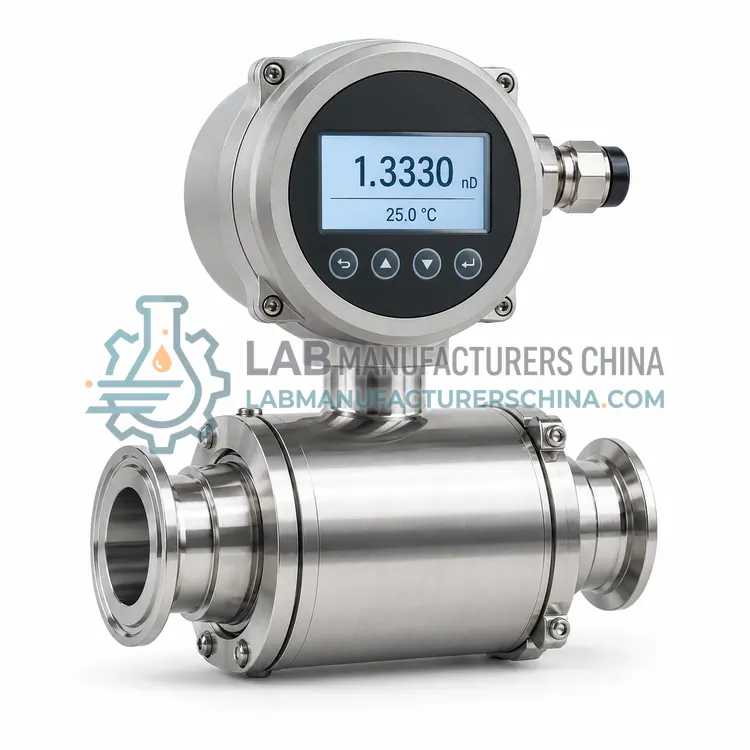
An inline process refractometer is a probe-style sensor installed in a pipe or tank that continuously measures refractive index and reports concentration as Brix or a custom scale. It supports process control in sugar, beverage, chemical and coolant production lines.
What is the Inline Process Refractometer?
An inline process refractometer is a probe-style sensor installed in a pipe or tank that continuously measures refractive index and reports concentration as Brix or a custom scale. It supports process control in sugar, beverage, chemical and coolant production lines.
Overview
An inline refractometer places a sensor prism, usually sapphire or glass, directly in contact with the process stream. An LED source illuminates the prism at a range of angles and a CCD array observes the critical angle edge, from which refractive index is calculated. A built-in temperature sensor corrects for process temperature changes from about −20 to 140 °C, and the signal is converted to a concentration using a stored curve for the specific solution. Stainless steel 316L and hygienic clamp, flange or insertion fittings allow installation in sanitary food lines and chemical plants, and a CIP-tolerant design withstands cleaning chemistry. Outputs include 4–20 mA, Modbus or PROFIBUS. Optional wash nozzles or prism wipers address fouling. Measurement is continuous, typically updating every second, allowing real-time control of dosing and blending, with no sampling.
How does it work?
A refractometer determines the refractive index n, the ratio of the speed of light in vacuum to that in the sample, typically at the sodium D line of 589.3 nm. Most analytical designs use the critical angle method: light at a range of incident angles strikes the interface between a high-index prism and the sample, and above the critical angle total internal reflection occurs. The position of the light-dark boundary is observed visually through an eyepiece or detected electronically with a CCD or photodiode array, and converted to refractive index by the instrument. Because refractive index depends on temperature, the prism is thermostatted, commonly to 20 °C, or the reading is compensated by automatic temperature compensation. Conversion tables translate n to Brix, sugar, salt or other concentration scales for defined solutions.
What are the key features?
- Continuous measurement with one-second updates enables real-time blending and dosing control.
- Sapphire prism and 316L wetted parts handle aggressive and hygienic process streams.
- Integrated temperature compensation covers process temperatures up to 140 °C.
- Hygienic clamp, flange or insertion fittings suit sanitary and chemical installations.
- 4–20 mA, Modbus and PROFIBUS outputs integrate with plant control systems.
- Optional prism wash nozzles reduce fouling on viscous or crystallizing streams.
What are the technical specifications?
A typical inline process refractometer configuration offers refractive index range of 1.3200–1.5300 nD, brix range of 0–100 %, accuracy, nD of ±0.0002, accuracy, Brix of ±0.1 %, process temperature of −20 to 140 °C and process pressure of Up to 16 bar. Values are indicative of the product class; the exact figures for each configuration are confirmed on the quotation and the calibration documents supplied with the instrument.
Which applications is it used for?
The Inline Process Refractometer is used in sugar refining and syrup dosing, beverage blending and carbonation, chemical concentration control and metalworking fluid and coolant monitoring. Across the wider Refractometers class, laboratories also deploy it for sugar and Brix measurement in food and beverages, identity and purity of chemicals and solvents and pharmaceutical raw material testing.
Which standards and certifications apply?
Relevant standards and methods include USP <831>, Ph. Eur. 2.2.6, ASTM D1218, ASTM D1747, ISO 5661, OIML R 124 (refractometers for sugar) and GB/T 614. Certification candidates for this model are CE and ISO 9001 manufacturing; each is to be confirmed for the specific configuration before shipment, and certificates are supplied only where they have been issued.
Calibrate with distilled water (nD 1.33299 at 20 °C) and, where needed, certified refractive index standards bracketing the working range. Clean the prism immediately after use with a soft tissue and a suitable solvent, because dried sample can scratch or cloud the surface; sapphire prisms resist scratching better than glass. Keep the instrument away from vibration and direct sunlight. Allow samples to equilibrate to the prism temperature, particularly volatile solvents. Verify temperature sensors on schedule and follow the laboratory calibration procedure. For pharmacopoeial use, confirm adherence to the relevant chapter.
How do I select the right Inline Process Refractometer?
Choose an inline refractometer when concentration must be controlled continuously without sampling delay. Laboratory instruments remain necessary for periodic verification of the inline reading. In an RFQ, specify the process fluid, temperature and pressure, refractive index range, process connection, hygienic standard, output protocol, cleaning method and any wash-in-place requirements.
How does it compare with other Refractometers variants?
Decide first whether you need analog or digital readout; digital models remove operator subjectivity and support data logging. Refractive index range and resolution should cover your samples, for example 1.3000–1.7000 nD with 0.0001 resolution for general chemicals, or 0–95 Brix for syrups. Temperature control is decisive: Peltier-controlled prisms give ±0.02 °C and suit regulated testing, while ATC handhelds are adequate for field checks. Consider sample type such as viscous, volatile, opaque or solid, since these affect prism material and sample cell design. For processes, choose an inline sensor with automatic cleaning. Also check available scales, wavelength options, calibration standards and compliance features such as audit trails and pharmacopoeial methods.
Full specifications
| Refractive index range | 1.3200–1.5300 nD |
|---|---|
| Brix range | 0–100 % |
| Accuracy, nD | ±0.0002 |
| Accuracy, Brix | ±0.1 % |
| Process temperature | −20 to 140 °C |
| Process pressure | Up to 16 bar |
| Prism material | Sapphire |
| Wetted materials | 316L stainless steel, PEEK, FKM or EPDM seal |
| Response time | ≤1 s update; T90 ≤10 s |
| Output | 4–20 mA, Modbus RTU, PROFIBUS (option) |
| Ingress protection | IP67 / IP69K (enclosure dependent) |
Indicative values for this product class. Final specifications are confirmed on the quotation and in the calibration documents supplied with the instrument.
Applications
- Sugar refining and syrup dosing
- Beverage blending and carbonation
- Chemical concentration control
- Metalworking fluid and coolant monitoring
Key features
- Continuous measurement with one-second updates enables real-time blending and dosing control.
- Sapphire prism and 316L wetted parts handle aggressive and hygienic process streams.
- Integrated temperature compensation covers process temperatures up to 140 °C.
- Hygienic clamp, flange or insertion fittings suit sanitary and chemical installations.
- 4–20 mA, Modbus and PROFIBUS outputs integrate with plant control systems.
- Optional prism wash nozzles reduce fouling on viscous or crystallizing streams.
Frequently asked questions about Inline Process Refractometer
Yes, if the installation avoids cold spots and uses prism wash or steam cleaning to remove deposits. Supersaturated liquors can crystallize on the prism, so the probe placement and cleaning schedule should be defined for the application.
Periodic laboratory verification remains good practice. A grab sample is measured with a calibrated benchtop refractometer to confirm the inline reading and allow offset correction if the process changes.
Accuracy is influenced by temperature compensation, prism fouling, air bubbles, strong color or turbidity in some designs, and the suitability of the conversion curve. Regular cleaning and calibration against laboratory values maintain accuracy.
A refractometer measures the refractive index of a sample, a dimensionless number describing how strongly light bends when entering it. Because this value depends on composition, it is used to determine concentration, purity or identity, reported as nD, Brix or other scales.
The refractive index of liquids changes by roughly 0.0001 to 0.0005 per °C, so a 1 °C error causes a measurable concentration error. Precise refractometers thermostat the prism, typically to 20.00 °C, while handhelds use automatic temperature compensation with limited range.
Brix is a scale that expresses the concentration of dissolved sucrose in water as grams per 100 g of solution, derived from refractive index. One degree Brix corresponds to 1 % sucrose by mass, and the scale is also used for other soluble solids.
Related models