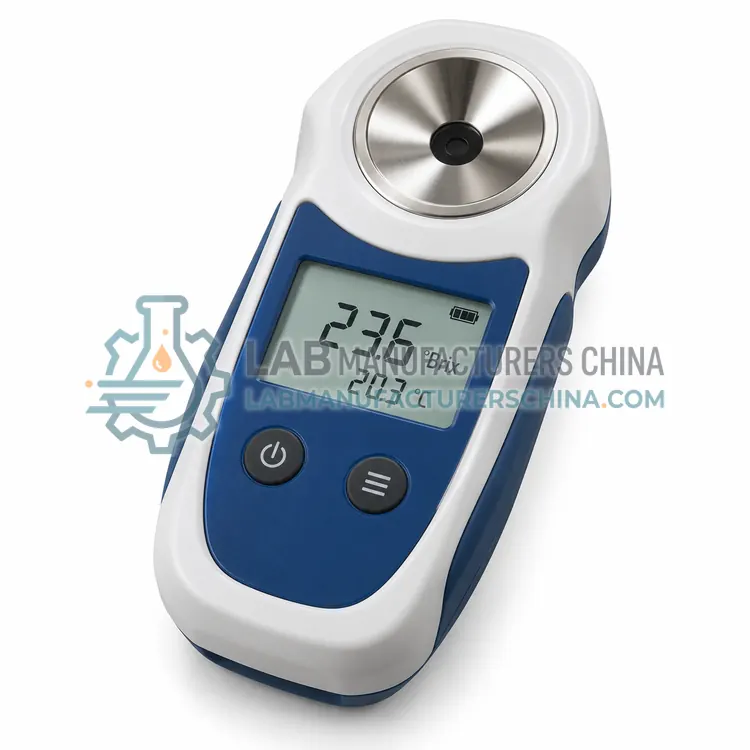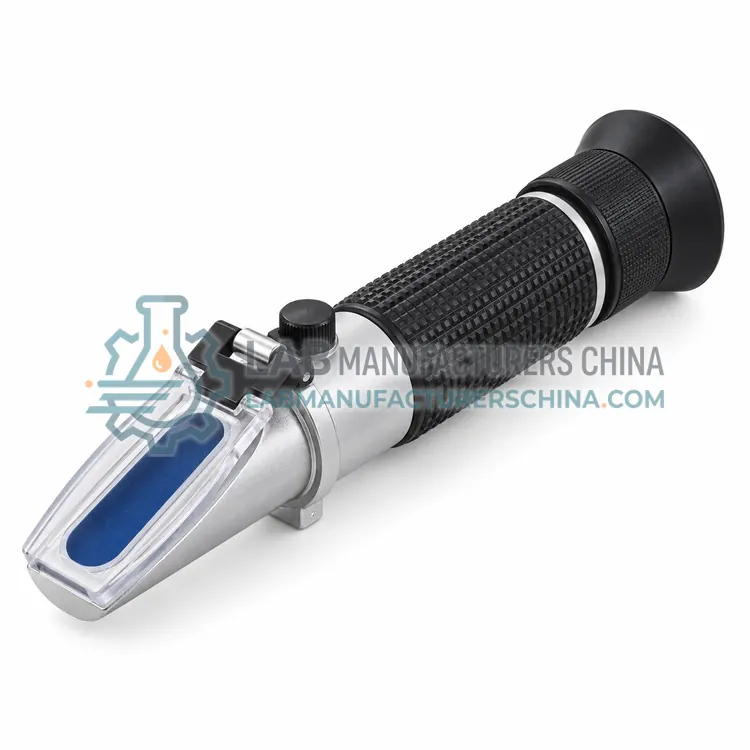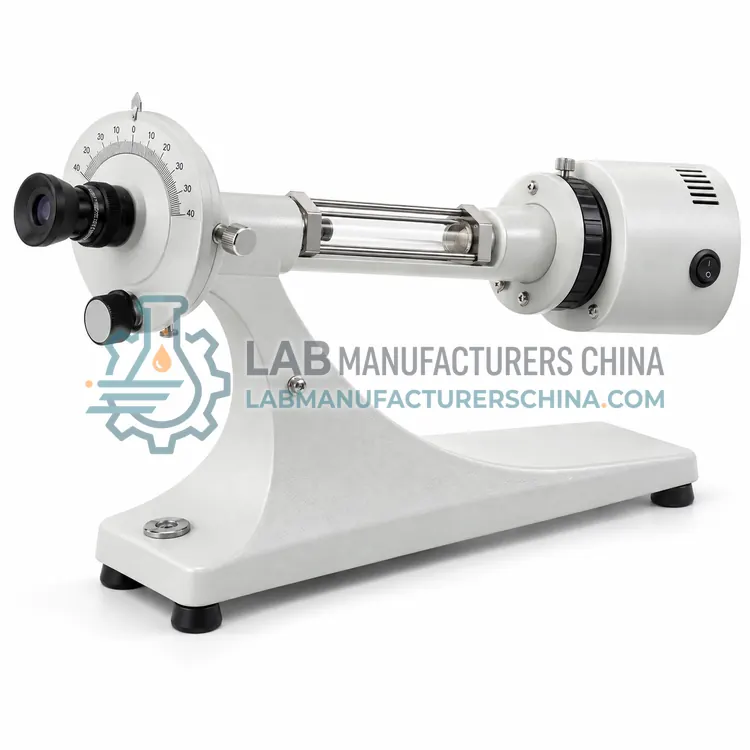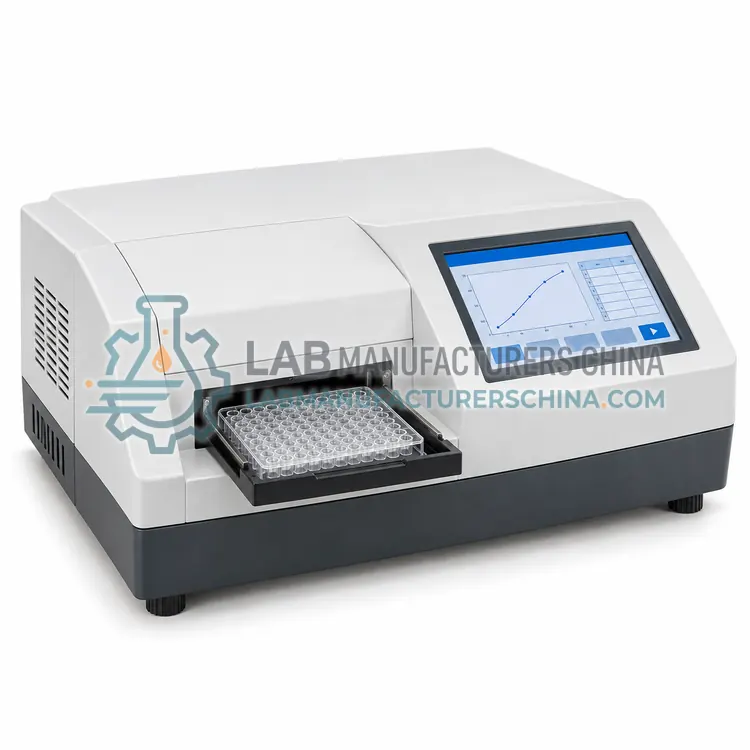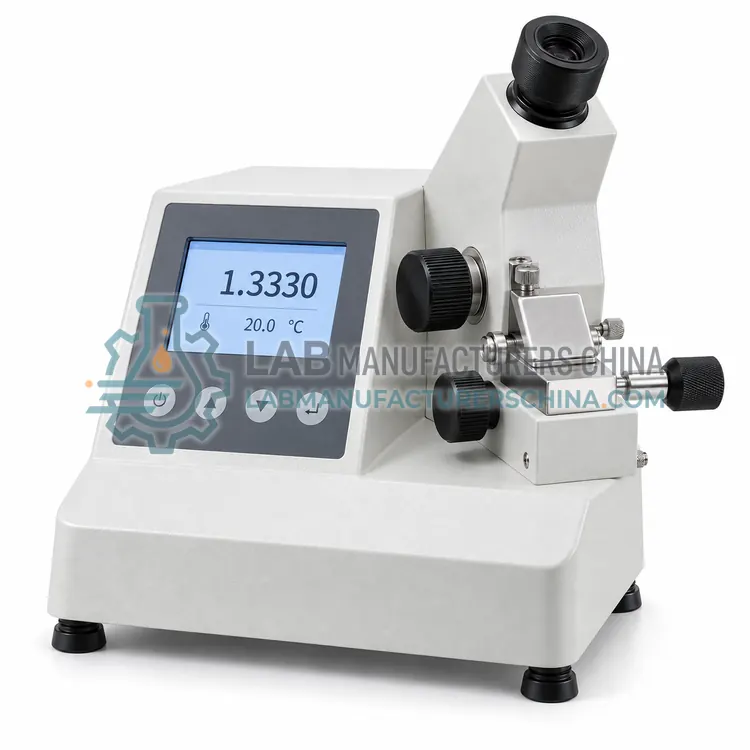
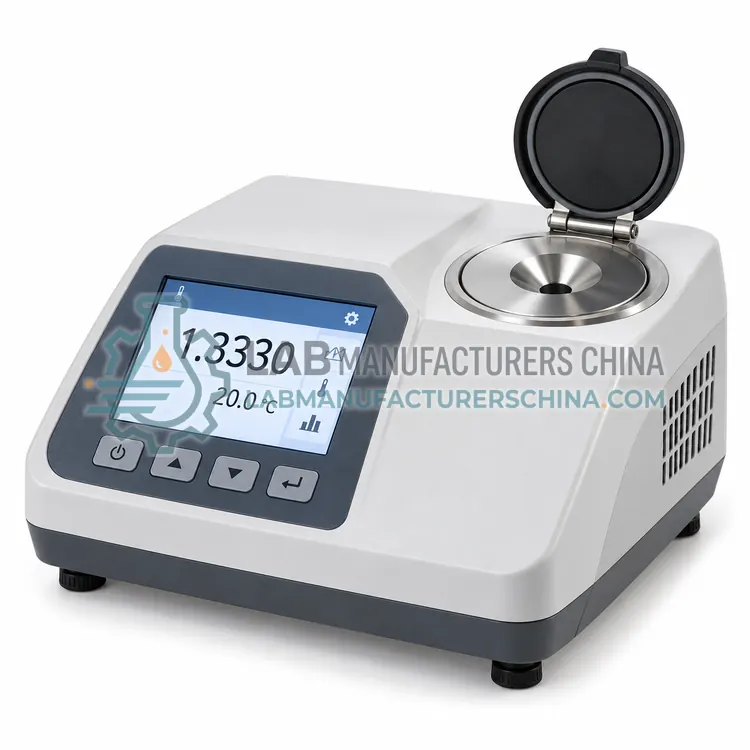
Automatic Peltier Digital Refractometer
自动帕尔贴数字折光仪
- SKU REF-0002
- Refractometers
- CE (to be confirmed)
- ISO 9001 manufacturing (to be confirmed)
Price on request — FOB / CIF quoted per order
Prices depend on configuration, quantity and destination port.
Key specifications
| Refractive index range | 1.3200–1.5800 nD |
|---|---|
| Resolution, nD | 0.00001 |
| Accuracy, nD | ±0.00002 |
| Brix range and accuracy | 0–100 %, ±0.01 % |
| Temperature range | 5–85 °C |
| Temperature stability | ±0.02 °C |
Request a quote Download brochure · to be provided
By Lab Manufacturers China Technical TeamLast reviewed Standards: USP <831>, Ph. Eur. 2.2.6, ASTM D1218
What is the Automatic Peltier Digital Refractometer?
An automatic Peltier digital refractometer measures refractive index with ±0.00002 nD accuracy on a sapphire prism held at a set temperature to ±0.02 °C. It is used for regulated quality control, pharmaceutical raw materials, beverage production and high-throughput testing.
What is the Automatic Peltier Digital Refractometer?
An automatic Peltier digital refractometer measures refractive index with ±0.00002 nD accuracy on a sapphire prism held at a set temperature to ±0.02 °C. It is used for regulated quality control, pharmaceutical raw materials, beverage production and high-throughput testing.
Overview
In an automatic digital refractometer a LED at 589.3 nm illuminates a sapphire prism, and a CCD or photodiode array detects the critical angle position, which is converted to refractive index with no operator interpretation. A Peltier element heats and cools the prism block between 5 and 85 °C and reaches the target temperature within minutes, eliminating the water bath. Sapphire resists scratching and chemical attack, so corrosive and abrasive samples can be measured. Automatic sample recognition, measurement-ready detection and bubble checks improve reproducibility, while a touchscreen provides methods for Brix, sugar inversion, density conversion, alcohol and user-defined scales. Resolution of 0.00001 nD is common. Pharmacopoeial compliance features include audit trails, user levels and electronic signatures. A flow-through cell and autosampler can expand throughput to dozens of samples per hour.
How does it work?
A refractometer determines the refractive index n, the ratio of the speed of light in vacuum to that in the sample, typically at the sodium D line of 589.3 nm. Most analytical designs use the critical angle method: light at a range of incident angles strikes the interface between a high-index prism and the sample, and above the critical angle total internal reflection occurs. The position of the light-dark boundary is observed visually through an eyepiece or detected electronically with a CCD or photodiode array, and converted to refractive index by the instrument. Because refractive index depends on temperature, the prism is thermostatted, commonly to 20 °C, or the reading is compensated by automatic temperature compensation. Conversion tables translate n to Brix, sugar, salt or other concentration scales for defined solutions.
What are the key features?
- Sapphire prism resists scratches and withstands acids, alkalis and solvents.
- Peltier control from 5 to 85 °C holds temperature within ±0.02 °C without a water bath.
- CCD detection eliminates operator judgment of the boundary line.
- Built-in scales include Brix, sugar inversion, alcohol and user-defined conversions.
- Audit trail, user levels and electronic signatures support regulated environments.
- Optional autosampler and flow cell increase throughput to dozens of samples per hour.
What are the technical specifications?
A typical automatic peltier digital refractometer configuration offers refractive index range of 1.3200–1.5800 nD, resolution, nD of 0.00001, accuracy, nD of ±0.00002, brix range and accuracy of 0–100 %, ±0.01 %, temperature range of 5–85 °C and temperature stability of ±0.02 °C. Values are indicative of the product class; the exact figures for each configuration are confirmed on the quotation and the calibration documents supplied with the instrument.
Which applications is it used for?
The Automatic Peltier Digital Refractometer is used in pharmaceutical raw material release testing, beverage and syrup QC, petrochemical and solvent analysis and cosmetics and fragrance quality control. Across the wider Refractometers class, laboratories also deploy it for sugar and Brix measurement in food and beverages, identity and purity of chemicals and solvents and pharmaceutical raw material testing.
Which standards and certifications apply?
Relevant standards and methods include USP <831>, Ph. Eur. 2.2.6, ASTM D1218, ASTM D1747, ISO 5661, OIML R 124 (refractometers for sugar) and GB/T 614. Certification candidates for this model are CE and ISO 9001 manufacturing; each is to be confirmed for the specific configuration before shipment, and certificates are supplied only where they have been issued.
Calibrate with distilled water (nD 1.33299 at 20 °C) and, where needed, certified refractive index standards bracketing the working range. Clean the prism immediately after use with a soft tissue and a suitable solvent, because dried sample can scratch or cloud the surface; sapphire prisms resist scratching better than glass. Keep the instrument away from vibration and direct sunlight. Allow samples to equilibrate to the prism temperature, particularly volatile solvents. Verify temperature sensors on schedule and follow the laboratory calibration procedure. For pharmacopoeial use, confirm adherence to the relevant chapter.
How do I select the right Automatic Peltier Digital Refractometer?
Select the automatic Peltier refractometer for regulated testing, frequent users, or when high accuracy and water-bath-free operation are needed. It is more expensive than Abbe or handheld models. In an RFQ, state the accuracy target, temperature range, prism material, required scales, compliance features such as audit trails, and autosampler needs.
How does it compare with other Refractometers variants?
Decide first whether you need analog or digital readout; digital models remove operator subjectivity and support data logging. Refractive index range and resolution should cover your samples, for example 1.3000–1.7000 nD with 0.0001 resolution for general chemicals, or 0–95 Brix for syrups. Temperature control is decisive: Peltier-controlled prisms give ±0.02 °C and suit regulated testing, while ATC handhelds are adequate for field checks. Consider sample type such as viscous, volatile, opaque or solid, since these affect prism material and sample cell design. For processes, choose an inline sensor with automatic cleaning. Also check available scales, wavelength options, calibration standards and compliance features such as audit trails and pharmacopoeial methods.
Full specifications
| Refractive index range | 1.3200–1.5800 nD |
|---|---|
| Resolution, nD | 0.00001 |
| Accuracy, nD | ±0.00002 |
| Brix range and accuracy | 0–100 %, ±0.01 % |
| Temperature range | 5–85 °C |
| Temperature stability | ±0.02 °C |
| Prism material | Sapphire |
| Wavelength | 589.3 nm (LED) |
| Measurement time | ≈30 s |
| Sample volume | ≈1 mL |
| Display and interface | 7-inch touchscreen, USB, Ethernet, RS-232 |
Indicative values for this product class. Final specifications are confirmed on the quotation and in the calibration documents supplied with the instrument.
Applications
- Pharmaceutical raw material release testing
- Beverage and syrup QC
- Petrochemical and solvent analysis
- Cosmetics and fragrance quality control
Key features
- Sapphire prism resists scratches and withstands acids, alkalis and solvents.
- Peltier control from 5 to 85 °C holds temperature within ±0.02 °C without a water bath.
- CCD detection eliminates operator judgment of the boundary line.
- Built-in scales include Brix, sugar inversion, alcohol and user-defined conversions.
- Audit trail, user levels and electronic signatures support regulated environments.
- Optional autosampler and flow cell increase throughput to dozens of samples per hour.
Frequently asked questions about Automatic Peltier Digital Refractometer
Most models change between 20 °C and 25 °C in a few minutes, and the measurement typically begins when the software detects a stable sample temperature. Heating to 60–85 °C takes longer and depends on sample and prism heat capacity.
Sapphire has a Mohs hardness of 9 and is chemically inert, so it resists scratching and corrosion from acids, alkalis and abrasive samples. Glass prisms are softer and can cloud with aggressive liquids, reducing long-term accuracy.
Yes, if a sample cover or lid limits evaporation and the sample temperature is stabilized before measurement. Highly volatile solvents should be measured rapidly with a cover, and the instrument should be checked against a reference liquid of similar index.
A refractometer measures the refractive index of a sample, a dimensionless number describing how strongly light bends when entering it. Because this value depends on composition, it is used to determine concentration, purity or identity, reported as nD, Brix or other scales.
The refractive index of liquids changes by roughly 0.0001 to 0.0005 per °C, so a 1 °C error causes a measurable concentration error. Precise refractometers thermostat the prism, typically to 20.00 °C, while handhelds use automatic temperature compensation with limited range.
Brix is a scale that expresses the concentration of dissolved sucrose in water as grams per 100 g of solution, derived from refractive index. One degree Brix corresponds to 1 % sucrose by mass, and the scale is also used for other soluble solids.
Related models