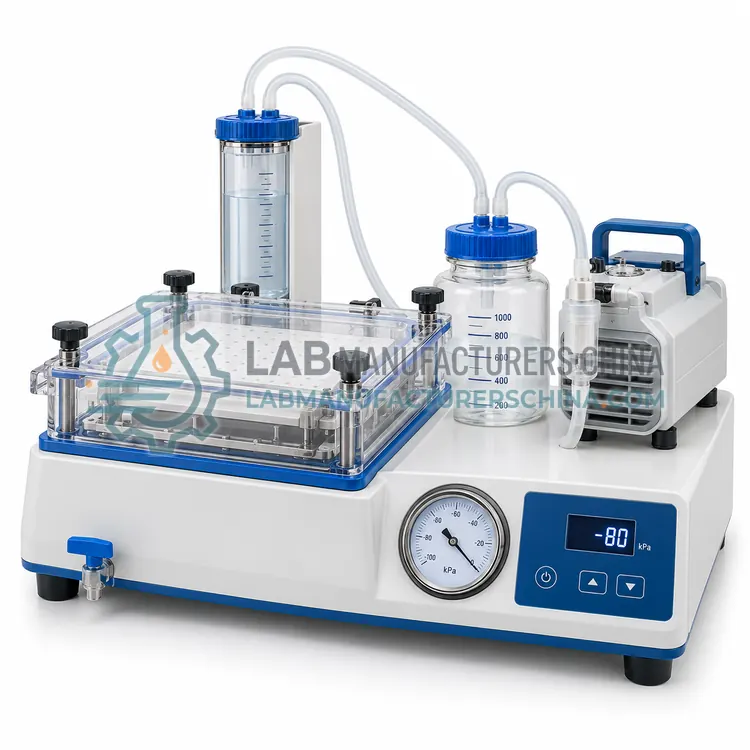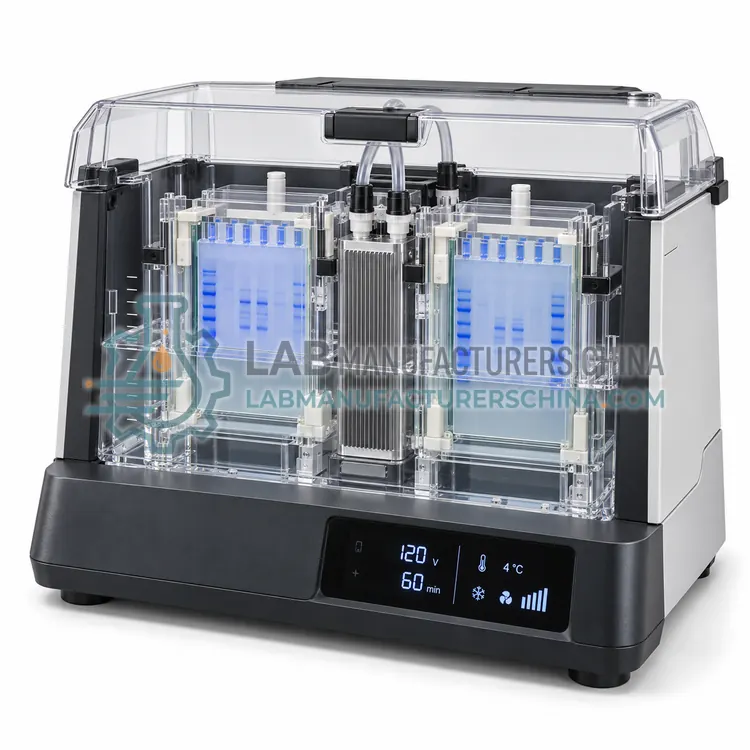
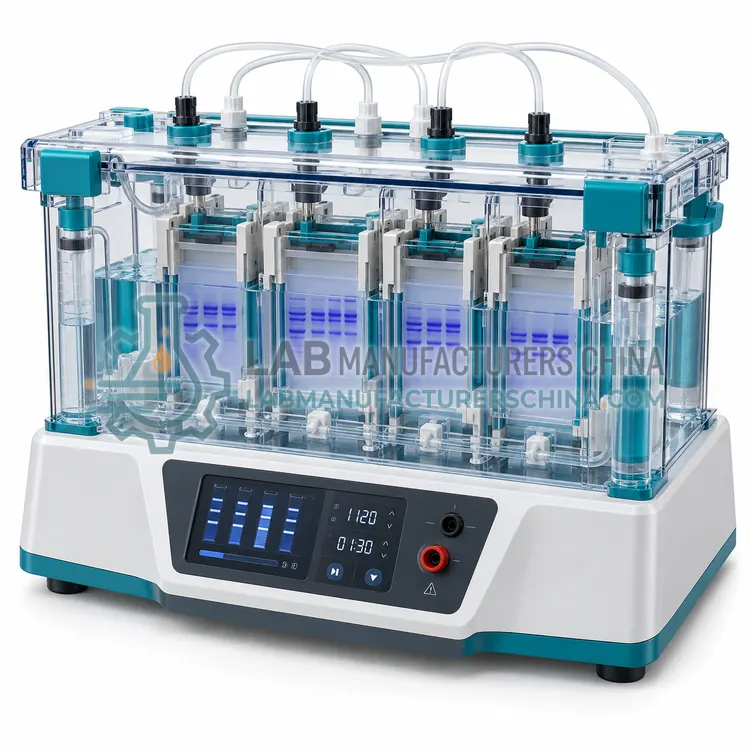
Multichannel Vertical Electrophoresis System
多通道垂直电泳系统
- SKU PRE-0003
- Protein Electrophoresis
- CE (to be confirmed)
- ISO 9001 manufacturing (to be confirmed)
- IEC 61010-1 safety (to be confirmed)
Price on request — FOB / CIF quoted per order
Prices depend on configuration, quantity and destination port.
Key specifications
| Gels per run | 6–12 |
|---|---|
| Gel size | approx. 80 x 100 mm or 100 x 100 mm |
| Gel thickness | 0.75–1.5 mm |
| Maximum voltage | up to 300 V |
| Maximum current | up to 1,000 mA |
| Maximum power | up to 100 W |
Request a quote Download brochure · to be provided
By Lab Manufacturers China Technical TeamLast reviewed Standards: USP <1057>, Ph. Eur. 2.2.31, Ph. Eur. 2.2.34
What is the Multichannel Vertical Electrophoresis System?
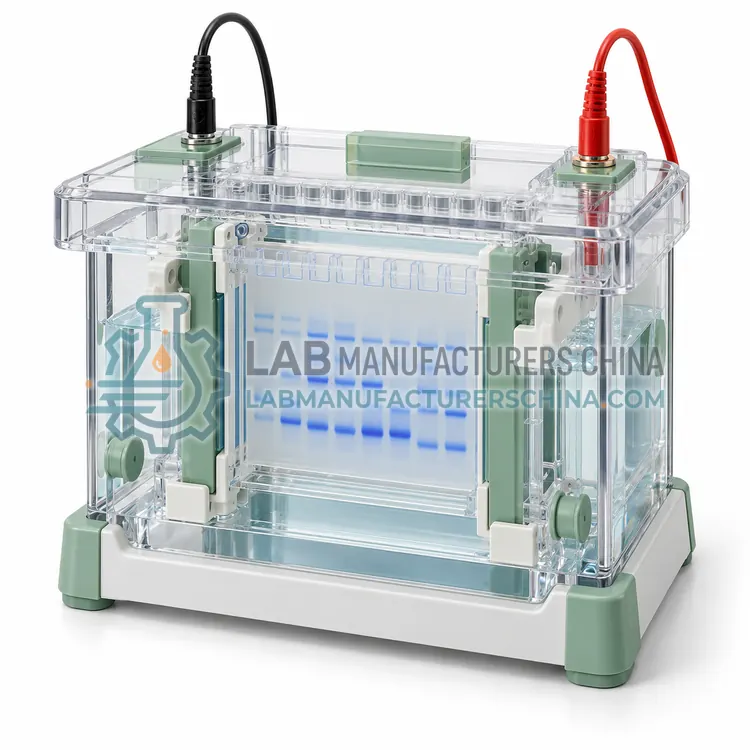
A multichannel vertical system runs 6 to 12 gels in one tank with shared buffer chambers and uniform electrode geometry, screening large sample sets under identical conditions in a single run. It suits process development and high-throughput purity checking.
What is the Multichannel Vertical Electrophoresis System?
A multichannel vertical system runs 6 to 12 gels in one tank with shared buffer chambers and uniform electrode geometry, screening large sample sets under identical conditions in a single run. It suits process development and high-throughput purity checking.
Overview
The tank holds a rack of identical cassettes between two large plate electrodes, so all gels experience the same field strength and buffer composition. Programs typically allow two to four voltage steps, and buffer is recirculated or cooled to prevent a temperature gradient from gel to gel. Because conditions are identical, the format is well suited to side-by-side comparisons such as fermentation time courses, purification fractions or stability panels, where differences between lanes should reflect samples and not the gel. Capacity ranges from 6 to 12 gels of 1 mm thickness, and some tanks accept two different gel sizes in the same run. Buffer consumption is higher than for mini systems, and the rack should be loaded evenly so that current density is uniform across the electrodes.
How does it work?
In SDS-PAGE, the sample is denatured with sodium dodecyl sulfate and a reducing agent so that proteins unfold and acquire a uniform negative charge proportional to their length. When an electric field is applied, all proteins migrate toward the anode, and the polyacrylamide mesh sieves them so that migration distance depends mainly on molecular weight. A discontinuous buffer system with stacking and resolving gel layers concentrates proteins into a sharp band before separation. Isoelectric focusing instead uses a pH gradient and separates proteins according to their isoelectric point, where net charge is zero and migration stops. Two-dimensional electrophoresis combines the two, separating by charge first and by size second, which resolves thousands of protein spots. Capillary systems perform SDS or charge separation in a narrow capillary with on-line absorbance or fluorescence detection, replacing staining with quantitative detection.
What are the key features?
- Runs 6 to 12 identical gels in a single tank
- Plate electrodes giving uniform field across all cassettes
- Buffer recirculation or cooling to limit temperature gradients
- Multi-step voltage programs with timer
- Even rack loading to keep current density uniform
- Compatible with precast and hand-cast cassettes
What are the technical specifications?
A typical multichannel vertical electrophoresis system configuration offers gels per run of 6–12, gel size of approx. 80 x 100 mm or 100 x 100 mm, gel thickness of 0.75–1.5 mm, maximum voltage of up to 300 V, maximum current of up to 1,000 mA and maximum power of up to 100 W. Values are indicative of the product class; the exact figures for each configuration are confirmed on the quotation and the calibration documents supplied with the instrument.
Which applications is it used for?
The Multichannel Vertical Electrophoresis System is used in fermentation and expression time-course monitoring, purification fraction purity screening, formulation and stability panel comparison and high-volume purity determination in quality control. Across the wider Protein Electrophoresis class, laboratories also deploy it for protein purity and molecular weight determination, recombinant protein expression analysis and two-dimensional proteome profiling.
Which standards and certifications apply?
Relevant standards and methods include USP <1057>, Ph. Eur. 2.2.31, Ph. Eur. 2.2.34, IEC 61010-1, ISO 17025 and ISO 15189. Certification candidates for this model are CE, ISO 9001 manufacturing and IEC 61010-1 safety; each is to be confirmed for the specific configuration before shipment, and certificates are supplied only where they have been issued.
Acrylamide is a neurotoxin and suspected carcinogen, so powder handling and gel casting should be performed in a fume hood or with ready-to-use precast gels, and gloves must be worn. Buffer pH and ionic strength affect stacking and resolution, so working buffers should be prepared fresh and not reused excessively. Consistent sample loading, reducing agent freshness and heating time determine how sharp bands appear. Gels should be run within the recommended voltage and current limits, and temperature control matters for high-voltage runs because Joule heating distorts bands. Staining and destaining protocols must be standardised for comparative densitometry, and images used for purity calculations should be captured in the linear range of the camera. Keep records of gel percentage, running conditions and staining for traceability.
How do I select the right Multichannel Vertical Electrophoresis System?
Select a multichannel system when many samples must be compared under identical conditions in one run, which reduces gel-to-gel variation and operator time. Specify gel capacity, supported gel sizes, voltage and power limits, cooling or recirculation requirements and buffer volume.
How does it compare with other Protein Electrophoresis variants?
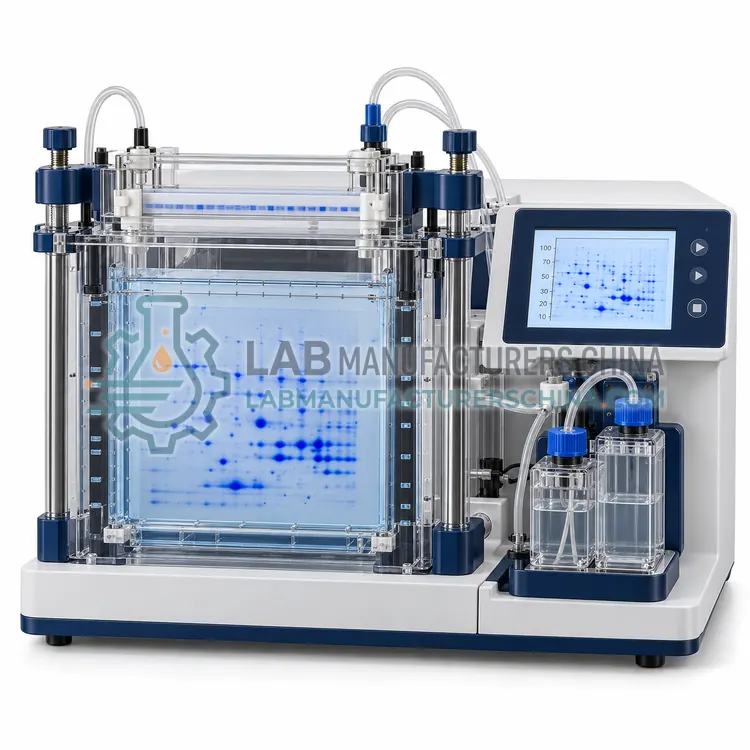
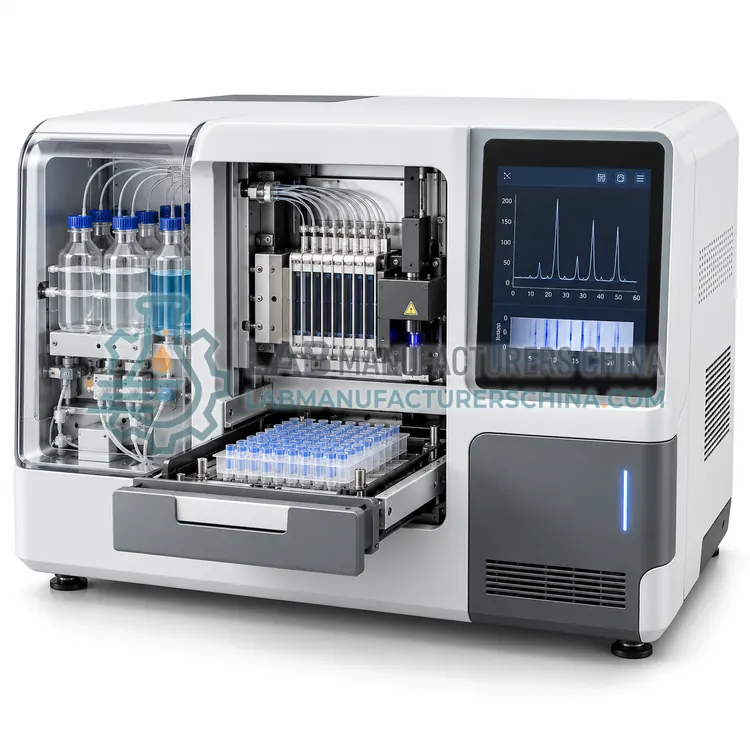
Start with the purpose. For routine purity and molecular weight, a vertical SDS-PAGE system with 1 mm gels and 10–15 wells covers most needs and is inexpensive. Mini systems reduce buffer and sample consumption, run faster and are convenient for immunoblotting, at the cost of lower resolution for closely spaced bands. Multichannel systems process 6 to 12 gels in one tank when screening many samples. Two-dimensional electrophoresis is chosen when complex proteomes must be resolved, and it requires an isoelectric focusing first dimension plus consistent sample preparation. Capillary systems give numerical purity results and are preferred where regulated release testing, low sample volume or full automation is required. Check gel percentage and gradient availability, maximum voltage and current, cooling provisions, glass plate compatibility and whether precast gels are supported.
Full specifications
| Gels per run | 6–12 |
|---|---|
| Gel size | approx. 80 x 100 mm or 100 x 100 mm |
| Gel thickness | 0.75–1.5 mm |
| Maximum voltage | up to 300 V |
| Maximum current | up to 1,000 mA |
| Maximum power | up to 100 W |
| Buffer volume | approx. 3,000–6,000 mL |
| Cooling | Recirculation or external chiller connection |
| Run time | approx. 60–120 min for a full rack |
| Dimensions (W x D x H) | approx. 300 x 250 x 250 mm |
Indicative values for this product class. Final specifications are confirmed on the quotation and in the calibration documents supplied with the instrument.
Applications
- Fermentation and expression time-course monitoring
- Purification fraction purity screening
- Formulation and stability panel comparison
- High-volume purity determination in quality control
Key features
- Runs 6 to 12 identical gels in a single tank
- Plate electrodes giving uniform field across all cassettes
- Buffer recirculation or cooling to limit temperature gradients
- Multi-step voltage programs with timer
- Even rack loading to keep current density uniform
- Compatible with precast and hand-cast cassettes
Frequently asked questions about Multichannel Vertical Electrophoresis System
All gels share the same buffer, temperature and voltage, so differences between lanes reflect samples rather than run conditions. This makes the format useful for time courses and fraction panels where many side-by-side comparisons are needed.
Cooling or buffer recirculation is recommended for full racks at high voltage, because several gels generate substantial heat. Without it, an internal temperature gradient can shift migration rates from the first to the last cassette.
A large tank typically holds 3–6 litres, and buffer should be replaced regularly rather than reused indefinitely. Reuse changes pH and ionic strength, which alters stacking and can slow or distort migration.
SDS binds proteins in proportion to their length and gives them a uniform negative charge, so migration in the gel depends mainly on molecular weight. A stacking gel concentrates the sample into a narrow band before the resolving gel separates the proteins.
Use 15% or gradient gels for proteins below 30 kDa, 12% for 15–80 kDa, 10% for 30–120 kDa and 7.5–8% for proteins above 100 kDa. Gradient gels cover a wide range in one run and are convenient when samples vary.
When a complex mixture such as a cell lysate must be resolved into individual proteins. The first dimension separates by isoelectric point, the second by molecular weight, giving thousands of spots that can be compared between conditions to find differentially expressed proteins.