
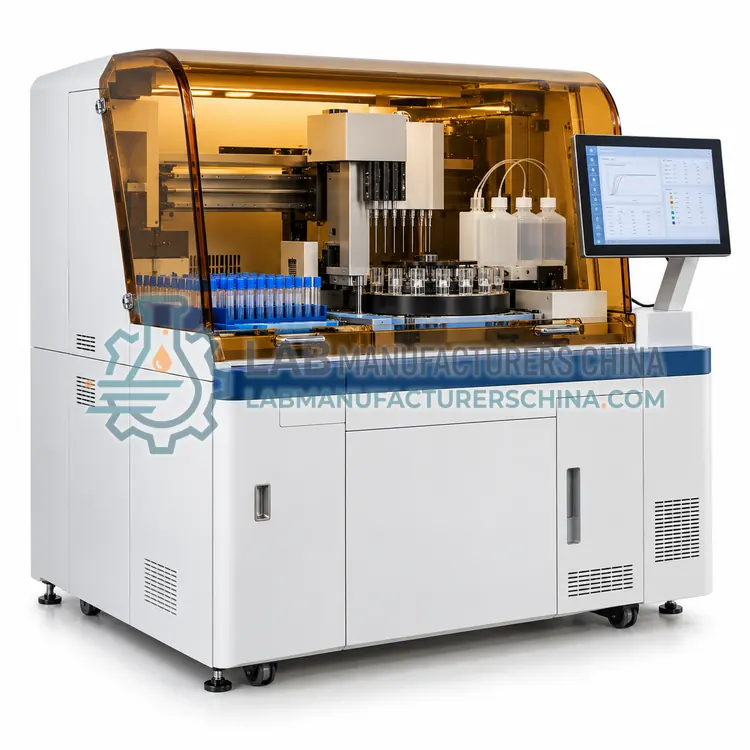
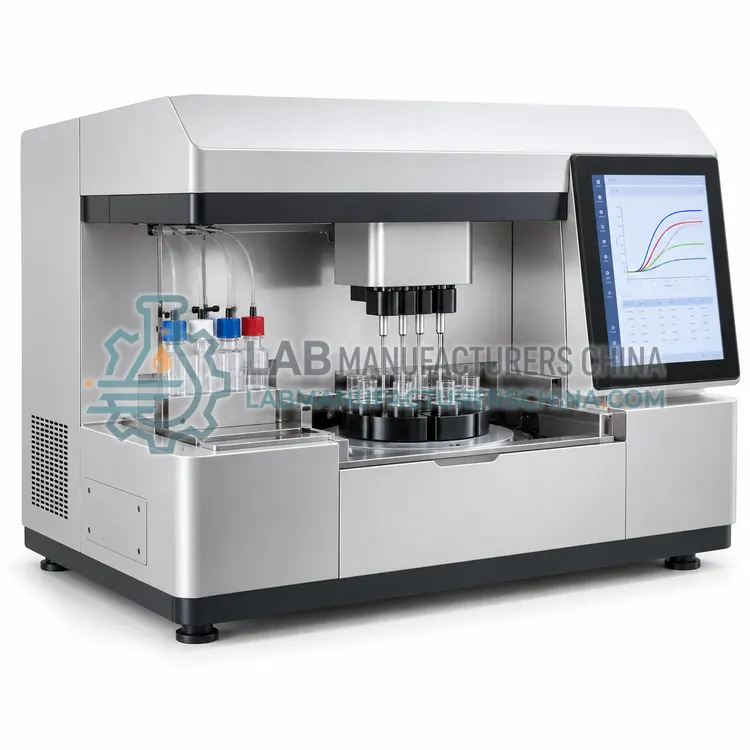
Multi-Channel Platelet Aggregometer
多通道血小板聚集仪
- SKU PLA-0004
- Platelet Analyzers
- CE (to be confirmed)
- ISO 13485 manufacturing (to be confirmed)
- NMPA class II registration (to be confirmed)
Price on request — FOB / CIF quoted per order
Prices depend on configuration, quantity and destination port.
Key specifications
| Channels | 4–8 independent aggregation channels |
|---|---|
| Measurement mode | Light transmission or impedance per channel |
| Temperature | 37 °C ±0.2 °C per channel |
| Stir speed | Adjustable 600–1200 rpm per channel |
| Sample volume | 250–500 µL per channel |
| Throughput | Up to 8 reactions per 6-min run |
Request a quote Download brochure · to be provided
By Lab Manufacturers China Technical TeamLast reviewed Standards: ISO 15189, CLSI H58, CLSI EP05
What is the Multi-Channel Platelet Aggregometer?
A multi-channel aggregometer runs four to eight aggregation reactions in parallel, which allows a full agonist panel and controls on one sample at the same time. It suits laboratories investigating platelet disorders where dose-response curves are needed within the sample stability window.
What is the Multi-Channel Platelet Aggregometer?
A multi-channel aggregometer runs four to eight aggregation reactions in parallel, which allows a full agonist panel and controls on one sample at the same time. It suits laboratories investigating platelet disorders where dose-response curves are needed within the sample stability window.
Overview
Because platelet reactivity falls with time after collection, testing all agonists sequentially on a single-channel instrument risks losing reactivity by the end of the panel. A multi-channel instrument solves this by measuring several agonists, doses and a control concurrently on one sample, so the results are directly comparable and the sample is used within its stability window. Channels are independent, each with its own stirrer, temperature control and detector, and the software records all traces with the same timestamp. Capacity of four to eight channels also supports replicate testing for research and simultaneous testing of a patient and a normal control, which improves interpretation when reference patterns are being established.
How does it work?
Platelet function testing uses two main approaches. In aggregation methods, platelet-rich plasma or whole blood is stirred at 37 degrees Celsius with an agonist such as adenosine diphosphate, collagen, arachidonic acid or ristocetin. In light transmission aggregometry the sample clarifies as platelets clump and the increase in transmitted light is recorded as an aggregation curve. In impedance aggregometry platelets adhere to electrode wires and the rise in electrical impedance between them is recorded. In luminescence aggregometry, ATP released from dense granules reacts with luciferin-luciferase reagent and the emitted light is measured alongside the aggregation trace. In high-shear systems, blood is aspirated through a capillary coated with collagen and adenosine diphosphate or epinephrine, and the time until the aperture occludes is reported as the closure time. All methods depend on controlled temperature, agonist quality and prompt processing of citrated samples.
What are the key features?
- Four to eight independent aggregation channels
- Concurrent agonist panel and control on one sample
- Independent stirrer, temperature control and detector per channel
- Timestamped recording of all traces together
- Replicate testing for research applications
- Simultaneous patient and normal control measurement
What are the technical specifications?
A typical multi-channel platelet aggregometer configuration offers channels of 4–8 independent aggregation channels, measurement mode of Light transmission or impedance per channel, temperature of 37 °C ±0.2 °C per channel, stir speed of Adjustable 600–1200 rpm per channel, sample volume of 250–500 µL per channel and throughput of Up to 8 reactions per 6-min run. Values are indicative of the product class; the exact figures for each configuration are confirmed on the quotation and the calibration documents supplied with the instrument.
Which applications is it used for?
The Multi-Channel Platelet Aggregometer is used in platelet disorder diagnostic panels, dose-response agonist studies, research on antiplatelet drug effects and pediatric platelet function testing with limited sample. Across the wider Platelet Analyzers class, laboratories also deploy it for investigation of inherited platelet disorders, testing for aspirin and P2Y12 inhibitor response and diagnosis of von Willebrand disease with ristocetin.
Which standards and certifications apply?
Relevant standards and methods include ISO 15189, CLSI H58, CLSI EP05, ICSH recommendations on platelet function testing, IEC 61010-1 and IEC 61010-2-101. Certification candidates for this model are CE, ISO 13485 manufacturing and NMPA class II registration; each is to be confirmed for the specific configuration before shipment, and certificates are supplied only where they have been issued.
Collect blood into citrate or hirudin as specified, avoid traumatic venepuncture and process samples within one to four hours, because platelet reactivity declines with time. Keep the aggregometer at 37 degrees Celsius, verify the temperature with an external thermometer and ensure the stir bar rotates at the specified speed. Reagents must be reconstituted and stored exactly as instructed, since degraded agonists give falsely low aggregation. Verify performance with normal control samples and review curves for shape and amplitude, not only the maximum value. Low platelet counts, hemolysis, lipemia and certain drugs affect results, so medication history should be documented before testing.
How do I select the right Multi-Channel Platelet Aggregometer?
Specify a multi-channel instrument when a full agonist panel must be completed on one sample within the stability window, or when patient and control samples are compared in the same run. In the RFQ confirm channel independence, whether measurement modes can be mixed, and the software's ability to align traces by timestamp for comparison.
How does it compare with other Platelet Analyzers variants?
Choose the method according to the clinical question. Light transmission aggregometry is the classical approach and allows a full agonist panel, while impedance aggregometry accepts whole blood and is less affected by low platelet counts and lipemia. Luminescence aggregometry adds dense granule storage pool assessment. High-shear closure time systems are simple to operate and useful for screening and for monitoring antiplatelet therapy, but they give limited mechanistic information. Consider sample volume, which matters for pediatric patients, the number of channels available per run, and the reagent or agonist supply. Confirm whether your laboratory can maintain proficiency in interpretation, because aggregation curves require experience, and take part in external quality assessment where a scheme exists.
Full specifications
| Channels | 4–8 independent aggregation channels |
|---|---|
| Measurement mode | Light transmission or impedance per channel |
| Temperature | 37 °C ±0.2 °C per channel |
| Stir speed | Adjustable 600–1200 rpm per channel |
| Sample volume | 250–500 µL per channel |
| Throughput | Up to 8 reactions per 6-min run |
| Data storage | 1,000 multi-channel records |
| Interfaces | USB, LAN with export to analysis software |
| Power supply | AC 100–240 V, 50/60 Hz |
Indicative values for this product class. Final specifications are confirmed on the quotation and in the calibration documents supplied with the instrument.
Applications
- Platelet disorder diagnostic panels
- Dose-response agonist studies
- Research on antiplatelet drug effects
- Pediatric platelet function testing with limited sample
Key features
- Four to eight independent aggregation channels
- Concurrent agonist panel and control on one sample
- Independent stirrer, temperature control and detector per channel
- Timestamped recording of all traces together
- Replicate testing for research applications
- Simultaneous patient and normal control measurement
Frequently asked questions about Multi-Channel Platelet Aggregometer
Yes, each channel needs its own aliquot of plasma or whole blood, so a four-channel run consumes four times the per-channel volume. This must be planned for pediatric patients, where a reduced agonist panel may be more appropriate than a full panel.
Some instruments allow optical and impedance channels to coexist, which is useful for comparing methods or for samples unsuitable for optical measurement. Confirm the configuration before purchase, since mixing modes may require separate reference ranges.
Running patient and control samples simultaneously removes the effect of reagent and temperature drift between runs, and completing the agonist panel on one sample avoids the loss of reactivity that occurs over time. The result is a more internally consistent data set for diagnosis.
Each channel needs the same routine as a single-channel instrument: cuvette and stirrer cleaning, temperature verification and optical or electrode checks. Maintenance is usually performed channel by channel, and the laboratory should record which channel was serviced to trace irregularities.
It measures the increase in light transmitted through stirred platelet-rich plasma as platelets aggregate in response to an agonist. The resulting curve shows the rate, extent and reversibility of aggregation for each agonist, and comparison with normal patterns supports the diagnosis of specific platelet disorders.
Common agonists are adenosine diphosphate to assess P2Y12 and P2Y1 receptors, arachidonic acid to assess the cyclooxygenase pathway, collagen for the glycoprotein VI pathway, ristocetin for von Willebrand factor and glycoprotein Ib, and epinephrine or thrombin receptor peptide for additional receptor studies.
Collect blood with minimal stasis into citrate or, for some assays, hirudin, keep it at room temperature and test within one to four hours. Do not refrigerate, shake vigorously or delay processing, because platelet activation and disaggregation change the curves and can make interpretation unreliable.
Related models
Fully Automated Coagulation Analyzer with Cap-Piercing Autoloader
带穿刺开盖进样器的全自动凝血分析仪
- CE (to be confirmed)
- +2