X-ray Fluorescence Spectrometer for Mineral Assay
矿石化验 X 射线荧光光谱仪
- SKU MIA-0003
- Mineral Analysis
- CE (to be confirmed)
- ISO 9001 manufacturing (to be confirmed)
Price on request — FOB / CIF quoted per order
Prices depend on configuration, quantity and destination port.
Key specifications
| Element range | Na to U with vacuum or helium path |
|---|---|
| Concentration range | From about 1 mg/kg to 100 % |
| X-ray tube power | 1–4 kW |
| Detector | Flow proportional and scintillation, or SDD |
| Sample format | Pressed pellet or fused bead, 32–40 mm |
| Measurement time | 2–10 min per sample |
Request a quote Download brochure · to be provided
By Lab Manufacturers China Technical TeamLast reviewed Standards: ISO 9516-1, ISO 11535, ISO 3082
What is the X-ray Fluorescence Spectrometer for Mineral Assay?
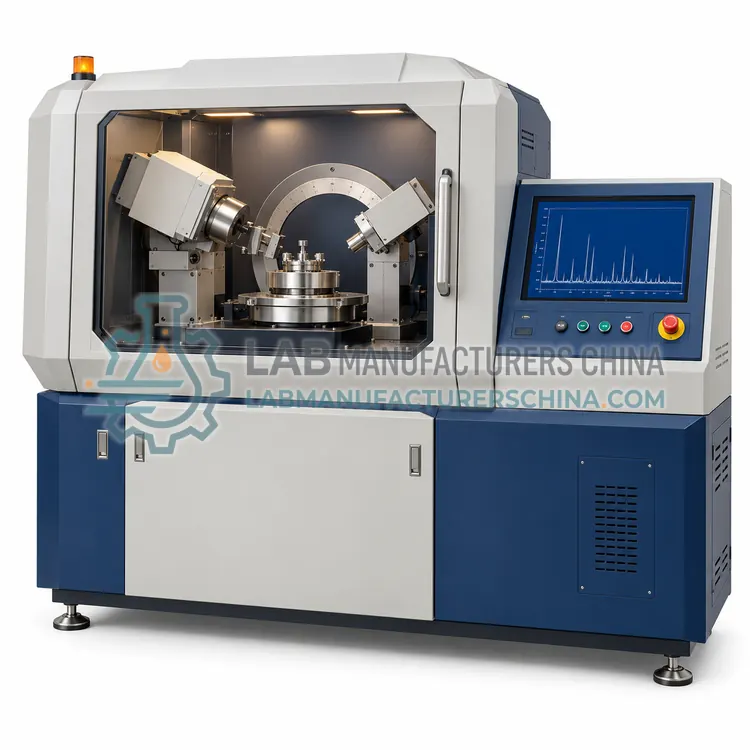
An X-ray fluorescence spectrometer determines element concentrations in ores, concentrates and tailings from pressed powders or fused beads, covering major and trace elements in one measurement. It is the workhorse of mineral assay.
What is the X-ray Fluorescence Spectrometer for Mineral Assay?
An X-ray fluorescence spectrometer determines element concentrations in ores, concentrates and tailings from pressed powders or fused beads, covering major and trace elements in one measurement. It is the workhorse of mineral assay.
Overview
The instrument irradiates a prepared sample with X-rays from a rhodium or similar tube, exciting characteristic fluorescence from each element. Wavelength-dispersive spectrometers use analysing crystals and detectors to resolve lines precisely and handle light elements well; energy-dispersive types use a semiconductor detector and give faster, more compact results. Pressed powders with a binder are quick and suit control work, while fusion in a lithium borate flux dissolves the sample and removes particle size and mineralogical effects, improving accuracy for major oxides and allowing the loss on ignition to be measured. Calibration uses certified reference ores and concentrates and covers the element range and matrix of the deposit, because mineralogy affects the relationship between intensity and concentration. Results are reported as oxides or elements and converted to the reporting basis your specification requires.
How does it work?
Each technique answers a different question. X-ray diffraction measures the angles at which a crystalline sample diffracts a monochromatic beam; lattice spacings follow Bragg's law, and the resulting pattern identifies phases, with peak intensities refined to give approximate weight fractions. Automated mineralogy combines a scanning electron microscope with energy-dispersive spectrometry, acquiring element maps of polished sections and converting them into mineral classifications, from which abundance, grain size, association and liberation are calculated. X-ray fluorescence excites a pressed or fused sample and measures the fluorescent radiation of each element, giving concentrations from major to trace levels after matrix correction. Density separation compares a sample's behaviour in a liquid of known specific gravity, which indicates mineral composition and washability. Magnetic separation tests quantify the fraction that is recoverable by magnetic separation, which matters for magnetite ores and for removing iron-bearing gangue.
What are the key features?
- Rhodium X-ray tube with analysing crystals or semiconductor detector
- Pressed powder and fused bead sample handling
- Multi-element reporting including penalty elements
- Loss on ignition calculated from fusion data
- Calibration from certified ore and concentrate standards
- Vacuum or helium path for light elements
What are the technical specifications?
A typical x-ray fluorescence spectrometer for mineral assay configuration offers element range of Na to U with vacuum or helium path, concentration range of From about 1 mg/kg to 100 %, X-ray tube power of 1–4 kW, detector of Flow proportional and scintillation, or SDD, sample format of Pressed pellet or fused bead, 32–40 mm and measurement time of 2–10 min per sample. Values are indicative of the product class; the exact figures for each configuration are confirmed on the quotation and the calibration documents supplied with the instrument.
Which applications is it used for?
The X-ray Fluorescence Spectrometer for Mineral Assay is used in ore, concentrate and tailings assay, penalty element and gangue oxide reporting, control analysis for plant and mine laboratories and feed preparation for metallurgical accounting. Across the wider Mineral Analysis class, laboratories also deploy it for ore and concentrate phase identification, elemental assay including penalty elements and mineral liberation and texture analysis.
Which standards and certifications apply?
Relevant standards and methods include ISO 9516-1, ISO 11535, ISO 3082, ASTM E877, ISO 13320 and IEC 61010-1. Certification candidates for this model are CE and ISO 9001 manufacturing; each is to be confirmed for the specific configuration before shipment, and certificates are supplied only where they have been issued.
Sample preparation dominates data quality in mineral analysis. Diffraction needs a fine, randomly oriented powder, so back-loading, side-loading or spray drying is used to avoid preferred orientation, and grinding must not alter soft phases. X-ray fluorescence needs consistent particle size, binder and pressing pressure, or fused beads prepared with a suitable flux; calibration is then built from certified reference materials that bracket the sample range. Automated mineralogy relies on well-polished, carbon-coated sections and on a mineral list and classification rules that match the deposit, so the scheme should be documented and validated against assay data. Heavy liquids used in density separation are hazardous and need fume extraction, splash protection and safe disposal. Instruments require stable power, temperature control and regular performance checks with reference standards.
How do I select the right X-ray Fluorescence Spectrometer for Mineral Assay?
Select the XRF spectrometer when multi-element concentrations are needed at high throughput, and decide between wavelength and energy dispersive designs by your light element and precision requirements. Specify calibration standards, sample preparation equipment and reporting needs.
How does it compare with other Mineral Analysis variants?
Choose the technique by the question, not by habit. Bulk element concentrations, including penalty elements, are best determined by X-ray fluorescence with pressed powders for speed or fused beads for accuracy. Phase identification and quantification require X-ray diffraction, which is also used to follow alteration and to check grinding products for unwanted phases. Where the texture matters, that is, how grains are associated and how well the valuable mineral is liberated, automated mineralogy is the appropriate tool, since bulk assays cannot reveal locking. Physical tests such as density separation and magnetic separation are used to predict processing behaviour and to build washability or recovery curves. Laboratories often combine techniques: X-ray diffraction to identify what is present, X-ray fluorescence to quantify elements, and automated mineralogy to explain why a flotation or magnetic separation result was achieved.
Full specifications
| Element range | Na to U with vacuum or helium path |
|---|---|
| Concentration range | From about 1 mg/kg to 100 % |
| X-ray tube power | 1–4 kW |
| Detector | Flow proportional and scintillation, or SDD |
| Sample format | Pressed pellet or fused bead, 32–40 mm |
| Measurement time | 2–10 min per sample |
| Repeatability | About 0.1–1 % relative for major elements |
| Sample changer | Up to 20 positions |
Indicative values for this product class. Final specifications are confirmed on the quotation and in the calibration documents supplied with the instrument.
Applications
- Ore, concentrate and tailings assay
- Penalty element and gangue oxide reporting
- Control analysis for plant and mine laboratories
- Feed preparation for metallurgical accounting
Key features
- Rhodium X-ray tube with analysing crystals or semiconductor detector
- Pressed powder and fused bead sample handling
- Multi-element reporting including penalty elements
- Loss on ignition calculated from fusion data
- Calibration from certified ore and concentrate standards
- Vacuum or helium path for light elements
Frequently asked questions about X-ray Fluorescence Spectrometer for Mineral Assay
Pressed powders are faster and adequate for many control analyses, while fused beads remove particle size and mineralogical effects and give better accuracy for major oxides and for samples whose mineralogy varies widely.
The relation between fluorescence intensity and concentration depends on the matrix, and ore mineralogy varies between deposits. Calibrations built on standards similar to the samples being analysed keep bias small for major and penalty elements.
Sodium, magnesium and aluminium fluorescence is strongly absorbed by air, so the beam path is evacuated or flushed with helium, and thin-window detectors plus careful sample preparation are used to obtain reliable results.
X-ray diffraction identifies crystalline phases directly from their diffraction pattern. Automated mineralogy identifies and maps minerals from element data on polished sections, and is preferred when grain size, association and liberation also need to be measured.
An assay reports element concentrations in the sample, such as percent copper or grams per tonne gold. Mineralogy reports which minerals are present, in what proportion, at what grain size and how they are associated, which explains processing behaviour.
Fusion dissolves the sample in a borate flux to form a homogeneous glass, which removes particle size and mineralogical effects and reduces matrix differences between samples and calibration standards, improving accuracy for major elements.
Related models