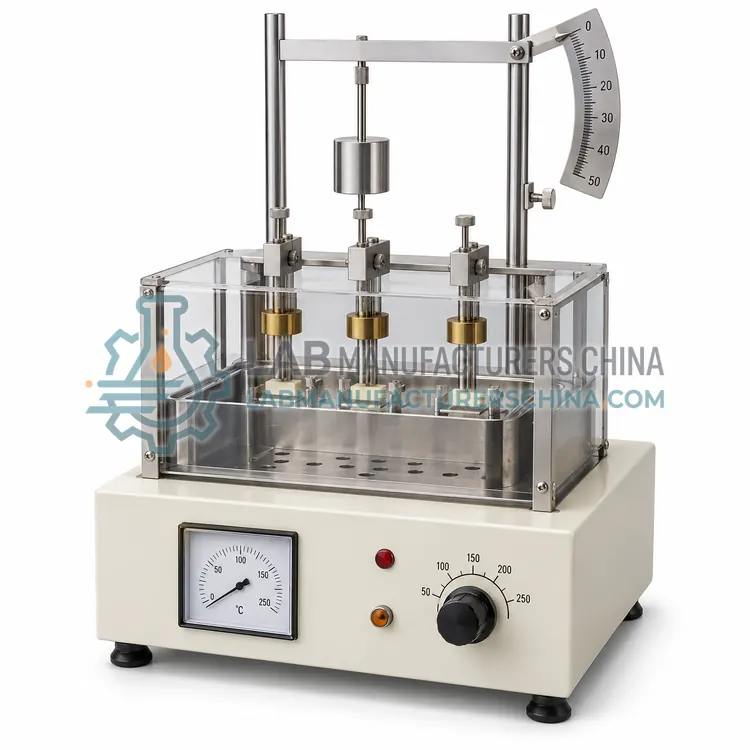
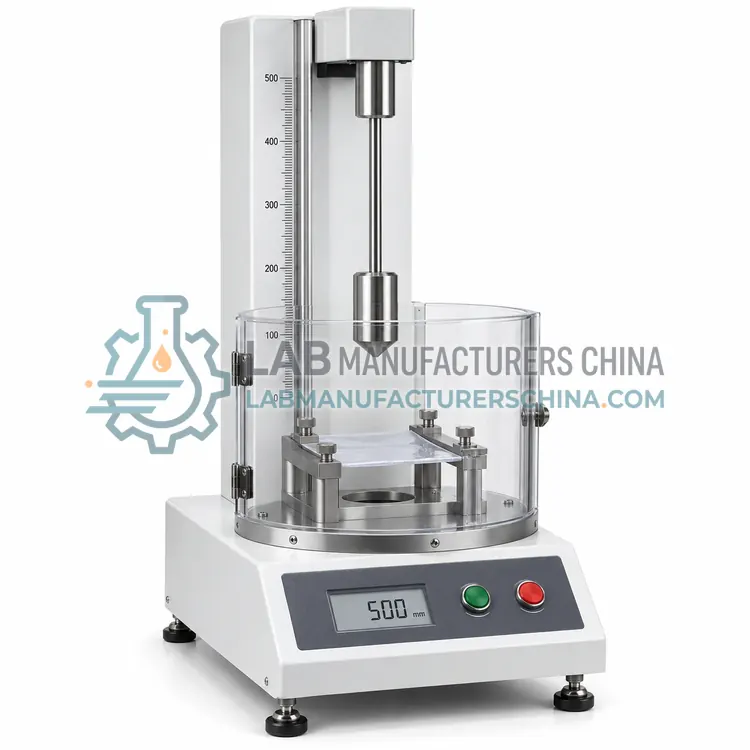
Falling Dart Impact Tester for Plastic Film
塑料薄膜落镖冲击试验机
- SKU IMA-0004
- Impact Analysis
- CE (to be confirmed)
- ISO 9001 manufacturing (to be confirmed)
Price on request — FOB / CIF quoted per order
Prices depend on configuration, quantity and destination port.
Key specifications
| Drop height | 0.66 m (ASTM D1709 method A) |
|---|---|
| Dart head diameter | 38 mm hemispherical typical |
| Dart mass range | 5–100 g with weight increments |
| Film thickness range | Up to 1 mm |
| Aperture diameter | 125 mm |
| Result output | Mass for 50% failure and impact energy |
Request a quote Download brochure · to be provided
By Lab Manufacturers China Technical TeamLast reviewed Standards: ISO 179-1, ISO 180, ISO 6603-2
What is the Falling Dart Impact Tester for Plastic Film?
A falling dart impact tester drops a weighted dart onto a clamped plastic film and determines the energy that causes 50% of specimens to fail. It is the standard method for film toughness and is used for packaging and agricultural film development.
What is the Falling Dart Impact Tester for Plastic Film?
A falling dart impact tester drops a weighted dart onto a clamped plastic film and determines the energy that causes 50% of specimens to fail. It is the standard method for film toughness and is used for packaging and agricultural film development.
Overview
A film specimen is clamped over a circular aperture, and a dart with a defined hemispherical or gothic head is released from a fixed height so that its kinetic energy is set by the mass. The test proceeds by the staircase method: depending on whether the specimen fails, the dart mass is increased or decreased by a fixed increment, and the sequence of failures and non-failures gives the mass for 50% failure, which is converted to impact energy. Temperature and humidity conditioning are specified, because polyethylene films become markedly more brittle when cold, and the film must be free of handling creases. The method is sensitive to film gauge, orientation and additive content, so specimens are taken from defined positions across the web.
How does it work?
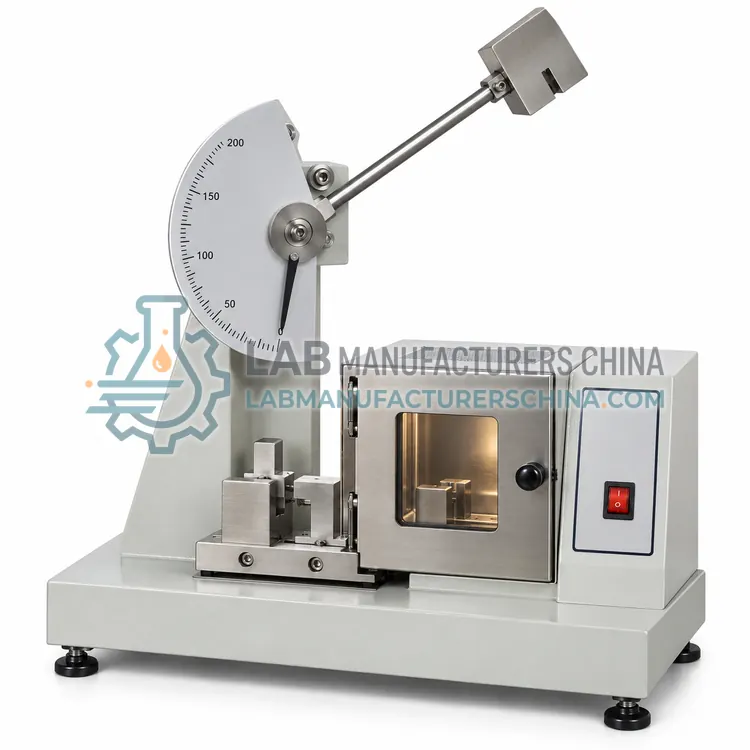
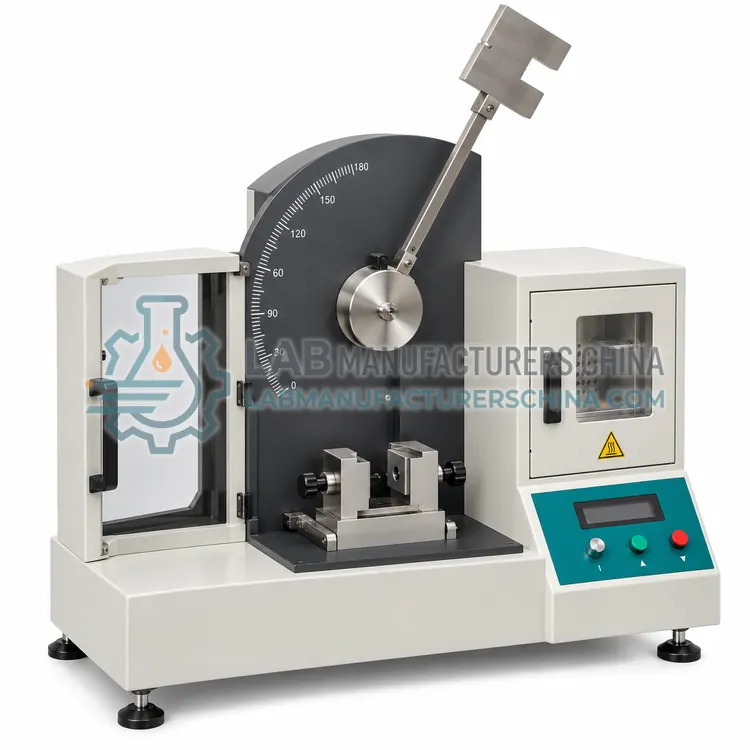
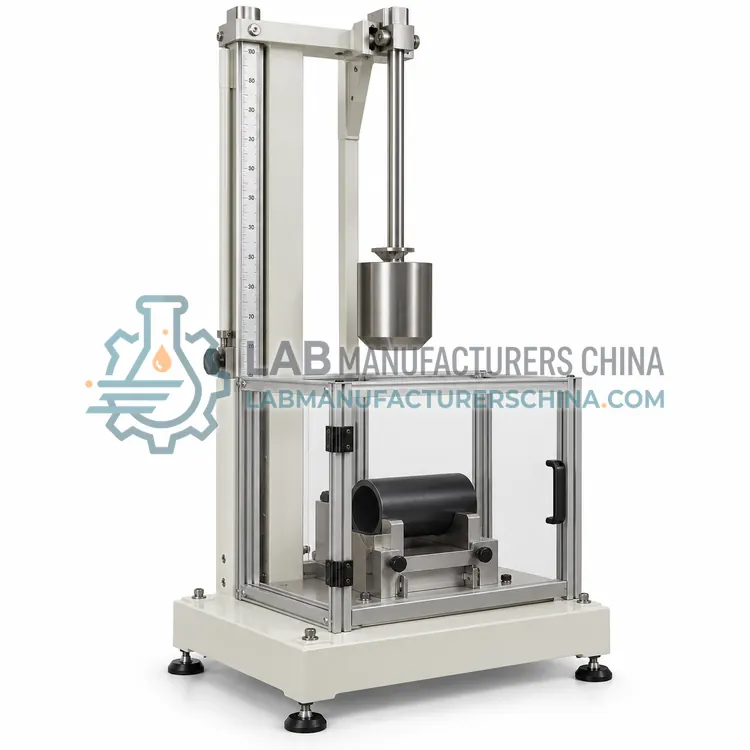
Impact tests apply a defined energy in a very short time, so the material responds in a brittle or semi-brittle manner that differs from slow tensile behaviour. Pendulum instruments release a weighted hammer from a fixed angle; the hammer strikes a supported or cantilevered specimen and the energy absorbed is calculated from the difference between release and follow-through angles, or measured directly by an encoder. Instrumented hammers add a strain-gauge striker that records force against time, so crack initiation and propagation energies can be separated. Drop weight and dart methods use a falling mass: a dart striking a clamped film gives the energy for 50% failure, while a tup striking a pipe section assesses resistance to external damage. Specimen geometry, notch radius, support span and conditioning temperature all control the result.
What are the key features?
- Interchangeable dart heads and incremental weights
- Pneumatic film clamping without slippage
- Staircase method evaluation software
- Fixed drop height for defined kinetic energy
- Temperature and humidity conditioning guidance
- Specimen location mapping across the web
What are the technical specifications?
A typical falling dart impact tester for plastic film configuration offers drop height of 0.66 m (ASTM D1709 method A), dart head diameter of 38 mm hemispherical typical, dart mass range of 5–100 g with weight increments, film thickness range of Up to 1 mm, aperture diameter of 125 mm and result output of Mass for 50% failure and impact energy. Values are indicative of the product class; the exact figures for each configuration are confirmed on the quotation and the calibration documents supplied with the instrument.
Which applications is it used for?
The Falling Dart Impact Tester for Plastic Film is used in polyethylene packaging film toughness, agricultural and greenhouse film evaluation, film grade comparison for converters and incoming film verification in packaging plants. Across the wider Impact Analysis class, laboratories also deploy it for impact strength qualification of moulding grades, notch sensitivity comparison between formulations and low-temperature toughness testing.
Which standards and certifications apply?
Relevant standards and methods include ISO 179-1, ISO 180, ISO 6603-2, ISO 8256, ASTM D256, ASTM D6110, ASTM D1709, ASTM D2444 and IEC 61010-1. Certification candidates for this model are CE and ISO 9001 manufacturing; each is to be confirmed for the specific configuration before shipment, and certificates are supplied only where they have been issued.
Cut specimens with the notch in the specified orientation, because anisotropy from moulding flow changes the result substantially; use a motorised notch cutter and verify the notch radius with a profile gauge. Condition specimens at 23 °C and 50% relative humidity, or in a bath at the test temperature when low-temperature toughness is measured, and transfer them to the machine quickly. Verify the pendulum by releasing it without a specimen, confirm that friction losses stay within the standard limit, and check the blade and supports for wear or damage. Report the specimen type, notch geometry, hammer energy and observed failure mode together with the numerical result.
How do I select the right Falling Dart Impact Tester for Plastic Film?
Specify a dart tester when the material is film or thin sheet, since film cannot be evaluated by a pendulum method. Confirm the dart head geometry and available mass range against the standard you follow, and check that the equipment records the full staircase sequence so that the calculation can be audited. Low-temperature conditioning is advisable for agricultural and packaging applications.
How does it compare with other Impact Analysis variants?
Select the method named in your material or product specification, because results are not interchangeable between geometries. Izod suits rigid moulding materials and is common in resin specifications, while Charpy is preferred for plate, sheet and weld evaluation and is more widely used in Europe. Instrumented hammers are chosen when the failure mode itself must be studied rather than only the absorbed energy. Falling dart testing applies to films and thin sheets where a pendulum cannot hold the specimen, and falling weight testing applies to pipes, fittings and thick sections. For any of these, specify the energy range, specimen conditioning options, notch-cutting equipment and whether low-temperature conditioning is required.
Full specifications
| Drop height | 0.66 m (ASTM D1709 method A) |
|---|---|
| Dart head diameter | 38 mm hemispherical typical |
| Dart mass range | 5–100 g with weight increments |
| Film thickness range | Up to 1 mm |
| Aperture diameter | 125 mm |
| Result output | Mass for 50% failure and impact energy |
| Clamping | Pneumatic ring clamp |
| Conditioning | 23 °C, 50% RH per ISO 291 |
| Power supply | 220 V, 50/60 Hz |
Indicative values for this product class. Final specifications are confirmed on the quotation and in the calibration documents supplied with the instrument.
Applications
- Polyethylene packaging film toughness
- Agricultural and greenhouse film evaluation
- Film grade comparison for converters
- Incoming film verification in packaging plants
Key features
- Interchangeable dart heads and incremental weights
- Pneumatic film clamping without slippage
- Staircase method evaluation software
- Fixed drop height for defined kinetic energy
- Temperature and humidity conditioning guidance
- Specimen location mapping across the web
Frequently asked questions about Falling Dart Impact Tester for Plastic Film
A fixed mass increment is defined, and after each test the mass is reduced if the specimen failed and increased if it did not. The sequence of failures and survivals across at least twenty specimens is evaluated by a standard statistical procedure to give the mass at which half the specimens would fail.
Blown and cast films have different properties along and across the machine direction, and tear and impact resistance depend on the orientation of the molecular chains. Specimens should be identified by their direction, and results from specimens cut in different directions should not be pooled in one average.
Scatter usually comes from gauge variation across the film, creases or handling damage, incomplete clamping, or a mass increment that is too coarse. Sampling from the same position on several rolls and using the increments specified in the method normally brings the scatter within the expected range.
In both tests a pendulum breaks a notched specimen, but the specimen support differs. The Izod specimen is held as a vertical cantilever with the notch facing the striker, while the Charpy specimen is supported horizontally at both ends and struck in the middle. Notch geometry and specimen dimensions also differ, so results are not directly comparable.
A sharper notch concentrates stress over a smaller volume, so it promotes brittle fracture and lowers the measured energy. Standards define types with different radii, for example 0.25 mm and 1 mm, and results obtained with different notch types must not be compared or mixed in one specification.
Below the ductile-to-brittle transition temperature the absorbed energy falls sharply, so a value measured at 23 °C does not describe cold-weather performance. Low-temperature testing uses a conditioning bath and immediate transfer to the machine, and the specimen temperature should be reported together with the result.
Related models