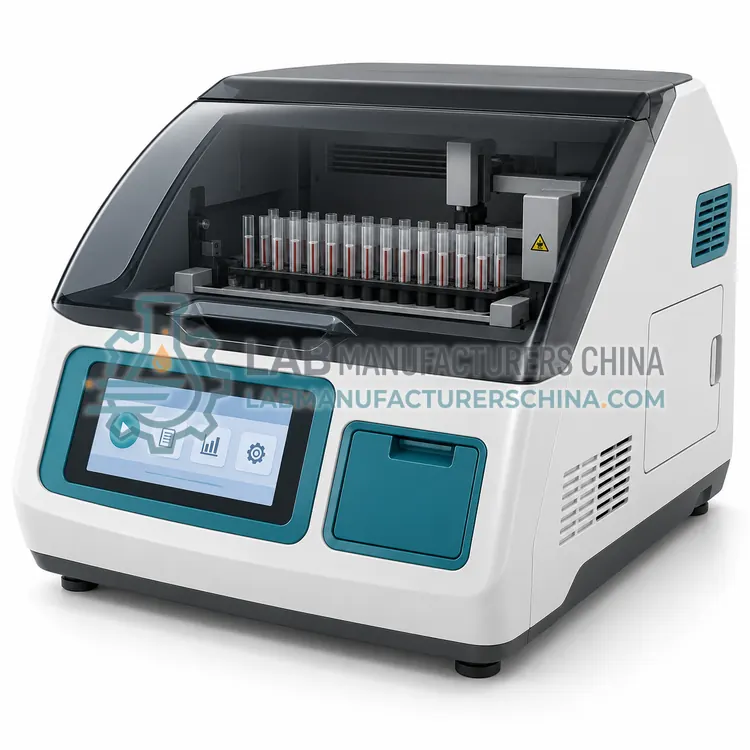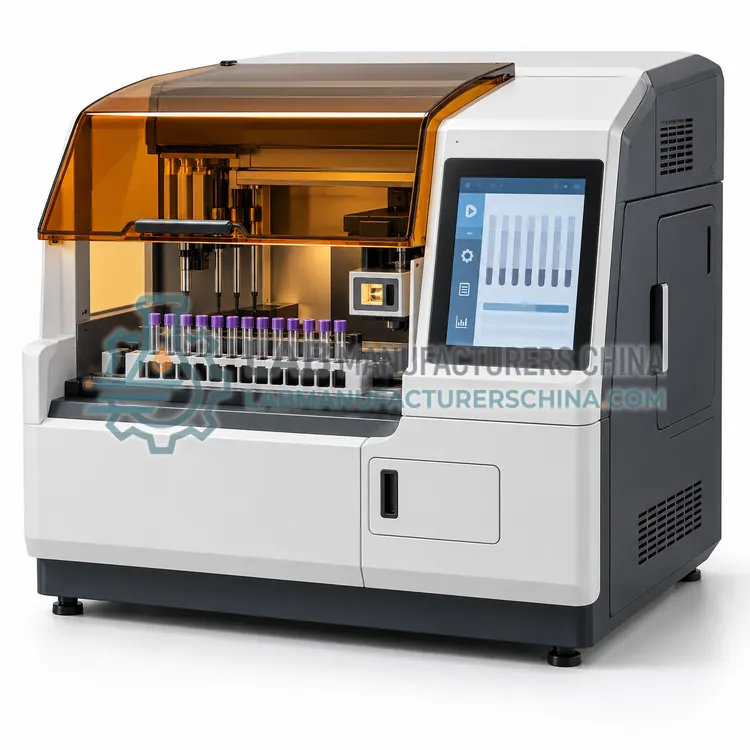
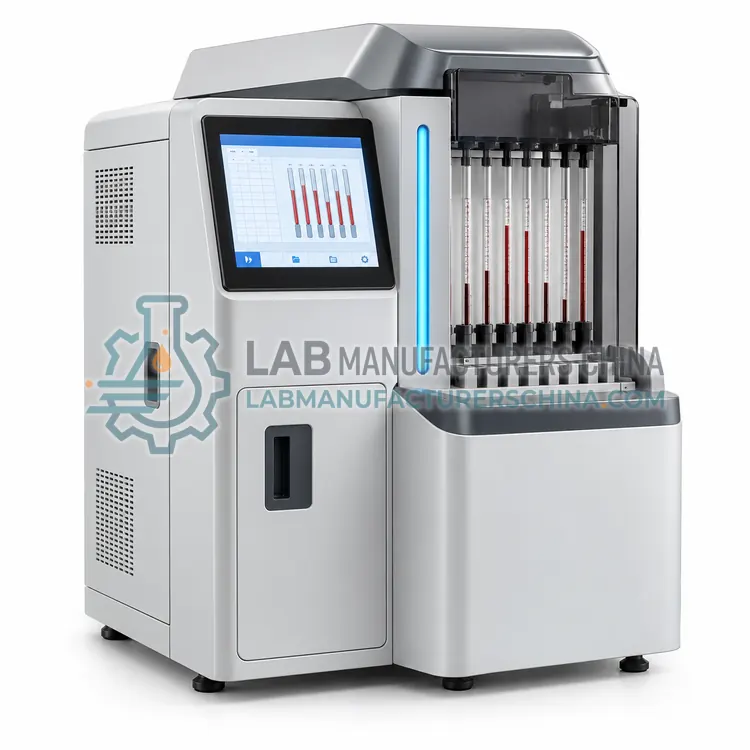
Semi-Automated Westergren ESR System
半自动 Westergren 血沉系统
- SKU ESA-0003
- ESR Analyzers
- CE (to be confirmed)
- ISO 13485 manufacturing (to be confirmed)
- NMPA class II registration (to be confirmed)
Price on request — FOB / CIF quoted per order
Prices depend on configuration, quantity and destination port.
Key specifications
| Method | Westergren reference method, 1 h settling |
|---|---|
| Throughput | 20–40 tubes/h |
| Tube type | Standard Westergren tubes, 200 mm |
| Sample volume | About 1 mL diluted blood per tube |
| Measuring range | 0–150 mm/h |
| Temperature control | 18–25 °C ±1 °C controlled rack |
Request a quote Download brochure · to be provided
By Lab Manufacturers China Technical TeamLast reviewed Standards: ISO 15189, ICSH ESR reference method, CLSI H02
What is the Semi-Automated Westergren ESR System?
A semi-automated Westergren system uses the reference Westergren tubes and the classical one-hour settling principle, with optical reading of the plasma column and software calculation of the result. It suits laboratories that must preserve the reference method for accreditation or clinical reasons.
What is the Semi-Automated Westergren ESR System?
A semi-automated Westergren system uses the reference Westergren tubes and the classical one-hour settling principle, with optical reading of the plasma column and software calculation of the result. It suits laboratories that must preserve the reference method for accreditation or clinical reasons.
Overview
The technician fills a standard Westergren tube or a citrate or EDTA tube to the mark, places it in a vertical rack that is temperature controlled at 18 to 25 degrees Celsius, and starts the run. After the settling period, or continuously, an optical reader measures the height of the clear plasma column against a scale and the software converts it to millimeters per hour. Because the tube geometry matches the reference method, no extrapolation is needed and results are directly comparable with published reference intervals. Manual steps remain: tube filling, mixing and loading, so throughput is moderate at 20 to 40 tubes per hour and operator technique affects precision. The system is often chosen where regulatory documents list the Westergren method explicitly.
How does it work?
When anticoagulated blood stands in a vertical tube, red cells aggregate and settle, leaving a column of clear plasma above them. The height of that plasma column after one hour, expressed in millimeters, is the Westergren sedimentation rate. Aggregation is promoted by fibrinogen and globulins, so an elevated rate indicates an acute phase response even though the test is not specific for any diagnosis. Automated instruments reproduce this process with capillary tubes held vertically at a controlled temperature, usually 18 to 25 degrees Celsius, and track the falling interface with an array of photodiodes or an infrared sensor. Because the settling curve is nonlinear, algorithms extrapolate a one-hour value from a shorter measurement period, and the algorithms are validated against the Westergren reference method. Some instruments read standard Westergren tubes with a barcode instead of using capillary tubes.
What are the key features?
- Standard Westergren tube geometry matching the reference method
- Optical reading of the plasma column with automatic calculation
- Temperature-controlled vertical rack at 18 to 25 °C
- Barcode or label identification of each tube position
- No extrapolation, so published reference intervals apply directly
- Manual sample filling and mixing with clear procedural steps
What are the technical specifications?
A typical semi-automated westergren esr system configuration offers method of Westergren reference method, 1 h settling, throughput of 20–40 tubes/h, tube type of Standard Westergren tubes, 200 mm, sample volume of About 1 mL diluted blood per tube, measuring range of 0–150 mm/h and temperature control of 18–25 °C ±1 °C controlled rack. Values are indicative of the product class; the exact figures for each configuration are confirmed on the quotation and the calibration documents supplied with the instrument.
Which applications is it used for?
The Semi-Automated Westergren ESR System is used in laboratories requiring the reference Westergren method, clinical research with protocol-specified ESR, low to moderate outpatient ESR demand and backup method when automated analyzers are unavailable. Across the wider ESR Analyzers class, laboratories also deploy it for screening for inflammatory and infectious disease, follow-up of rheumatoid arthritis and vasculitis and monitoring of polymyalgia rheumatica and giant cell arteritis.
Which standards and certifications apply?
Relevant standards and methods include ISO 15189, ICSH ESR reference method, CLSI H02, CLSI EP05, IEC 61010-1 and IEC 61010-2-101. Certification candidates for this model are CE, ISO 13485 manufacturing and NMPA class II registration; each is to be confirmed for the specific configuration before shipment, and certificates are supplied only where they have been issued.
Place the analyzer on a stable surface free of vibration, because any movement disturbs the settling interface, and keep it away from direct sunlight and heat sources so that the measuring position stays within the specified temperature range. Verify performance at installation against the Westergren reference method on at least forty samples spanning normal and elevated values, and repeat the comparison after major service. Run control material at the recommended frequency, usually daily when samples are reported, and keep the optical windows, tubes and holders clean. Use only the specified capillary or Westergren tubes, since tube bore and cleanliness affect the result, and treat all blood samples and used tubes as infectious waste.
How do I select the right Semi-Automated Westergren ESR System?
Choose this system when the Westergren method must be maintained, when protocol documents specify it, or when only a few ESR tests are performed each day. In the RFQ confirm the tube specification, whether the rack is temperature controlled, how results are transferred to the LIS, and the training required for consistent tube filling. Ask for the verification protocol used to compare the optical reading with visual reading.
How does it compare with other ESR Analyzers variants?
Choose an ESR analyzer when the test is requested often enough that manual Westergren tubes consume unacceptable technician time, generally more than ten to twenty tests per day. Compare instruments by throughput, sample volume, tube type and the temperature control of the measuring position. Capillary photometry models accept small volumes and suit pediatric work, while instruments reading standard Westergren tubes may be preferred where the reference method must be preserved for accreditation. Check whether the analyzer needs a dedicated blood collection tube or can use an EDTA or citrate tube already collected, and whether mixing is automatic. Confirm quality control material availability, calibration or verification procedure, and biosafety features such as closed tube handling.
Full specifications
| Method | Westergren reference method, 1 h settling |
|---|---|
| Throughput | 20–40 tubes/h |
| Tube type | Standard Westergren tubes, 200 mm |
| Sample volume | About 1 mL diluted blood per tube |
| Measuring range | 0–150 mm/h |
| Temperature control | 18–25 °C ±1 °C controlled rack |
| Reading | Optical scanner over the rack or manual scale |
| Data storage | 5,000 results with time stamps |
| Power supply | AC 100–240 V, 50/60 Hz |
Indicative values for this product class. Final specifications are confirmed on the quotation and in the calibration documents supplied with the instrument.
Applications
- Laboratories requiring the reference Westergren method
- Clinical research with protocol-specified ESR
- Low to moderate outpatient ESR demand
- Backup method when automated analyzers are unavailable
Key features
- Standard Westergren tube geometry matching the reference method
- Optical reading of the plasma column with automatic calculation
- Temperature-controlled vertical rack at 18 to 25 °C
- Barcode or label identification of each tube position
- No extrapolation, so published reference intervals apply directly
- Manual sample filling and mixing with clear procedural steps
Frequently asked questions about Semi-Automated Westergren ESR System
Some accreditation schemes, research protocols and clinical guidelines specify the Westergren method, and reference intervals in the literature derive from it. Using the reference method avoids the need to validate a conversion algorithm and keeps results directly comparable with historical records and publications.
Incomplete mixing before filling, incorrect fill volume, air bubbles in the column, tilting or vibration of the rack, and delay before reading are the most common. Each changes the sedimentation result, so written procedures, regular competency assessment and immediate reading at the end of the settling period are essential.
Many racks support barcode labels, so the tube is identified when it is placed and the result is assigned automatically. Barcode identification reduces transcription errors and supports direct transfer to the laboratory information system, which is especially useful when several tubes are read in one session.
An elevated sedimentation rate indicates an acute phase response and is associated with infection, inflammation, autoimmune disease, some malignancies and tissue damage. It is a nonspecific test, so results are interpreted with the clinical picture, with other acute phase markers such as C-reactive protein, and with serial measurements in the same patient.
Automated analyzers are calibrated to give results comparable with the Westergren reference method, and suppliers usually report correlation coefficients above 0.9 with acceptable bias. Laboratories must still verify the comparison locally, especially in the normal range where reporting differences influence clinical decisions, and document the results.
Many automated instruments use EDTA whole blood collected for the blood count, while others require a dedicated capillary or citrate tube. Westergren reference tubes are read directly by some analyzers. Tube bore, fill volume and anticoagulant all influence the result, so use only the tubes specified by the manufacturer.
Related models