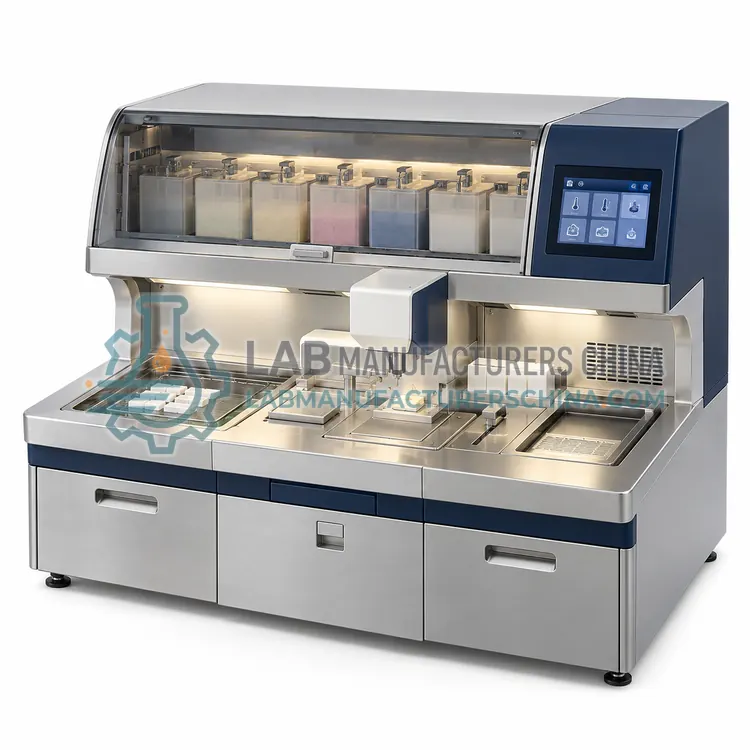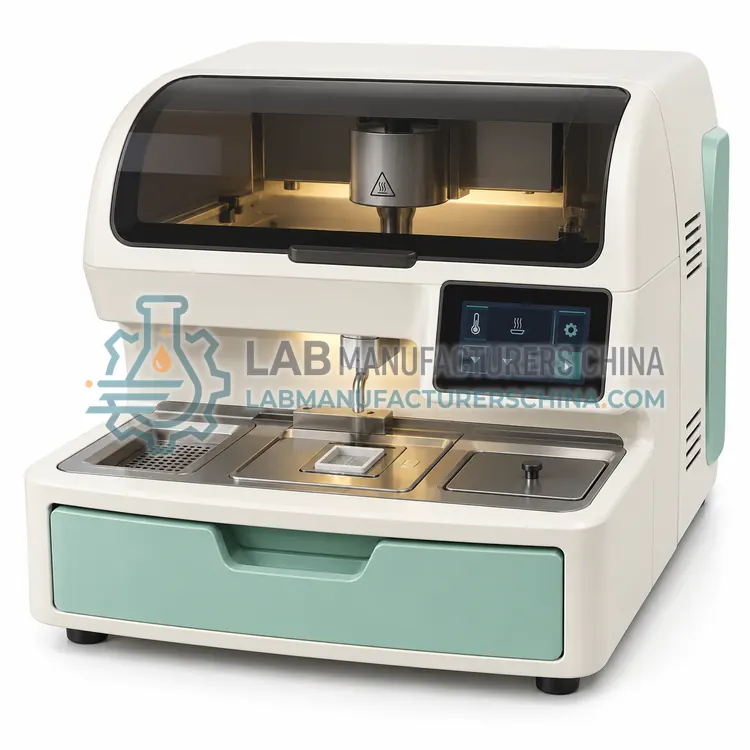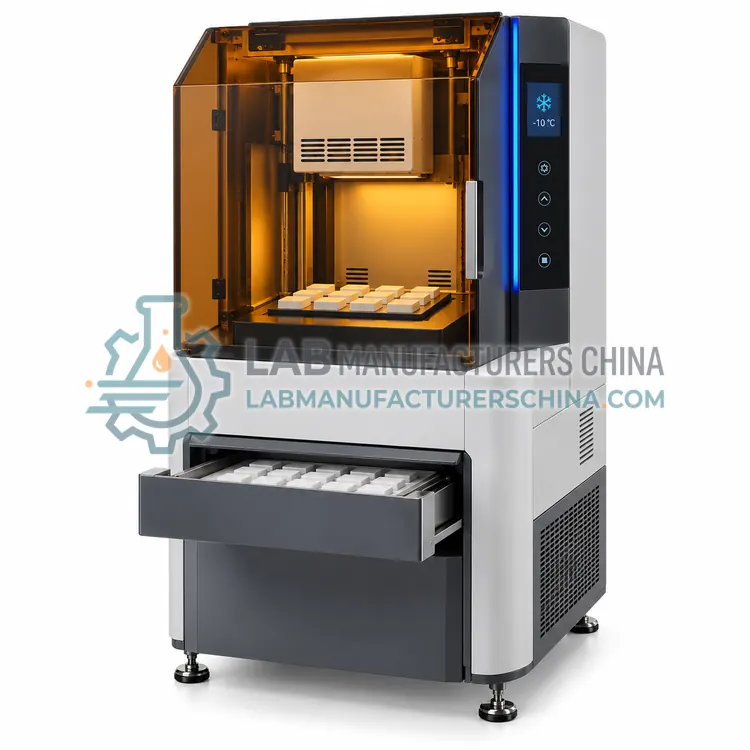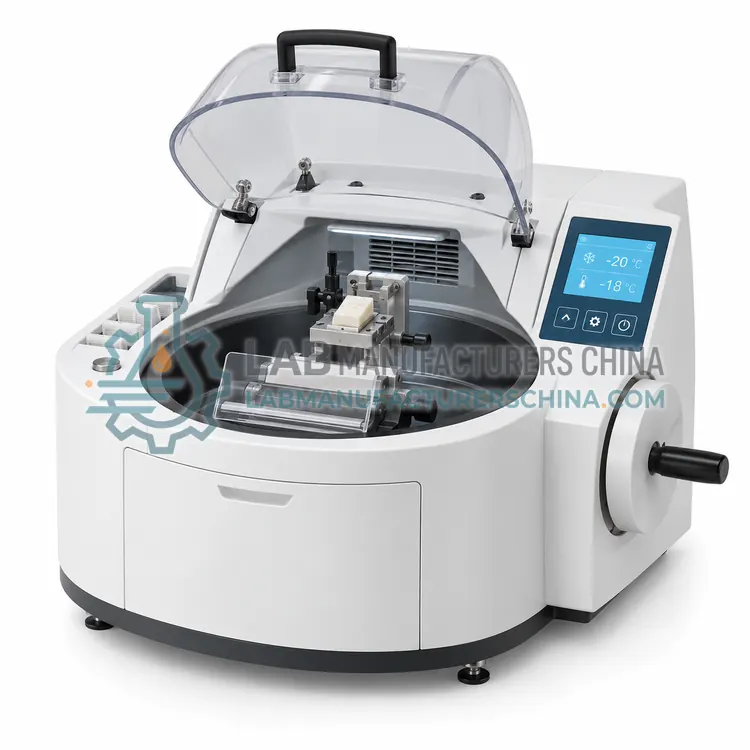
Combined Paraffin Embedding Station
组合式石蜡包埋机
- SKU EMS-0001
- Embedding Stations
- CE (to be confirmed)
- IEC 61010-1 compliance (to be confirmed)
- ISO 13485 manufacturing (to be confirmed)
Price on request — FOB / CIF quoted per order
Prices depend on configuration, quantity and destination port.
Key specifications
| Paraffin tank volume | 3–5 L |
|---|---|
| Paraffin temperature | Ambient to 75 °C |
| Work area temperature | Ambient to 75 °C |
| Cold plate temperature | –5 to 5 °C |
| Cold plate capacity | 20–40 molds |
| Cassette tray capacity | 100–150 cassettes |
Request a quote Download brochure · to be provided
By Lab Manufacturers China Technical TeamLast reviewed Standards: IEC 61010-1, IEC 61010-2-010, IEC 61326-1
What is the Combined Paraffin Embedding Station?
A combined paraffin embedding station integrates a heated dispenser, work area, forceps warmer and cold plate in one unit. It fits small to medium histology laboratories that embed a few hundred blocks per day with one operator.
What is the Combined Paraffin Embedding Station?
A combined paraffin embedding station integrates a heated dispenser, work area, forceps warmer and cold plate in one unit. It fits small to medium histology laboratories that embed a few hundred blocks per day with one operator.
Overview
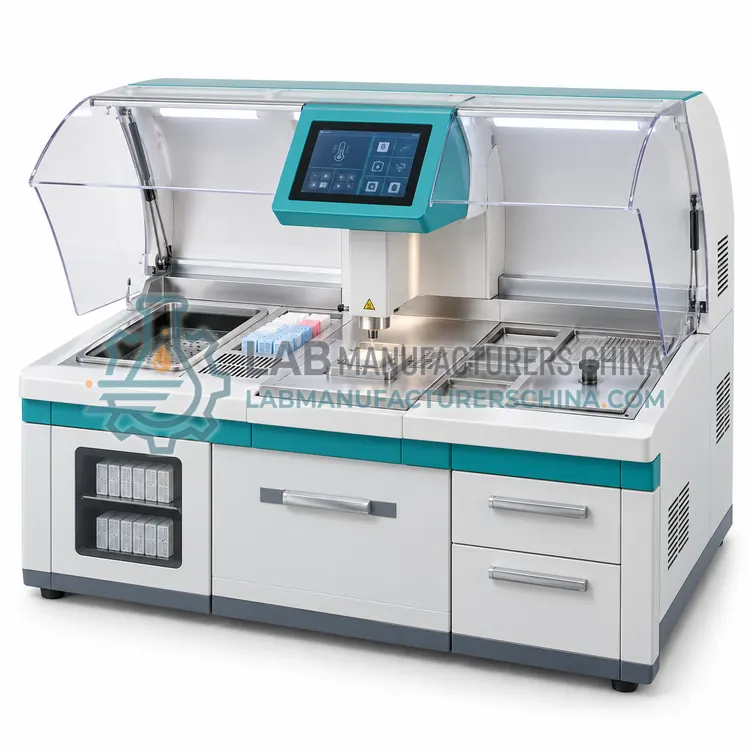
The combined embedding station is a single bench unit with a paraffin tank on one side, a heated work area in the middle and a cold plate on the other. Tank volumes are typically 3 to 5 liters with a dispensing spout controlled by a hand lever or foot pedal. A heated tray keeps cassettes warm, while a forceps well holds tools at working temperature. The cold plate cools molds to between –5 and 5 °C, with capacity for 20 to 40 molds. Lighting and magnification options help with orientation of small biopsies. Temperature controllers allow separate settings for paraffin, work area and tray. The compact footprint makes the unit easy to install, but the single workstation limits parallel work, so throughput is bounded by one operator.
How does it work?
An embedding station combines a heated paraffin reservoir with a dispensing spout, a heated work surface and a separate cold plate. Processed tissue in its cassette is kept warm in a heated tray. The operator picks up the tissue with heated forceps, places it in a base mold filled with paraffin from the dispenser, orients it for sectioning, then sets the labeled cassette on top as a mounting base. The mold moves to the cold plate, where a Peltier or compressor-cooled surface solidifies the wax rapidly and uniformly, typically reaching 0 to –10 °C. Thermostats hold the paraffin at 60 to 65 °C, slightly above its melting point, and a flow valve or foot pedal controls dispensing. Modular designs separate the dispenser and cold plate, while combined units have both in one housing.
What are the key features?
- Paraffin tank, heated work area and cold plate in one unit
- Hand lever or foot pedal dispensing control
- Heated cassette tray and forceps warmer
- Separate temperature settings for wax, work area and tray
- Optional illumination and magnifier for small biopsies
- Compact bench footprint
What are the technical specifications?
A typical combined paraffin embedding station configuration offers paraffin tank volume of 3–5 L, paraffin temperature of Ambient to 75 °C, work area temperature of Ambient to 75 °C, cold plate temperature of –5 to 5 °C, cold plate capacity of 20–40 molds and cassette tray capacity of 100–150 cassettes. Values are indicative of the product class; the exact figures for each configuration are confirmed on the quotation and the calibration documents supplied with the instrument.
Which applications is it used for?
The Combined Paraffin Embedding Station is used in small histology laboratories, surgical pathology, veterinary laboratories and teaching laboratories. Across the wider Embedding Stations class, laboratories also deploy it for histology blocks, surgical pathology and research tissue banking.
Which standards and certifications apply?
Relevant standards and methods include IEC 61010-1, IEC 61010-2-010, IEC 61326-1, ISO 15189 and ISO 13485. Certification candidates for this model are CE, IEC 61010-1 compliance and ISO 13485 manufacturing; each is to be confirmed for the specific configuration before shipment, and certificates are supplied only where they have been issued.
Place the station on a stable bench with ventilation and away from drafts. Allow the paraffin to melt fully before use, and do not leave it above the recommended temperature for long periods, since prolonged heating degrades wax. Filter and change paraffin on a regular schedule and clean the dispenser nozzle to avoid blockage. Use heat-resistant gloves, because reservoirs and forceps are hot. Verify wax temperature with a calibrated thermometer, inspect cold plate condition and clean spilled paraffin promptly to prevent fire risk and slips. Check electrical safety and cord condition routinely, and follow local rules for paraffin waste disposal.
How do I select the right Combined Paraffin Embedding Station?
Choose a combined unit for small to medium volumes and limited bench space, where a single operator can keep up with block production. Specify tank volume, cold plate capacity, control type, temperature range and power supply in an RFQ. If two people need to embed at the same time, consider a modular system with a separate cold plate.
How does it compare with other Embedding Stations variants?
Decide between a combined unit and modular components. Combined stations save space and suit small labs, while separate dispensers and cold plates let two operators work in parallel in busy services. Check paraffin tank volume against daily block counts, and compare cold plate capacity and temperature range, since cooling speed affects throughput and block quality. Look at ergonomic features such as foot control, flow rate adjustment, magnifier lights, forceps warmers and cassette tray size. For large workloads consider automated embedding systems that handle molds mechanically. Confirm that the wax temperature is stable, spare heaters are available and the tank is easy to clean. Specify voltage, filter type and whether the unit should connect to cassette or block labeling workflows.
Full specifications
| Paraffin tank volume | 3–5 L |
|---|---|
| Paraffin temperature | Ambient to 75 °C |
| Work area temperature | Ambient to 75 °C |
| Cold plate temperature | –5 to 5 °C |
| Cold plate capacity | 20–40 molds |
| Cassette tray capacity | 100–150 cassettes |
| Dispenser control | Hand lever or foot pedal |
| Dimensions (W×D×H) | about 500 × 600 × 400 mm |
| Power supply | 220 V, 50 Hz, about 0.8 kW |
Indicative values for this product class. Final specifications are confirmed on the quotation and in the calibration documents supplied with the instrument.
Applications
- Small histology laboratories
- Surgical pathology
- Veterinary laboratories
- Teaching laboratories
Key features
- Paraffin tank, heated work area and cold plate in one unit
- Hand lever or foot pedal dispensing control
- Heated cassette tray and forceps warmer
- Separate temperature settings for wax, work area and tray
- Optional illumination and magnifier for small biopsies
- Compact bench footprint
Frequently asked questions about Combined Paraffin Embedding Station
A single operator can usually produce 150 to 400 blocks per day depending on tissue complexity and cooling time. Cold plate size and paraffin volume can become limits, so choose capacity above your typical daily peak.
On a cold plate at about –5 °C, a standard block usually solidifies in 5 to 15 minutes. Larger blocks or thick molds take longer. Cooling too fast can cause cracks, so follow the recommended plate temperature and avoid freezing blocks in a freezer.
Yes. Most accept stainless steel base molds of common sizes, and some accept disposable plastic molds. Confirm mold compatibility and cold plate contact, since poor contact slows solidification and may produce uneven blocks.
An embedding station dispenses molten paraffin and cools it so processed tissue can be oriented in a mold and formed into a solid block. The block is then mounted on a microtome to cut thin sections for slides.
Paraffin is usually held at 60 to 65 °C, a few degrees above its melting point, which is commonly 56 to 58 °C. Overheating degrades the wax and can damage tissue, so the temperature should be checked with a calibrated thermometer.
Combined stations put the dispenser, work area and cold plate in one unit, saving space. Modular systems separate them so two operators can work in parallel and each module can be replaced independently, which suits higher volumes.