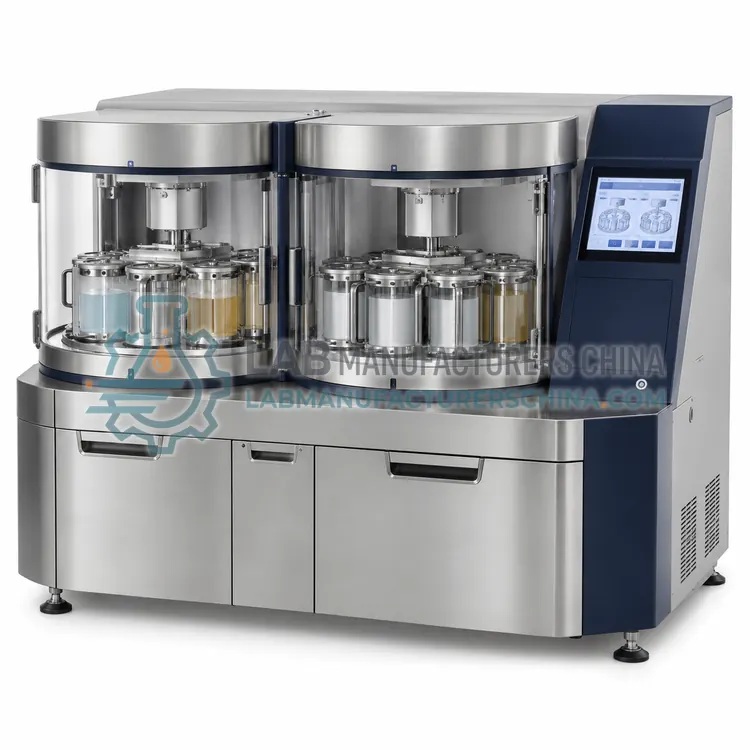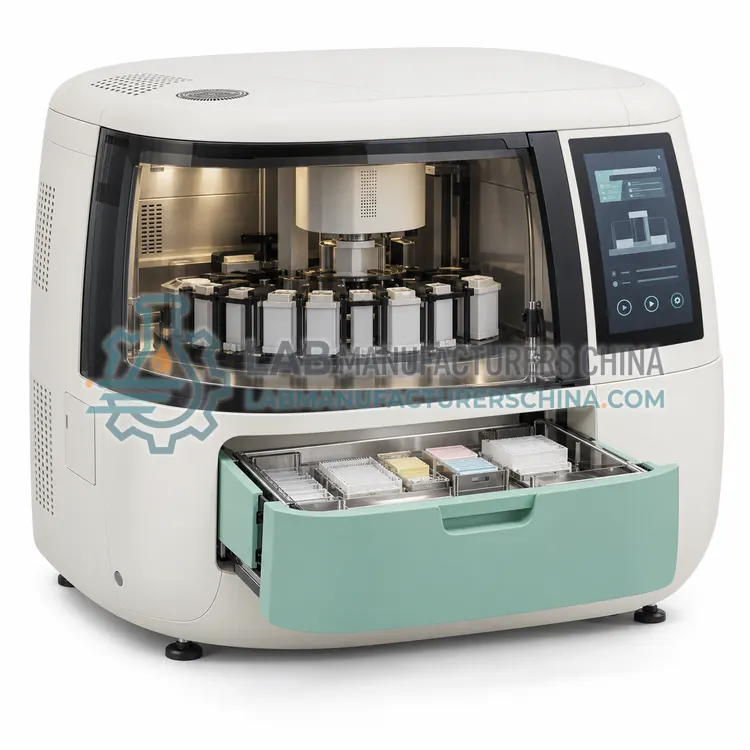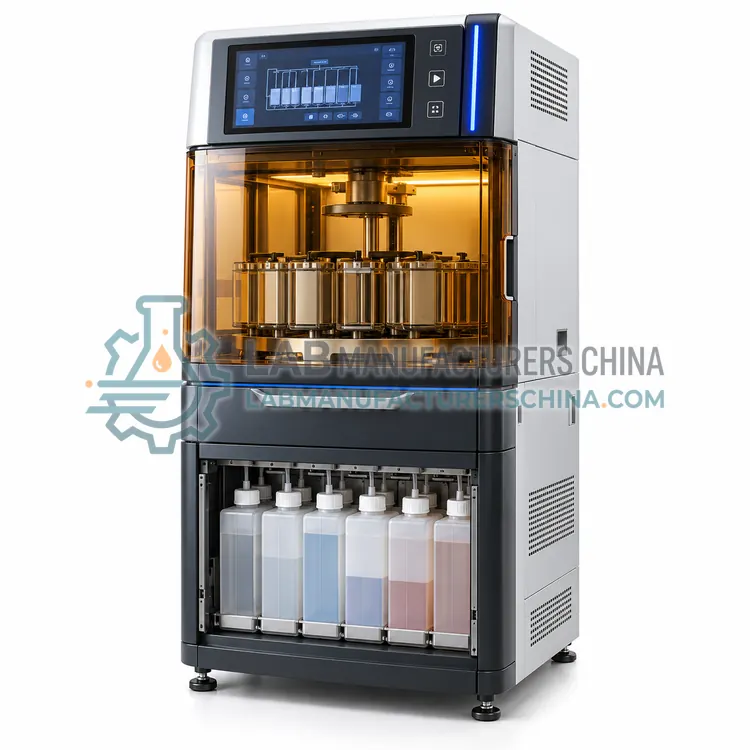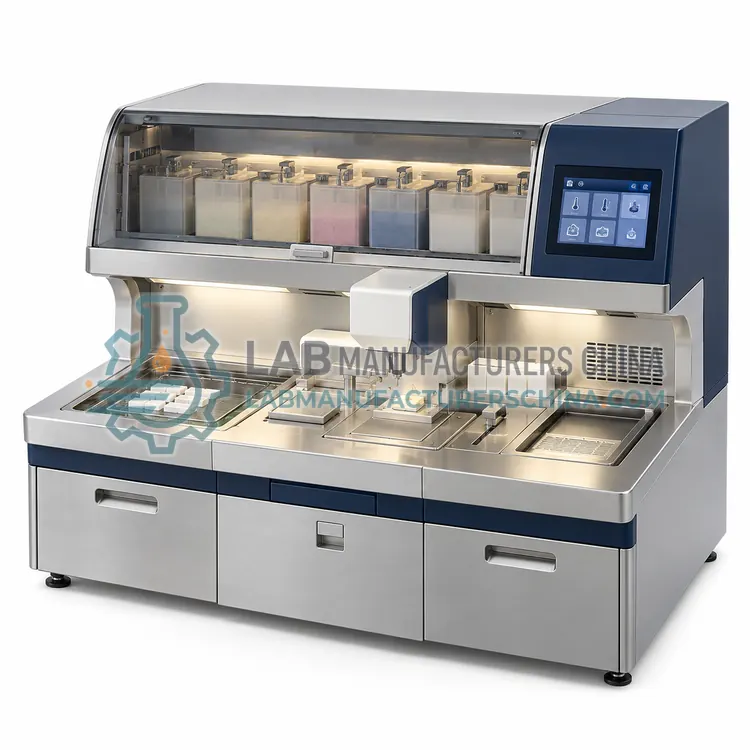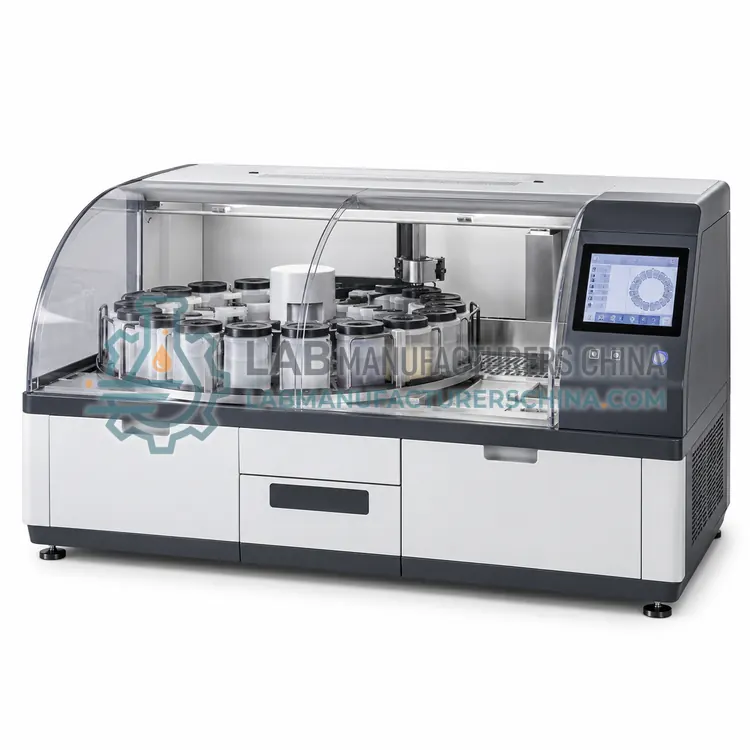
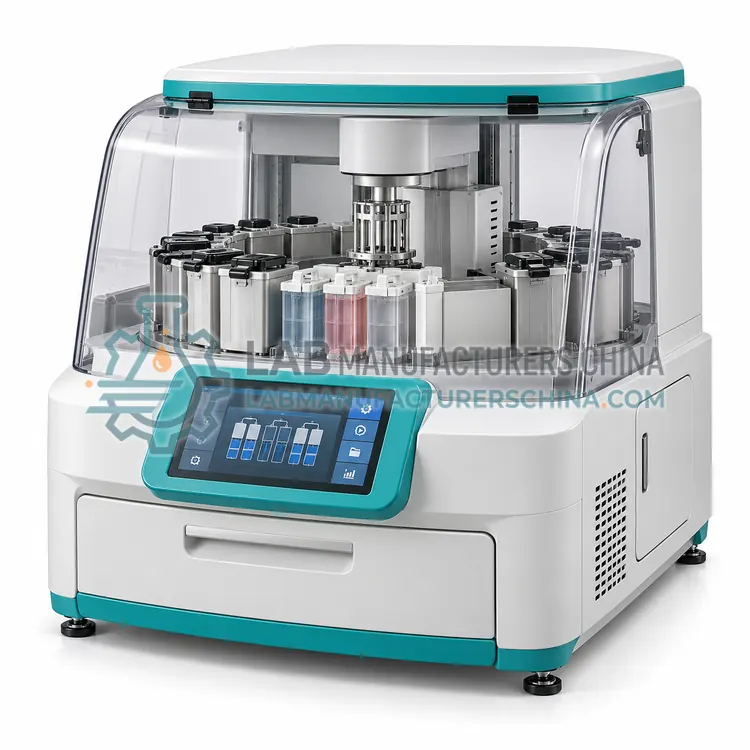
Enclosed Vacuum Tissue Processor
封闭式真空组织处理机
- SKU TIP-0002
- Tissue Processors
- CE (to be confirmed)
- IEC 61010-2-101 / IEC 61010-1 compliance (to be confirmed)
- ISO 13485 manufacturing (to be confirmed)
Price on request — FOB / CIF quoted per order
Prices depend on configuration, quantity and destination port.
Key specifications
| Capacity | 100–300 cassettes |
|---|---|
| Reagent bottles | 10–12 plus 2–3 paraffin chambers |
| Retort temperature | Ambient to 85 °C |
| Vacuum level | Down to –80 kPa |
| Pressure | Up to +50 kPa |
| Program time | 1–24 h |
Request a quote Download brochure · to be provided
By Lab Manufacturers China Technical TeamLast reviewed Standards: IEC 61010-1, IEC 61010-2-101, IEC 61326-1
What is the Enclosed Vacuum Tissue Processor?
An enclosed vacuum tissue processor moves reagents between sealed bottles and a single retort, applying vacuum and pressure cycles with fume containment. It suits medium to high-volume laboratories needing reproducible infiltration and lower staff exposure to solvents.
What is the Enclosed Vacuum Tissue Processor?
An enclosed vacuum tissue processor moves reagents between sealed bottles and a single retort, applying vacuum and pressure cycles with fume containment. It suits medium to high-volume laboratories needing reproducible infiltration and lower staff exposure to solvents.
Overview
In an enclosed processor the cassette basket stays in one retort while valves and pumps fill it with each reagent from sealed bottles and return it afterward. Vacuum and pressure cycles remove air and drive reagent into dense tissue, and the retort is heated and often agitated. Typical capacity is 100 to 300 cassettes. Level sensors, reagent counters and automatic cleaning cycles reduce operator intervention, and a carbon filter or exhaust hood captures vapors. Because reagents are moved in a closed path, exposure is lower and cross-contamination can be controlled with cleaning steps between reagents. Touchscreen controllers store many programs, log events and can export audit records. Installation requires a stable power supply, exhaust connection and sufficient room for reagent bottles and paraffin chambers.
How does it work?
A tissue processor moves cassettes through a programmed sequence of reagents: formalin fixative, graded ethanol to remove water, a clearing agent such as xylene or an isoparaffin substitute to remove alcohol, and molten paraffin that infiltrates the tissue. In carousel models the basket is raised and lowered into open stations. In enclosed models, a retort is filled and drained by pump or pressure from sealed reagent bottles. Vacuum and pressure cycles accelerate penetration by drawing air out of the tissue, while heating and agitation improve diffusion. Sensors monitor level, temperature and reagent use, and a fume-control system with a carbon filter captures solvent vapors. Programs are typically 4 to 14 hours, and rapid protocols can be under 2 hours for small biopsies.
What are the key features?
- Single sealed retort with pump or pressure reagent transfer
- Programmable vacuum and pressure cycles for dense tissue
- Reagent-use counters and automatic cleaning cycles
- Heated retort with optional agitation
- Carbon filter or exhaust connection for vapor control
- Event log and audit export for quality systems
What are the technical specifications?
A typical enclosed vacuum tissue processor configuration offers capacity of 100–300 cassettes, reagent bottles of 10–12 plus 2–3 paraffin chambers, retort temperature of Ambient to 85 °C, vacuum level of Down to –80 kPa, pressure of Up to +50 kPa and program time of 1–24 h. Values are indicative of the product class; the exact figures for each configuration are confirmed on the quotation and the calibration documents supplied with the instrument.
Which applications is it used for?
The Enclosed Vacuum Tissue Processor is used in busy surgical pathology, hospital histology, reference laboratories and dense tissue processing. Across the wider Tissue Processors class, laboratories also deploy it for surgical pathology, biopsy processing and research histology.
Which standards and certifications apply?
Relevant standards and methods include IEC 61010-1, IEC 61010-2-101, IEC 61326-1, ISO 15189, CLSI QMS 02 and ISO 13485. Certification candidates for this model are CE, IEC 61010-2-101 / IEC 61010-1 compliance and ISO 13485 manufacturing; each is to be confirmed for the specific configuration before shipment, and certificates are supplied only where they have been issued.
Place the processor in a ventilated room with a dedicated circuit, and connect a carbon filter or exhaust duct, since xylene and formalin are hazardous. Follow the maker's schedule for reagent replacement, based on cassette count rather than time alone, and keep a record of changes. Run cleaning programs with the correct solvent and change the paraffin bath filter routinely. Use level sensor and temperature checks as part of monthly maintenance, and verify wax temperature with a calibrated thermometer. Validate each protocol with representative tissue, checking for under-processing or brittleness. Provide spill kits and staff training, and follow local rules for solvent and formalin waste.
How do I select the right Enclosed Vacuum Tissue Processor?
Choose an enclosed vacuum processor when daily cassette counts regularly exceed what a carousel handles, or when fume exposure and reagent traceability are priorities. Specify retort capacity, vacuum and pressure range, bottle layout, cleaning cycles, connectivity and the solvent types supported. Ask for installation requirements such as exhaust, power and floor space, and request validation data for mixed tissue types.
How does it compare with other Tissue Processors variants?
Choose first by daily cassette volume and specimen mix. Low volumes and teaching labs suit carousel models, while busy services favor enclosed retorts that protect staff from fumes and allow vacuum. If biopsies must be reported the same day, pick a model with rapid or microwave-assisted programs. Dual-retort systems let you run two independent batches for flexible start times. Look at reagent management, such as reagent-use counters and cleaning cycles, and check the solvent you plan to use, since xylene-free protocols need compatible seals and tubing. Verify capacity per basket, program storage, connectivity to LIS, and ventilation or fume filter requirements. Ask about validation data for your tissue types.
Full specifications
| Capacity | 100–300 cassettes |
|---|---|
| Reagent bottles | 10–12 plus 2–3 paraffin chambers |
| Retort temperature | Ambient to 85 °C |
| Vacuum level | Down to –80 kPa |
| Pressure | Up to +50 kPa |
| Program time | 1–24 h |
| Stored programs | Up to 20 |
| Display | 7–10 in touchscreen |
| Power supply | 220 V, 50 Hz, about 2 kW |
Indicative values for this product class. Final specifications are confirmed on the quotation and in the calibration documents supplied with the instrument.
Applications
- Busy surgical pathology
- Hospital histology
- Reference laboratories
- Dense tissue processing
Key features
- Single sealed retort with pump or pressure reagent transfer
- Programmable vacuum and pressure cycles for dense tissue
- Reagent-use counters and automatic cleaning cycles
- Heated retort with optional agitation
- Carbon filter or exhaust connection for vapor control
- Event log and audit export for quality systems
Frequently asked questions about Enclosed Vacuum Tissue Processor
Vacuum removes trapped air from tissue so reagents and paraffin penetrate more completely, especially in dense or fatty specimens. It shortens cycles and improves block quality, but vacuum levels and durations must be validated to avoid tissue distortion.
Reagents are transferred through sealed lines and the retort is cleaned or flushed between reagent types according to the program. Reagent-use counters also prompt timely replacement, which limits carry-over of water or formalin into later steps.
Footprints are typically 60 to 90 cm wide with 70 to 90 cm depth, plus clearance for bottle access and exhaust. Floor-standing models need a load-bearing surface and service space behind the unit. Confirm dimensions and weight with the supplier.
A tissue processor automatically dehydrates fixed tissue in graded alcohols, clears it with a solvent and infiltrates it with molten paraffin. The result is a firm block that a microtome can cut into thin, uniform sections for staining and microscopy.
Routine overnight programs run about 8 to 14 hours, while rapid programs for small biopsies can finish in 1 to 3 hours. Thick or fatty specimens need longer cycles. Program length is set by specimen thickness, reagent temperature and whether vacuum or microwave assistance is used.
Xylene-free protocols use isoparaffin or other clearing agents with high-temperature paraffin and have shown acceptable morphology in many laboratories. Reliability depends on matching the program to tissue type, validating with control blocks and confirming that seals and tubing are compatible with the substitute solvent.
Related models