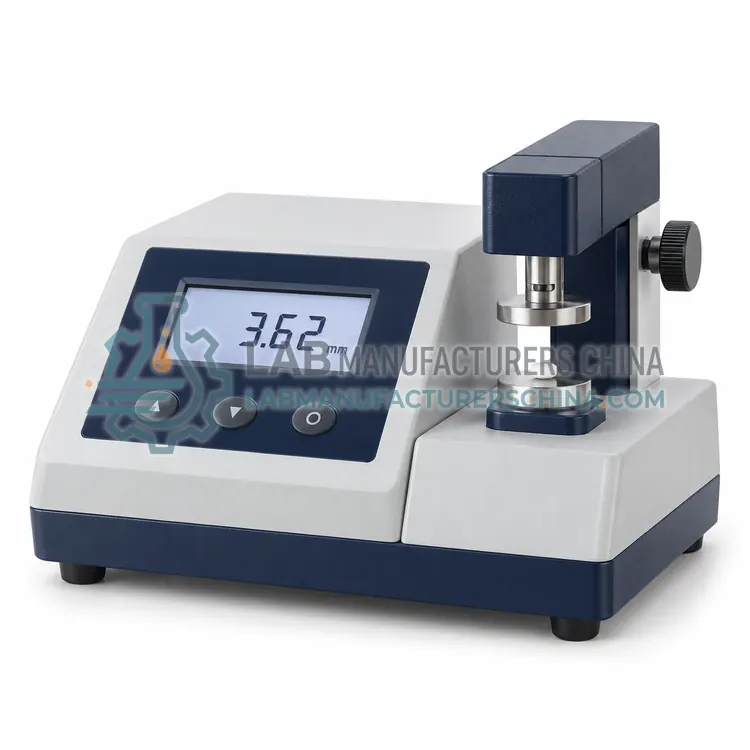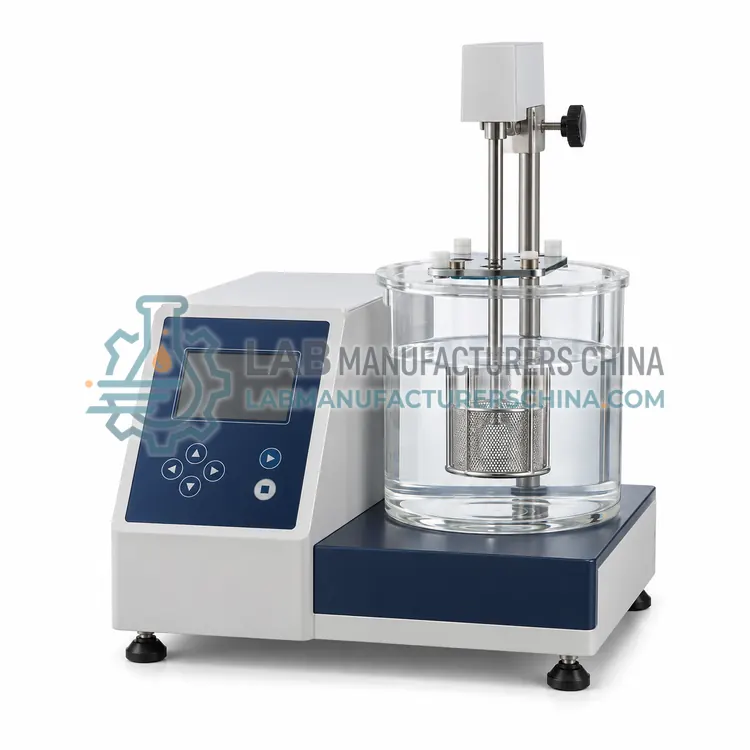
Portable Disintegration Tester
便携式崩解时限测试仪
- SKU DIT-0005
- Disintegration Testers
- CE (to be confirmed)
- ISO 9001 manufacturing (to be confirmed)
Price on request — FOB / CIF quoted per order
Prices depend on configuration, quantity and destination port.
Key specifications
| Number of baskets | 1 |
|---|---|
| Tubes per basket | 6 |
| Stroke length | 55 ± 2 mm |
| Frequency | 30 ± 2 cycles/min |
| Warm-up time to 37 °C | ≤ 20 min |
| Temperature accuracy | ± 1.0 °C |
Request a quote Download brochure · to be provided
By Lab Manufacturers China Technical TeamLast reviewed Standards: USP <701>, Ph. Eur. 2.9.1, JP 6.09
What is the Portable Disintegration Tester?
A portable disintegration tester is a compact, lighter unit with an integrated heater that can be moved between production floor and laboratory. It is used for in-process checks near the tablet press where full laboratory equipment is impractical.
What is the Portable Disintegration Tester?
A portable disintegration tester is a compact, lighter unit with an integrated heater that can be moved between production floor and laboratory. It is used for in-process checks near the tablet press where full laboratory equipment is impractical.
Overview
The portable tester integrates the drive, heated bath and controller in a small housing, typically under 15 kg, with a single six-tube basket-rack and a 1 L vessel. It follows the same stroke and frequency as laboratory models, but the water bath is sometimes replaced by a direct heater and a circulating stirrer to shorten warm-up. Power can be mains only or include a rechargeable battery for remote use. Because it is used close to production, cleaning is fast and the instrument can be covered to avoid contamination. The compact bath has lower thermal mass, so temperature stability may be less than in larger laboratory bath systems, and results from portable use should be correlated with laboratory release results. It suits IPC checks and not formal release testing.
How does it work?
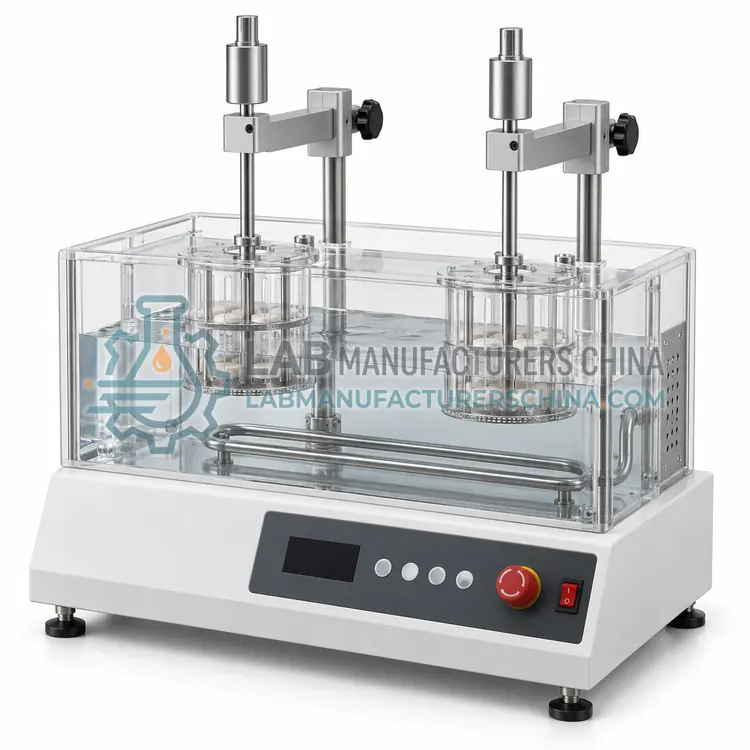
A disintegration tester consists of a basket-rack assembly, a motor-driven mechanism, and a thermostatic bath. The basket-rack holds six transparent tubes with a stainless steel mesh (typically 2.0 mm aperture) at the bottom. The mechanism moves the assembly vertically through a distance of 53 to 57 mm at 29 to 32 cycles per minute, while the immersion fluid, usually water, 0.1 M hydrochloric acid or phosphate buffer, is held at 37 ± 2 °C. A dosage unit is placed in each tube, optionally with a perforated disc that adds gentle mechanical action. The test ends when no residue, other than fragments of insoluble coating or capsule shell, remains on the mesh. The operator records the time of complete disintegration, which is compared with the monograph limit, commonly 15 to 60 minutes.
What are the key features?
- Compact housing under 15 kg for movement to the production area
- Integrated heater and circulating stirrer for fast warm-up
- Same six-tube basket-rack and pharmacopoeial stroke
- Optional battery for use without a nearby outlet
- Easy-clean surfaces and cover for shop-floor use
What are the technical specifications?
A typical portable disintegration tester configuration offers number of baskets of 1, tubes per basket of 6, stroke length of 55 ± 2 mm, frequency of 30 ± 2 cycles/min, warm-up time to 37 °C of ≤ 20 min and temperature accuracy of ± 1.0 °C. Values are indicative of the product class; the exact figures for each configuration are confirmed on the quotation and the calibration documents supplied with the instrument.
Which applications is it used for?
The Portable Disintegration Tester is used in in-process control at the tablet press, quick formulation checks, multi-site QA checks and field and audit demonstrations. Across the wider Disintegration Testers class, laboratories also deploy it for tablet and capsule release testing, formulation development and stability studies.
Which standards and certifications apply?
Relevant standards and methods include USP <701>, Ph. Eur. 2.9.1, JP 6.09 and IEC 61010-1. Certification candidates for this model are CE and ISO 9001 manufacturing; each is to be confirmed for the specific configuration before shipment, and certificates are supplied only where they have been issued.
Install the tester on a stable bench with a level water bath and access to clean water. Calibrate stroke length, frequency and temperature at installation and at defined intervals, using an independent thermometer and a ruler or gauge. Replace the immersion medium frequently and clean tubes, mesh and discs to prevent residue build-up that blocks the mesh. Use deaerated medium if required by the method, because air bubbles can lift tablets. Check the mesh for distortion, since a damaged screen changes the test outcome. Record lot numbers of medium, bath temperature and operator. Under GMP, document IQ, OQ and PQ, and verify the system with a suitable reference tablet where practical.
How do I select the right Portable Disintegration Tester?
Select the portable model for in-process checks where speed and mobility matter more than the tightest temperature control. For release testing, use a laboratory bath model. In an RFQ, specify weight limits, warm-up time, optional battery, temperature accuracy and cleaning requirements.
How does it compare with other Disintegration Testers variants?
Choose according to sample throughput, temperature control and data requirements. A two-basket tester allows two test groups in parallel and is often chosen where stage testing is performed, for example acid stage followed by buffer stage for enteric products. Single-basket units are adequate for routine release. Confirm stroke length, frequency and basket dimensions against the target pharmacopoeia, and check that the bath can hold 37 °C within ±1 °C. Automatic endpoint detection reduces subjectivity, which matters for opaque or colored dosage forms where visual judgment is difficult. Laboratories under GMP should look for software with audit trails and probe-based temperature recording. A portable or benchtop size matters if bench space is limited, and a bath with a cooling or sealed circulation option helps in warm climates.
Full specifications
| Number of baskets | 1 |
|---|---|
| Tubes per basket | 6 |
| Stroke length | 55 ± 2 mm |
| Frequency | 30 ± 2 cycles/min |
| Warm-up time to 37 °C | ≤ 20 min |
| Temperature accuracy | ± 1.0 °C |
| Vessel volume | 1000 mL |
| Weight | approx. 12 kg |
| Power supply | 220 V, 50/60 Hz; optional battery |
| Dimensions (W×D×H) | approx. 300 × 300 × 450 mm |
Indicative values for this product class. Final specifications are confirmed on the quotation and in the calibration documents supplied with the instrument.
Applications
- In-process control at the tablet press
- Quick formulation checks
- Multi-site QA checks
- Field and audit demonstrations
Key features
- Compact housing under 15 kg for movement to the production area
- Integrated heater and circulating stirrer for fast warm-up
- Same six-tube basket-rack and pharmacopoeial stroke
- Optional battery for use without a nearby outlet
- Easy-clean surfaces and cover for shop-floor use
Frequently asked questions about Portable Disintegration Tester
Only if it meets the pharmacopoeial parameters and is qualified for that use. Many sites use portable units for in-process checks and keep a laboratory bath model for release, which avoids questions about temperature stability.
Warm-up typically takes 15 to 20 minutes with direct heating, depending on the starting temperature and the medium volume. Pre-warming the medium shortens the wait and improves stability.
Moving the instrument can shift leveling and mechanical alignment. Check that the unit stands level and verify stroke, frequency and temperature at defined intervals, and after any transport that may have caused a shock.
A disintegration tester is a pharmacopoeial apparatus that moves tablets or capsules up and down in a heated fluid and measures how long they take to break apart. It is used as a quick quality test for oral solid dosage forms.
The standard temperature is 37 ± 2 °C, representing body temperature. The bath must hold this range throughout the test, and many laboratories check it with a calibrated independent thermometer rather than relying solely on the display.
Disintegration measures when a dosage form breaks into particles, while dissolution measures the rate and extent to which the drug enters solution. A tablet can disintegrate quickly and still dissolve slowly, so the two tests are complementary.
Related models
Disintegration Tester with Disc-Free Basket for Capsules and Soft Gels
胶囊及软胶囊用崩解时限测试仪
- CE (to be confirmed)
- +1