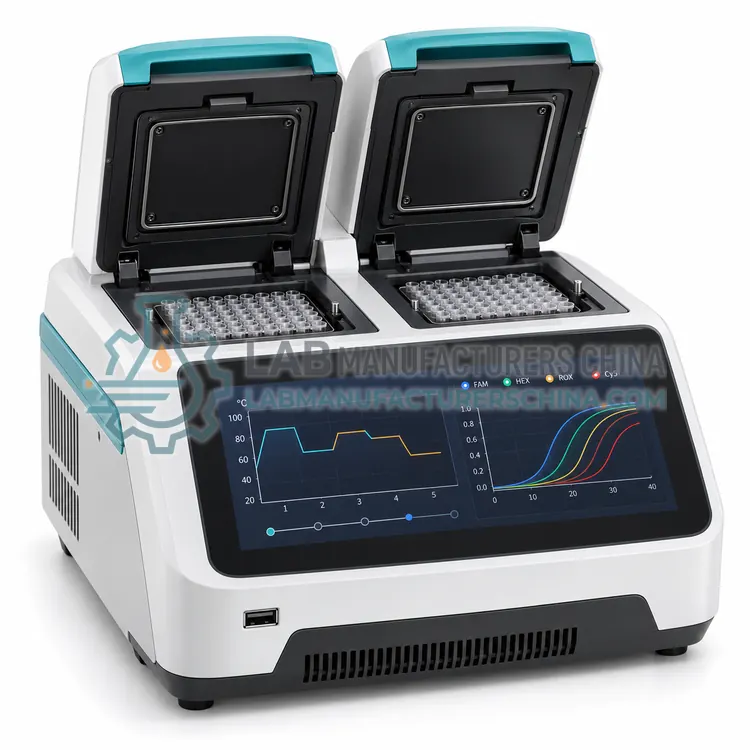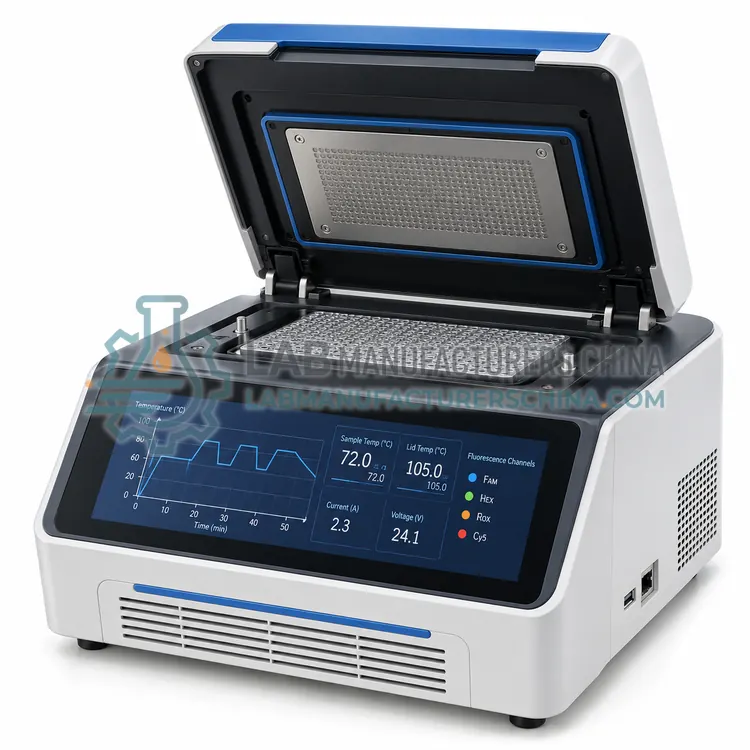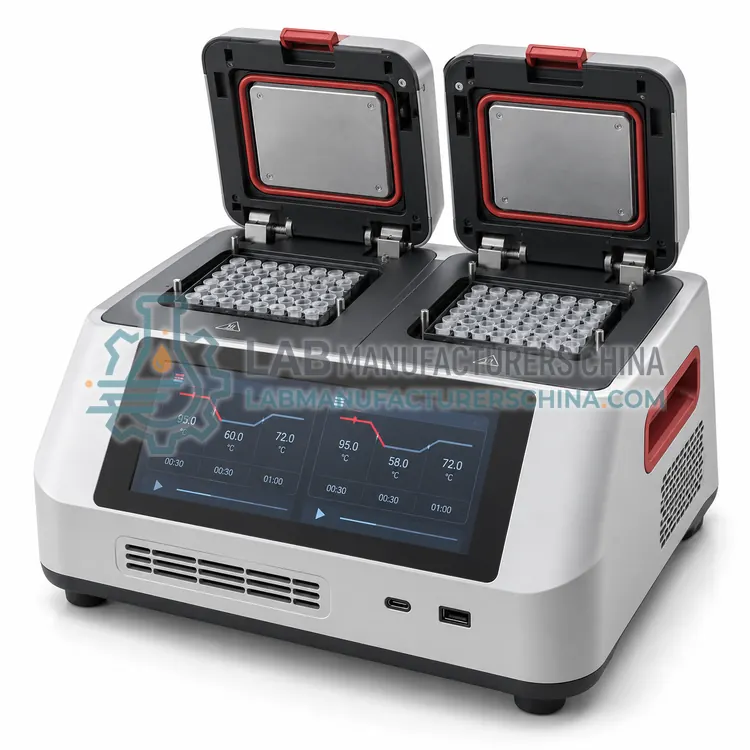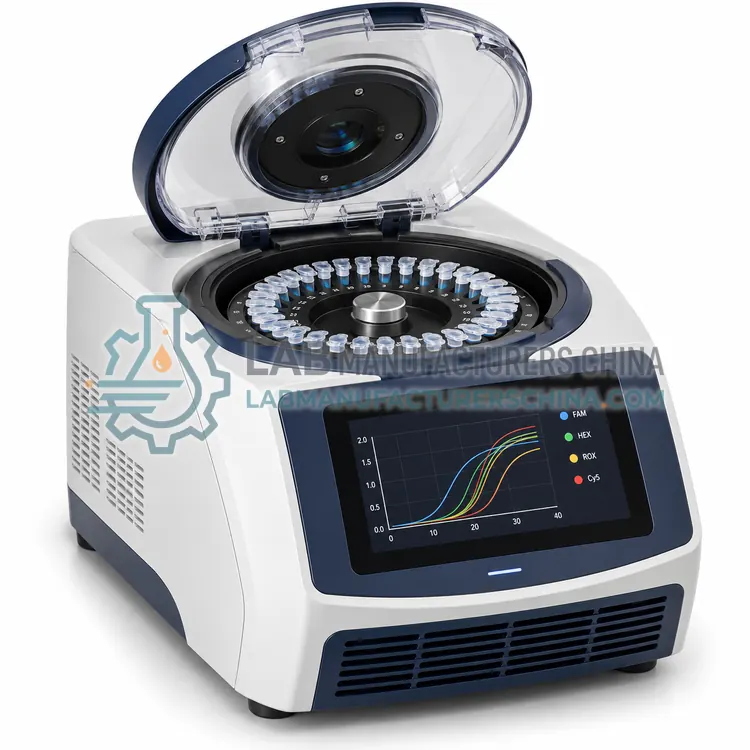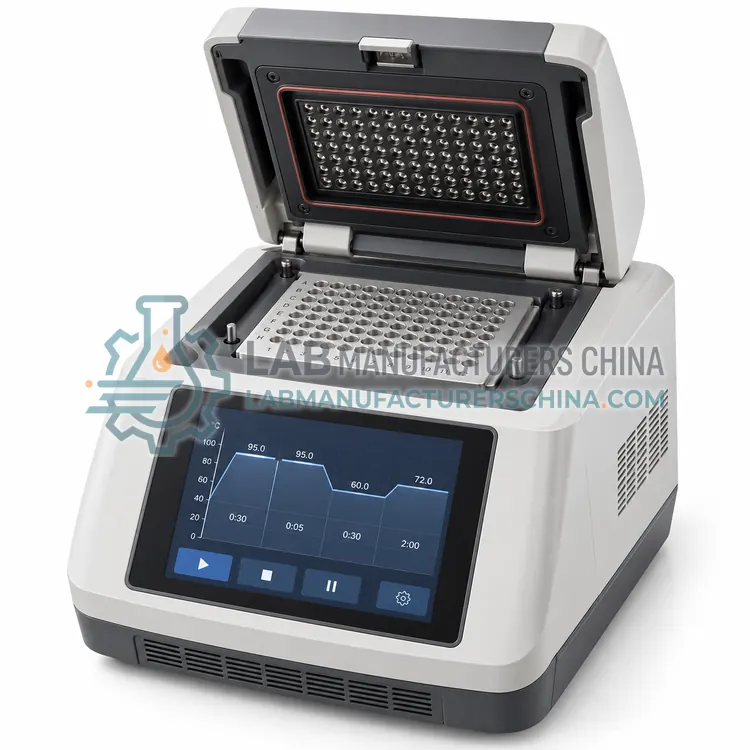
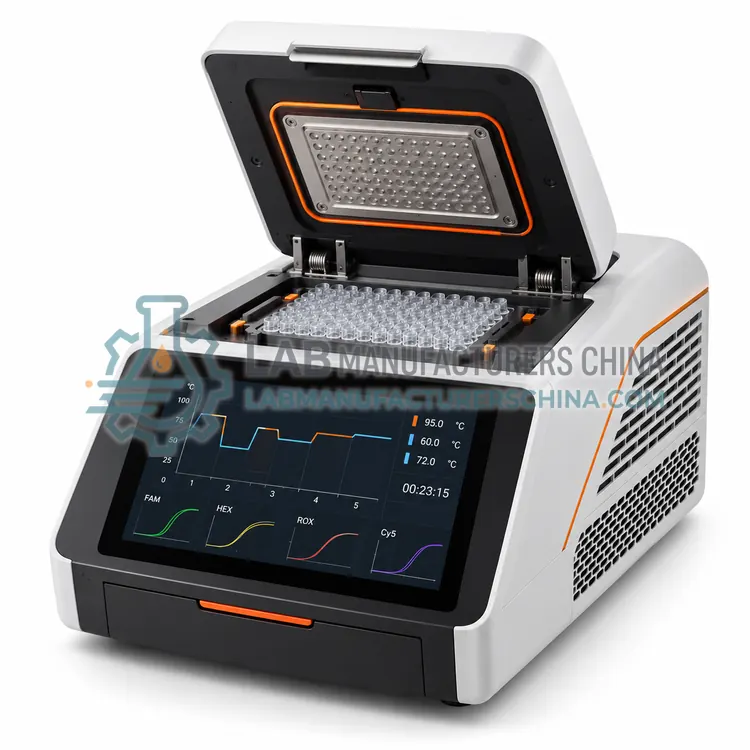
Fast Thermal Cycler
快速热循环仪
- SKU COP-0003
- Conventional PCR
- CE (to be confirmed)
- ISO 9001 manufacturing (to be confirmed)
Price on request — FOB / CIF quoted per order
Prices depend on configuration, quantity and destination port.
Key specifications
| Block format | 96 × 0.2 mL wells, thin-wall |
|---|---|
| Temperature range | 4–99 °C |
| Max heating rate | 5–6 °C/s |
| Max cooling rate | 3–4 °C/s |
| Block uniformity | ±0.4 °C during ramp, ±0.3 °C at hold |
| Temperature accuracy | ±0.25 °C |
Request a quote Download brochure · to be provided
By Lab Manufacturers China Technical TeamLast reviewed Standards: ISO 20395, ISO 22174, IEC 61010-1
What is the Fast Thermal Cycler?
A fast thermal cycler uses a low-mass block and high-power Peltier elements to reach ramp rates of 5–6 °C/s, cutting a 30-cycle run to 30–60 minutes. It is the right choice for laboratories running high volumes of short-amplicon PCR with polymerases validated for fast cycling.
What is the Fast Thermal Cycler?
A fast thermal cycler uses a low-mass block and high-power Peltier elements to reach ramp rates of 5–6 °C/s, cutting a 30-cycle run to 30–60 minutes. It is the right choice for laboratories running high volumes of short-amplicon PCR with polymerases validated for fast cycling.
Overview
A fast cycler reduces run time by lowering block thermal mass and using high-output Peltier modules with efficient heat sinking, reaching 5–6 °C/s heating and 3–4 °C/s cooling. Silver or thin-wall aluminum blocks are common, and uniformity specifications are generally slightly looser, around ±0.4 °C during fast ramps. The instrument supports the same tube and plate formats as standard cyclers, but thin-wall plates give the best sample ramp. Fast protocols require enzymes with high processivity, short extension steps of 5–15 seconds, and amplicons below roughly 1 kb. Reaction volumes of 5–50 µL are preferred because large volumes lag the block. Fast cycling is well suited to screening, colony PCR and diagnostics with high daily turnover.
How does it work?
A thermal cycler holds reaction tubes or plates in a metal block whose temperature is controlled by Peltier thermoelectric elements. Each cycle denatures double-stranded DNA at about 94–98 °C, cools to the primer annealing temperature, typically 50–68 °C, and then heats to about 72 °C so a thermostable DNA polymerase extends the primers. Repeating this 25–40 times amplifies the target exponentially. Key components include the Peltier-driven block, a heat sink and fan, a temperature sensor feedback loop, a heated lid that prevents condensation and evaporation, and a controller that stores multi-step programs. Block uniformity and ramp rate determine how reproducibly each well reaches its set temperature.
What are the key features?
- Low-mass block reaches 5–6 °C/s heating for shorter runs
- High-output Peltier modules with efficient heat sinking
- Thin-wall plate compatibility for faster sample response
- Program library includes fast-cycling templates
- Ramp-rate limiter to adapt legacy protocols
- Heated lid with fast pre-heat to shorten start time
What are the technical specifications?
A typical fast thermal cycler configuration offers block format of 96 × 0.2 mL wells, thin-wall, temperature range of 4–99 °C, max heating rate of 5–6 °C/s, max cooling rate of 3–4 °C/s, block uniformity of ±0.4 °C during ramp, ±0.3 °C at hold and temperature accuracy of ±0.25 °C. Values are indicative of the product class; the exact figures for each configuration are confirmed on the quotation and the calibration documents supplied with the instrument.
Which applications is it used for?
The Fast Thermal Cycler is used in high-throughput screening PCR, diagnostic amplification with short turnaround, colony PCR and short-amplicon genotyping. Across the wider Conventional PCR class, laboratories also deploy it for gene cloning and plasmid construction, genotyping and mutation screening and pathogen detection by end-point PCR.
Which standards and certifications apply?
Relevant standards and methods include ISO 20395, ISO 22174, IEC 61010-1, IEC 61010-2-010, MIQE guidelines (research reporting) and CLSI MM19. Certification candidates for this model are CE and ISO 9001 manufacturing; each is to be confirmed for the specific configuration before shipment, and certificates are supplied only where they have been issued.
Install the cycler on a stable bench with at least 10 cm of clearance for air intake and exhaust, away from direct sunlight and drafts. Verify block temperature accuracy and uniformity at installation and at least annually using a calibrated multi-point probe, and record results for audit. Clean the block wells with a lint-free swab and 70% ethanol to remove spilled reagent and prevent cross-contamination, and inspect the heated lid seal. Use sealing films or caps matched to the lid pressure. Keep pre-PCR and post-PCR work areas physically separated, and run no-template controls to detect amplicon carry-over. Firmware updates and program backups should be controlled under the laboratory's document system.
How do I select the right Fast Thermal Cycler?
Select a fast cycler when daily sample volume is high and amplicons are short enough for fast enzymes. Compared with standard cyclers, it saves time but asks for polymerase validation and thin-wall consumables. In an RFQ, specify required ramp rate, total run time for a reference protocol, uniformity during ramp, compatible plate profile, reaction volume range, and request a demonstration with your own enzyme and primers.
How does it compare with other Conventional PCR variants?
Choose first by throughput and format: 96-well blocks suit most research work, 384-well blocks suit high-throughput screening, and small 16–48 well units suit teaching or occasional use. Next, compare ramp rate and block uniformity, because fast cyclers shorten run time but need polymerases and buffers validated for short steps. Dual-block instruments allow two independent programs at once and help shared core facilities. Check the heated lid range, programmable features such as touchdown and gradient, and whether the block is interchangeable. Consider connectivity for audit trails if the laboratory works under quality systems, and confirm the tube or plate formats you use, including low-profile plates and strip tubes.
Full specifications
| Block format | 96 × 0.2 mL wells, thin-wall |
|---|---|
| Temperature range | 4–99 °C |
| Max heating rate | 5–6 °C/s |
| Max cooling rate | 3–4 °C/s |
| Block uniformity | ±0.4 °C during ramp, ±0.3 °C at hold |
| Temperature accuracy | ±0.25 °C |
| Typical 30-cycle run time | 30–60 min |
| Heated lid range | 30–110 °C |
| Reaction volume | 5–50 µL |
| Power supply | 100–240 V AC, 50/60 Hz, about 800 W |
Indicative values for this product class. Final specifications are confirmed on the quotation and in the calibration documents supplied with the instrument.
Applications
- High-throughput screening PCR
- Diagnostic amplification with short turnaround
- Colony PCR
- Short-amplicon genotyping
Key features
- Low-mass block reaches 5–6 °C/s heating for shorter runs
- High-output Peltier modules with efficient heat sinking
- Thin-wall plate compatibility for faster sample response
- Program library includes fast-cycling templates
- Ramp-rate limiter to adapt legacy protocols
- Heated lid with fast pre-heat to shorten start time
Frequently asked questions about Fast Thermal Cycler
Often yes, but results may shift. Fast blocks can overshoot or shorten effective hold time, and enzymes with low processivity may underperform. Use the ramp limiter to mimic slower cycling, then validate against your current results before switching.
Not inherently, but short annealing and extension steps can reduce yield for long or GC-rich targets. Validate each assay and adjust primer concentration, annealing temperature or enzyme choice for targets above about 1 kb.
Thin-wall polypropylene plates and tubes transfer heat fastest. Use low-profile plates and sealing films recommended by the manufacturer so the heated lid seats fully without deforming wells, which would slow heat transfer.
It amplifies a chosen DNA segment by cycling a reaction mix through denaturation, annealing and extension temperatures. The product is analysed after the run, usually on an agarose gel. Typical uses include cloning, genotyping, sequencing template preparation, and qualitative detection of pathogens or transgenes.
Conventional PCR reads the result at the end of the run, usually by gel electrophoresis, and gives a qualitative yes or no answer. Real-time PCR measures fluorescence every cycle and can quantify starting template. Conventional cyclers cost less and have no optical module.
Block temperature accuracy and uniformity should be verified at installation and at least once a year, or after any repair or relocation. Laboratories working under ISO 17025 or GMP often shorten this interval and keep calibration certificates traceable to national standards.
Related models