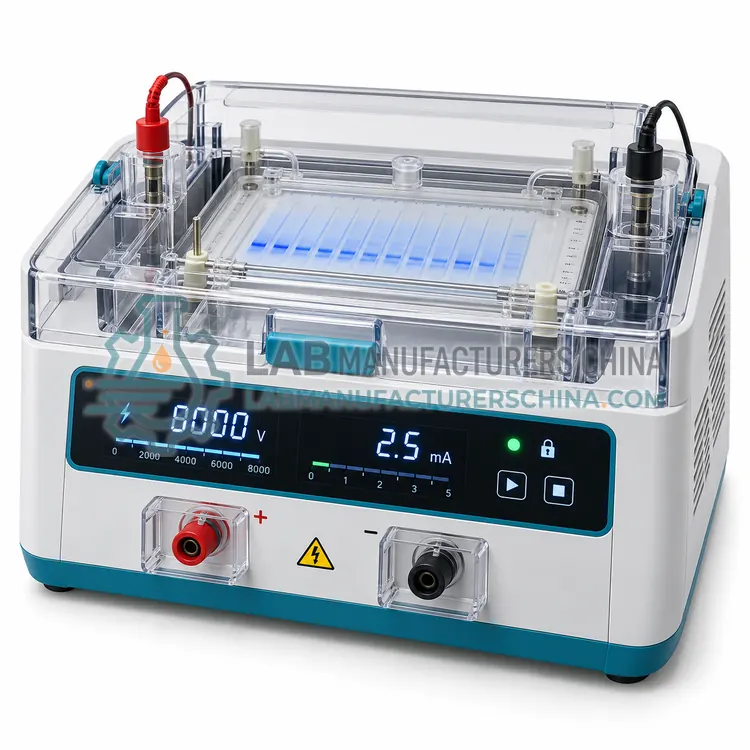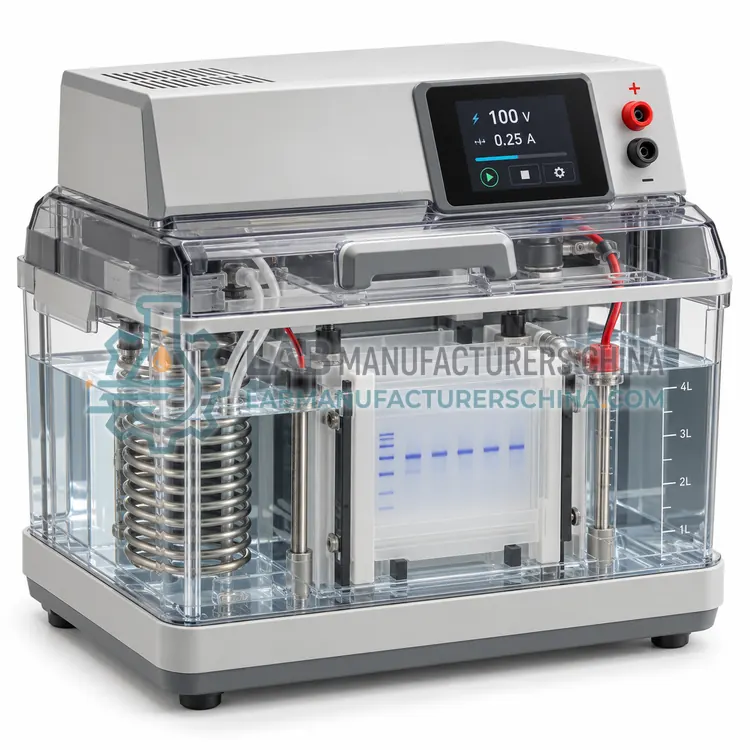
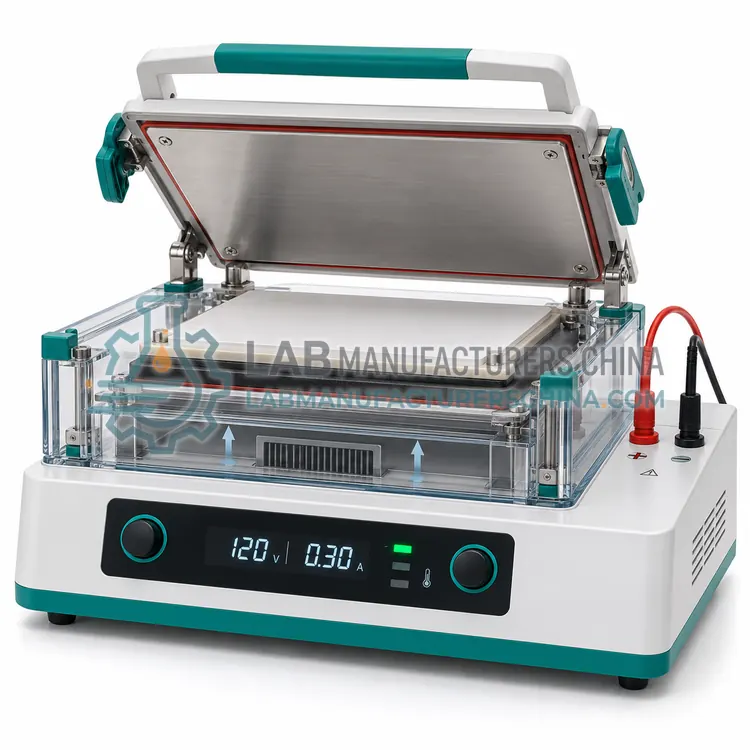
Semi-Dry Electroblotting System
半干式电转印仪
- SKU BLS-0002
- Blotting Systems
- CE (to be confirmed)
- ISO 9001 manufacturing (to be confirmed)
- RoHS (to be confirmed)
Price on request — FOB / CIF quoted per order
Prices depend on configuration, quantity and destination port.
Key specifications
| Transfer area (W x L) | approx. 10 x 15 cm to 20 x 20 cm |
|---|---|
| Gels per run | 1–2 (stacked plates) |
| Buffer volume | approx. 50–200 mL |
| Typical transfer conditions | 10–25 V, up to 2.5 A, 30–60 min |
| Electrode spacing | approx. 0.5–1 cm |
| Maximum voltage | 30 V DC |
Request a quote Download brochure · to be provided
By Lab Manufacturers China Technical TeamLast reviewed Standards: IEC 61010-1, IEC 61326-1, ISO 17025
What is the Semi-Dry Electroblotting System?
A flat-plate blotter that transfers proteins between two graphite or metal electrodes through buffer-soaked paper, using little buffer and finishing in 30–60 minutes. It suits routine transfers of small and medium proteins where speed and buffer saving matter.
What is the Semi-Dry Electroblotting System?
A flat-plate blotter that transfers proteins between two graphite or metal electrodes through buffer-soaked paper, using little buffer and finishing in 30–60 minutes. It suits routine transfers of small and medium proteins where speed and buffer saving matter.
Overview
In a semi-dry blotter the gel-membrane stack sits horizontally between a lower anode plate and an upper cathode plate. The stack is built from filter papers saturated with buffer, so only tens of millilitres are needed rather than litres. The short distance between electrodes, typically under 1 cm, gives a strong field at low voltage, so transfers run at 10–25 V and up to 2.5 A for 30–60 minutes. Graphite plates give even current, while stainless-steel or platinum-coated plates resist corrosion and allow flexible buffer systems. Continuous and discontinuous buffer systems are used to improve transfer of mixed-size proteins. The design is compact, quick and economical, which suits routine work on proteins of 15–100 kDa. Efficiency for very large proteins is lower than with wet tanks, and the stack can dry out if over-run.
How does it work?
Blotting moves separated molecules from a fragile gel to a durable membrane while preserving their relative positions. In electroblotting, the gel and membrane are pressed together in a sandwich between filter papers and sponges or buffer-wetted stacks, and an electric field drives charged molecules out of the gel and onto the membrane, where they bind by hydrophobic or electrostatic interaction. Wet tank systems submerge the sandwich in buffer between plate electrodes, semi-dry systems place it between flat graphite or metal plate electrodes with only buffer-soaked paper, and rapid systems use high current with special buffers. Vacuum and capillary blotting draw buffer through the gel to carry nucleic acids onto the membrane. After transfer, the membrane is blocked and probed, and signals are detected chemically or by fluorescence.
What are the key features?
- Flat plate electrodes only 0.5–1 cm apart give a strong field at 10–25 V
- Stack needs only buffer-soaked filter paper, using tens of millilitres instead of litres
- Graphite or platinum-coated plates provide even current across the whole transfer area
- Safety cover with interlock prevents operation while open
- Interchangeable plates fit gel sizes from mini to midi format
- Compact footprint suits benches where space and buffer storage are limited
What are the technical specifications?
A typical semi-dry electroblotting system configuration offers transfer area (W x L) of approx. 10 x 15 cm to 20 x 20 cm, gels per run of 1–2 (stacked plates), buffer volume of approx. 50–200 mL, typical transfer conditions of 10–25 V, up to 2.5 A, 30–60 min, electrode spacing of approx. 0.5–1 cm and maximum voltage of 30 V DC. Values are indicative of the product class; the exact figures for each configuration are confirmed on the quotation and the calibration documents supplied with the instrument.
Which applications is it used for?
The Semi-Dry Electroblotting System is used in routine western blotting, small and medium protein transfer, fast transfer workflows and teaching laboratories. Across the wider Blotting Systems class, laboratories also deploy it for western blotting, southern blotting and northern blotting.
Which standards and certifications apply?
Relevant standards and methods include IEC 61010-1, IEC 61326-1, ISO 17025, Ph. Eur. 2.2.31 and USP <1053>. Certification candidates for this model are CE, ISO 9001 manufacturing and RoHS; each is to be confirmed for the specific configuration before shipment, and certificates are supplied only where they have been issued.
Good contact between gel and membrane without trapped bubbles is the main factor for transfer quality, so roll out air with a tube before closing the cassette. Pre-wet PVDF in methanol and equilibrate gels in transfer buffer. Keep buffer cold or use an ice pack and stirrer for wet transfers to limit heating. Do not exceed the current or voltage limits of the tank, and follow the orientation of electrodes carefully. Clean electrodes and cassettes regularly, and do not leave buffer in the tank. Mind methanol flammability and the chemical safety of acrylamide and probe reagents. Electrical safety follows IEC 61010-1, and transfer efficiency should be checked with reversible stains or pre-stained markers.
How do I select the right Semi-Dry Electroblotting System?
Select a semi-dry blotter for routine, fast transfers of proteins below about 100 kDa and when buffer use matters. Wet tanks are better for large proteins. Specify transfer area, plate material, maximum current, whether multi-gel stacking is required and power supply compatibility.
How does it compare with other Blotting Systems variants?
Choose the transfer format from the target and the workload. Wet tank transfer is the most forgiving for large proteins above 100 kDa and for quantitative work. Semi-dry is faster and uses less buffer, which suits routine transfers of small and medium proteins. Rapid systems finish in about 7–10 minutes and suit high sample turnover but need matching consumables. Vacuum and capillary blotting are standard for Southern and northern work with large DNA and RNA fragments. Dot or slot manifolds are used when no separation is needed. Check transfer area against your gel format, membrane compatibility with PVDF, nitrocellulose or nylon, cooling options, maximum current and whether the power supply you have can drive the system.
Full specifications
| Transfer area (W x L) | approx. 10 x 15 cm to 20 x 20 cm |
|---|---|
| Gels per run | 1–2 (stacked plates) |
| Buffer volume | approx. 50–200 mL |
| Typical transfer conditions | 10–25 V, up to 2.5 A, 30–60 min |
| Electrode spacing | approx. 0.5–1 cm |
| Maximum voltage | 30 V DC |
| Maximum current | 2.5 A |
| Electrode material | Graphite or platinum-coated titanium |
| Protein size range | approx. 10–100 kDa |
| Dimensions (W x D x H) | approx. 280 x 260 x 100 mm |
Indicative values for this product class. Final specifications are confirmed on the quotation and in the calibration documents supplied with the instrument.
Applications
- Routine western blotting
- Small and medium protein transfer
- Fast transfer workflows
- Teaching laboratories
Key features
- Flat plate electrodes only 0.5–1 cm apart give a strong field at 10–25 V
- Stack needs only buffer-soaked filter paper, using tens of millilitres instead of litres
- Graphite or platinum-coated plates provide even current across the whole transfer area
- Safety cover with interlock prevents operation while open
- Interchangeable plates fit gel sizes from mini to midi format
- Compact footprint suits benches where space and buffer storage are limited
Frequently asked questions about Semi-Dry Electroblotting System
Most semi-dry transfers take 30–60 minutes at 10–25 V and up to 2.5 A, depending on gel thickness, protein size and buffer. Limit the time for small proteins to avoid transfer through the membrane.
It can, but efficiency usually falls above about 100 kDa because the stack has limited buffer and cooling. Lower methanol, a small amount of SDS, longer transfer and thinner gels help, but a wet tank is generally more reliable.
Stacks dry out if filter papers are too thin, buffer is insufficient or the run is too long at high current. Use enough thick paper saturated with buffer, limit the current and avoid leaving the transfer running unattended.
A blotting system moves proteins, DNA or RNA from an electrophoresis gel onto a membrane while preserving their pattern, so they can be detected with antibodies or probes. It includes wet tank, semi-dry, rapid, vacuum and dot-blot devices.
Wet transfer submerges the gel-membrane sandwich in a buffer tank and is better for large proteins and quantitative work. Semi-dry uses only buffer-soaked paper between plate electrodes, so it is faster and uses less buffer but can be less efficient for large proteins.
PVDF binds more protein, withstands stripping and reprobing, and needs methanol pre-wetting. Nitrocellulose needs no activation and gives low background, so it suits routine immunodetection. Nylon is used for nucleic acids, which require crosslinking after transfer.
Related models
Capillary Gel Electrophoresis System for CE-SDS Protein Analysis
用于 CE-SDS 蛋白分析的毛细管凝胶电泳系统
- CE (to be confirmed)
- +2