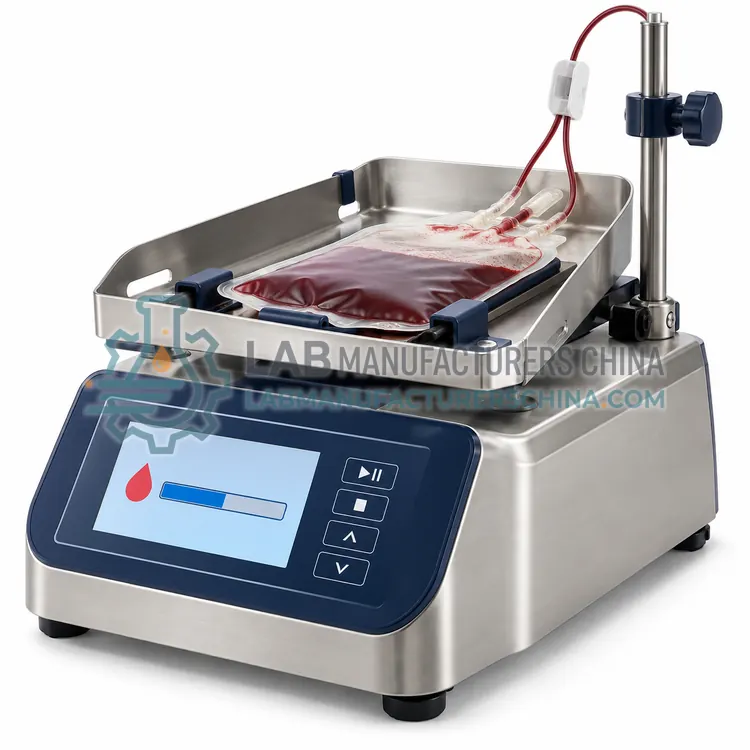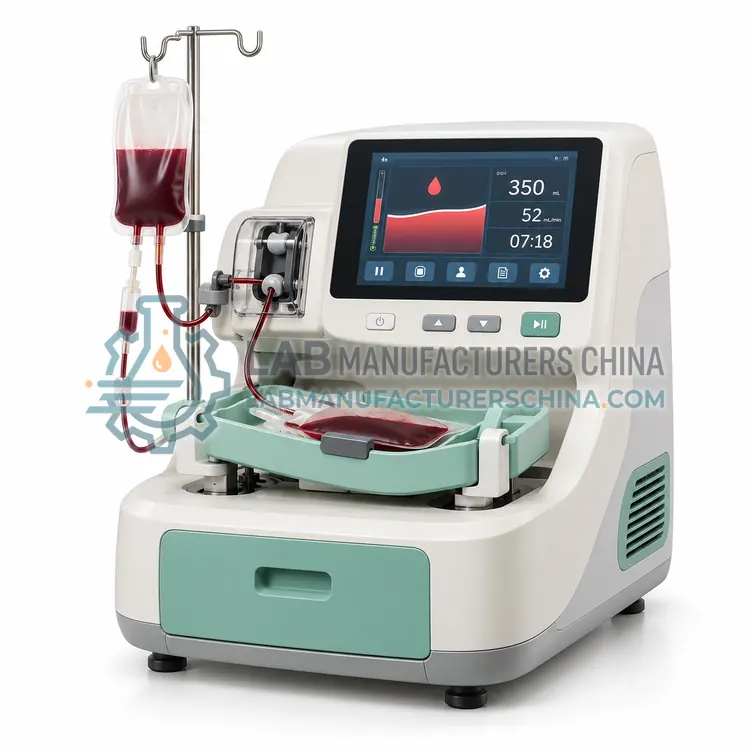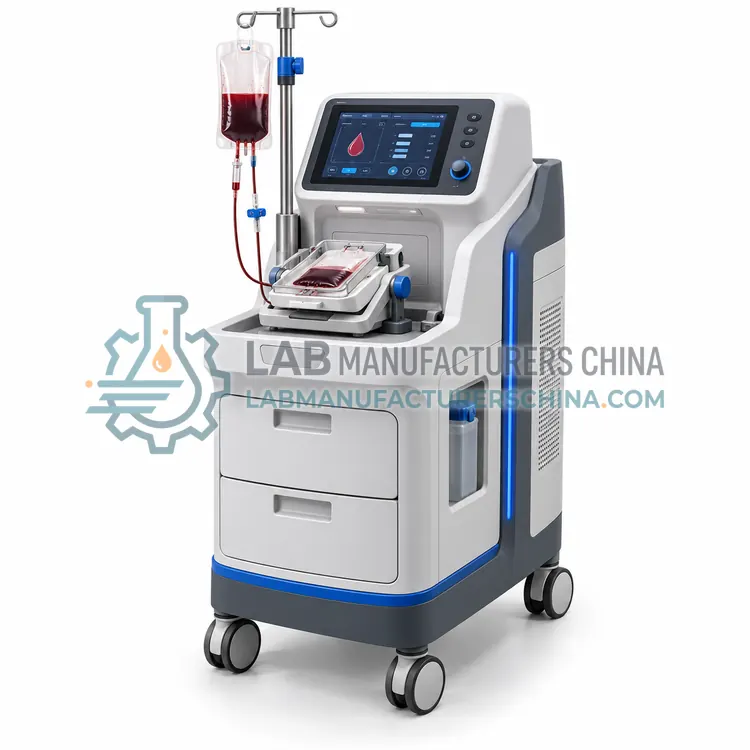
Dual-Bag Blood Collection Monitor
双袋采血监测仪
- SKU BCM-0002
- Blood Collection Monitors
- CE (to be confirmed)
- ISO 13485 (to be confirmed)
- IEC 60601-1 test report (to be confirmed)
Price on request — FOB / CIF quoted per order
Prices depend on configuration, quantity and destination port.
Key specifications
| Stations | 2 independent |
|---|---|
| Weighing range per station | 0–1000 g |
| Resolution | 1 g |
| Volume accuracy | ±5 mL at 450 mL |
| Rocking rate | 10–15 cycles/min |
| Target presets | 350 / 400 / 450 mL and custom |
Request a quote Download brochure · to be provided
By Lab Manufacturers China Technical TeamLast reviewed Standards: ISO 13485, IEC 60601-1, IEC 60601-1-2
What is the Dual-Bag Blood Collection Monitor?
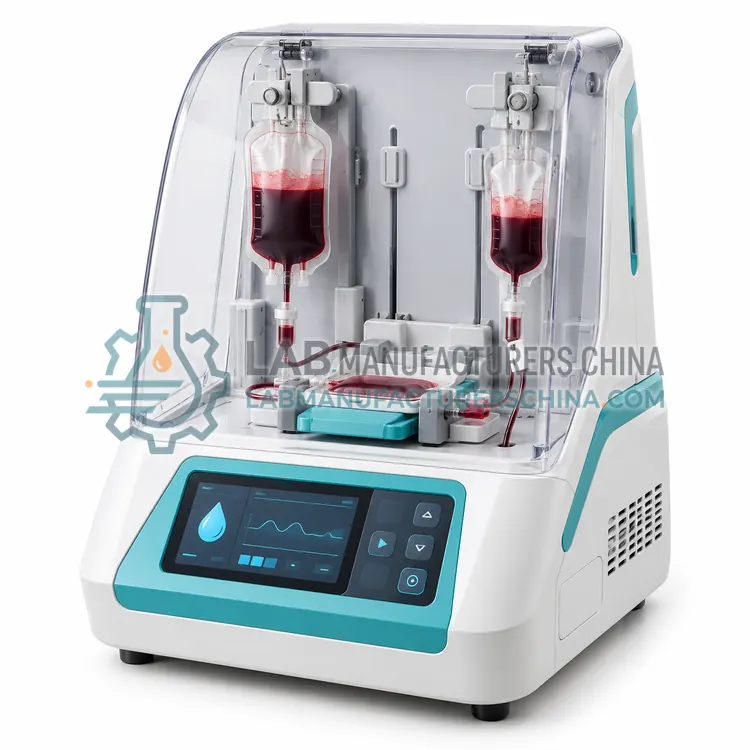
A dual-bag blood collection monitor has two independent rocking and weighing stations in one housing, letting one operator run two donors or two bags at the same time. It suits higher-throughput donor rooms that want to save bench space and cabling.
What is the Dual-Bag Blood Collection Monitor?
A dual-bag blood collection monitor has two independent rocking and weighing stations in one housing, letting one operator run two donors or two bags at the same time. It suits higher-throughput donor rooms that want to save bench space and cabling.
Overview
Each station of a dual-bag monitor has its own load cell, rocker motor and display channel, so donations can start and finish independently. Weight range and resolution are equal to single units, typically 1 g over 0–1000 g. A shared controller reduces cabling and gives a single power and data connection. Independent alarms, clamp outputs and target presets apply to each channel. Some models support collection sets with satellite bags for component separation. The footprint is usually 500–600 mm wide, less than two separate monitors. Failure of one station should not stop the other, so check that channels are electrically independent. The dual layout suits donor beds placed side by side and makes one central display of both donors practical for staff supervision.
How does it work?
A blood collection monitor combines a tilting or rocking platform, a load cell and a microcontroller. The donor's blood flows by gravity and venous pressure into the bag, which rests on the platform. The rocker mixes blood with citrate anticoagulant, for example CPD or CPDA-1, to prevent clotting. The load cell measures mass, and the controller converts it to volume using blood density, about 1.053 g/mL, and compares it with a target such as 450 mL ±10%. Flow rate and elapsed time are displayed, and the system alarms on low flow, over-time collection or incomplete mixing. Many models drive a pinch clamp or tubing clamp to stop flow automatically at the target, and record each donation for traceability.
What are the key features?
- Two independent stations with separate load cells and rockers
- Independent alarms and clamp outputs per channel
- Single power and data connection reduces cabling
- Weight resolution of 1 g over 0–1000 g per station
- Compact width under 600 mm for side-by-side donor beds
- Preset volume targets and custom entry per channel
What are the technical specifications?
A typical dual-bag blood collection monitor configuration offers stations of 2 independent, weighing range per station of 0–1000 g, resolution of 1 g, volume accuracy of ±5 mL at 450 mL, rocking rate of 10–15 cycles/min and target presets of 350 / 400 / 450 mL and custom. Values are indicative of the product class; the exact figures for each configuration are confirmed on the quotation and the calibration documents supplied with the instrument.
Which applications is it used for?
The Dual-Bag Blood Collection Monitor is used in high-throughput donor rooms, two-bed donation stations, blood center collection lines and mobile drives with mains power. Across the wider Blood Collection Monitors class, laboratories also deploy it for whole blood donation collection, mobile donation drives and hospital autologous donation.
Which standards and certifications apply?
Relevant standards and methods include ISO 13485, IEC 60601-1, IEC 60601-1-2, IEC 62304, ISO 3826-1 and AABB Standards for Blood Banks and Transfusion Services. Certification candidates for this model are CE, ISO 13485 and IEC 60601-1 test report; each is to be confirmed for the specific configuration before shipment, and certificates are supplied only where they have been issued.
Calibrate the load cell with certified weights at installation and on a regular schedule, commonly every six to twelve months, and verify mixing motion daily. Keep the platform level and free of vibration. Clean surfaces with approved disinfectants after each donor and inspect clamps for wear. Batteries on portable units need periodic replacement and charge logging. Software that stores donor data must follow data protection rules, and the device should be covered by the blood establishment's quality system. Keep service records and confirm electrical safety testing according to local rules.
How do I select the right Dual-Bag Blood Collection Monitor?
Choose the dual-bag monitor when two donors are supervised from one point and bench space is limited. Specify whether channels must be electrically independent, clamp outputs, display layout and data port. A single-bag unit is simpler where only one donor is bled at a time.
How does it compare with other Blood Collection Monitors variants?
Choose by collection setting. Fixed donor rooms can use mains-powered benchtop units, while mobile drives need battery-powered portable monitors. Check weight range and resolution, the accuracy of the volume calculation and whether mixing speed and angle are adjustable for your bag type. Automatic clamp, flow alarms and target presets reduce operator load. For traceability, consider barcode scanning, donor ID entry, bag lot recording and network output to the blood establishment information system. Confirm cleaning, tubing compatibility and operating hours per charge. Also check electrical safety class and how the device handles power interruption without losing donation data.
Full specifications
| Stations | 2 independent |
|---|---|
| Weighing range per station | 0–1000 g |
| Resolution | 1 g |
| Volume accuracy | ±5 mL at 450 mL |
| Rocking rate | 10–15 cycles/min |
| Target presets | 350 / 400 / 450 mL and custom |
| Display | Dual-channel LCD |
| Clamp outputs | 2, optional pinch clamps |
| Power supply | 100–240 V AC, 50/60 Hz |
| Dimensions (W×D×H) | approx. 560 × 290 × 150 mm |
Indicative values for this product class. Final specifications are confirmed on the quotation and in the calibration documents supplied with the instrument.
Applications
- High-throughput donor rooms
- Two-bed donation stations
- Blood center collection lines
- Mobile drives with mains power
Key features
- Two independent stations with separate load cells and rockers
- Independent alarms and clamp outputs per channel
- Single power and data connection reduces cabling
- Weight resolution of 1 g over 0–1000 g per station
- Compact width under 600 mm for side-by-side donor beds
- Preset volume targets and custom entry per channel
Frequently asked questions about Dual-Bag Blood Collection Monitor
Yes. Each channel has its own controller logic, display and alarms, so one donor can start while another is finishing. Confirm that an alarm on one channel does not mute the other and that both are visible to the operator.
Usually yes: a shared housing is about 500–600 mm wide against roughly 650 mm for two singles, and it has one power cord and data link. The saving is modest, so workflow and donor bed layout should decide.
A well-designed dual monitor keeps the second station working while the first is serviced or tagged out. Ask the supplier whether spare modules are available and whether calibration certificates cover each station separately.
It rocks the bag to mix blood with anticoagulant and weighs the bag to calculate collected volume and flow rate. The controller alarms or clamps the tubing when the target volume is reached or donation takes too long, helping produce consistent units and donor safety.
Accuracy depends on load cell resolution and the density constant, usually 1.053 g/mL for whole blood. Good units resolve 1 g or better and meet collection targets within a few milliliters, but donation volume tolerance in guidelines is typically ±10% of the target.
Anticoagulant in the bag must contact blood continuously or clots can form, which would make the unit unusable. Gentle rocking at a set rate distributes citrate through the flow, and alarms warn if the mixer stops during collection.