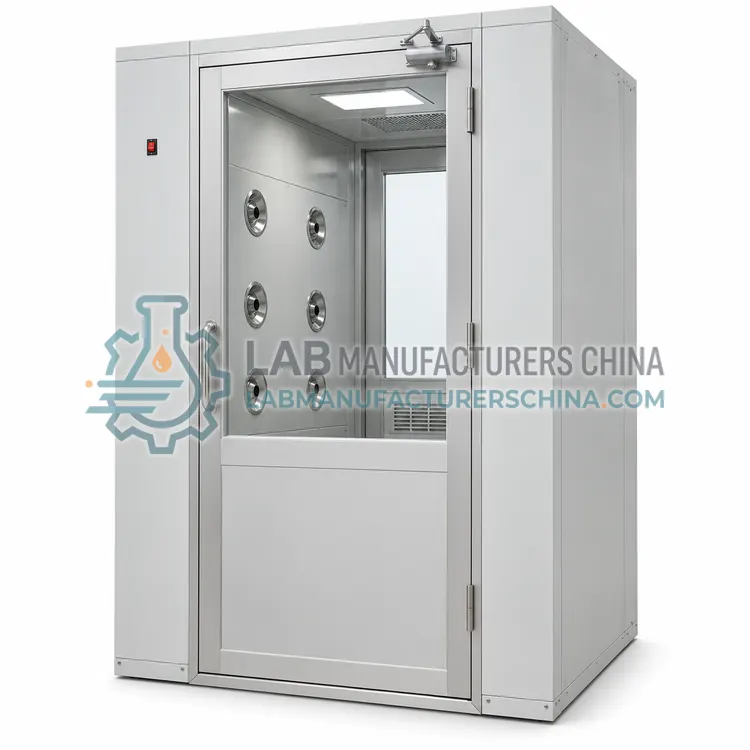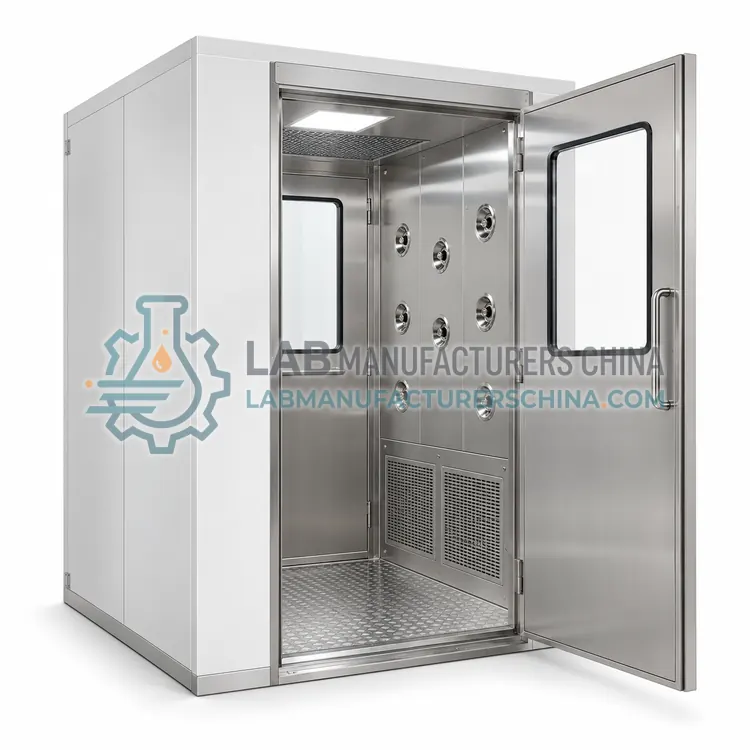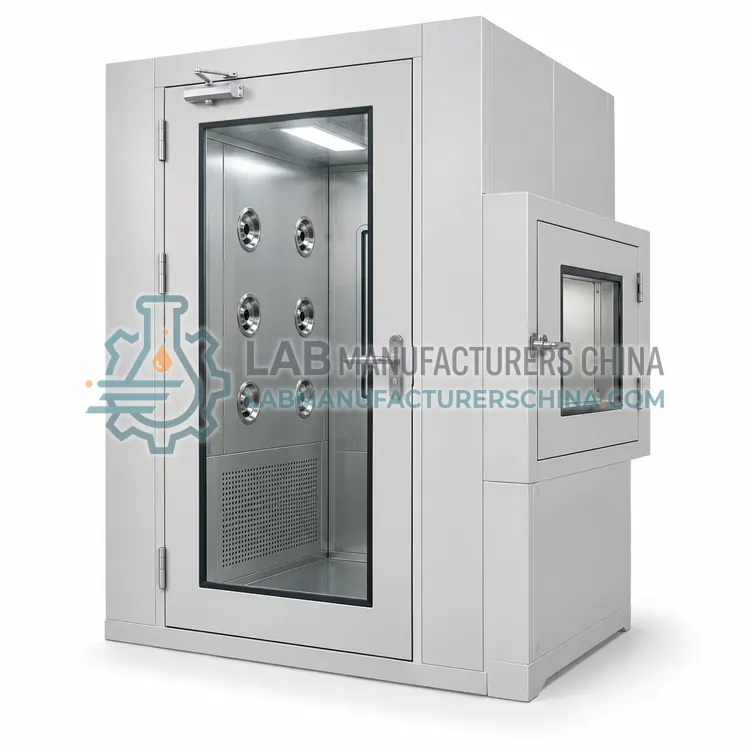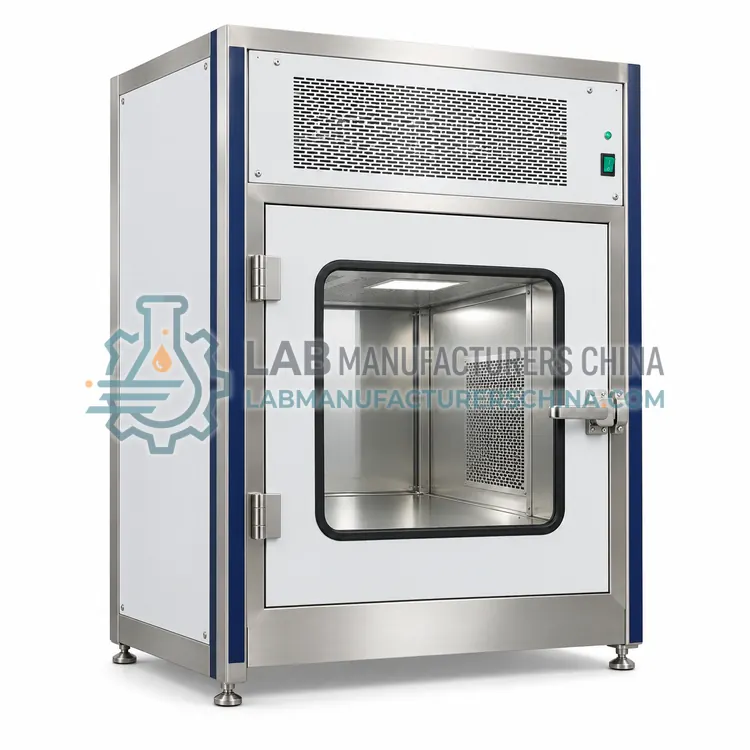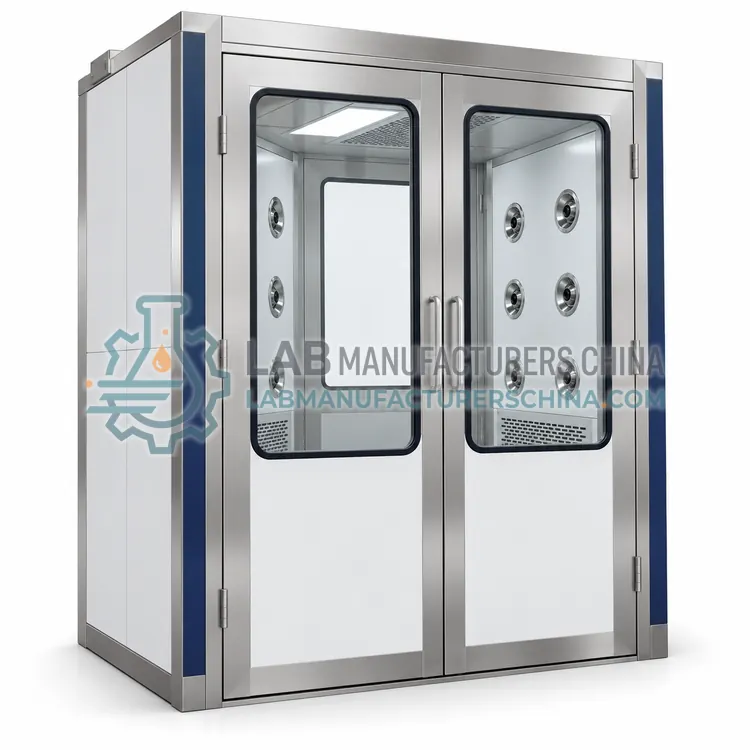
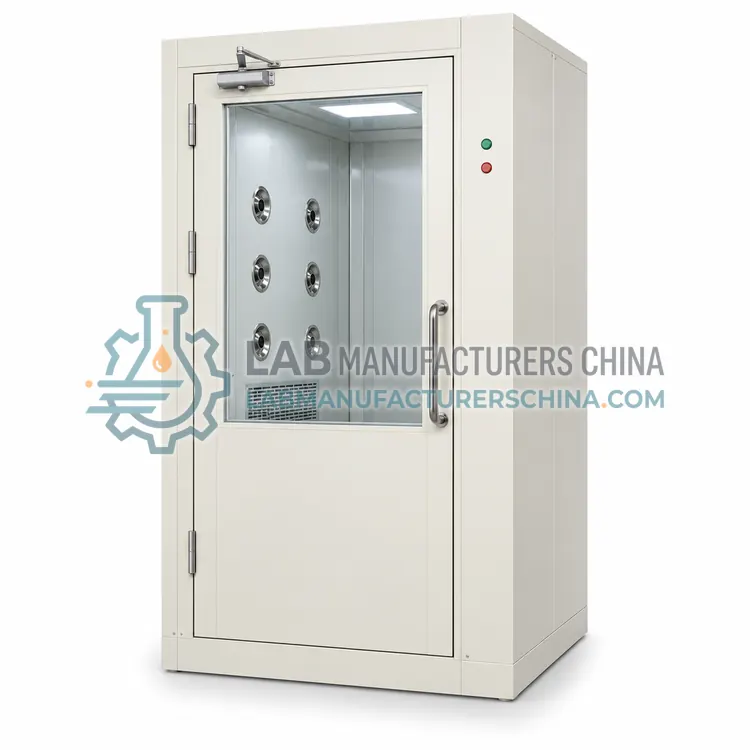
Single-Person Air Shower
单人风淋室
- SKU AIS-0001
- Air Showers
- CE (to be confirmed)
- ISO 9001 manufacturing (to be confirmed)
Price on request — FOB / CIF quoted per order
Prices depend on configuration, quantity and destination port.
Key specifications
| Nozzle outlet velocity | 20–25 m/s |
|---|---|
| Number of nozzles | 12–24 |
| Filter grade | H13 HEPA (99.99 % at MPPS) |
| Airflow | 1000–1500 m3/h |
| Cycle time | 15–99 s adjustable |
| Overall size | ≈ 1000 × 1000 × 2100 mm |
Request a quote Download brochure · to be provided
By Lab Manufacturers China Technical TeamLast reviewed Standards: ISO 14644-1 (cleanroom classification), ISO 14644-4 (cleanroom design and construction), GB 50073 (cleanroom design code)
What is the Single-Person Air Shower?
A single-person air shower is a compact interlocked chamber that cleans one operator per cycle with jets from the side, and sometimes the ceiling. It is the most common entry point to ISO 7–8 cleanrooms where staff numbers are moderate.
What is the Single-Person Air Shower?
A single-person air shower is a compact interlocked chamber that cleans one operator per cycle with jets from the side, and sometimes the ceiling. It is the most common entry point to ISO 7–8 cleanrooms where staff numbers are moderate.
Overview
The chamber typically measures about 1000 × 1000 × 2100 mm overall, with a 700–800 mm clear width. Two side panels carry 12–24 adjustable nozzles that deliver 20–25 m/s outlet velocity, while a prefilter and H13 HEPA filter recirculate air through side return grilles. A centrifugal blower moves around 1000–1500 m3/h. Doors are electromagnetically interlocked with an automatic entry sensor, and a cycle timer is set between 15 and 99 seconds. Panels are powder-coated cold-rolled steel or 304 stainless steel with a smooth interior. Mains supply is single-phase 220 V at about 1.0–1.5 kW. Units are supplied fully assembled or as flat-pack panels for installation through narrow doors.
How does it work?
An air shower draws room air through a prefilter and a HEPA or ULPA filter, then accelerates it through adjustable nozzles at 20–25 m/s so the jets strip loose particles and fibres from garments and skin. The contaminated air is captured by return grilles at floor or side level, passes the prefilter and recirculates, so the chamber itself stays clean. A centrifugal blower, a cycle timer typically set to 15–99 seconds, and interlocked doors complete the system: one door cannot open until the other is closed and the cycle finishes. Stainless steel or powder-coated steel panels provide smooth, cleanable surfaces. Sensors detect entry and start the shower automatically, and fluorescent lighting and an emergency release provide safe operation. Material showers use the same principle in a conveyor or pass-through format.
What are the key features?
- Interlocked doors with automatic entry sensor
- 12–24 adjustable nozzles at 20–25 m/s
- Prefilter plus H13 HEPA recirculation
- Timer adjustable 15–99 seconds
- Steel or 304 stainless steel cabinet
- Emergency release and internal lighting
What are the technical specifications?
A typical single-person air shower configuration offers nozzle outlet velocity of 20–25 m/s, number of nozzles of 12–24, filter grade of H13 HEPA (99.99 % at MPPS), airflow of 1000–1500 m3/h, cycle time of 15–99 s adjustable and overall size of ≈ 1000 × 1000 × 2100 mm. Values are indicative of the product class; the exact figures for each configuration are confirmed on the quotation and the calibration documents supplied with the instrument.
Which applications is it used for?
The Single-Person Air Shower is used in electronics assembly, pharmaceutical packaging, medical-device assembly and laboratory cleanrooms. Across the wider Air Showers class, laboratories also deploy it for electronics manufacturing, pharmaceutical production and medical-device assembly.
Which standards and certifications apply?
Relevant standards and methods include ISO 14644-1 (cleanroom classification), ISO 14644-4 (cleanroom design and construction), GB 50073 (cleanroom design code), JG/T 382 (air shower), EN 1822 (HEPA and ULPA filters) and IEC 61010-1. Certification candidates for this model are CE and ISO 9001 manufacturing; each is to be confirmed for the specific configuration before shipment, and certificates are supplied only where they have been issued.
Place the air shower between the gowning room and the classified area, with flat, level floors and an electrical supply of 220–380 V. Interlocks and emergency releases must be tested at commissioning, and a fire-rated door strategy confirmed with the building designer. Replace prefilters every 3–6 months and test the HEPA filter by DOP or PAO scan annually, measuring nozzle velocity with an anemometer. Clean stainless surfaces with compatible disinfectants and keep nozzles free of debris. Air showers do not replace gowning procedures, so define entry SOPs, and avoid using them in rooms where an air-lock with pressure cascade is already required by regulation.
How do I select the right Single-Person Air Shower?
Choose a single-person shower when fewer than roughly 20 staff enter per shift and each person can shower individually. For higher throughput move to a double-person or tunnel layout. RFQ details: room class, door size, panel material, power supply, cycle time and whether remote monitoring is needed.
How does it compare with other Air Showers variants?
Choose by who or what passes through, the room classification and the available space. Personnel showers are specified by the number of people per cycle, with single-person units the most common and two- or multi-person tunnels for higher flow. Cargo showers need a chamber sized for trolleys and loads, often with conveyor rollers. Check nozzle velocity, which should reach at least 20 m/s at the outlet, and the filter grade, HEPA H13 or H14 for ISO 5–8 areas. Consider panel material, stainless steel for pharma and powder-coated steel for electronics, plus interlock logic, cycle time and door type. Confirm fan noise, electrical supply and footprint. A bypass or manual override route must be planned for emergencies and equipment movement.
Full specifications
| Nozzle outlet velocity | 20–25 m/s |
|---|---|
| Number of nozzles | 12–24 |
| Filter grade | H13 HEPA (99.99 % at MPPS) |
| Airflow | 1000–1500 m3/h |
| Cycle time | 15–99 s adjustable |
| Overall size | ≈ 1000 × 1000 × 2100 mm |
| Clear interior width | 700–800 mm |
| Power supply | 220 V, 50 Hz, 1.0–1.5 kW |
| Panel material | Powder-coated steel or 304 SS |
| Noise level | ≤ 65 dB(A) |
Indicative values for this product class. Final specifications are confirmed on the quotation and in the calibration documents supplied with the instrument.
Applications
- Electronics assembly
- Pharmaceutical packaging
- Medical-device assembly
- Laboratory cleanrooms
Key features
- Interlocked doors with automatic entry sensor
- 12–24 adjustable nozzles at 20–25 m/s
- Prefilter plus H13 HEPA recirculation
- Timer adjustable 15–99 seconds
- Steel or 304 stainless steel cabinet
- Emergency release and internal lighting
Frequently asked questions about Single-Person Air Shower
With a typical 20-second cycle and door transitions, throughput is about 60–90 people per hour. Longer cycles reduce this. For shift changes with larger groups, a two-person unit or a tunnel layout avoids queues.
Flat-pack units can often be brought through a standard 900 mm door and assembled inside. The installer must check ceiling height, about 2100–2300 mm, floor levelness and an available 220 V supply before delivery.
No. An air shower uses recirculated air and has no water connection, so it needs only a power supply. Some designs add a small exhaust port or pressure relief, but no drain is required.
An air shower is an enclosed chamber that blows HEPA-filtered air at 20–25 m/s over people or goods entering a cleanroom to remove loose particles. Its interlocked doors also act as a partial airlock between the gowning area and the classified room.
Typical cycles run 15–99 seconds, with 15–30 seconds common for personnel. Longer times suit bulky garments or heavy loads, while shorter times maintain throughput. The cycle is set on a timer and should be validated against the facility's contamination requirements.
No. An air shower removes loose particles from already-gowned personnel but cannot replace cleanroom garments, hoods and gloves. It is one step in an entry procedure that includes changing rooms, garment control and hand hygiene.
Related models