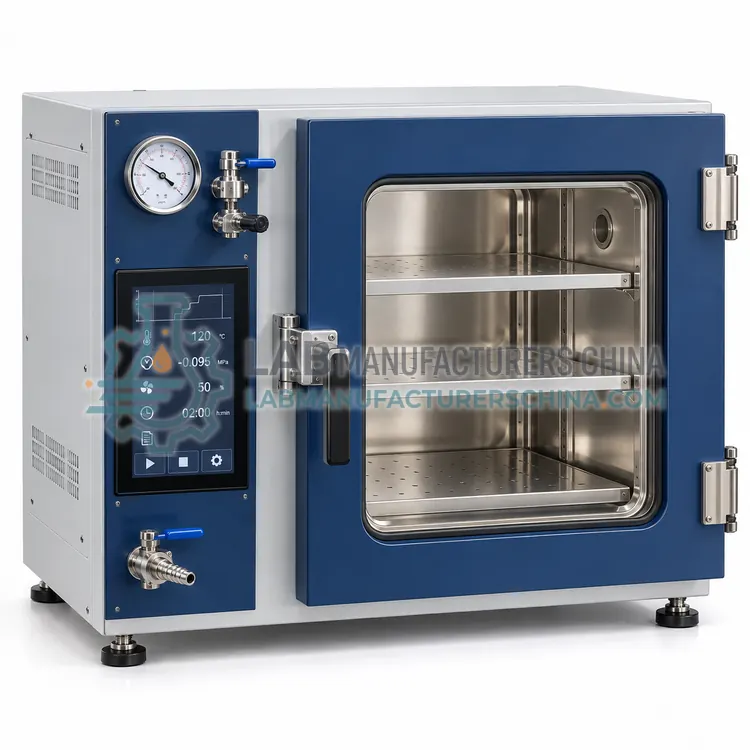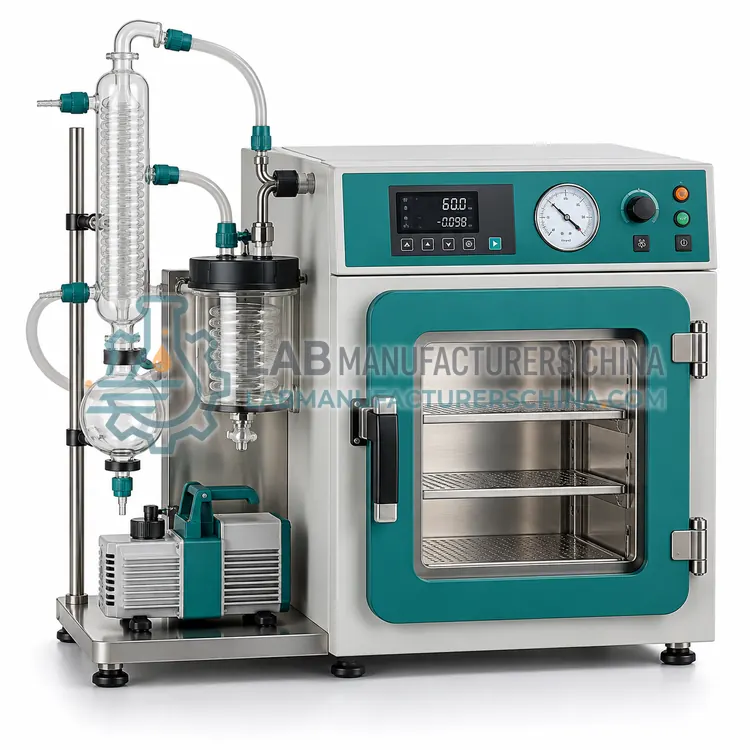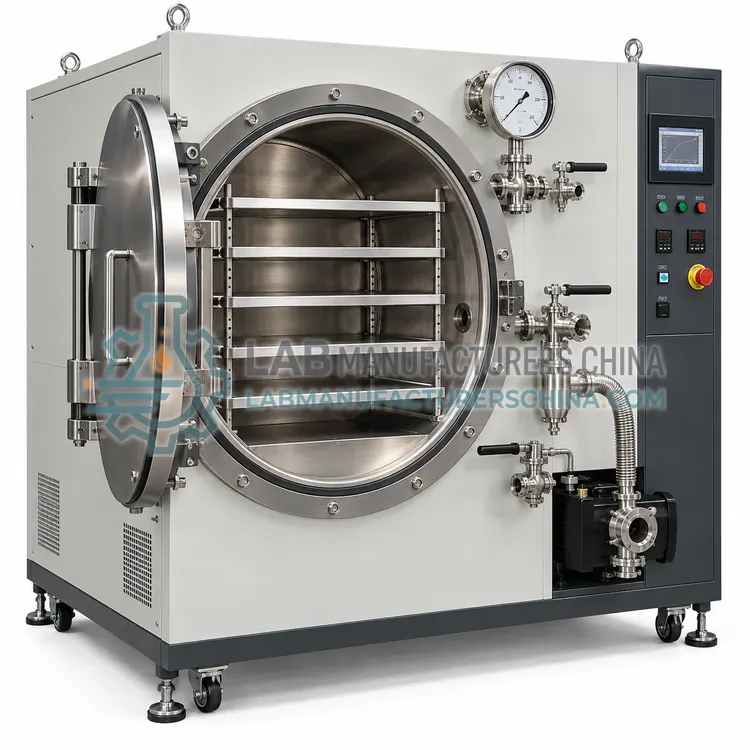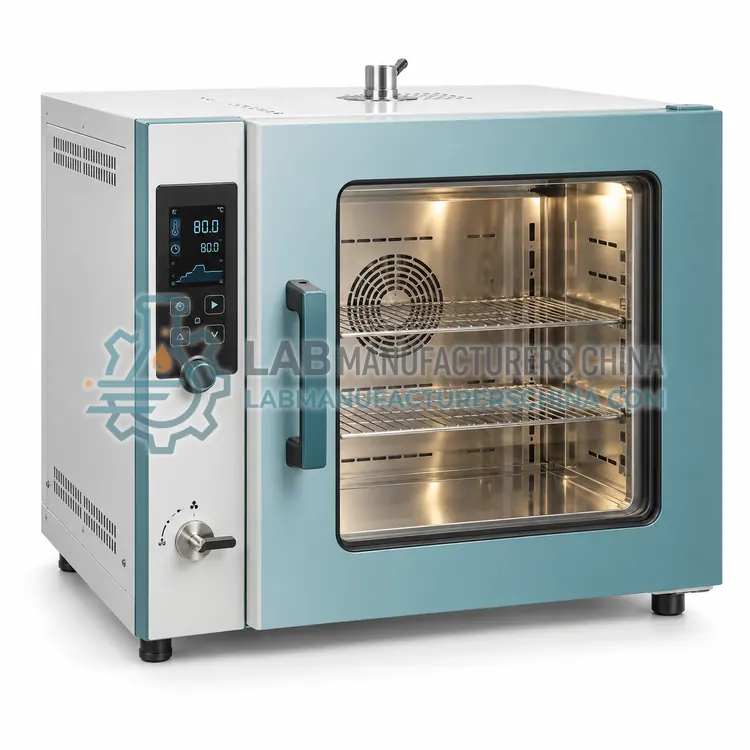
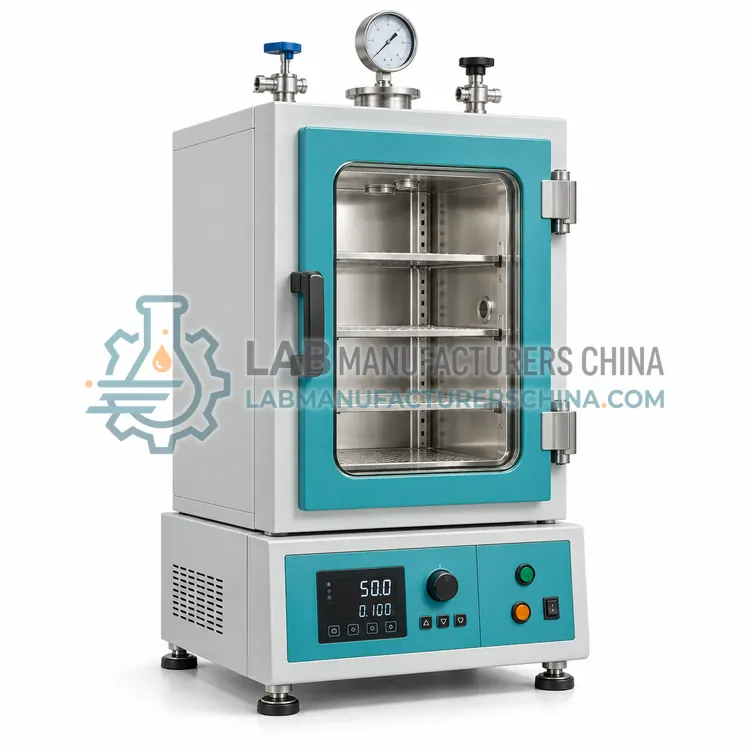
Vertical Vacuum Drying Oven
立式真空干燥箱
- SKU VAO-0002
- Vacuum Ovens
- CE (to be confirmed)
- ISO 9001 manufacturing (to be confirmed)
- RoHS (to be confirmed)
Price on request — FOB / CIF quoted per order
Prices depend on configuration, quantity and destination port.
Key specifications
| Chamber volume | 50–250 L |
|---|---|
| Temperature range | RT+10 to 250 C |
| Ultimate vacuum | ≤133 Pa |
| Temperature uniformity | ±2–5 C |
| Shelves supplied | 4–6 |
| Display resolution | 0.1 C |
Request a quote Download brochure · to be provided
By Lab Manufacturers China Technical TeamLast reviewed Standards: IEC 61010-1, IEC 61010-2-010, DIN 12880
What is the Vertical Vacuum Drying Oven?
A vertical vacuum drying oven uses a tall chamber with stacked shelves to dry taller or larger batches under reduced pressure. It is the right choice when floor or bench depth is limited but capacity and shelf area are needed.
What is the Vertical Vacuum Drying Oven?
A vertical vacuum drying oven uses a tall chamber with stacked shelves to dry taller or larger batches under reduced pressure. It is the right choice when floor or bench depth is limited but capacity and shelf area are needed.
Overview
The vertical vacuum oven places the chamber above the control base, giving a tall interior of about 50 to 250 liters with four to six shelves. This shape accepts taller vessels and larger flat loads than a benchtop box, but occupies less floor depth. Construction is similar, with a stainless steel chamber, reinforced door and jacket or shelf heating, and the control cabinet holds the PID controller, vacuum gauge, vent valve and pump connections. Temperature reaches 200 to 250 C, and vacuum performance matches comparable horizontal models. Because the door is at the front and the chamber is deep, loading is easier with trays, and several shelves allow separate batches to be dried in one cycle. It is often used where throughput must grow without expanding footprint.
How does it work?
A vacuum oven removes air from a sealed chamber with a pump, lowering the boiling point of water and solvents so evaporation proceeds quickly at moderate temperature. The chamber is a thick-walled vessel, usually stainless steel, with a reinforced door, silicone or fluororubber gasket and a transparent window. Heating comes from elements in the walls, a water or oil jacket, or heated shelves, so most heat reaches the sample by conduction and radiation rather than convection. A Pt100 sensor and PID controller hold the setpoint, while a vacuum gauge or sensor displays chamber pressure. Cold traps, solvent recovery units and inert-gas purge connections can be added for solvent-laden samples. The mild cycle protects thermolabile and easily oxidized materials.
What are the key features?
- Tall chamber of 50 to 250 liters with four to six shelves
- Front-opening reinforced door for tray loading
- Stainless steel interior with jacket or shelf heating
- Integrated control cabinet with PID controller and vacuum gauge
- Cold trap and inert gas ports
- Independent over-temperature limiter
What are the technical specifications?
A typical vertical vacuum drying oven configuration offers chamber volume of 50–250 L, temperature range of RT+10 to 250 C, ultimate vacuum of ≤133 Pa, temperature uniformity of ±2–5 C, shelves supplied of 4–6 and display resolution of 0.1 C. Values are indicative of the product class; the exact figures for each configuration are confirmed on the quotation and the calibration documents supplied with the instrument.
Which applications is it used for?
The Vertical Vacuum Drying Oven is used in multi-shelf batch drying, tall vessel and tray drying, electronics and optical part processing and pharmaceutical sample preparation. Across the wider Vacuum Ovens class, laboratories also deploy it for heat-sensitive powder drying, degassing of liquids and resins and drying electronic and optical components.
Which standards and certifications apply?
Relevant standards and methods include IEC 61010-1, IEC 61010-2-010, DIN 12880, ISO 9001 and GB/T 30435. Certification candidates for this model are CE, ISO 9001 manufacturing and RoHS; each is to be confirmed for the specific configuration before shipment, and certificates are supplied only where they have been issued.
Vacuum ovens need a compatible pump, usually a rotary-vane or dry pump, and for solvent work a cold trap to protect the pump and recover vapour. Never use a vacuum oven as a pressure vessel, and never open the door until the chamber is vented to atmosphere. Place the oven on a stable surface with pump clearance and route exhaust safely. Calibrate temperature and verify vacuum tightness periodically, checking the door gasket for wear and replacing it as needed. Clean shelves and chamber after solvent use, and keep a log of pump oil changes or dry-pump service.
How do I select the right Vertical Vacuum Drying Oven?
Select the vertical vacuum oven when several shelves or taller vessels are needed and floor depth is constrained. Benchtop models are cheaper for single-tray work, while horizontal floor models offer a wider working area. In the RFQ, specify volume, number of shelves, temperature, ultimate vacuum, pump type and door opening direction.
How does it compare with other Vacuum Ovens variants?
Choose a vacuum oven when the sample degrades at the drying temperature, oxidizes in air, or contains a solvent that must be recovered. Start with chamber volume and shelf area against batch size, then set temperature range, usually up to 200 or 250 C, and the required ultimate vacuum, from about 133 Pa for general drying to below 10 Pa for demanding work. Decide whether you need heated shelves for better conduction or a jacket-heated chamber. Check the gasket and window material if aggressive solvents are used, and specify a cold trap or solvent recovery unit. Confirm pump compatibility, controller profile, safety interlocks and electrical supply.
Full specifications
| Chamber volume | 50–250 L |
|---|---|
| Temperature range | RT+10 to 250 C |
| Ultimate vacuum | ≤133 Pa |
| Temperature uniformity | ±2–5 C |
| Shelves supplied | 4–6 |
| Display resolution | 0.1 C |
| Timer range | 1–9999 min |
| Heating power | 1.5–3 kW |
| Interior material | 304 stainless steel |
| Power supply | 220/380 V, 50/60 Hz |
Indicative values for this product class. Final specifications are confirmed on the quotation and in the calibration documents supplied with the instrument.
Applications
- Multi-shelf batch drying
- Tall vessel and tray drying
- Electronics and optical part processing
- Pharmaceutical sample preparation
Key features
- Tall chamber of 50 to 250 liters with four to six shelves
- Front-opening reinforced door for tray loading
- Stainless steel interior with jacket or shelf heating
- Integrated control cabinet with PID controller and vacuum gauge
- Cold trap and inert gas ports
- Independent over-temperature limiter
Frequently asked questions about Vertical Vacuum Drying Oven
Most vertical models ship with four to six adjustable shelves, and the spacing can be changed for taller items. Each shelf must remain in good thermal contact with the heating surface, and overloading a single shelf reduces both uniformity and vacuum performance.
Yes. Vacuum performance depends on the pump, gasket and chamber sealing rather than orientation, so vertical and benchtop models of similar construction reach comparable pressures, typically 133 Pa with a single-stage pump.
They pack several shelves into a small floor depth, so a laboratory can dry multiple batches or larger trays in one cycle without expanding its footprint. Loading tall vessels through the front door is also easier than with a shallow horizontal chamber.
Under vacuum, water and solvents boil at lower temperature, so samples dry faster and at lower heat, with less oxidation. This protects thermolabile, oxygen-sensitive and reactive materials that would degrade in a conventional oven.
Typical chambers reach about 133 Pa with a rotary-vane pump, and below 10 Pa with a two-stage pump and good seals. Practical working pressure also depends on the vapour load, so drying usually occurs at a few hundred to a few thousand pascals.
A cold trap is recommended whenever solvents or large amounts of water are evaporated. It condenses vapour before it reaches the pump, protecting pump oil and seals and allowing solvent recovery. It is less critical for dry, low-vapour samples.
Related models