Ultrasonic Homogenizer with Sound-Proof Enclosure
带隔音罩的超声波均质机
- SKU ULH-0005
- Ultrasonic Homogenizers
- CE (to be confirmed)
- RoHS (to be confirmed)
- ISO 9001 manufacturing (to be confirmed)
Price on request — FOB / CIF quoted per order
Prices depend on configuration, quantity and destination port.
Key specifications
| Frequency | 20 kHz |
|---|---|
| Output power | 100–1,200 W |
| Working volume | 0.5–250 mL |
| Noise level (enclosed) | 60–70 dB(A) |
| Probe diameter | 2–20 mm |
| Probe material | Titanium alloy |
Request a quote Download brochure · to be provided
By Lab Manufacturers China Technical TeamLast reviewed Standards: IEC 61010-1, IEC 61010-2-051, IEC 62127-1
What is the Ultrasonic Homogenizer with Sound-Proof Enclosure?
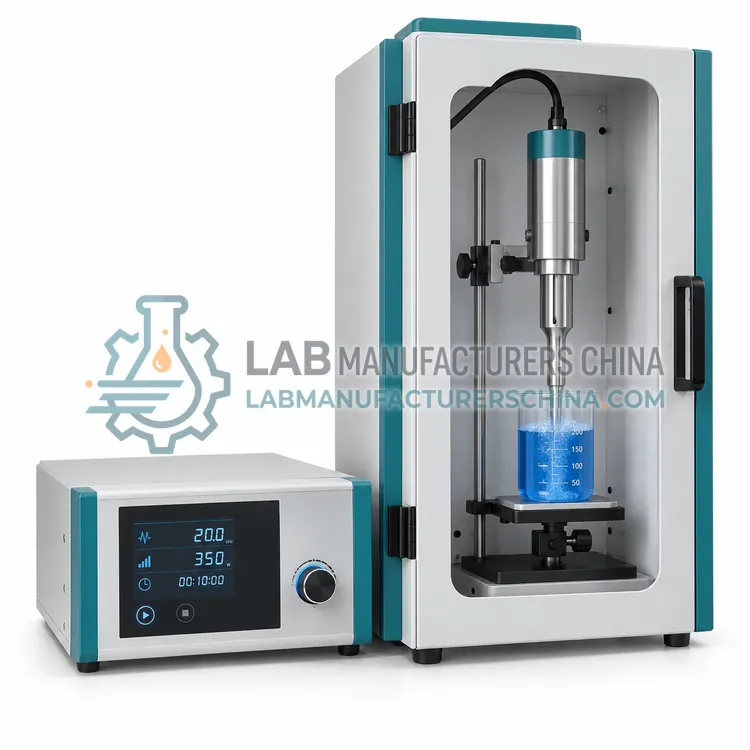
An ultrasonic homogenizer with sound-proof enclosure integrates the generator, probe and a noise-absorbing chamber with an interlocked door. It lowers noise below 70 dB(A) and protects users in shared laboratories and biosafety-conscious workflows.
What is the Ultrasonic Homogenizer with Sound-Proof Enclosure?
An ultrasonic homogenizer with sound-proof enclosure integrates the generator, probe and a noise-absorbing chamber with an interlocked door. It lowers noise below 70 dB(A) and protects users in shared laboratories and biosafety-conscious workflows.
Overview
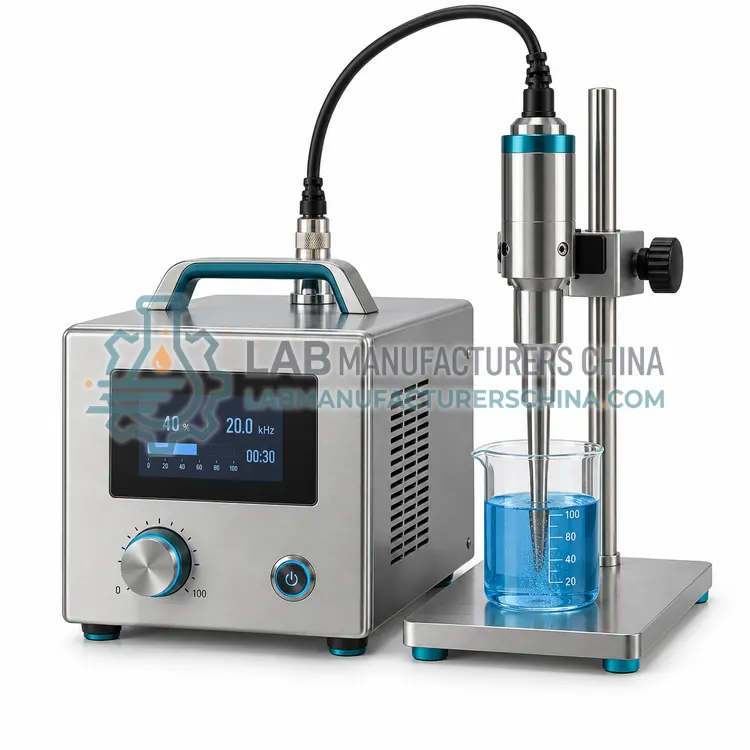
This variant houses a probe-type ultrasonic homogenizer in an enclosure lined with sound-absorbing foam and closed by an interlocked door. Noise at the operator position falls from above 90 dB(A) to about 60 to 70 dB(A). Inside, a stand positions the probe and a holder for tubes or beakers, and an ice bath or cooling plate helps control temperature. A safety interlock cuts power when the door opens. Generators range from 100 to 1,200 W at 20 kHz, with a display for amplitude, pulse time, energy and temperature, and the door often includes a viewing window. Some models have a motor-driven lift for the probe or sample. The enclosure reduces aerosol spread when combined with a filter, and is convenient in shared rooms. It adds cost and bench space but improves user safety and compliance with workplace noise limits.
How does it work?
An ultrasonic generator converts mains power into a high-frequency electrical signal, typically 20 kHz, which drives a piezoelectric transducer. The transducer expands and contracts to produce longitudinal vibration, and a booster and a horn or probe amplify this motion to amplitudes of 20 to 200 micrometers at the tip. When the tip vibrates in liquid, alternating pressure waves form microscopic vacuum bubbles that grow and collapse violently, a process called cavitation. The collapse creates localized high temperature, pressure and shear jets, which rupture cells, break agglomerates and form emulsions. Key components are the generator, transducer, booster, probe or tip, and optional temperature sensor and sound enclosure. Amplitude, pulse mode, treatment time and probe diameter determine the energy delivered per volume. Cooling is essential because the process heats samples.
What are the key features?
- Sound-absorbing enclosure reduces noise to about 60–70 dB(A)
- Interlocked door cuts power when opened
- Stand and holder position the probe and sample precisely
- Display of amplitude, pulse time, energy and temperature
- Viewing window and internal light for sample monitoring
- Power of 100–1,200 W at 20 kHz
What are the technical specifications?
A typical ultrasonic homogenizer with sound-proof enclosure configuration offers frequency of 20 kHz, output power of 100–1,200 W, working volume of 0.5–250 mL, noise level (enclosed) of 60–70 dB(A), probe diameter of 2–20 mm and probe material of Titanium alloy. Values are indicative of the product class; the exact figures for each configuration are confirmed on the quotation and the calibration documents supplied with the instrument.
Which applications is it used for?
The Ultrasonic Homogenizer with Sound-Proof Enclosure is used in shared laboratory sonication, biosafety-conscious lysis, nanoparticle dispersion, teaching and core facilities and method-driven sample preparation. Across the wider Ultrasonic Homogenizers class, laboratories also deploy it for cell lysis and protein extraction, nanoparticle and graphene dispersion and nanoemulsion and liposome preparation.
Which standards and certifications apply?
Relevant standards and methods include IEC 61010-1, IEC 61010-2-051, IEC 62127-1, ISO 13320 and GB 4793.1. Certification candidates for this model are CE, RoHS and ISO 9001 manufacturing; each is to be confirmed for the specific configuration before shipment, and certificates are supplied only where they have been issued.
Always protect hearing, because ultrasonic units produce audible noise and subharmonics; use a sound enclosure or ear protection. Immerse the probe to the recommended depth and keep it centered without touching the vessel wall. Cool samples in an ice bath and use pulsed operation to limit heat, especially for proteins and RNA. Never run the probe in air, because this can damage the transducer. Inspect the tip for pitting and replace it when erosion is visible, since tip wear changes delivered power. Calibrate power output periodically with calorimetry. Clean with water or alcohol after each sample. Comply with IEC 61010-1 and local noise regulations, and use biosafety precautions because sonication can generate aerosols.
How do I select the right Ultrasonic Homogenizer with Sound-Proof Enclosure?
Choose an enclosed unit for shared or teaching laboratories where noise and operator safety matter. An open probe system is acceptable in a dedicated sonication room with hearing protection. In the RFQ, specify volume range, internal dimensions, cooling method and interlock requirements.
How does it compare with other Ultrasonic Homogenizers variants?
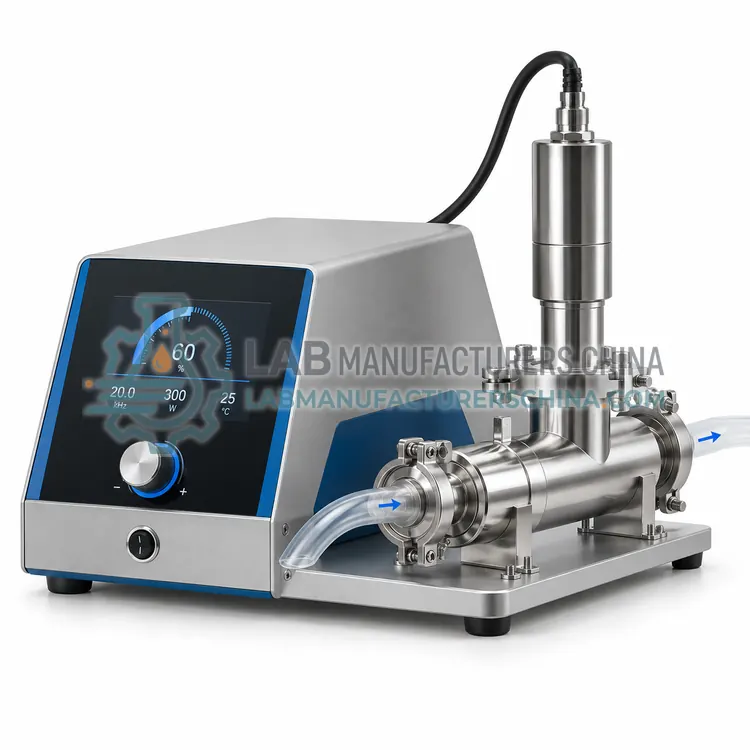
Select an ultrasonic homogenizer by power, frequency, sample volume and format. Probe-type units deliver the highest energy density and are used for cell lysis and nanoparticle dispersion, with power from 100 to 1,200 W. Microtip probes handle volumes from 0.2 to 10 mL. Cup-horn systems treat sealed tubes indirectly and avoid aerosol and cross-contamination. Flow-through cells support continuous processing from milliliters to liters per minute. Enclosures reduce noise, which can reach 90 dB(A) or more without protection. Verify that the probe material, usually titanium alloy, is compatible with the sample, and check the availability of replacement tips. Consider pulse control, temperature sensing, amplitude stability and data logging. Ask for treatment time and energy per volume to allow method reproducibility across instruments.
Full specifications
| Frequency | 20 kHz |
|---|---|
| Output power | 100–1,200 W |
| Working volume | 0.5–250 mL |
| Noise level (enclosed) | 60–70 dB(A) |
| Probe diameter | 2–20 mm |
| Probe material | Titanium alloy |
| Door safety | Interlock cuts power on opening |
| Display | Amplitude, time, energy, temperature |
| Enclosure material | Steel with acoustic foam lining |
| Internal dimensions | 300 × 300 × 400 mm |
| Power supply | 100–240 V, 50/60 Hz |
Indicative values for this product class. Final specifications are confirmed on the quotation and in the calibration documents supplied with the instrument.
Applications
- Shared laboratory sonication
- Biosafety-conscious lysis
- Nanoparticle dispersion
- Teaching and core facilities
- Method-driven sample preparation
Key features
- Sound-absorbing enclosure reduces noise to about 60–70 dB(A)
- Interlocked door cuts power when opened
- Stand and holder position the probe and sample precisely
- Display of amplitude, pulse time, energy and temperature
- Viewing window and internal light for sample monitoring
- Power of 100–1,200 W at 20 kHz
Frequently asked questions about Ultrasonic Homogenizer with Sound-Proof Enclosure
Enclosures typically lower noise at the operator position to about 60 to 70 dB(A), compared with 90 dB(A) or more for open probes. Actual values depend on power and sample.
It limits spread of aerosols and sprays, but it is not a biosafety cabinet. For infectious material use a sealed tube, a cup horn or a biosafety cabinet.
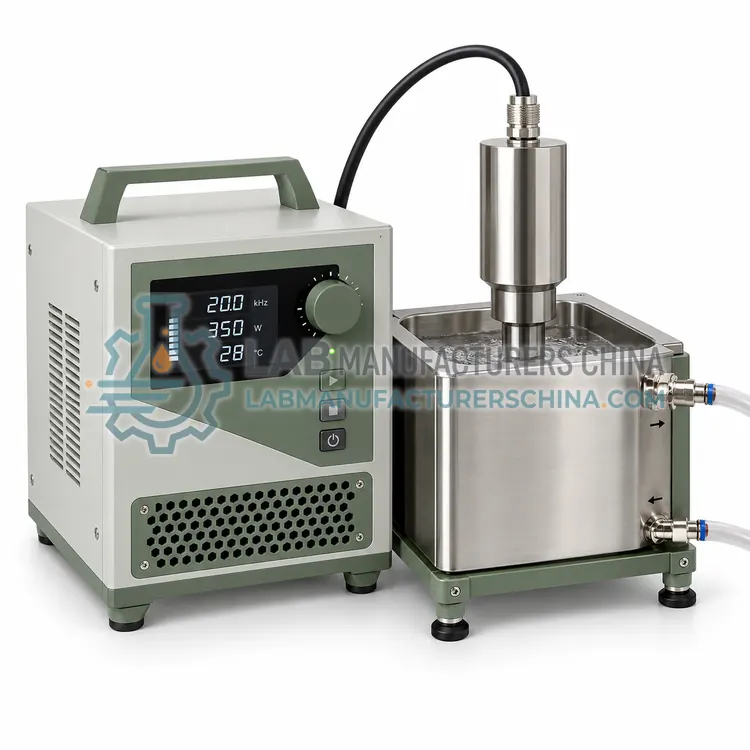
Most enclosures accommodate an ice bath or cooling plate. Confirm internal height and whether a circulating chiller can be routed through the wall.
An ultrasonic homogenizer transmits 20 kHz vibration through a probe to create cavitation in liquid. It lyses cells, disperses nanoparticles, emulsifies and degasses samples in biology, pharmaceutical, materials and chemical laboratories.
Pressure waves form microscopic bubbles that collapse violently, producing shear jets and local heat. These forces rupture cell walls and membranes, releasing contents, and also break agglomerates and form emulsions.
A probe touches the sample and gives the highest intensity, while a cup horn treats sealed tubes through a water bath. The cup horn avoids aerosols and contamination but is slower.
Related models