Microfluidic Syringe Pump
微流控注射泵
- SKU SYP-0005
- Syringe Pumps
- CE (to be confirmed)
- RoHS (to be confirmed)
- ISO 9001 manufacturing (to be confirmed)
Price on request — FOB / CIF quoted per order
Prices depend on configuration, quantity and destination port.
Key specifications
| Flow range | 0.1 nL/min–500 µL/min |
|---|---|
| Syringe sizes | 10 µL–1,000 µL |
| Flow stability | ± 0.5–1 % |
| Motor type | Stepper with fine microstepping |
| Dead volume | Below 10 µL with matched fittings |
| Pressure sensor | Optional, 0–30 bar |
Request a quote Download brochure · to be provided
By Lab Manufacturers China Technical TeamLast reviewed Standards: IEC 61010-1, IEC 60601-2-24, IEC 61326-1
What is the Microfluidic Syringe Pump?
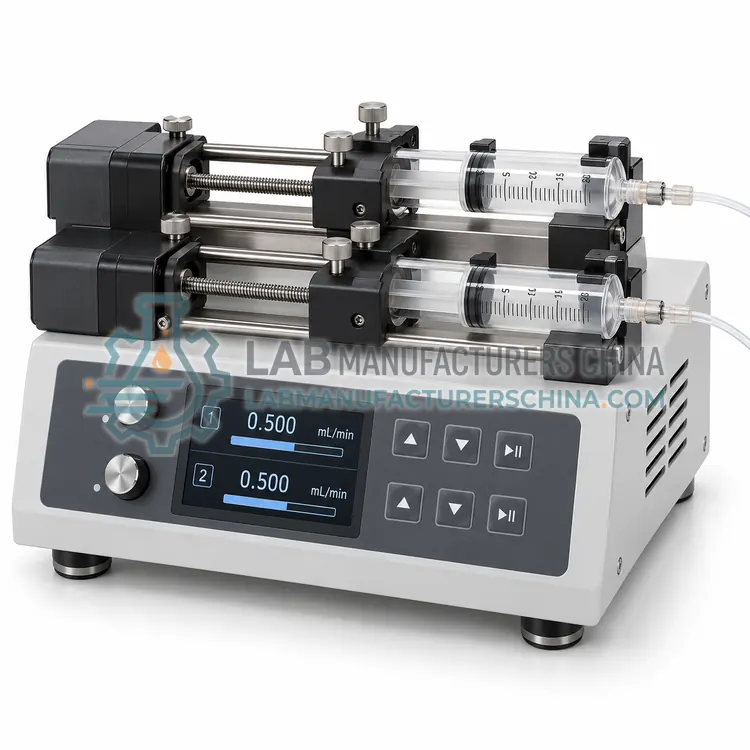
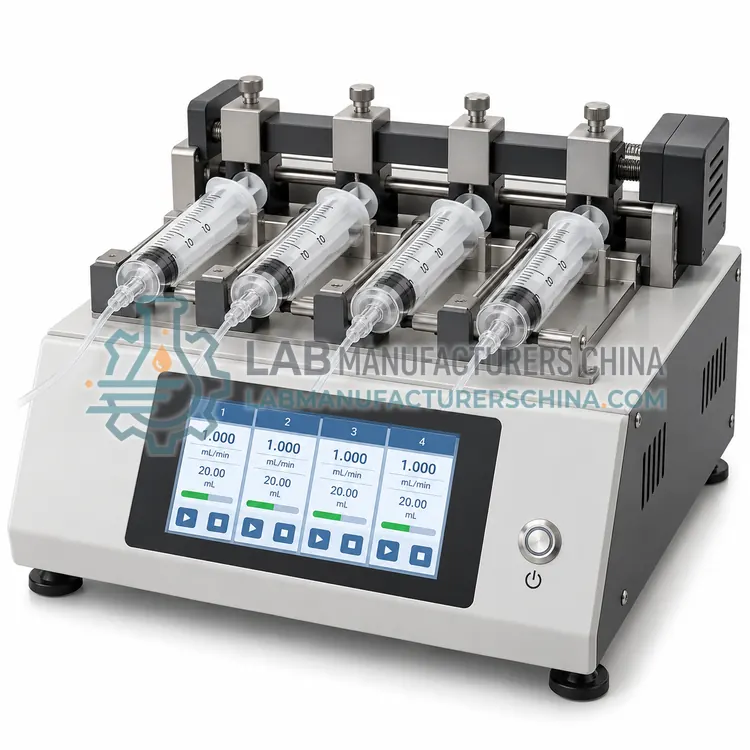
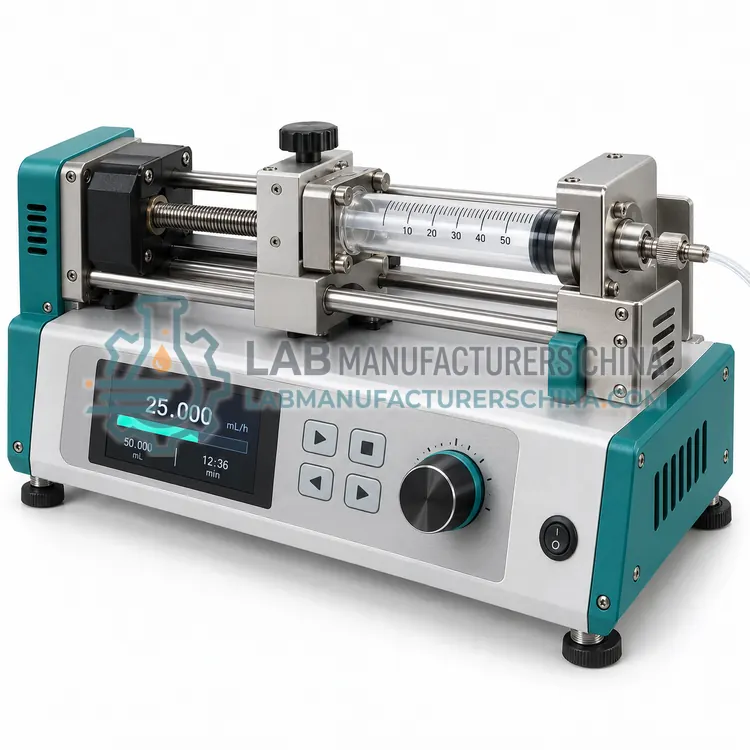
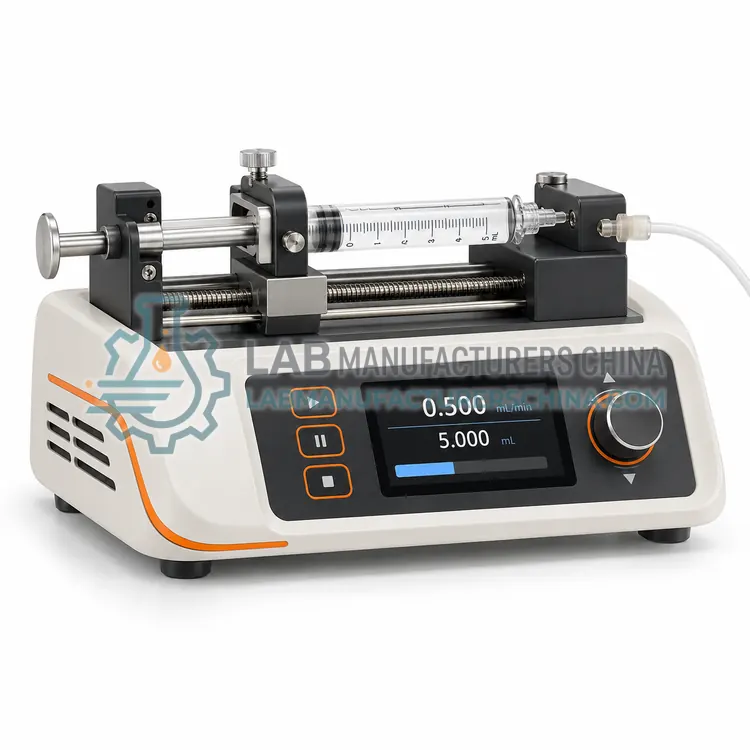
A microfluidic syringe pump delivers nanoliter to microliter flows with high stability for chips, perfusion and droplet systems. It uses small syringes and fine microstepping to minimize pulsation and overall dead volume.
What is the Microfluidic Syringe Pump?
A microfluidic syringe pump delivers nanoliter to microliter flows with high stability for chips, perfusion and droplet systems. It uses small syringes and fine microstepping to minimize pulsation and overall dead volume.
Overview
The microfluidic syringe pump is optimized for very low flows. Syringes of 10 to 1,000 microliters are driven by a finely microstepped motor, giving flows from about 0.1 nanoliters per minute up to several hundred microliters per minute. Very small lead-screw steps and rigid connections keep pulsation to a minimum, which is critical for droplet generation, laminar co-flow and long perfusion experiments where each fluctuation alters the result. Dead volume in the connection to the chip is kept low with short, small-bore tubing and fittings matched to the chip port. Some systems integrate pressure sensors to detect channel blockage, which is common in microfluidic chips. The pump can be programmed for constant flow, ramps and alternating cycles, and multiple units can be synchronized for co-flow and gradient experiments.
How does it work?
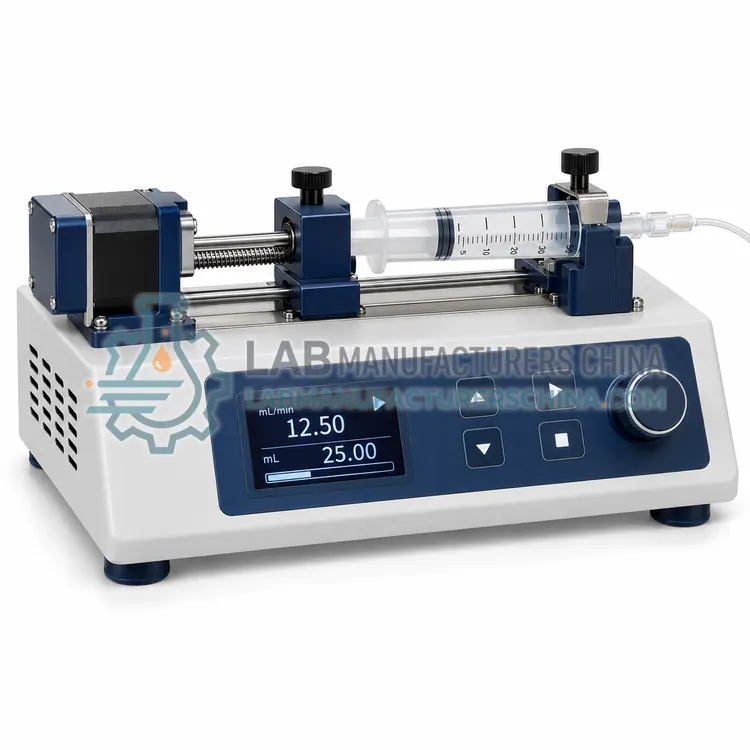
A syringe pump holds a syringe in a clamp and advances the plunger with a lead screw turned by a stepper motor. Flow rate equals the plunger cross-sectional area multiplied by the linear speed, so a small syringe gives a very low flow and a large syringe gives a higher flow at the same motor speed. Because the drive is positive displacement and continuous, flow is smooth and independent of back pressure until the motor stalls, which makes these pumps valuable for microfluidics, chromatography and infusion. Typical components are the drive mechanism, syringe clamp, control electronics and often a pressure sensor or valve. Pumps range from microliter syringes delivering nanoliters per minute to large syringes delivering hundreds of milliliters per minute, and multi-syringe configurations add parallel or mixing functions.
What are the key features?
- Flows from 0.1 nL/min to several hundred µL/min
- Fine microstepping for minimal pulsation
- Low dead volume with short small-bore connections
- Pressure sensor option for blockage detection
- Programmable ramps and alternating cycles
- Synchronization of multiple pumps for co-flow
What are the technical specifications?
A typical microfluidic syringe pump configuration offers flow range of 0.1 nL/min–500 µL/min, syringe sizes of 10 µL–1,000 µL, flow stability of ± 0.5–1 %, motor type of Stepper with fine microstepping, dead volume of Below 10 µL with matched fittings and pressure sensor of Optional, 0–30 bar. Values are indicative of the product class; the exact figures for each configuration are confirmed on the quotation and the calibration documents supplied with the instrument.
Which applications is it used for?
The Microfluidic Syringe Pump is used in droplet generation, organ-on-chip perfusion, laminar co-flow studies, microreactor reagent feed and cell and particle manipulation. Across the wider Syringe Pumps class, laboratories also deploy it for microfluidic and lab-on-chip flow control, continuous reagent and nutrient infusion and chromatography sample injection.
Which standards and certifications apply?
Relevant standards and methods include IEC 61010-1, IEC 60601-2-24, IEC 61326-1, ISO 9001 and GB 4793.1. Certification candidates for this model are CE, RoHS and ISO 9001 manufacturing; each is to be confirmed for the specific configuration before shipment, and certificates are supplied only where they have been issued.
Prime the syringe and line to remove air, because bubbles compress and introduce flow error. Keep the line short and rigid to minimize compliance, which otherwise delays response and lowers accuracy at high pressure. Note the syringe size and manufacturer, since bore tolerances affect delivered volume, and recalibrate whenever the syringe type changes. Do not exceed the pressure rating of the syringe or the drive, and use a pressure sensor or stall detection on restricted systems. Avoid leaving highly viscous or crystallizing fluids in the syringe, and clean the plunger and seal regularly. Follow IEC 61010-1 for electrical safety. For regulated infusion, verify flow gravimetrically and record calibration data, since the pump is often a critical control in the method.
How do I select the right Microfluidic Syringe Pump?
Choose a microfluidic syringe pump when flows below about 500 microliters per minute and low pulsation are essential, such as droplet or perfusion work. For larger flows a standard syringe pump is more economical. In the RFQ, state flow range, syringe size, fittings and chip interface.
How does it compare with other Syringe Pumps variants?
Start with the required flow rate and syringe size, then choose the drive resolution and speed range that covers it. For nanoliter to microliter flows, a microfluidic pump with a small syringe gives the best stability. For high pressure, choose refractory or stainless steel syringes and a reinforced drive, and note the maximum pressure and any valves needed. Decide how many syringes must run at once: dual and multi-channel pumps allow parallel infusion and mixing. Check whether the pump supports programmable profiles such as ramps, pulses and refill cycles, and whether it can be controlled by software or external signals for integration. Verify wetted materials for chemical compatibility and choose the syringe type, since glass, plastic and steel each have limits. Calibration and flow verification complete the selection.
Full specifications
| Flow range | 0.1 nL/min–500 µL/min |
|---|---|
| Syringe sizes | 10 µL–1,000 µL |
| Flow stability | ± 0.5–1 % |
| Motor type | Stepper with fine microstepping |
| Dead volume | Below 10 µL with matched fittings |
| Pressure sensor | Optional, 0–30 bar |
| Connection | 1/32 in or 1/16 in fittings |
| Modes | Constant flow, ramp, alternate |
| Synchronization | Multiple pump co-flow |
| Power supply | 100–240 V, 50/60 Hz |
Indicative values for this product class. Final specifications are confirmed on the quotation and in the calibration documents supplied with the instrument.
Applications
- Droplet generation
- Organ-on-chip perfusion
- Laminar co-flow studies
- Microreactor reagent feed
- Cell and particle manipulation
Key features
- Flows from 0.1 nL/min to several hundred µL/min
- Fine microstepping for minimal pulsation
- Low dead volume with short small-bore connections
- Pressure sensor option for blockage detection
- Programmable ramps and alternating cycles
- Synchronization of multiple pumps for co-flow
Frequently asked questions about Microfluidic Syringe Pump
In droplet generation and laminar co-flow, small flow fluctuations change droplet size or interface position. Fine microstepping and rigid, low-volume connections keep flow steady.
Use short, small-bore tubing and fittings matched to your chip ports, and place the syringe close to the chip. Priming carefully also removes air that would otherwise add compliance.
If fitted with a pressure sensor, yes. A rising pressure at constant flow indicates blockage or increased resistance, letting you stop the pump before damage or sample loss.
The lead screw advances the plunger continuously, so there is no peristaltic pulsation or valve cycle. With microstepping, flow is nearly pulseless, which suits microfluidics and infusion where smooth delivery matters.
From nanoliters per minute with a small syringe to hundreds of milliliters per minute with a large syringe. Flow depends on syringe cross-section and motor speed, so syringe choice sets the working range.
Prime the syringe and tubing carefully, tap out visible bubbles and use a short, rigid line. Air pockets compress under pressure, which delays flow and lowers the delivered volume.
Related models