Single-Syringe Infusion Pump
单通道注射泵
- SKU SYP-0001
- Syringe Pumps
- CE (to be confirmed)
- RoHS (to be confirmed)
- ISO 9001 manufacturing (to be confirmed)
Price on request — FOB / CIF quoted per order
Prices depend on configuration, quantity and destination port.
Key specifications
| Flow range | 0.1 µL/h–100 mL/min |
|---|---|
| Syringe sizes | 0.5 µL–100 mL |
| Flow accuracy | ± 1 % after calibration |
| Motor type | Stepper with microstepping |
| Modes | Infuse, withdraw, pause |
| Max force | 20–90 N |
Request a quote Download brochure · to be provided
By Lab Manufacturers China Technical TeamLast reviewed Standards: IEC 61010-1, IEC 60601-2-24, IEC 61326-1
What is the Single-Syringe Infusion Pump?
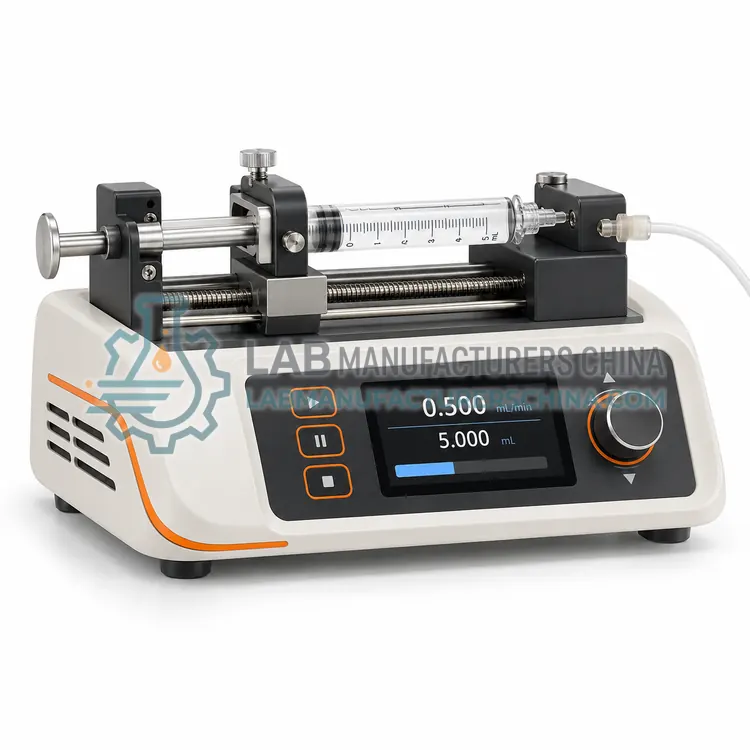
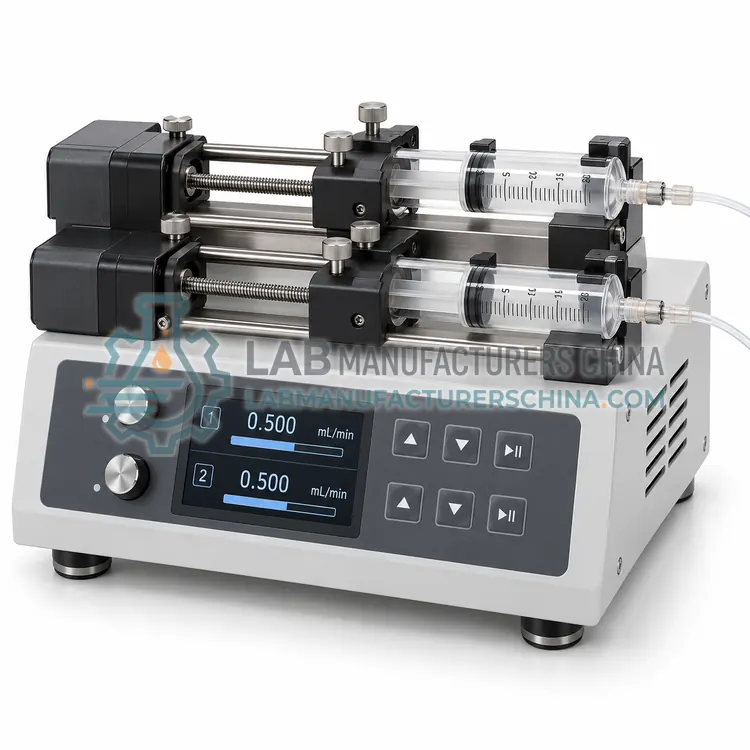
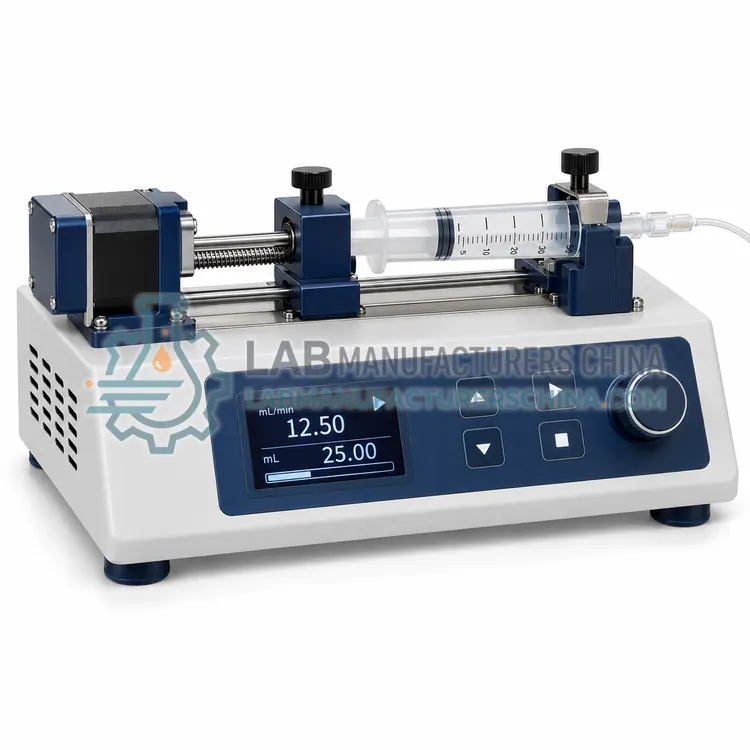
A single-syringe infusion pump drives one syringe at a precisely controlled rate for continuous delivery of liquids. It is the standard choice for infusion, reagent addition and any duty where smooth, accurate low flow is required.
What is the Single-Syringe Infusion Pump?
A single-syringe infusion pump drives one syringe at a precisely controlled rate for continuous delivery of liquids. It is the standard choice for infusion, reagent addition and any duty where smooth, accurate low flow is required.
Overview
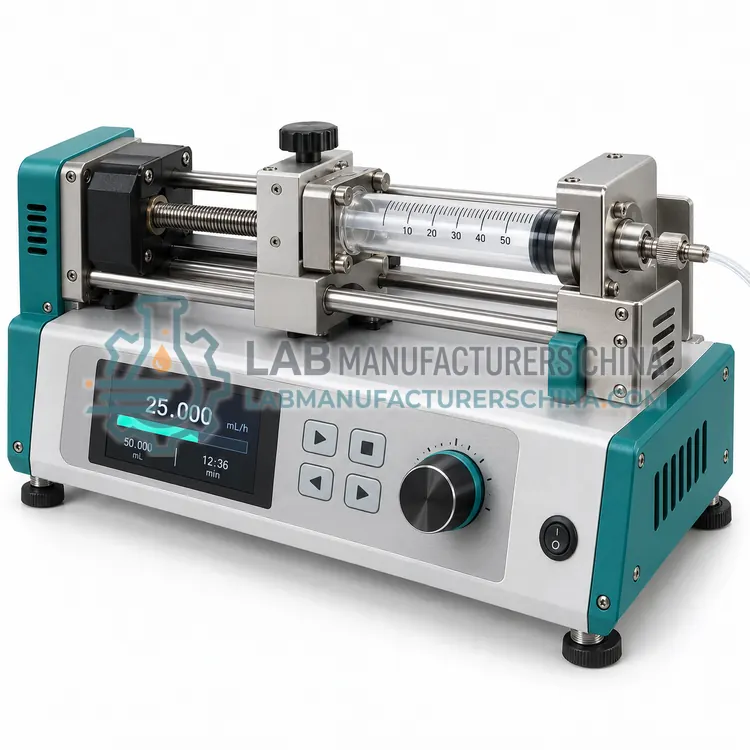
The single-syringe pump is the simplest syringe pump format. A stepper motor turns a lead screw that advances the plunger, and the operator enters flow rate or volume on a keypad. Flow ranges from about 0.1 microliters per hour with a micro syringe to 100 milliliters per minute with a large syringe. Syringe sizes from 0.5 microliters to 100 milliliters are accommodated by adjustable clamps or interchangeable holders. Features include volume limit, infusion and withdrawal modes, pause, and sometimes patient or process alarms. Accuracy is typically 1 percent after calibration. The pump is used for continuous reagent addition in reactors, gradient generation, drug infusion in animal studies, and calibration of flow meters. Because it holds one syringe, it is compact, easy to prime and simple to validate.
How does it work?
A syringe pump holds a syringe in a clamp and advances the plunger with a lead screw turned by a stepper motor. Flow rate equals the plunger cross-sectional area multiplied by the linear speed, so a small syringe gives a very low flow and a large syringe gives a higher flow at the same motor speed. Because the drive is positive displacement and continuous, flow is smooth and independent of back pressure until the motor stalls, which makes these pumps valuable for microfluidics, chromatography and infusion. Typical components are the drive mechanism, syringe clamp, control electronics and often a pressure sensor or valve. Pumps range from microliter syringes delivering nanoliters per minute to large syringes delivering hundreds of milliliters per minute, and multi-syringe configurations add parallel or mixing functions.
What are the key features?
- One syringe with adjustable clamp for sizes 0.5 µL–100 mL
- Flow from about 0.1 µL/h to 100 mL/min
- Volume limit, infusion and withdrawal modes
- Calibrated accuracy of about 1 %
- Compact keypad control with pause and alarms
- Quick priming and straightforward validation
What are the technical specifications?
A typical single-syringe infusion pump configuration offers flow range of 0.1 µL/h–100 mL/min, syringe sizes of 0.5 µL–100 mL, flow accuracy of ± 1 % after calibration, motor type of Stepper with microstepping, modes of Infuse, withdraw, pause and max force of 20–90 N. Values are indicative of the product class; the exact figures for each configuration are confirmed on the quotation and the calibration documents supplied with the instrument.
Which applications is it used for?
The Single-Syringe Infusion Pump is used in continuous reagent infusion, drug delivery in animal studies, flow meter calibration, gradient generation and reactor feeding. Across the wider Syringe Pumps class, laboratories also deploy it for microfluidic and lab-on-chip flow control, continuous reagent and nutrient infusion and chromatography sample injection.
Which standards and certifications apply?
Relevant standards and methods include IEC 61010-1, IEC 60601-2-24, IEC 61326-1, ISO 9001 and GB 4793.1. Certification candidates for this model are CE, RoHS and ISO 9001 manufacturing; each is to be confirmed for the specific configuration before shipment, and certificates are supplied only where they have been issued.
Prime the syringe and line to remove air, because bubbles compress and introduce flow error. Keep the line short and rigid to minimize compliance, which otherwise delays response and lowers accuracy at high pressure. Note the syringe size and manufacturer, since bore tolerances affect delivered volume, and recalibrate whenever the syringe type changes. Do not exceed the pressure rating of the syringe or the drive, and use a pressure sensor or stall detection on restricted systems. Avoid leaving highly viscous or crystallizing fluids in the syringe, and clean the plunger and seal regularly. Follow IEC 61010-1 for electrical safety. For regulated infusion, verify flow gravimetrically and record calibration data, since the pump is often a critical control in the method.
How do I select the right Single-Syringe Infusion Pump?
Choose the single-syringe pump for one stream that must be delivered accurately and smoothly. For two or more streams, choose a dual or multi-channel model, and for very low microfluidic flows choose a dedicated micro pump. In the RFQ, state flow, syringe size and interface.
How does it compare with other Syringe Pumps variants?
Start with the required flow rate and syringe size, then choose the drive resolution and speed range that covers it. For nanoliter to microliter flows, a microfluidic pump with a small syringe gives the best stability. For high pressure, choose refractory or stainless steel syringes and a reinforced drive, and note the maximum pressure and any valves needed. Decide how many syringes must run at once: dual and multi-channel pumps allow parallel infusion and mixing. Check whether the pump supports programmable profiles such as ramps, pulses and refill cycles, and whether it can be controlled by software or external signals for integration. Verify wetted materials for chemical compatibility and choose the syringe type, since glass, plastic and steel each have limits. Calibration and flow verification complete the selection.
Full specifications
| Flow range | 0.1 µL/h–100 mL/min |
|---|---|
| Syringe sizes | 0.5 µL–100 mL |
| Flow accuracy | ± 1 % after calibration |
| Motor type | Stepper with microstepping |
| Modes | Infuse, withdraw, pause |
| Max force | 20–90 N |
| Control | Keypad, RS232 or USB option |
| Volume limit | Programmable |
| Weight | 2–5 kg |
| Power supply | 100–240 V, 50/60 Hz |
Indicative values for this product class. Final specifications are confirmed on the quotation and in the calibration documents supplied with the instrument.
Applications
- Continuous reagent infusion
- Drug delivery in animal studies
- Flow meter calibration
- Gradient generation
- Reactor feeding
Key features
- One syringe with adjustable clamp for sizes 0.5 µL–100 mL
- Flow from about 0.1 µL/h to 100 mL/min
- Volume limit, infusion and withdrawal modes
- Calibrated accuracy of about 1 %
- Compact keypad control with pause and alarms
- Quick priming and straightforward validation
Frequently asked questions about Single-Syringe Infusion Pump
Typically 1 percent of set flow after calibration, with good reproducibility. Accuracy depends on syringe bore tolerance and compliance in the line, so recalibrate when the syringe type changes.
Yes, most models support both directions, which is useful for sampling and for refill cycles in recirculating systems. Confirm the withdrawal speed range and any volume limits.
Match material and size to the fluid and flow: glass for accuracy, plastic for convenience and disposability, and stainless steel for high pressure or aggressive chemicals. Confirm compatibility with the pump clamp.
The lead screw advances the plunger continuously, so there is no peristaltic pulsation or valve cycle. With microstepping, flow is nearly pulseless, which suits microfluidics and infusion where smooth delivery matters.
From nanoliters per minute with a small syringe to hundreds of milliliters per minute with a large syringe. Flow depends on syringe cross-section and motor speed, so syringe choice sets the working range.
Prime the syringe and tubing carefully, tap out visible bubbles and use a short, rigid line. Air pockets compress under pressure, which delays flow and lowers the delivered volume.
Related models