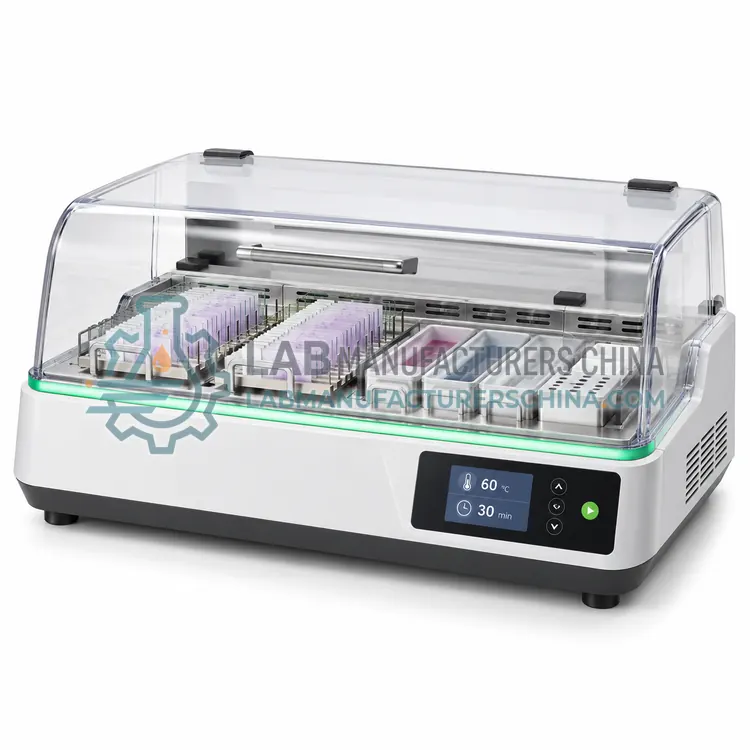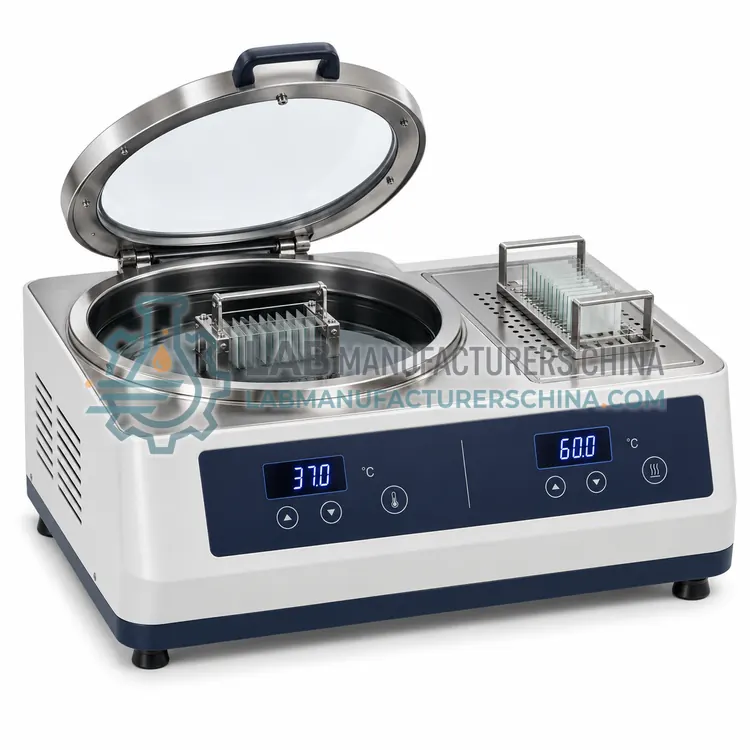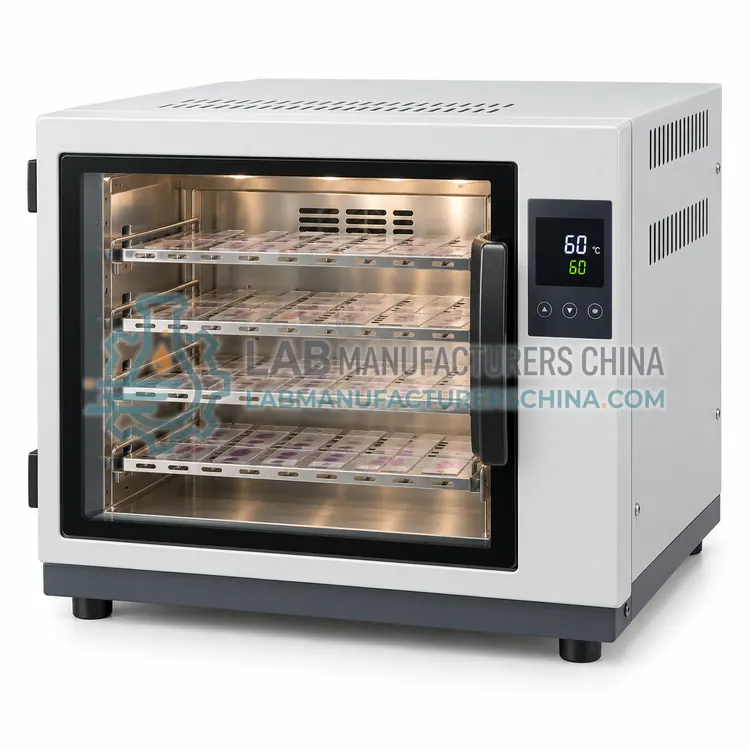
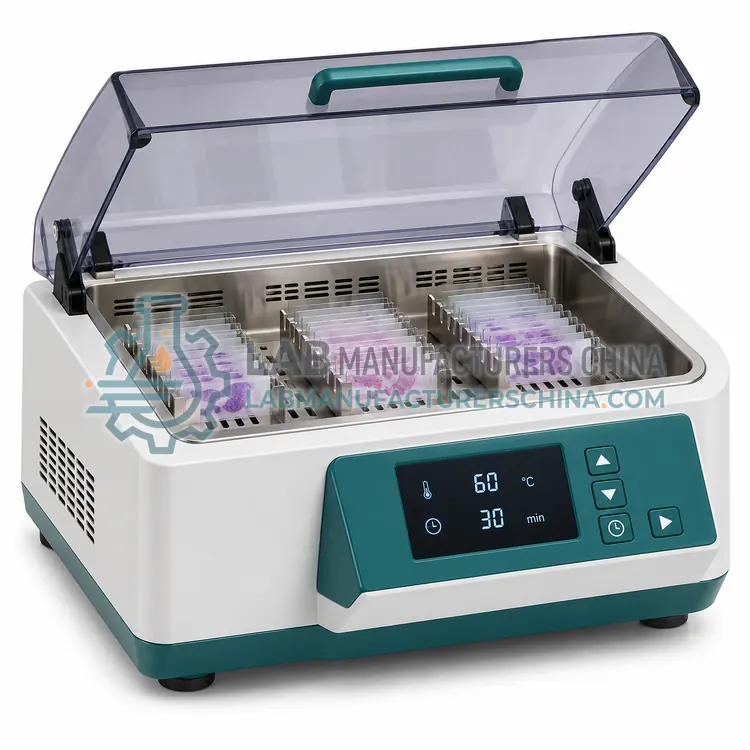
Digital Slide Warmer
数显烤片器
- SKU SLD-0002
- Slide Dryers
- CE (to be confirmed)
- IEC 61010-1 compliance (to be confirmed)
- ISO 13485 manufacturing (to be confirmed)
Price on request — FOB / CIF quoted per order
Prices depend on configuration, quantity and destination port.
Key specifications
| Temperature range | ambient to 90 °C |
|---|---|
| Temperature stability | ±1 °C |
| Display resolution | 0.1 °C |
| Plate size | about 300 × 220 mm |
| Slide capacity | about 30–40 slides |
| Timer | 0–999 min with alarm |
Request a quote Download brochure · to be provided
By Lab Manufacturers China Technical TeamLast reviewed Standards: IEC 61010-1, IEC 61010-2-010, IEC 61326-1
What is the Digital Slide Warmer?
A digital slide warmer is a hotplate with a microprocessor controller and calibrated display, holding the surface within about ±1 °C of the setpoint. It suits laboratories that need documented, reproducible drying conditions.
What is the Digital Slide Warmer?
A digital slide warmer is a hotplate with a microprocessor controller and calibrated display, holding the surface within about ±1 °C of the setpoint. It suits laboratories that need documented, reproducible drying conditions.
Overview
The digital slide warmer adds a sensor, controller and display to the hotplate concept. Temperature is normally settable from ambient to 90 °C with a resolution of 0.1 or 1 °C and stability near ±1 °C, which removes the guesswork of a dial thermostat. Many models include a timer, an over-temperature cut-out and an alarm, so a batch cannot be forgotten on the plate. A smooth, easy-clean surface in black or grey improves contrast when checking whether the water film has cleared. Because the setpoint can be read and logged, these warmers fit laboratories working to ISO 15189 or internal quality procedures that require documented equipment conditions. Some versions combine the warmer with a flotation bath or add a second independently controlled zone.
How does it work?
After a section is floated onto a slide, a film of water remains between the tissue and the glass, and the section is held only by weak adhesion. A slide dryer supplies controlled heat, usually 55 to 65 °C, which evaporates the water, melts the paraffin in and around the tissue and lets the softened protein-rich section conform to the glass surface. Cooling then leaves the section firmly bonded, so it resists the alcohol, xylene and aqueous reagents used in staining. A hotplate dries slides from below by conduction, while an oven dries them by circulating warm air and can hold larger batches. Some protocols use 37 °C overnight or 60 °C for 20 to 60 minutes, and immunohistochemistry baking often follows the same principle with longer or warmer cycles.
What are the key features?
- Microprocessor control with calibrated digital display
- Temperature stability of about ±1 °C
- Timer, over-temperature cut-out and alarm
- Easy-clean dark surface for adhesion checks
- Readable and loggable setpoint
- Optional second controlled heating zone
What are the technical specifications?
A typical digital slide warmer configuration offers temperature range of ambient to 90 °C, temperature stability of ±1 °C, display resolution of 0.1 °C, plate size of about 300 × 220 mm, slide capacity of about 30–40 slides and timer of 0–999 min with alarm. Values are indicative of the product class; the exact figures for each configuration are confirmed on the quotation and the calibration documents supplied with the instrument.
Which applications is it used for?
The Digital Slide Warmer is used in laboratories under ISO 15189, immunohistochemistry baking, routine paraffin histology and research histology with fixed protocols. Across the wider Slide Dryers class, laboratories also deploy it for histology slide drying, immunohistochemistry preparation and routine pathology.
Which standards and certifications apply?
Relevant standards and methods include IEC 61010-1, IEC 61010-2-010, IEC 61326-1 and ISO 15189. Certification candidates for this model are CE, IEC 61010-1 compliance and ISO 13485 manufacturing; each is to be confirmed for the specific configuration before shipment, and certificates are supplied only where they have been issued.
Set the temperature according to the validated staining protocol, because excessive heat causes tissue shrinkage, antigen loss and cracking, particularly for lymph node and fatty tissue. Verify the plate or chamber temperature with a calibrated thermometer at defined intervals, since a drifting thermostat is a common cause of sections washing off during staining. Keep the surface clean of wax, and never use the dryer as a general hotplate for chemicals or samples. Allow slides to cool before loading onto an automatic stainer, and record temperature settings, checks and maintenance in the laboratory log.
How do I select the right Digital Slide Warmer?
Choose a digital warmer when you need a documented, reproducible drying temperature, when several operators share the instrument, or when a timer prevents over-baking. Confirm accuracy, resolution, timer range, plate dimensions and whether the surface temperature is uniform across the full area. Specify the slide and rack format you use.
How does it compare with other Slide Dryers variants?
Choose a slide dryer by throughput, temperature control and workflow. A hotplate is simplest and fastest for individual racks and lets the technician watch adhesion as the water evaporates. A digital warmer adds a calibrated readout and stable setpoint, which suits laboratories that must document conditions. An oven handles large batches for hours or overnight but takes longer to load and unload. A programmable oven supports stepped profiles for immunohistochemistry. Compare plate or chamber size, slide capacity, temperature range and uniformity, warm-up time and whether a timer or alarm is available. Confirm the surface is easy to clean and resistant to wax and xylene, and that the required slide format fits the racks or slots.
Full specifications
| Temperature range | ambient to 90 °C |
|---|---|
| Temperature stability | ±1 °C |
| Display resolution | 0.1 °C |
| Plate size | about 300 × 220 mm |
| Slide capacity | about 30–40 slides |
| Timer | 0–999 min with alarm |
| Surface material | Coated aluminium or stainless steel |
| Warm-up time | about 10–20 min |
| Power supply | 220 V, 50 Hz, about 0.5 kW |
Indicative values for this product class. Final specifications are confirmed on the quotation and in the calibration documents supplied with the instrument.
Applications
- Laboratories under ISO 15189
- Immunohistochemistry baking
- Routine paraffin histology
- Research histology with fixed protocols
Key features
- Microprocessor control with calibrated digital display
- Temperature stability of about ±1 °C
- Timer, over-temperature cut-out and alarm
- Easy-clean dark surface for adhesion checks
- Readable and loggable setpoint
- Optional second controlled heating zone
Frequently asked questions about Digital Slide Warmer
Yes, typically within about ±1 °C against a few degrees for a dial thermostat, and the setpoint is displayed rather than inferred from a dial mark. Accuracy still depends on periodic verification with a calibrated thermometer.
Baking removes water and melts paraffin, but too long at a high temperature shrinks tissue and destroys antigens. A timer with an alarm stops the cycle predictably, which is useful when staff handle several batches at once.
Some variation is normal, especially near the edges of large plates, which is why uniformity should be checked at several points. Slides dried in the centre of the plate usually see the nominal setpoint, while edge positions may be slightly cooler or warmer.
Most protocols dry paraffin sections at 55 to 65 °C for 20 to 60 minutes, or at about 37 °C overnight. Immunohistochemistry may use a longer or warmer bake before antigen retrieval. Excessive heat causes shrinkage and antigen loss.
Likely causes are incomplete drying, too low a baking temperature, water left under the section, a dirty or uncoated slide, or very fatty and dense tissue. Check the plate temperature with a calibrated thermometer and consider coated or charged slides.
A hotplate dries slides by direct conduction and is quick for small racks, while a convection oven dries by moving warm air and holds large batches for hours or overnight. Hotplates are common for routine work; ovens suit bulk and programmed protocols.
Related models