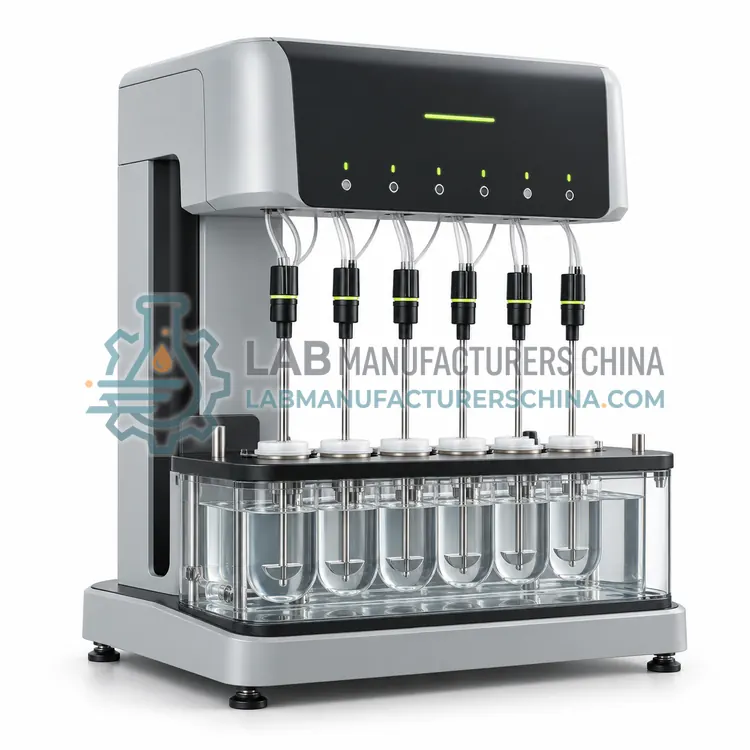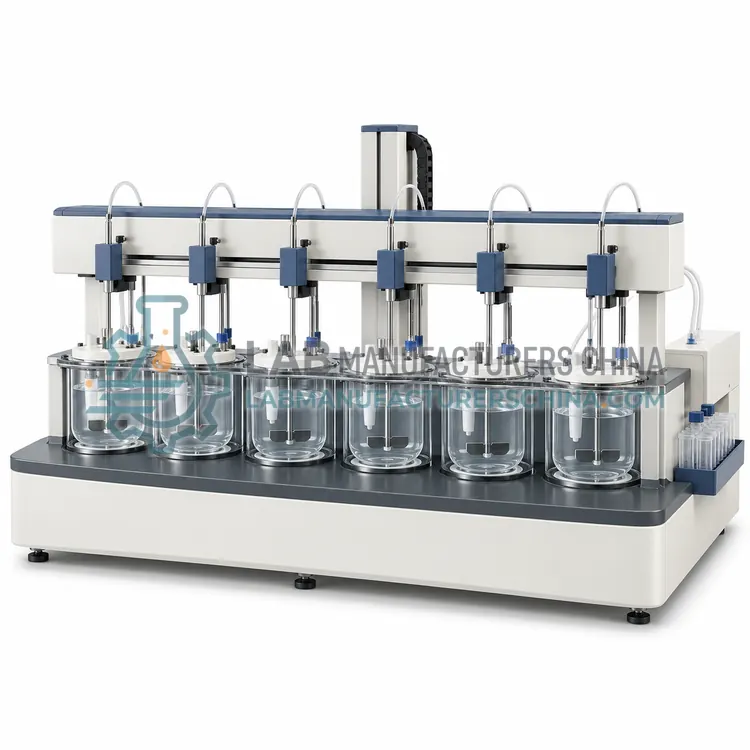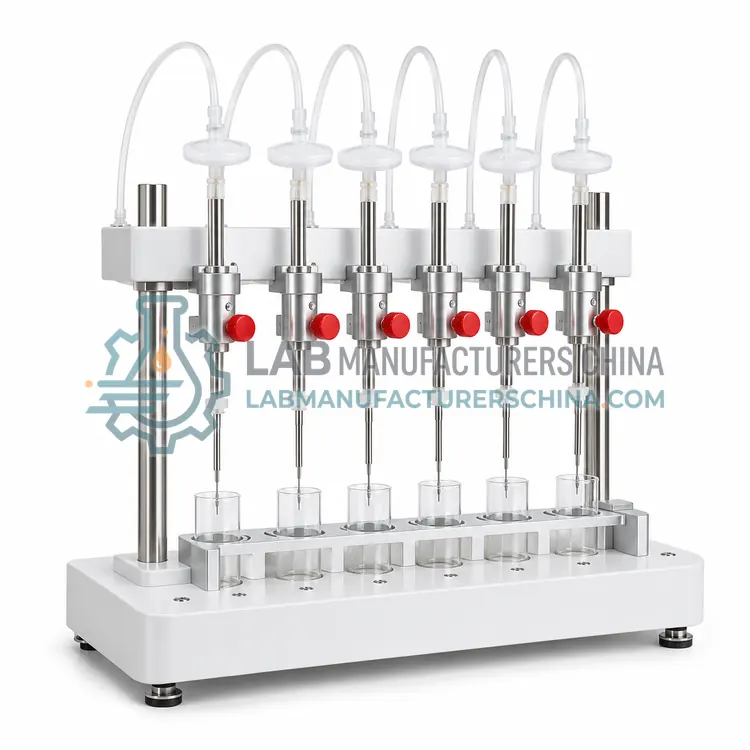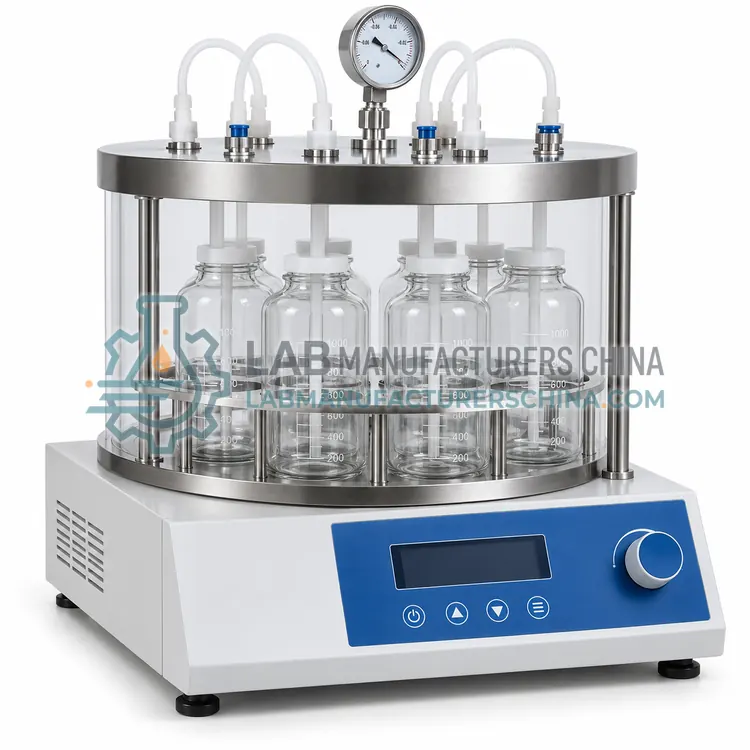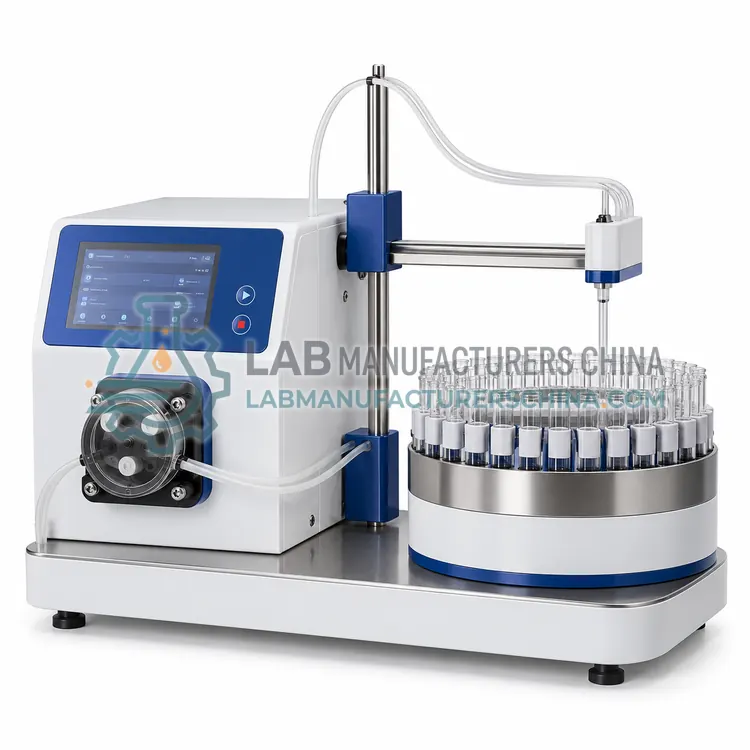
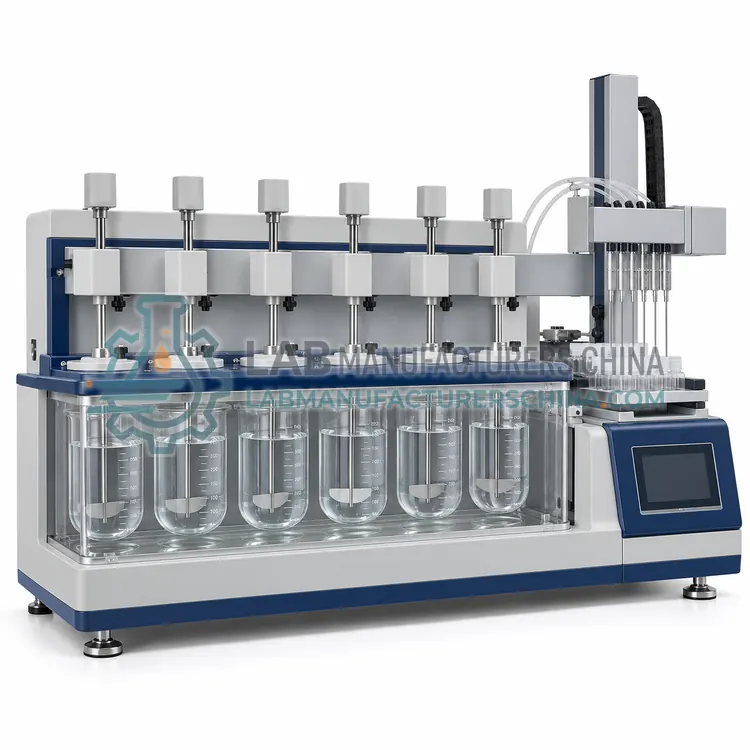
Syringe-Pump Automated Dissolution Sampler
注射泵自动溶出取样器
- SKU SAS-0001
- Sampling Systems
- CE (to be confirmed)
- ISO 9001 manufacturing (to be confirmed)
Price on request — FOB / CIF quoted per order
Prices depend on configuration, quantity and destination port.
Key specifications
| Sampling channels | 6 or 8 |
|---|---|
| Sample volume | 1–10 mL |
| Volume accuracy | ±2% |
| Timing accuracy | ±2 s |
| Filter size | 10 µm full-flow or 0.45 µm |
| Sample destination | vials, cuvette, flow cell |
Request a quote Download brochure · to be provided
By Lab Manufacturers China Technical TeamLast reviewed Standards: USP <711>, USP <1092>, Ph. Eur. 2.9.3
What is the Syringe-Pump Automated Dissolution Sampler?
A syringe-pump automated dissolution sampler withdraws fixed aliquots from each vessel through filtered cannulas and dispenses them into vials or a flow cell at preset times. It is used for unattended pull-point sampling in dissolution profiles. It suits profiles with many pull points.
What is the Syringe-Pump Automated Dissolution Sampler?
A syringe-pump automated dissolution sampler withdraws fixed aliquots from each vessel through filtered cannulas and dispenses them into vials or a flow cell at preset times. It is used for unattended pull-point sampling in dissolution profiles. It suits profiles with many pull points.
Overview
The sampler uses a precision syringe pump and a multi-position valve to pull a programmed aliquot, typically 1 to 10 mL, from each vessel through a filter at the tip of a cannula positioned at the compendial sampling zone midway between the medium surface and the top of the paddle, at least 1 cm from the vessel wall. Sample volumes are dispensed into HPLC vials, a fraction tray or a UV cuvette. Timing is controlled by software, typically with accuracy of ±2 seconds against the USP tolerance of ±2%. Cannulas are flushed with air or medium between pulls to prevent carry-over, and sampling probes automatically retract after each pull to avoid disturbing hydrodynamics. The volume drawn and the time stamps are recorded. Syringe accuracy gives well-controlled volumes, and the system is suited to dissolution profiles with many pull points, replacing manual pipetting at times that are often inconvenient.
How does it work?
A sampling system places a filtered probe in the compendial sampling zone of each vessel and moves a defined volume of medium by syringe pump, peristaltic pump or vacuum to the destination. Valves select the channel, timers trigger sampling at preset times, and flush steps clear the lines. Probes are fitted with filters, typically 10 µm full-flow or 0.45 µm, which stop dissolution by removing undissolved particles. In-situ fibre-optic probes skip withdrawal entirely and measure absorbance in the vessel. Data such as time, volume and vial position are logged. Performance depends on timing accuracy, volume accuracy, dead volume, adsorption to tubing and filters, and the effect of the probe on hydrodynamics. Replacement of sampled volume with fresh medium can keep vessel volume constant.
What are the key features?
- Precision syringe with multi-position valve for 6 to 8 vessels
- Programmable aliquot volume from 1 to 10 mL
- Probe retraction after each pull to limit hydrodynamic disturbance
- Air or medium flush to limit carry-over
- Timing accuracy within ±2 seconds
- Logged sample times and volumes for data integrity
What are the technical specifications?
A typical syringe-pump automated dissolution sampler configuration offers sampling channels of 6 or 8, sample volume of 1–10 mL, volume accuracy of ±2%, timing accuracy of ±2 s, filter size of 10 µm full-flow or 0.45 µm and sample destination of vials, cuvette, flow cell. Values are indicative of the product class; the exact figures for each configuration are confirmed on the quotation and the calibration documents supplied with the instrument.
Which applications is it used for?
The Syringe-Pump Automated Dissolution Sampler is used in dissolution profile sampling, overnight stability dissolution, multi-time-point QC and generic bioequivalence support. Across the wider Sampling Systems class, laboratories also deploy it for dissolution profile automation, regulated QC testing and extended-release studies.
Which standards and certifications apply?
Relevant standards and methods include USP <711>, USP <1092>, Ph. Eur. 2.9.3, JP 6.10, ChP 0931, ASTM E2503 and 21 CFR Part 11. Certification candidates for this model are CE and ISO 9001 manufacturing; each is to be confirmed for the specific configuration before shipment, and certificates are supplied only where they have been issued.
Validate automated sampling against manual pulls during OQ and method transfer, checking timing, volume accuracy and carry-over. Clean and inspect probes and cannulas regularly, since blockage and film build-up affect recovery. Replace pump tubing and filters per schedule, and evaluate drug adsorption on tubing and filters. Keep cannula position within the compendial zone and avoid contact with paddles or baskets. Ensure software provides audit trail, user access control and time-stamped records. Include samplers in preventive maintenance and calibration programs alongside the dissolution tester.
How do I select the right Syringe-Pump Automated Dissolution Sampler?
Choose a syringe-pump sampler for unattended multi-time-point tests with a six- or eight-vessel tester. Specify aliquot range, vial format, filter type, compatibility with your dissolution bath and whether media replacement is needed. For in situ UV readout without withdrawing samples, a fibre-optic probe system may be better.
How does it compare with other Sampling Systems variants?
Match the system to the number of time points, unattended operation needs and analytical method. Syringe-pump samplers give accurate aliquots and suit vial-based HPLC analysis. Peristaltic online systems suit continuous UV profiles and fraction collection. Fibre-optic probes give the fastest time resolution without withdrawal but need UV-active, non-interfering analytes. Media replacement is worth having when withdrawn volume exceeds a few percent of vessel volume. Manual kits suit single-point QC and backup. Key specifications are timing accuracy, volume accuracy, channel count, filter options, carry-over, compatibility with the existing tester and software data integrity. Validate against manual sampling before replacing it in a regulated method.
Full specifications
| Sampling channels | 6 or 8 |
|---|---|
| Sample volume | 1–10 mL |
| Volume accuracy | ±2% |
| Timing accuracy | ±2 s |
| Filter size | 10 µm full-flow or 0.45 µm |
| Sample destination | vials, cuvette, flow cell |
| Carry-over | ≤ 0.3% |
| Minimum interval | about 30 s per channel |
| Compatibility | USP Apparatus 1 and 2 testers |
| Power supply | 220 V AC, 50/60 Hz, about 0.3 kW |
Indicative values for this product class. Final specifications are confirmed on the quotation and in the calibration documents supplied with the instrument.
Applications
- Dissolution profile sampling
- Overnight stability dissolution
- Multi-time-point QC
- Generic bioequivalence support
Key features
- Precision syringe with multi-position valve for 6 to 8 vessels
- Programmable aliquot volume from 1 to 10 mL
- Probe retraction after each pull to limit hydrodynamic disturbance
- Air or medium flush to limit carry-over
- Timing accuracy within ±2 seconds
- Logged sample times and volumes for data integrity
Frequently asked questions about Syringe-Pump Automated Dissolution Sampler
Automated samplers typically pull samples within ±2 seconds of the target time, well inside the ±2% tolerance that USP <711> allows for sampling times. Verification is part of OQ.
The sampling point is midway between the surface of the medium and the top of the rotating paddle or basket, and not less than 1 cm from the vessel wall, as USP <711> specifies.
Poorly designed probes can disturb flow. Retracting probes, small-diameter cannulas and validated positions limit this effect, and method validation compares automated and manual sampling for equivalence.
It is equipment that withdraws filtered aliquots from dissolution vessels at preset times and sends them to vials, detectors or collectors, replacing manual pipetting and improving timing and traceability.
USP <711> specifies a point midway between the medium surface and the top of the rotating paddle or basket, at least 1 cm from the vessel wall.
Filters remove undissolved particles immediately so that dissolution stops in the sample and the aliquot is clear for analysis. Filter adsorption must be evaluated for each drug.