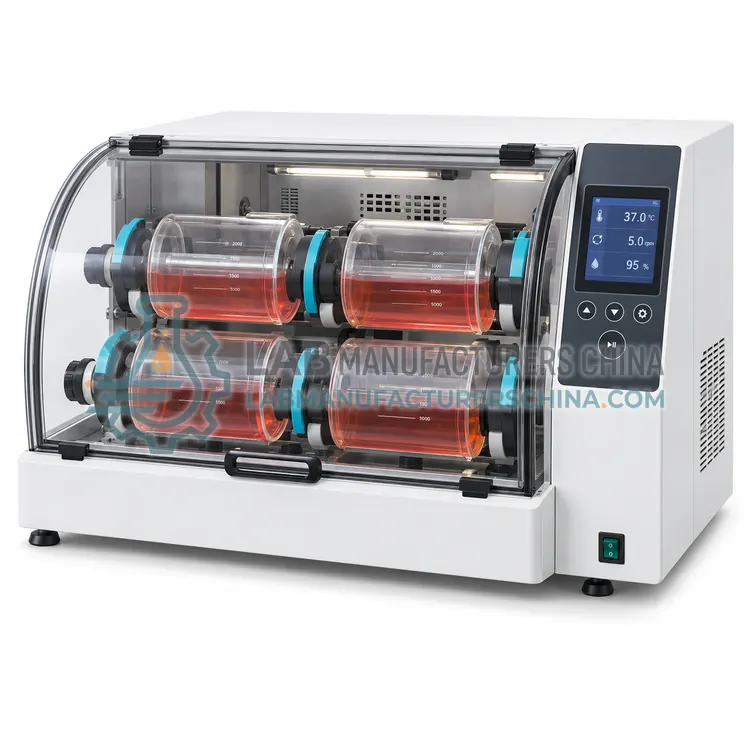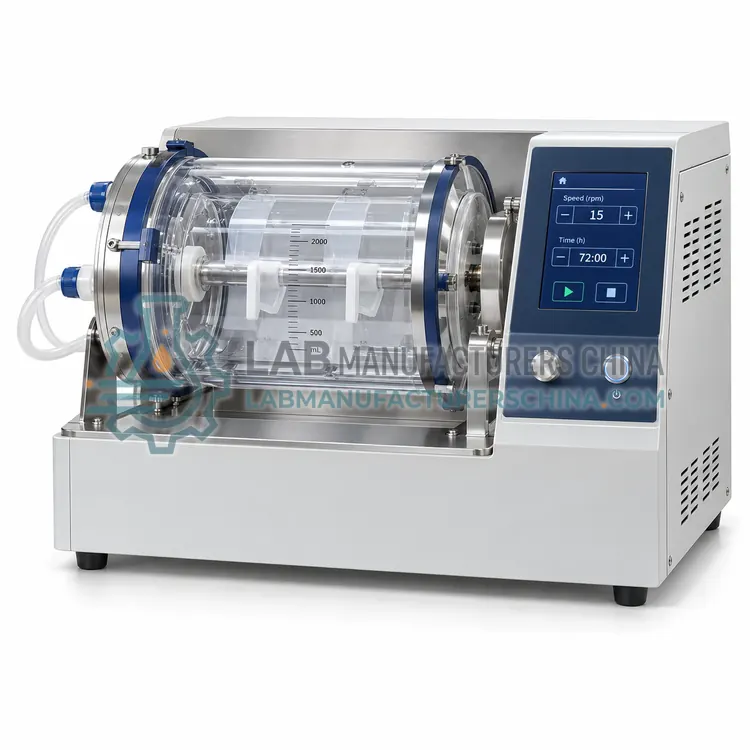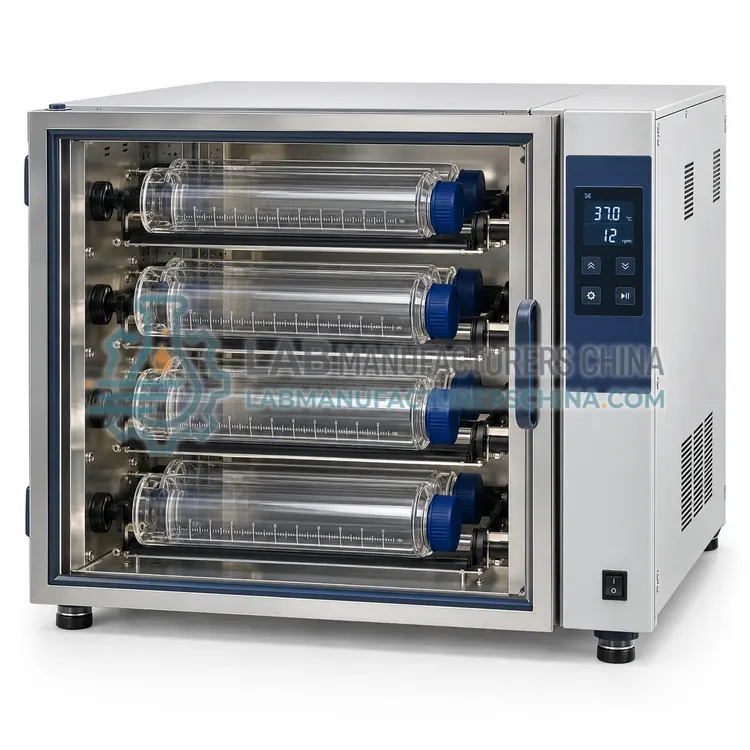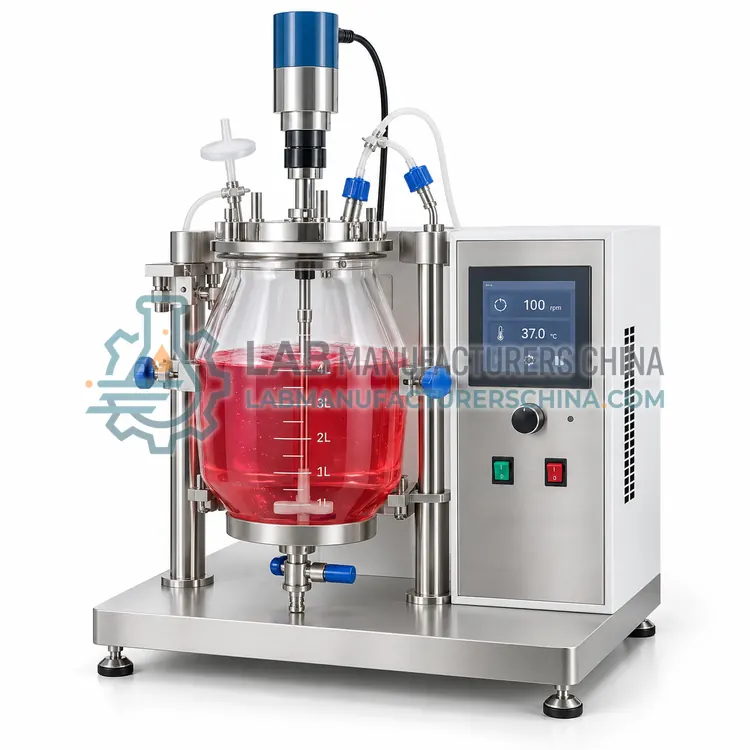
Rotating Wall Vessel Bioreactor
旋转壁式生物反应器
- SKU ROL-0005
- Roller Systems
- CE (to be confirmed)
- ISO 9001 manufacturing (to be confirmed)
- IEC 61010-1 safety (to be confirmed)
Price on request — FOB / CIF quoted per order
Prices depend on configuration, quantity and destination port.
Key specifications
| Working volume | 10–500 mL (model dependent) |
|---|---|
| Rotation speed | 5–60 rpm, adjustable |
| Shear stress | very low, typically below 0.1 Pa |
| Vessel diameter | approx. 50–150 mm |
| Gas exchange | Permeable membrane or silicone wall |
| Temperature control | 35–39 °C, within ±0.5 °C |
Request a quote Download brochure · to be provided
By Lab Manufacturers China Technical TeamLast reviewed Standards: IEC 61010-1, IEC 61010-2-010, IEC 61326-1
What is the Rotating Wall Vessel Bioreactor?
A rotating wall vessel bioreactor rotates a fluid-filled cylinder so that cells remain suspended with minimal shear stress and no settling, creating a low-stress environment for three-dimensional aggregates and sensitive primary cell types.
What is the Rotating Wall Vessel Bioreactor?
A rotating wall vessel bioreactor rotates a fluid-filled cylinder so that cells remain suspended with minimal shear stress and no settling, creating a low-stress environment for three-dimensional aggregates and sensitive primary cell types.
Overview
The vessel is a horizontally mounted cylinder filled with medium and rotated about its axis. At the correct speed the cells are held in suspension by the balance of gravitational settling and fluid drag, so they experience very low shear stress and no impeller contact. Gas exchange takes place through a permeable membrane or a gas-permeable silicone wall, and medium is added or removed through rotating seals. The low-shear environment encourages cells to aggregate into three-dimensional structures, which is used for cartilage, bone, cardiac and tumour models, and for expanding cells that lose function when stirred. Speed must be adjusted as aggregates grow, since larger masses settle faster, and oxygen delivery becomes the limiting factor at high density.
How does it work?
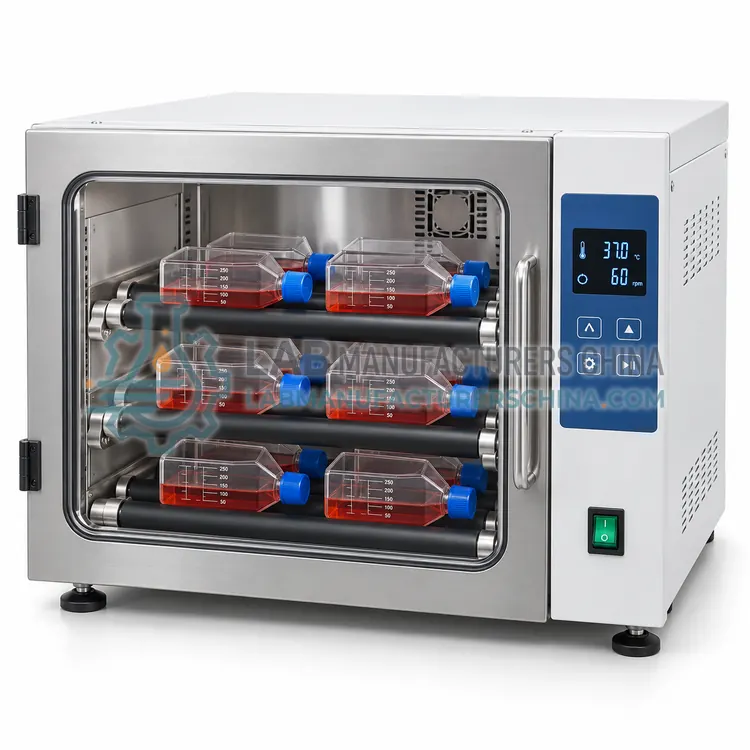
Rotating a cylindrical vessel slowly, usually 0.1–2 rpm, keeps a thin film of medium moving over the inner surface. Adherent cells attach to the wetted wall and are alternately submerged in medium and exposed to the gas phase as the bottle turns, which improves oxygen transfer compared with a static flask and distributes nutrients evenly. Suspension cells are kept gently in motion so they do not settle. For high-density processes the vessels are placed in a warm cabinet or an incubated roller apparatus that controls temperature and, in some designs, carbon dioxide. Cell yield scales with the internal surface area of the bottle, so a 1,700 cm² roller bottle provides the equivalent growth area of several T-flasks while using less medium. Shear stress remains low because the fluid motion is gentle.
What are the key features?
- Horizontally rotating cylinder with low-shear suspension
- Speed control matched to aggregate size and settling rate
- Gas exchange through permeable membrane or silicone wall
- Promotion of three-dimensional cell aggregates
- Rotating seals for aseptic medium exchange
- Temperature-controlled operation with optional perfusion
What are the technical specifications?
A typical rotating wall vessel bioreactor configuration offers working volume of 10–500 mL (model dependent), rotation speed of 5–60 rpm, adjustable, shear stress of very low, typically below 0.1 Pa, vessel diameter of approx. 50–150 mm, gas exchange of Permeable membrane or silicone wall and temperature control of 35–39 °C, within ±0.5 °C. Values are indicative of the product class; the exact figures for each configuration are confirmed on the quotation and the calibration documents supplied with the instrument.
Which applications is it used for?
The Rotating Wall Vessel Bioreactor is used in three-dimensional tissue and organoid models, cartilage and bone tissue engineering, low-shear expansion of sensitive cell types and tumour spheroid growth for drug testing. Across the wider Roller Systems class, laboratories also deploy it for vaccine production in adherent cell lines, recombinant protein expression scale-up and mesenchymal stem cell expansion.
Which standards and certifications apply?
Relevant standards and methods include IEC 61010-1, IEC 61010-2-010, IEC 61326-1, ISO 14644-1, USP <1046> and ISO 9001. Certification candidates for this model are CE, ISO 9001 manufacturing and IEC 61010-1 safety; each is to be confirmed for the specific configuration before shipment, and certificates are supplied only where they have been issued.
Place the apparatus on a level surface, because uneven loading causes bottles to creep and can lead to breakage. Load bottles symmetrically and secure them with the supplied clamps or retaining rings. Medium volume should be about 10–20% of bottle capacity, enough for the film to cover the inner surface without splashing into the cap filter. Change medium or split cultures according to cell density, and let bottles warm to 37 °C before inoculation, since cold medium slows attachment. Clean the rollers and frame regularly to remove spilled medium, which otherwise attracts contamination. If the unit is used inside an incubator, confirm that its heat output does not disturb chamber temperature, and record speed settings and run times in batch documentation.
How do I select the right Rotating Wall Vessel Bioreactor?
Select a rotating wall vessel when low shear and three-dimensional aggregate formation are the goal, rather than maximum volumetric productivity. Specify working volume, rotation speed range, gas exchange method, temperature control and whether perfusion is needed.
How does it compare with other Roller Systems variants?
Choose by scale and control requirements. A basic roller apparatus with adjustable speed suits laboratories that use a separate CO2 incubator, while an incubated roller system with temperature and CO2 control reduces handling and improves reproducibility. Roller mixers provide gentle agitation for suspension cells in bottles or tubes rather than surface growth. For larger adherent processes, roller drum bioreactors and packed-bed or rotating wall vessels increase surface area further and can be integrated with perfusion. Decide on the number of positions, speed range and accuracy, vessel compatibility, motor type and whether CO2 control is required. Check that the apparatus fits your incubator or cabinet, that bottles are secured against slipping at higher speeds, and that the surface material is compatible with the cleaning and sterilisation method you use.
Full specifications
| Working volume | 10–500 mL (model dependent) |
|---|---|
| Rotation speed | 5–60 rpm, adjustable |
| Shear stress | very low, typically below 0.1 Pa |
| Vessel diameter | approx. 50–150 mm |
| Gas exchange | Permeable membrane or silicone wall |
| Temperature control | 35–39 °C, within ±0.5 °C |
| Aggregate size reached | approx. 100–500 µm |
| Perfusion | Optional, with rotating seal and pump |
| Applications | 3D aggregates, cartilage, cardiac and tumour models |
| Dimensions (W x D x H) | approx. 500 x 500 x 400 mm |
Indicative values for this product class. Final specifications are confirmed on the quotation and in the calibration documents supplied with the instrument.
Applications
- Three-dimensional tissue and organoid models
- Cartilage and bone tissue engineering
- Low-shear expansion of sensitive cell types
- Tumour spheroid growth for drug testing
Key features
- Horizontally rotating cylinder with low-shear suspension
- Speed control matched to aggregate size and settling rate
- Gas exchange through permeable membrane or silicone wall
- Promotion of three-dimensional cell aggregates
- Rotating seals for aseptic medium exchange
- Temperature-controlled operation with optional perfusion
Frequently asked questions about Rotating Wall Vessel Bioreactor
There is no impeller and no bubble sparging, so cells experience only the gentle drag of the rotating fluid. Local shear is typically well below 0.1 Pa, which allows sensitive cells and growing aggregates to remain intact.
Speed is matched to the settling velocity of the cells or aggregates so they stay suspended near the vessel axis. As aggregates grow, speed must be increased; too slow causes settling and too fast causes shear and dispersal of aggregates.
Through a gas-permeable membrane or silicone wall in contact with the culture, often with a controlled gas mix. At high aggregate density oxygen diffusion limits the maximum size, so medium exchange or perfusion is used to maintain supply.
A roller bottle has a large internal surface area in a small volume, so more cells can attach per millilitre of medium. Rotation also improves gas exchange and nutrient distribution, and handling one large vessel instead of many flasks reduces labour.
Most adherent cultures run at 0.1–1 rpm and suspension cultures at up to 2 rpm. The aim is a continuously moving medium film without splashing; higher speeds increase shear and can detach cells or wet the cap filter.
Only if the apparatus is used outside an incubator. Culture medium buffered with bicarbonate needs 5% CO2 to hold pH, so a basic apparatus must be placed in a CO2 incubator, while incubated models include the gas and temperature control themselves.
Related models