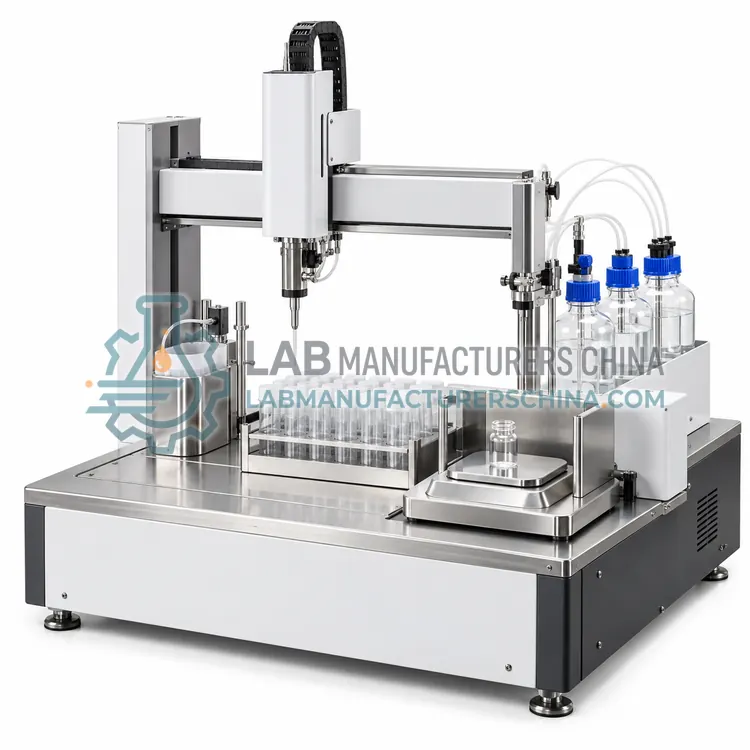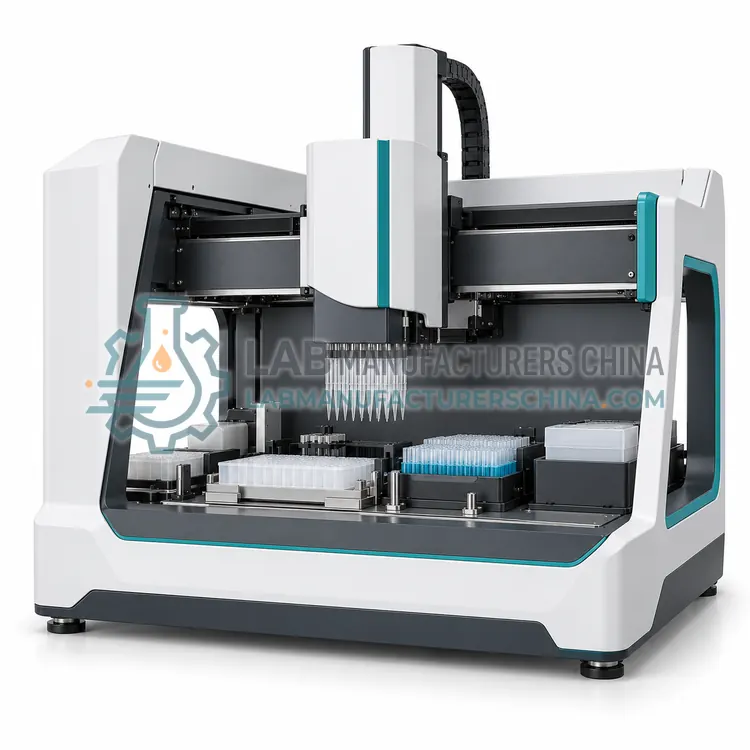
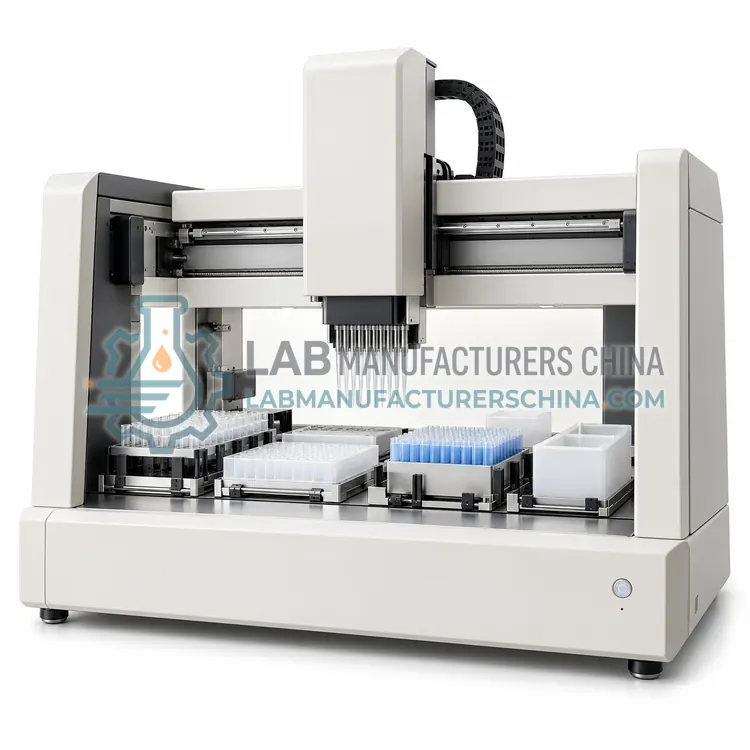
Air Displacement Liquid Handler
空气置换液体处理器
- SKU RLH-0001
- Robotic Liquid Handling
- CE (to be confirmed)
- ISO 9001 manufacturing (to be confirmed)
Price on request — FOB / CIF quoted per order
Prices depend on configuration, quantity and destination port.
Key specifications
| Type | Air displacement liquid handler |
|---|---|
| Volume range | 0.5–1000 µL per channel |
| Channels | 1–8 or 96-head |
| Accuracy | ± 1 % at nominal |
| Precision | 1–3 % CV |
| Tips | Disposable, tip-fit sealed |
Request a quote Download brochure · to be provided
By Lab Manufacturers China Technical TeamLast reviewed Standards: ISO 8655 (piston-operated volumetric apparatus), ANSI/SLAS microplate standards, IEC 61010-1 (safety requirements for electrical equipment)
What is the Air Displacement Liquid Handler?
An air displacement liquid handler uses a piston and an air column to draw liquid into a disposable tip. It suits aqueous solutions in plate and tube formats across a wide volume range.
What is the Air Displacement Liquid Handler?
An air displacement liquid handler uses a piston and an air column to draw liquid into a disposable tip. It suits aqueous solutions in plate and tube formats across a wide volume range.
Overview
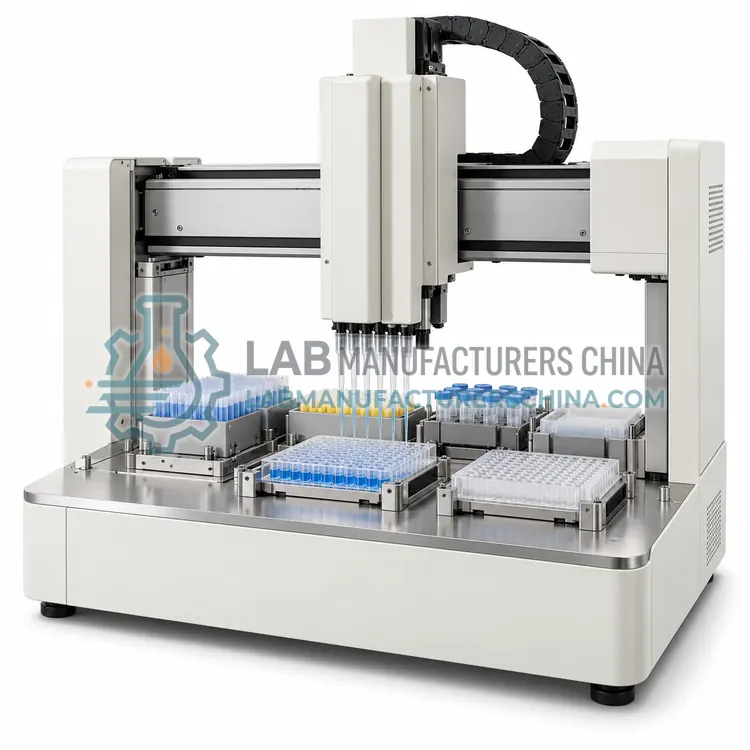
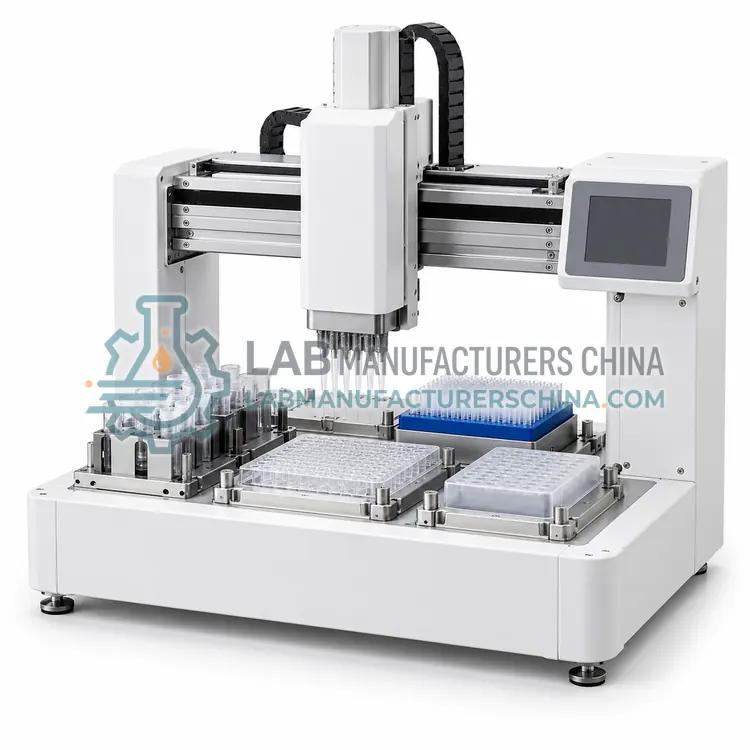
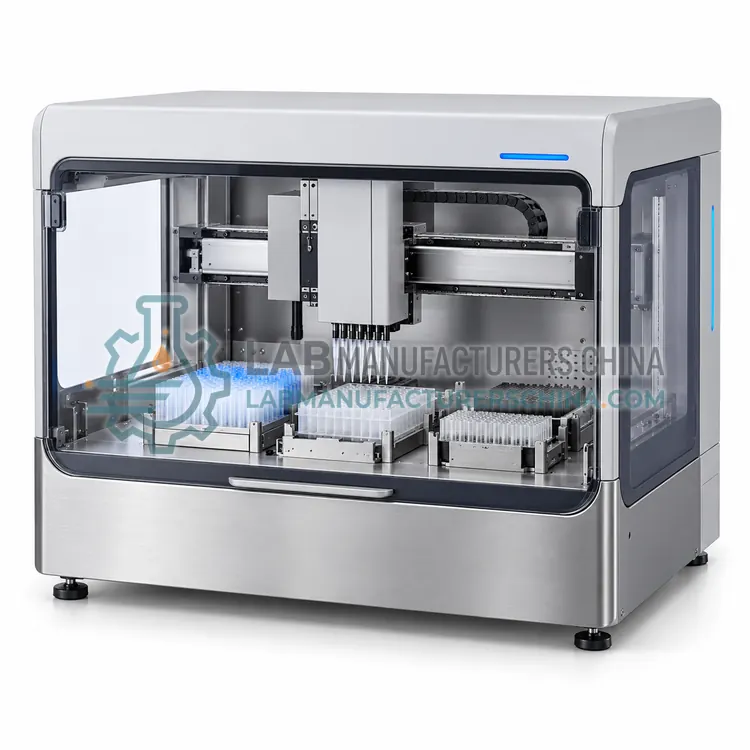
The handler aspirates liquid into a disposable tip by moving a piston that displaces an air column, so the liquid never touches the mechanism. Volume range is typically 0.5–1000 µL per channel, with 1–8 channels on a benchtop unit or a 96-head for plate work. Accuracy of about ± 1 % and precision of 1–3 % CV is achievable with matched tips and good technique, verified gravimetrically under ISO 8655. A deck holds plates, reservoirs and tip racks, and barcode reading tracks labware. Wash stations, heaters and shakers can be added. The design is well suited to aqueous reagents, buffers and diluted samples, and it changes tips or uses a washable probe between samples to control carry-over. Method software records volumes, order and mixing.
How does it work?
A liquid handler moves precise volumes of liquid by drawing them into a tip or probe and delivering them to a target vessel. In air displacement systems, a piston in the pipette or the robot moves an air column that pushes and pulls the liquid, which stays in a disposable tip. In positive displacement systems, the piston contacts the liquid directly inside a syringe, so volatile, viscous or detergent-like liquids and solvents are handled accurately. Multichannel heads aspirate 8, 96 or 384 tips at once for plate work, and nanolitre dispensers use solenoid valves, piezoelectric elements or capillary tips for very small volumes. Accuracy and precision depend on tip fit, liquid properties, temperature, wetting and aspiration speed, and are verified gravimetrically or photometrically under ISO 8655. Software defines volumes, order, mixing and wash steps, and records every action.
What are the key features?
- Piston and air column with disposable tips
- Volume range 0.5–1000 µL per channel
- 1–8 channels or 96-head format
- Accuracy about ± 1 %, precision 1–3 % CV
- Deck for plates, reservoirs and tips
- Wash station or tip change between samples
What are the technical specifications?
A typical air displacement liquid handler configuration offers type of Air displacement liquid handler, volume range of 0.5–1000 µL per channel, channels of 1–8 or 96-head, accuracy of ± 1 % at nominal, precision of 1–3 % CV and tips of Disposable, tip-fit sealed. Values are indicative of the product class; the exact figures for each configuration are confirmed on the quotation and the calibration documents supplied with the instrument.
Which applications is it used for?
The Air Displacement Liquid Handler is used in assay setup, sample dilution, PCR setup and QC plate preparation. Across the wider Robotic Liquid Handling class, laboratories also deploy it for plate-based assay setup, compound screening and PCR and qPCR setup.
Which standards and certifications apply?
Relevant standards and methods include ISO 8655 (piston-operated volumetric apparatus), ANSI/SLAS microplate standards, IEC 61010-1 (safety requirements for electrical equipment), USP <1058> (analytical instrument qualification), 21 CFR Part 11 (electronic records and signatures) and ISO/IEC 17025 (testing and calibration laboratories). Certification candidates for this model are CE and ISO 9001 manufacturing; each is to be confirmed for the specific configuration before shipment, and certificates are supplied only where they have been issued.
Verify accuracy and precision on installation and at intervals defined by your quality system, using gravimetric checks with water and photometric tests for dye solutions. Control temperature and humidity, since evaporation and viscosity change small volumes. Use the specified tips and fit them correctly, because a poor seal causes volume errors. Clean the deck, wash station and probes on schedule, and inspect for bent or blocked tips. For regulated work, restrict software access by role, retain audit trails and back up methods and data. Define carry-over limits and test them for trace work. Train operators to recognise partial dispenses, bubbles and clogs, and record all calibration, maintenance and method changes.
How do I select the right Air Displacement Liquid Handler?
Choose air displacement for aqueous reagents and buffers across a wide volume range, with tip changes or washing to control carry-over. Confirm volume range, channels and deck. RFQ: volumes, liquids, plate types, throughput and carry-over limits.
How does it compare with other Robotic Liquid Handling variants?
Match the technology to the liquid and the volume. Air displacement suits aqueous solutions where the tip is changed or washed between samples. Positive displacement suits volatile solvents, viscous liquids, detergents and long runs without tip changes, because the piston touches the liquid. Choose multichannel heads for plate-based work at 8–384 wells, and nanolitre dispensers when reagents are expensive or volumes below a microlitre are needed. Confirm accuracy and precision at the working volumes, and check compatibility with the plates, tips, tubes and reservoirs you use. Consider tip format, deck capacity, mixing and heating options, and software for method editing, audit trails and LIMS exchange. Verify carry-over performance if you run trace analysis, and confirm the service and calibration support available.
Full specifications
| Type | Air displacement liquid handler |
|---|---|
| Volume range | 0.5–1000 µL per channel |
| Channels | 1–8 or 96-head |
| Accuracy | ± 1 % at nominal |
| Precision | 1–3 % CV |
| Tips | Disposable, tip-fit sealed |
| Deck positions | 8–24 slots |
| Modules | Wash, heat, shake |
| Suitability | Aqueous solutions |
| Verification | Gravimetric per ISO 8655 |
Indicative values for this product class. Final specifications are confirmed on the quotation and in the calibration documents supplied with the instrument.
Applications
- Assay setup
- Sample dilution
- PCR setup
- QC plate preparation
Key features
- Piston and air column with disposable tips
- Volume range 0.5–1000 µL per channel
- 1–8 channels or 96-head format
- Accuracy about ± 1 %, precision 1–3 % CV
- Deck for plates, reservoirs and tips
- Wash station or tip change between samples
Frequently asked questions about Air Displacement Liquid Handler
Aqueous solutions, buffers, diluted samples and most biological reagents. Volatile solvents and detergents are handled less accurately because they evaporate or wet the tip walls.
At installation, after service or tip-related changes, and at intervals set by your quality system, commonly every three to six months for regulated work, using gravimetric tests at the working volumes.
The seal between the tip and the pipette determines the volume drawn. Poorly fitting tips leak, causing short or variable volumes, so the specified tips for that instrument should always be used.
Air displacement uses an air column and a disposable tip, suiting aqueous solutions. Positive displacement uses a piston in direct contact with the liquid, which suits volatile, viscous or detergent liquids and solvents accurately.
Gravimetrically with water at a controlled temperature, and photometrically with dye solutions, following ISO 8655. Tests are done at the working volumes and repeated on a schedule or after service.
When reagents are expensive or a large number of reactions must be run in a small area, for example in screening or qPCR. Nanolitre dispensers need careful calibration, controlled evaporation and compatible plate surfaces.
Related models