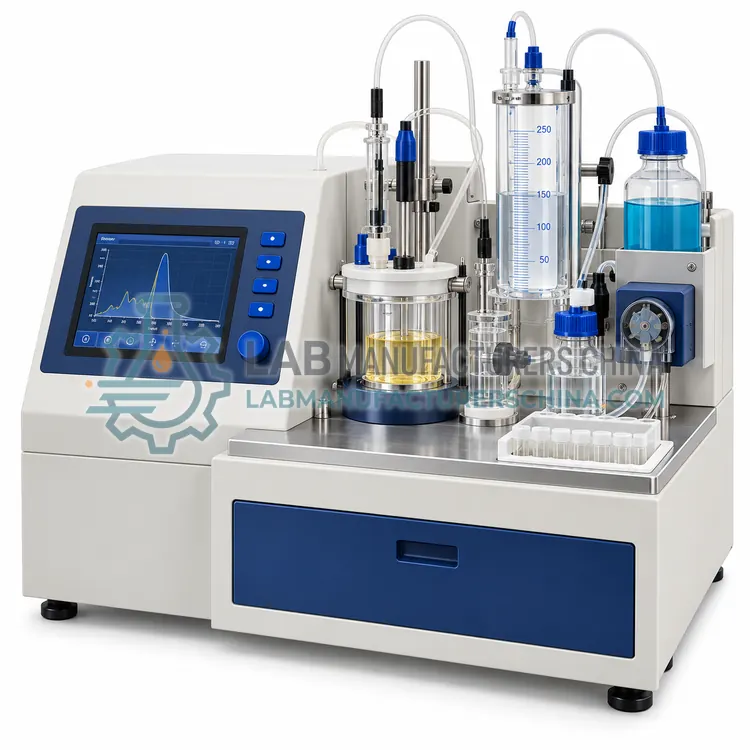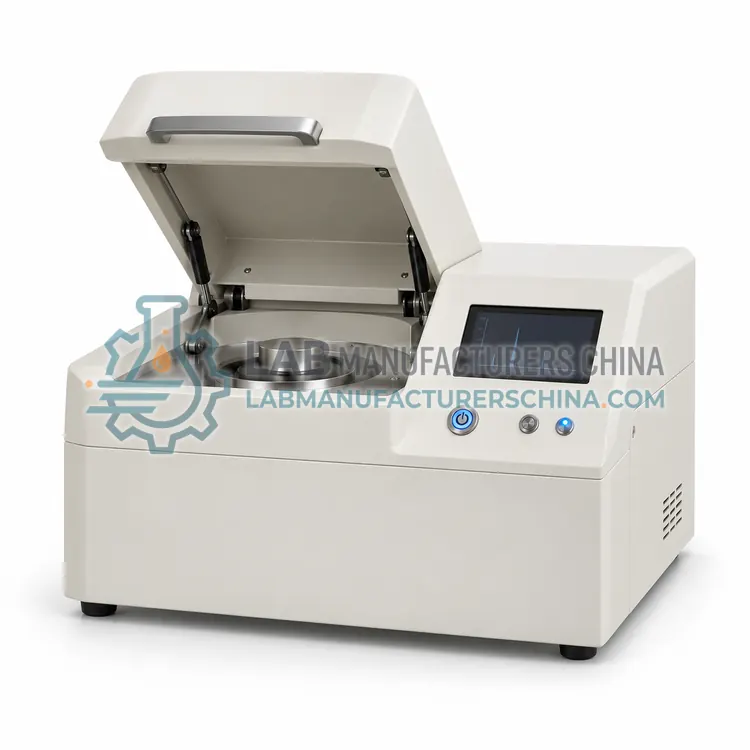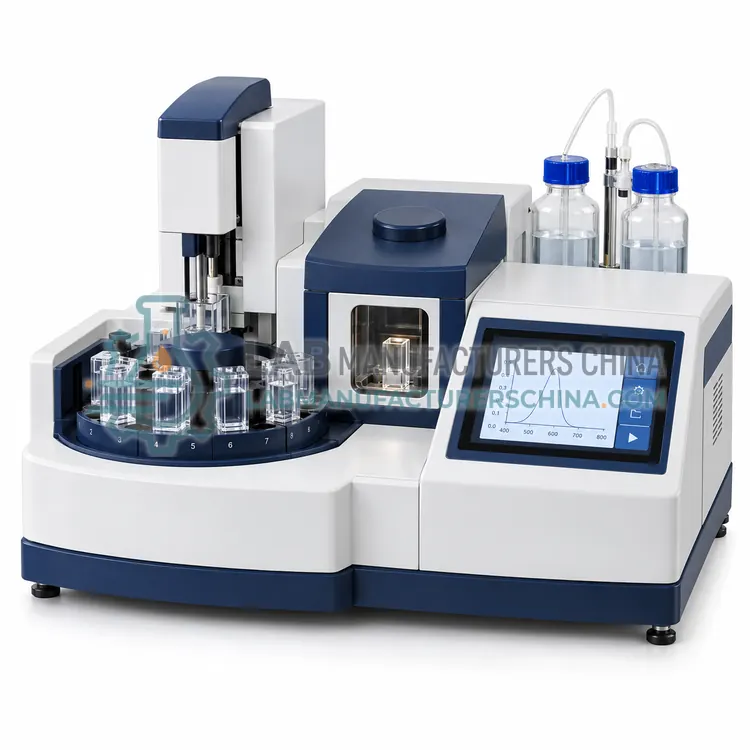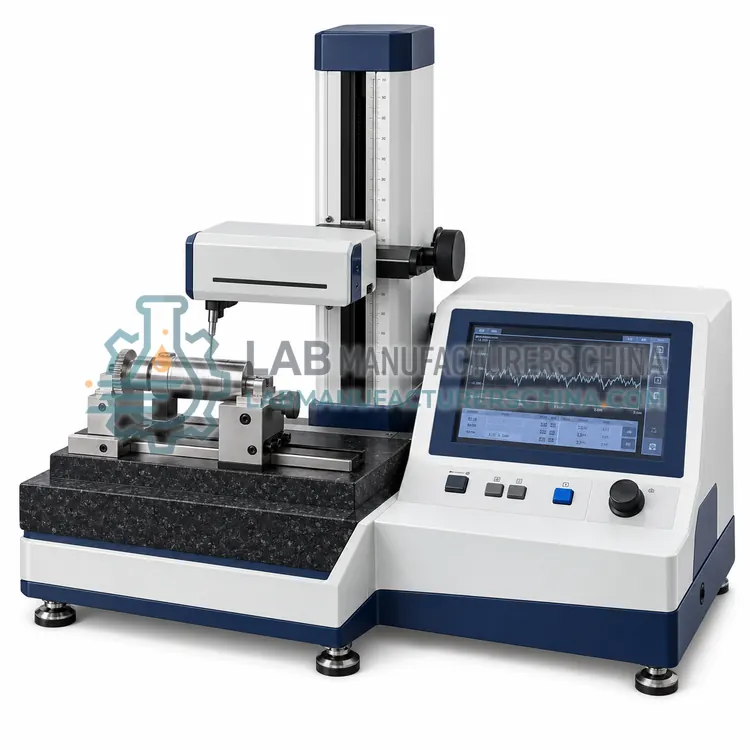
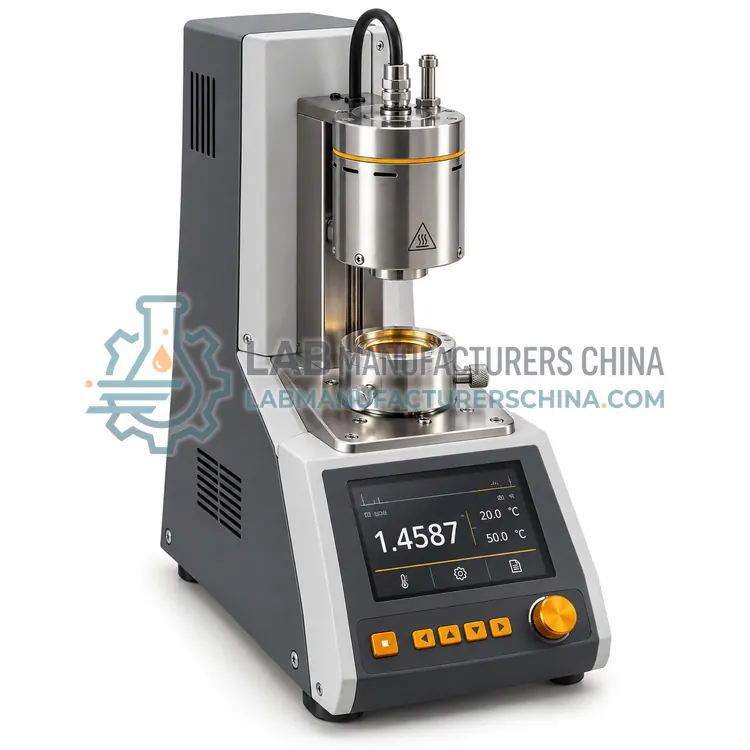
Digital Benchtop Refractometer
数显台式折光仪
- SKU QCA-0004
- QC Analyzers
- CE (to be confirmed)
- RoHS (to be confirmed)
- ISO 9001 manufacturing (to be confirmed)
Price on request — FOB / CIF quoted per order
Prices depend on configuration, quantity and destination port.
Key specifications
| Refractive index range | 1.3000–1.7000 nD |
|---|---|
| Refractive index accuracy | ±0.0001 nD |
| Brix range | 0–100 % |
| Brix accuracy | ±0.05 % |
| Temperature control | 15–70 °C, ±0.05 °C |
| Wavelength | 589 nm |
Request a quote Download brochure · to be provided
By Lab Manufacturers China Technical TeamLast reviewed Standards: ISO 9001, ISO 7027, ASTM E308
What is the Digital Benchtop Refractometer?
A benchtop refractometer that measures refractive index and Brix of liquids with automatic temperature compensation on a prism. It is the right choice for concentration control of syrups, coolants, solutions and oils where refractive index correlates with composition.
What is the Digital Benchtop Refractometer?
A benchtop refractometer that measures refractive index and Brix of liquids with automatic temperature compensation on a prism. It is the right choice for concentration control of syrups, coolants, solutions and oils where refractive index correlates with composition.
Overview
A digital benchtop refractometer determines the critical angle of total internal reflection at the interface between a sapphire prism and the sample. A light source, usually an LED at 589 nm, and a CCD or photodiode array detect the shadow-line position, which is converted to refractive index. A Peltier element holds the prism at 20 C or another setpoint to within 0.05 C because refractive index changes by about 0.0002 per degree. Measuring range is typically 1.3000 to 1.7000 nD with 0.0001 nD accuracy. The display can convert to Brix, salinity, concentration or custom scales. A measurement takes a few seconds on a few drops of liquid. It is robust, reproducible and less operator-dependent than manual Abbe refractometers, and suits clear to slightly turbid liquids.
How does it work?
QC analyzers are built around one dedicated measurement principle so that an operator can obtain a result in seconds to minutes with minimal training. Halogen moisture analyzers heat a sample and weigh the mass lost. Colorimeters illuminate a surface and measure reflected light through tristimulus filters or a spectrometer. X-ray fluorescence analyzers excite atoms with X-rays and read characteristic emission lines to identify elements. Refractometers measure the critical angle of light at a prism interface to determine refractive index. Turbidimeters detect light scattered at 90 degrees by suspended particles. Each instrument includes a stable source, a detector, temperature or geometry control, and firmware with pass and fail limits. Calibration with certified standards links results to recognized units and is checked regularly.
What are the key features?
- Sapphire prism resists scratching and chemical attack from acids, solvents and sugar solutions.
- Peltier temperature control holds the prism within 0.05 C for stable readings.
- Automatic conversion to Brix, salinity and user-defined concentration scales.
- Measurement in a few seconds requires only a few drops of sample.
- Stored methods with limits give operators immediate pass or fail indication.
- Optional sample changer and flow cell automate repeated testing.
What are the technical specifications?
A typical digital benchtop refractometer configuration offers refractive index range of 1.3000–1.7000 nD, refractive index accuracy of ±0.0001 nD, brix range of 0–100 %, brix accuracy of ±0.05 %, temperature control of 15–70 °C, ±0.05 °C and wavelength of 589 nm. Values are indicative of the product class; the exact figures for each configuration are confirmed on the quotation and the calibration documents supplied with the instrument.
Which applications is it used for?
The Digital Benchtop Refractometer is used in sugar and syrup Brix control, coolant and lubricant concentration, battery electrolyte and solvent checks and essential oil and chemical identity. Across the wider QC Analyzers class, laboratories also deploy it for incoming raw material inspection, lot release testing and positive material identification.
Which standards and certifications apply?
Relevant standards and methods include ISO 9001, ISO 7027, ASTM E308, ISO 11664-4, ASTM E1476 and IEC 61010-1. Certification candidates for this model are CE, RoHS and ISO 9001 manufacturing; each is to be confirmed for the specific configuration before shipment, and certificates are supplied only where they have been issued.
Place QC analyzers on a stable bench away from drafts, vibration and direct sunlight, and allow warm-up time before calibration. Establish a daily verification routine with a check standard such as a certified moisture standard, white tile or turbidity standard, and record the result in a control chart. Keep optics, prisms and sample cells clean using the recommended solvents. Schedule annual calibration or verification by an accredited service. X-ray instruments require radiation safety training and local registration. Where regulated, configure user access levels and electronic records to match the quality system, and define acceptance limits in the method document rather than leaving them to operators.
How do I select the right Digital Benchtop Refractometer?
Choose a digital benchtop refractometer when repeatable index or Brix readings are needed on clear liquids and temperature control matters. Choose a handheld refractometer for field spot checks. In an RFQ specify index range and accuracy, temperature range, required scales, sample chemical compatibility, need for a sample changer and any pharmacopeial or food standard requirements.
How does it compare with other QC Analyzers variants?
Start with the attribute named in the specification and the tolerance that must be resolved. Moisture analyzers suit powders, granules and pastes where a few minutes of drying is acceptable. Colorimeters are chosen when appearance is a release criterion, and geometry such as d/8 or 45/0 must match the method. Handheld XRF is selected for positive material identification and incoming metal checks. Refractometers fit liquids where concentration correlates with refractive index, and turbidimeters fit clear liquids where particle content is controlled. Compare measuring range, repeatability, sample size, and temperature control, then check whether the software supports limits, user levels, audit trails and data export. Confirm the availability of reference standards and calibration service before purchase.
Full specifications
| Refractive index range | 1.3000–1.7000 nD |
|---|---|
| Refractive index accuracy | ±0.0001 nD |
| Brix range | 0–100 % |
| Brix accuracy | ±0.05 % |
| Temperature control | 15–70 °C, ±0.05 °C |
| Wavelength | 589 nm |
| Prism material | Sapphire |
| Sample volume | 0.5–1 mL |
| Measurement time | ≈3–10 s |
| Interface | USB, RS-232 |
Indicative values for this product class. Final specifications are confirmed on the quotation and in the calibration documents supplied with the instrument.
Applications
- Sugar and syrup Brix control
- Coolant and lubricant concentration
- Battery electrolyte and solvent checks
- Essential oil and chemical identity
Key features
- Sapphire prism resists scratching and chemical attack from acids, solvents and sugar solutions.
- Peltier temperature control holds the prism within 0.05 C for stable readings.
- Automatic conversion to Brix, salinity and user-defined concentration scales.
- Measurement in a few seconds requires only a few drops of sample.
- Stored methods with limits give operators immediate pass or fail indication.
- Optional sample changer and flow cell automate repeated testing.
Frequently asked questions about Digital Benchtop Refractometer
Refractive index of most liquids changes by roughly 0.0002 per degree Celsius, so a one degree error produces a noticeable concentration error. Precise temperature control at the prism, typically 20.00 C, is required for comparable results.
Brix is a scale indicating the mass percentage of sucrose in an aqueous solution, derived from refractive index at a defined temperature. One degree Brix equals one gram of sucrose per 100 grams of solution.
Modern prism refractometers handle slightly turbid and colored samples because the measurement occurs at the surface. Highly opaque, particulate or gas-releasing samples may produce unclear shadow lines and should be filtered or degassed first.
QC analyzers are dedicated instruments that measure one or a few quality attributes, such as moisture, color, composition, refractive index or turbidity, and report pass or fail against a specification. They are designed for speed, repeatability and simple operation.
QC analyzers prioritize throughput, robustness and operator simplicity with fixed methods and limits, while research instruments prioritize flexibility, sensitivity and open method development. A QC analyzer usually measures one attribute quickly rather than many attributes in depth.
Verify with a check standard at the start of each shift or day of use, and record results on a control chart. Full calibration by a qualified provider is commonly annual, but should be shortened if drift is observed or usage is heavy.
Related models