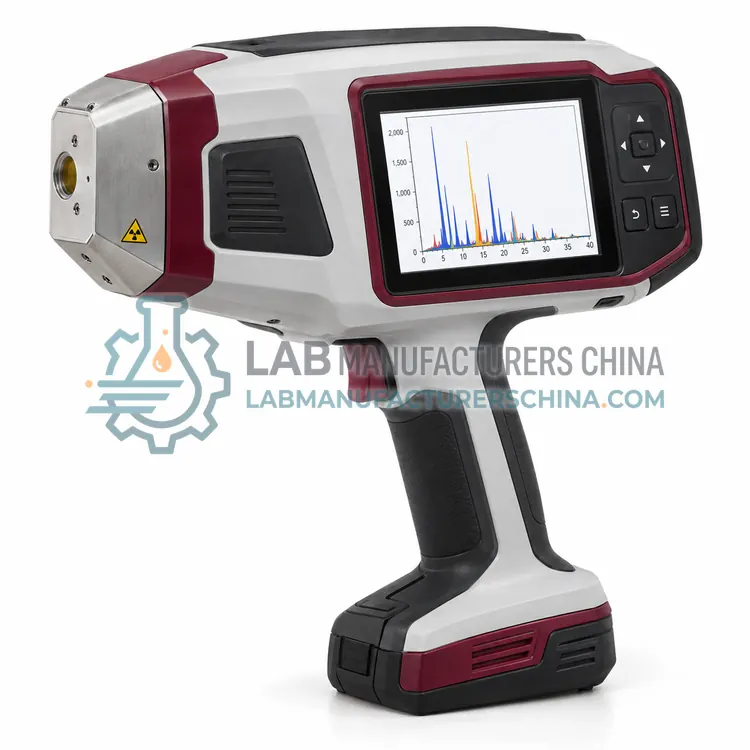

Handheld XRF Analyzer for Lead Paint Inspection
含铅涂料检测手持式 XRF 分析仪
- SKU POX-0005
- Portable XRF
- CE (to be confirmed)
- Radiation safety certification (to be confirmed)
- Lead paint protocol conformance (to be confirmed)
Price on request — FOB / CIF quoted per order
Prices depend on configuration, quantity and destination port.
Key specifications
| Measured element | lead and associated elements |
|---|---|
| Detection limit | 0.1–0.5 mg/cm2 |
| Spot size | 1–3 mm |
| Measurement time | 2–30 s |
| Substrate modes | wood, metal, plaster, concrete |
| Detector | silicon drift detector |
Request a quote Download brochure · to be provided
By Lab Manufacturers China Technical TeamLast reviewed Standards: US EPA Method 6200 Field portable XRF for soil, ISO 13196 Soil quality — Screening of selected elements by EDXRF, IEC 62321 Determination of restricted substances in electrotechnical products
What is the Handheld XRF Analyzer for Lead Paint Inspection?
This handheld XRF analyzer is dedicated to measuring lead in paint and surface coatings. It is chosen for routine housing, school, childcare and facility inspections and for compliance testing under lead paint regulations.
What is the Handheld XRF Analyzer for Lead Paint Inspection?
This handheld XRF analyzer is dedicated to measuring lead in paint and surface coatings. It is chosen for routine housing, school, childcare and facility inspections and for compliance testing under lead paint regulations.
Overview
The analyzer uses a small spot and a short measurement, optimized for thin paint layers on wood, plaster, metal and concrete. Calibrations and testing modes follow established lead paint protocols, and the software applies the regulatory threshold, reporting lead present or absent in milligrams per square centimetre. Substrate correction accounts for the underlying material, because wood, steel and plaster scatter differently. The operator tests representative locations and records results with room and component descriptions, and some units support photo documentation. Surface condition matters: peeling or dirty paint can bias results, and repeated testing in the same location is common practice. Many programs pair instrument screening with limited laboratory paint chip analysis for confirmation.
How does it work?
A small X-ray tube in the analyzer irradiates the sample, and a silicon drift detector measures the energies of the resulting characteristic X-rays. Electronics build a spectrum and calibrated software reports element concentrations. Because the instrument is small and battery powered, power is limited and measurement times are longer than on benchtop systems, and light elements below magnesium or aluminum cannot be measured in air. Fundamental parameter or empirical calibrations are stored onboard, and an internal shutter or reference standard verifies performance. The analyzer is pressed against the sample or mounted on a stand for extended measurements. Results depend strongly on surface condition, so cleaning, flatness and representative sampling are important in the field.
What are the key features?
- Small spot optimized for thin paint layers
- Short measurement for rapid inspection
- Regulatory threshold reporting in mg/cm2
- Substrate correction for wood, metal and plaster
- Room and component result documentation
- Compatible with confirmatory paint chip analysis
What are the technical specifications?
A typical handheld xrf analyzer for lead paint inspection configuration offers measured element of lead and associated elements, detection limit of 0.1–0.5 mg/cm2, spot size of 1–3 mm, measurement time of 2–30 s, substrate modes of wood, metal, plaster, concrete and detector of silicon drift detector. Values are indicative of the product class; the exact figures for each configuration are confirmed on the quotation and the calibration documents supplied with the instrument.
Which applications is it used for?
The Handheld XRF Analyzer for Lead Paint Inspection is used in housing and rental property lead inspection, school and childcare facility surveys, renovation and abatement verification and industrial and bridge coating assessment. Across the wider Portable XRF class, laboratories also deploy it for alloy grade identification and positive material verification, soil, sediment and environmental field screening and mining exploration and ore grade estimation.
Which standards and certifications apply?
Relevant standards and methods include US EPA Method 6200 Field portable XRF for soil, ISO 13196 Soil quality — Screening of selected elements by EDXRF, IEC 62321 Determination of restricted substances in electrotechnical products, ASTM F2617 Identification of alloy grades by handheld XRF, ISO 3497 Metallic coatings — X-ray spectrometric thickness and IEC 61010-2-091. Certification candidates for this model are CE, Radiation safety certification and Lead paint protocol conformance; each is to be confirmed for the specific configuration before shipment, and certificates are supplied only where they have been issued.
Portable XRF units are X-ray devices and require operator training, safe work procedures and, in many jurisdictions, registration or a licence. Never point the device at people, and use the shield or stand where possible. Radiation dose to the operator is very low during normal use but must be monitored and recorded. Surface contamination, paint, rust and coatings bias results, so samples are cleaned or measured through calibrated modes. Repeatability depends on sample positioning and measurement time. Battery management, detector temperature stabilization and periodic verification with a reference standard are part of routine use, and results are traceable only when calibration and operator competence are documented.
How do I select the right Handheld XRF Analyzer for Lead Paint Inspection?
Select a lead paint analyzer when inspection programs require rapid, non-destructive determination of lead in coatings across many locations. Specify the regulatory threshold and substrate types, and confirm that the testing mode matches the required protocol. Plan a confirmatory paint chip analysis program for quality assurance.
How does it compare with other Portable XRF variants?
Select a portable XRF analyzer by the application because calibration, spot size and features differ. Alloy analyzers use a large spot and comprehensive alloy libraries with grade identification. Soil and environmental analyzers use calibrated methods for regulatory elements and may include a stand and GPS. Mining analyzers optimize for light and heavy elements in ores and add pathfinder calibrations. RoHS analyzers target restricted elements in plastics and electronics with polymer-specific calibrations. Lead paint analyzers use a small spot and short measurement for compliance testing. Scrap sorting analyzers emphasize speed and grade identification. Confirm element range, spot size, calibration availability, battery life and whether a stand, printer and radiation safety features are included.
Full specifications
| Measured element | lead and associated elements |
|---|---|
| Detection limit | 0.1–0.5 mg/cm2 |
| Spot size | 1–3 mm |
| Measurement time | 2–30 s |
| Substrate modes | wood, metal, plaster, concrete |
| Detector | silicon drift detector |
| Reporting units | mg/cm2 and mg/kg |
| Battery life | 6–12 h typical use |
| Weight | 1.3–2.0 kg |
| Data export | inspection reports and CSV |
Indicative values for this product class. Final specifications are confirmed on the quotation and in the calibration documents supplied with the instrument.
Applications
- Housing and rental property lead inspection
- School and childcare facility surveys
- Renovation and abatement verification
- Industrial and bridge coating assessment
Key features
- Small spot optimized for thin paint layers
- Short measurement for rapid inspection
- Regulatory threshold reporting in mg/cm2
- Substrate correction for wood, metal and plaster
- Room and component result documentation
- Compatible with confirmatory paint chip analysis
Frequently asked questions about Handheld XRF Analyzer for Lead Paint Inspection
The underlying material scatters and absorbs X-rays differently, so the same paint layer can read differently on wood, steel or plaster. Substrate correction uses the measured signal of the base material to adjust the result, improving accuracy on the range of surfaces found in real buildings.
Paint thickness and composition vary across a surface, and a single short measurement can be affected by irregularities or operator placement. Repeating measurements and averaging improves confidence, and standard protocols define how many readings and what agreement is required before reporting a result.
A paint chip is needed when a result is near the threshold, when the instrument cannot access the surface reliably, or when a regulatory decision requires confirmation by a laboratory method. Chip analysis by acid digestion and atomic spectroscopy also quantifies lead per unit area or mass with higher accuracy.
For many alloy and screening applications portable XRF agrees within a few percent relative with laboratory results when calibration and surface preparation are appropriate. Accuracy is lower for light elements, trace levels and heterogeneous samples. Field results are usually used for screening and sorting, with laboratory confirmation for critical acceptance decisions.
Most handheld analyzers measure from magnesium or aluminum to uranium. Some models with vacuum or helium purge and thin windows can reach sodium. Elements below sodium are not measurable. Light-element performance also depends on the detector window, tube voltage and the calibration selected.
Samples should be cleaned of soil, paint, oil and corrosion, and the measured surface should be flat and representative. Rough or coated surfaces bias results, especially for light elements. For soil, sieving and drying followed by measurement in a sample cup improve precision and comparability between operators.
Related models