Online Oil Moisture Sensor
在线油液水分传感器
- SKU OCM-0001
- Oil Condition Monitoring
- CE (to be confirmed)
- ISO 9001 manufacturing (to be confirmed)
Price on request — FOB / CIF quoted per order
Prices depend on configuration, quantity and destination port.
Key specifications
| Measurement range | 0–100 % relative saturation |
|---|---|
| Accuracy | ± 3 % RS |
| Temperature range | −40 to 100 °C |
| Operating pressure | ≤ 50 bar |
| Response time (T90) | ≈ 2–5 min |
| Output | 4–20 mA, Modbus RTU |
Request a quote Download brochure · to be provided
By Lab Manufacturers China Technical TeamLast reviewed Standards: ISO 4406, ISO 4407, ISO 11171
What is the Online Oil Moisture Sensor?
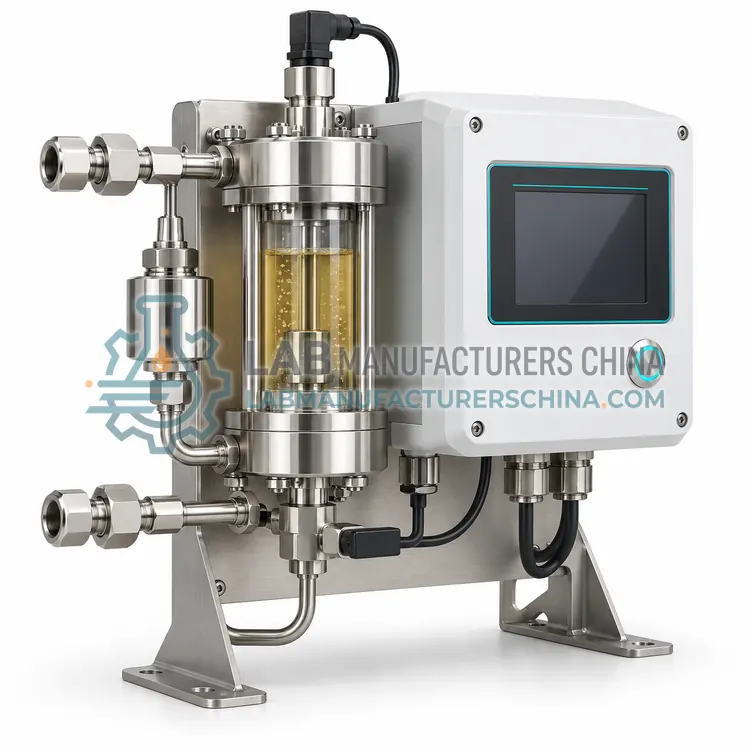
An online oil moisture sensor measures the relative saturation of water in oil with a capacitive polymer element and temperature probe. It gives continuous warning of water ingress in hydraulic, turbine and gearbox systems before free water forms and damages bearings.
What is the Online Oil Moisture Sensor?
An online oil moisture sensor measures the relative saturation of water in oil with a capacitive polymer element and temperature probe. It gives continuous warning of water ingress in hydraulic, turbine and gearbox systems before free water forms and damages bearings.
Overview
The probe has a thin-film polymer capacitor that absorbs water from oil in proportion to the water activity of the oil, which changes the capacitance. A temperature element measures oil temperature, and the electronics output percent relative saturation, which is 100 percent when oil holds the maximum dissolved water at that temperature. Because saturation limit depends on oil type and temperature, the sensor also computes water content in ppm when calibrated with oil-specific curves. Typical thresholds are 50 to 70 percent saturation for warning to avoid free water. The probe withstands pressures up to 50 bar and temperatures up to 100 degrees Celsius, and outputs 4-20 mA or digital signals. Fouling or varnish can slow response, so periodic cleaning and verification are recommended.
How does it work?
Condition monitoring sensors convert a physical property of oil into an electrical signal. Capacitive polymer sensors measure relative humidity of oil, expressed as percent saturation, because water absorbs into a polymer film and changes its capacitance. Light-blocking or light-scattering sensors count particles in a small flow cell, from which ISO 4406 cleanliness codes are derived. Inductive coil sensors detect ferrous and non-ferrous metal particles passing through a coil by the perturbation they cause in a magnetic field. Multi-sensor probes combine dielectric constant, conductivity, temperature and viscosity, computed from resonant tuning fork or quartz crystal oscillation, to produce an oil health index. Data is logged in a controller and transmitted to a condition monitoring platform through 4-20 mA, Modbus or other protocols, where alarm thresholds and trends are evaluated.
What are the key features?
- Capacitive polymer sensor measures relative saturation in percent
- Integrated temperature sensor and ppm calculation
- Pressure rating to 50 bar for inline mounting
- 4–20 mA, Modbus or IO-Link output options
- Compact stainless steel housing with threaded process connection
What are the technical specifications?
A typical online oil moisture sensor configuration offers measurement range of 0–100 % relative saturation, accuracy of ± 3 % RS, temperature range of −40 to 100 °C, operating pressure of ≤ 50 bar, response time (T90) of ≈ 2–5 min and output of 4–20 mA, Modbus RTU. Values are indicative of the product class; the exact figures for each configuration are confirmed on the quotation and the calibration documents supplied with the instrument.
Which applications is it used for?
The Online Oil Moisture Sensor is used in turbine lube oil water detection, hydraulic press and paper machine oil and offshore and marine gearbox monitoring. Across the wider Oil Condition Monitoring class, laboratories also deploy it for hydraulic system cleanliness monitoring, wind turbine gearbox oil condition monitoring and turbine lube oil water detection.
Which standards and certifications apply?
Relevant standards and methods include ISO 4406, ISO 4407, ISO 11171, ISO 17359, ISO 13374, ASTM D7647, ASTM D7917 and IEC 60079-0. Certification candidates for this model are CE and ISO 9001 manufacturing; each is to be confirmed for the specific configuration before shipment, and certificates are supplied only where they have been issued.
Install sensors at representative locations, typically in a flowing return line downstream of the component and upstream of the filter, where oil is well mixed and pressure is moderate. Avoid dead legs and ensure flow within the sensor's specified range. Configure alarms based on baseline data from new or healthy oil, not generic limits alone. Periodically verify sensor output against laboratory samples, since sensors drift or fouling can occur. Protect cables and connectors from vibration and heat, and follow hazardous-area requirements such as ATEX or IECEx where applicable. Document installation, calibration and alarm settings.
How do I select the right Online Oil Moisture Sensor?
Select a moisture sensor for assets where water ingress is a leading failure cause, such as turbines, marine systems and paper machines. Specify oil type, pressure, temperature, output protocol, process thread and whether relative saturation or ppm output is required. It does not measure particles or chemistry.
How does it compare with other Oil Condition Monitoring variants?
Match the sensor to the failure modes that matter for the asset. Hydraulic and turbine systems suffer mostly from particle and water contamination, so a particle monitor and moisture sensor are the priority. Gearboxes and engines exhibit wear and oil degradation, where a wear-debris sensor and a multi-parameter probe give earlier warning. Decide between inline permanent installation and portable devices: inline gives continuous trends and alarms, while portable gives flexible coverage of many assets. Check operating pressure and temperature, installation port threads, output signals, hazardous-area approvals, calibration method and whether the sensor reports absolute values, such as ppm water, or relative trends only. Integration with existing SCADA or CMMS systems should be confirmed before purchase.
Full specifications
| Measurement range | 0–100 % relative saturation |
|---|---|
| Accuracy | ± 3 % RS |
| Temperature range | −40 to 100 °C |
| Operating pressure | ≤ 50 bar |
| Response time (T90) | ≈ 2–5 min |
| Output | 4–20 mA, Modbus RTU |
| Process connection | G1/4, M12 or 3/4-16 UNF |
| Ingress protection | IP67 |
| Supply voltage | 9–30 V DC |
Indicative values for this product class. Final specifications are confirmed on the quotation and in the calibration documents supplied with the instrument.
Applications
- Turbine lube oil water detection
- Hydraulic press and paper machine oil
- Offshore and marine gearbox monitoring
Key features
- Capacitive polymer sensor measures relative saturation in percent
- Integrated temperature sensor and ppm calculation
- Pressure rating to 50 bar for inline mounting
- 4–20 mA, Modbus or IO-Link output options
- Compact stainless steel housing with threaded process connection
Frequently asked questions about Online Oil Moisture Sensor
Relative saturation expresses dissolved water as a percentage of the maximum amount the oil can hold at its temperature. At 100 percent, free water starts to form, so alarms are set well below this level, often 50 to 70 percent.
Most sensors work with mineral, synthetic and ester oils, but the saturation curve differs among oil types. Confirm compatibility and request calibration for your oil, especially for phosphate esters and additive-rich fluids.
Oil holds more water as it warms, so the same water content gives a lower saturation at higher temperature. Temperature measurement lets the sensor report consistent saturation and convert to ppm water accurately.
Oil condition monitoring tracks the health of lubricating or hydraulic oil using sensors or periodic tests, measuring water, particles, wear debris, viscosity and chemistry. Trends reveal contamination, wear or degradation early so maintenance can be planned before failure.
Online monitoring uses sensors installed on the machine to provide continuous data and alarms, while offline monitoring relies on periodic samples tested in a laboratory. Online data gives faster warning; laboratory tests give more precise and comprehensive results.
Water content, particle count and temperature are the most valuable for hydraulic and turbine systems. Wear debris, viscosity and dielectric constant add insight for gearboxes and engines. The best selection depends on the dominant failure modes of each asset.
Related models