Karl Fischer Titrator for Paper Moisture Determination
纸张水分测定用卡尔费休滴定仪
- SKU MOT-0003
- Moisture Testing
- CE (to be confirmed)
- ISO 9001 manufacturing (to be confirmed)
Price on request — FOB / CIF quoted per order
Prices depend on configuration, quantity and destination port.
Key specifications
| Measurement principle | Karl Fischer reaction with iodine |
|---|---|
| Water range | 10 µg to 100% depending on mode |
| Resolution | 0.1 µg water (coulometric) |
| Oven temperature | 40–200 °C programmable |
| Carrier gas | Dry nitrogen or air, 20–100 mL/min |
| Drift requirement | Below 2 µg/min before start |
Request a quote Download brochure · to be provided
By Lab Manufacturers China Technical TeamLast reviewed Standards: ISO 287, ISO 638, ISO 760
What is the Karl Fischer Titrator for Paper Moisture Determination?
A Karl Fischer titrator measures water in paper specifically by the quantitative reaction of iodine with water, so other volatile substances do not interfere. It is used where drying methods would overstate moisture or where a reference chemical result is needed.
What is the Karl Fischer Titrator for Paper Moisture Determination?
A Karl Fischer titrator measures water in paper specifically by the quantitative reaction of iodine with water, so other volatile substances do not interfere. It is used where drying methods would overstate moisture or where a reference chemical result is needed.
Overview
In coulometric Karl Fischer titration, iodine is generated electrochemically in the titration cell and the charge required to reach the endpoint is proportional to the amount of water, which gives very low detection limits. Volumetric titration uses a titrant of known iodine concentration and suits larger water contents. Solid samples such as paper are normally handled with an oven accessory: the specimen is heated in a sealed vial at a controlled temperature and the released water is transferred by dry carrier gas into the titration cell, so only water enters the cell and the fibre and fillers remain behind. Cell drift must be low and stable before each determination, and the oven temperature is chosen high enough to release the water but low enough to avoid decomposing additives.
How does it work?
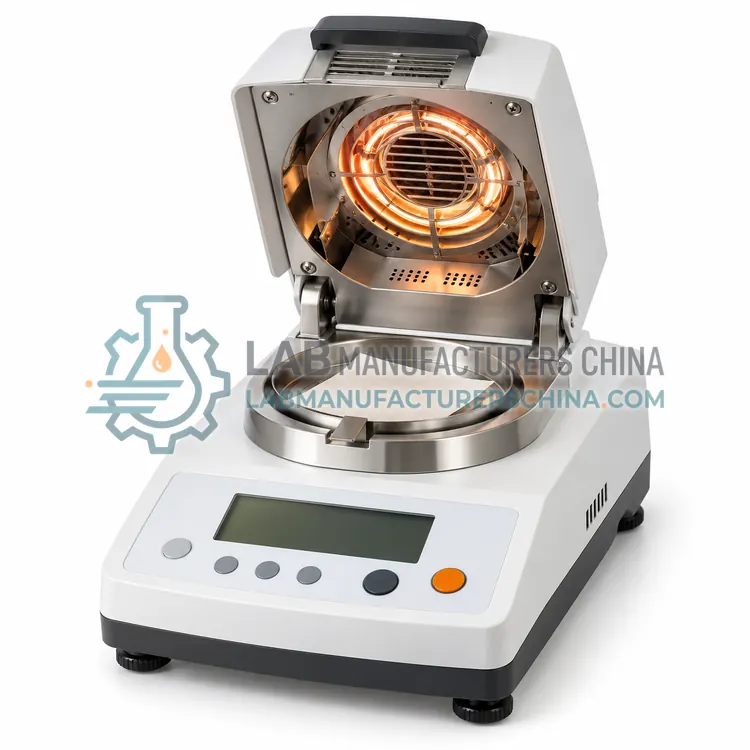
All moisture methods compare the mass of water in the sample with either the wet mass or the dry mass, and the chosen reference must always be reported because moisture content and dry matter content give different numbers. The reference method dries a specimen to constant mass in an oven at a specified temperature and calculates the mass loss. Halogen drying performs the same measurement quickly on a built-in balance, using a halogen radiator for faster and more uniform heating, and requires correlation with the oven method for each paper grade. Karl Fischer titration is a chemical method: iodine reacts quantitatively with water, and the endpoint is detected electrochemically, so it measures water specifically and is unaffected by other volatile substances. Microwave and near-infrared instruments measure indirectly through absorption or dielectric response and need calibration against a reference method.
What are the key features?
- Coulometric and volumetric titration modes
- Oven accessory for solid paper samples
- Specific response to water only
- Low detection limit in the microgram range
- Drift monitoring before each determination
- Programmable oven temperature
What are the technical specifications?
A typical karl fischer titrator for paper moisture determination configuration offers measurement principle of Karl Fischer reaction with iodine, water range of 10 µg to 100% depending on mode, resolution of 0.1 µg water (coulometric), oven temperature of 40–200 °C programmable, carrier gas of Dry nitrogen or air, 20–100 mL/min and drift requirement of Below 2 µg/min before start. Values are indicative of the product class; the exact figures for each configuration are confirmed on the quotation and the calibration documents supplied with the instrument.
Which applications is it used for?
The Karl Fischer Titrator for Paper Moisture Determination is used in reference moisture determination on paper and board, moisture in papers containing solvent residues, verification of moisture meters and analyzers and low-moisture specialty and electrical paper testing. Across the wider Moisture Testing class, laboratories also deploy it for incoming moisture checks on pulp and recovered paper, machine-direction moisture control during papermaking and finishing and converting moisture verification.
Which standards and certifications apply?
Relevant standards and methods include ISO 287, ISO 638, ISO 760, TAPPI T412, ASTM D644, ASTM D6869 and IEC 61010-1. Certification candidates for this model are CE and ISO 9001 manufacturing; each is to be confirmed for the specific configuration before shipment, and certificates are supplied only where they have been issued.
Sample handling dominates the uncertainty because paper equilibrates with the surrounding air within minutes. Cut sealed specimens, weigh them quickly in a closed container, and record the temperature and relative humidity of the laboratory, since the standard equilibrium condition defines the moisture of a well-conditioned sheet. Oven temperature, drying time and the use of a desiccator before weighing must follow the method, and the balance should be checked with certified masses. For indirect instruments, recalibrate whenever furnish, coating, grade or basis weight changes, and keep the reference results used to build the calibration. Store paper samples away from heat and direct sunlight before testing.
How do I select the right Karl Fischer Titrator for Paper Moisture Determination?
Specify Karl Fischer titration when the moisture result must be free from interference by other volatiles, when the paper has very low moisture, or when a reference value is needed to validate faster methods. Confirm that an oven accessory and appropriate vials are available, since direct addition of paper to the cell is not practical.
How does it compare with other Moisture Testing variants?
Choose the reference oven method when a specification value is required, since almost all paper moisture standards are written around it. Select a halogen instrument for routine control where speed matters, but establish and document the correlation with the oven method for each grade, including for coated and highly filled papers. Karl Fischer titration suits samples where volatile substances other than water are present, such as papers containing solvents, and can be combined with an oven accessory for solid samples that do not disperse. Microwave and near-infrared instruments are chosen for production use: the near-infrared systems mount on the machine and measure across the full web width continuously, while microwave instruments suit bale and stack checking on the floor.
Full specifications
| Measurement principle | Karl Fischer reaction with iodine |
|---|---|
| Water range | 10 µg to 100% depending on mode |
| Resolution | 0.1 µg water (coulometric) |
| Oven temperature | 40–200 °C programmable |
| Carrier gas | Dry nitrogen or air, 20–100 mL/min |
| Drift requirement | Below 2 µg/min before start |
| Typical specimen mass | 0.1–2 g |
| Data output | Water content, drift log and curve |
Indicative values for this product class. Final specifications are confirmed on the quotation and in the calibration documents supplied with the instrument.
Applications
- Reference moisture determination on paper and board
- Moisture in papers containing solvent residues
- Verification of moisture meters and analyzers
- Low-moisture specialty and electrical paper testing
Key features
- Coulometric and volumetric titration modes
- Oven accessory for solid paper samples
- Specific response to water only
- Low detection limit in the microgram range
- Drift monitoring before each determination
- Programmable oven temperature
Frequently asked questions about Karl Fischer Titrator for Paper Moisture Determination
Paper does not dissolve in the Karl Fischer reagent, so water cannot be released into the cell by direct titration. Heating the specimen in a sealed vial and sweeping the released water into the cell with dry carrier gas transfers only water, leaving fibre, filler and coating behind.
It must be high enough to release all the water in a reasonable time, yet below the temperature at which the paper or its additives decompose and release other substances. The correct value is established by measuring at two or three temperatures and selecting the lowest one that gives a stable, repeatable water content.
Drift shows the rate at which moisture enters the cell from the atmosphere or from reagent decomposition. A high or unstable drift adds a background signal that is counted as sample water, so the cell is conditioned until drift is low and stable, and the drift value is recorded with the result.
Moisture content expresses the mass of water as a percentage of the wet specimen, while dry matter content expresses the dry residue as a percentage of the wet specimen, so the two do not add to 100 in the usual sense. Standards state which basis applies, and results from the two bases must never be mixed in one specification.
Electrical and near-infrared instruments respond to the interaction of water with the fibre, filler and coating, so a calibration built on one furnish does not transfer to another. Each grade, coating type and basis weight range needs its own correlation, and the calibration should be rechecked after any change in raw materials.
Cut specimens from the sheet and place them immediately into a closed container or sealed bag, then transfer them to a weighing bottle or drying vessel with minimal exposure. Handling time, ambient conditions and the container used all affect the result, so they should be standardised and recorded in the procedure.