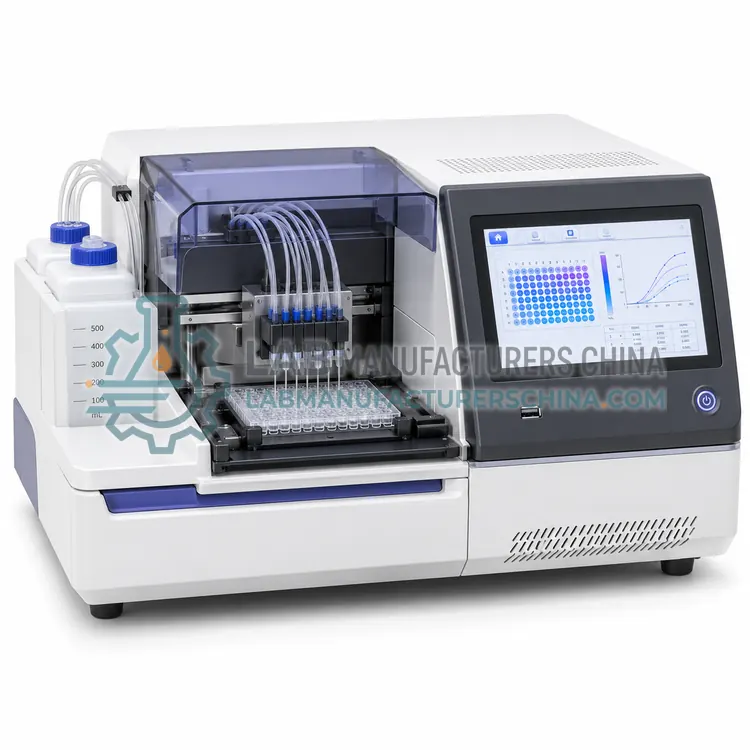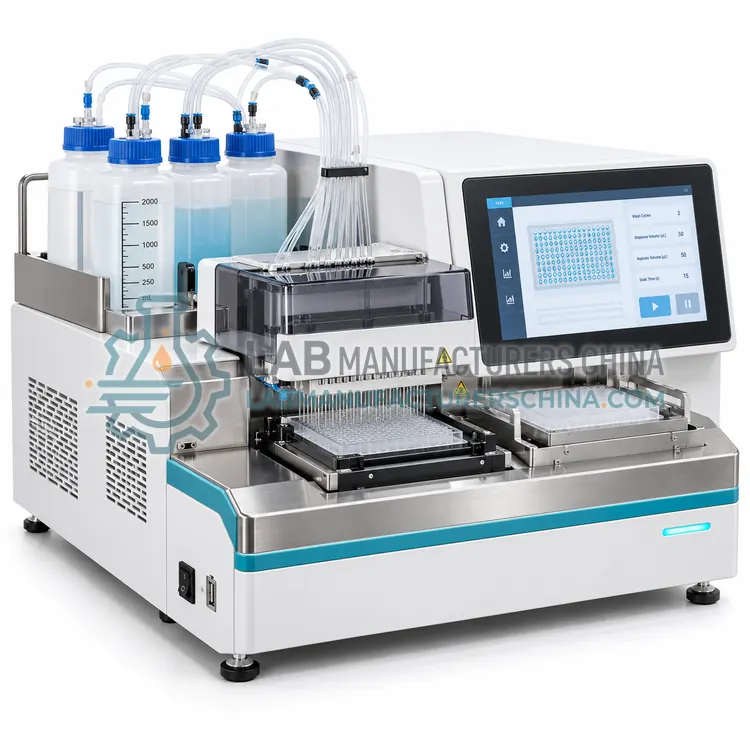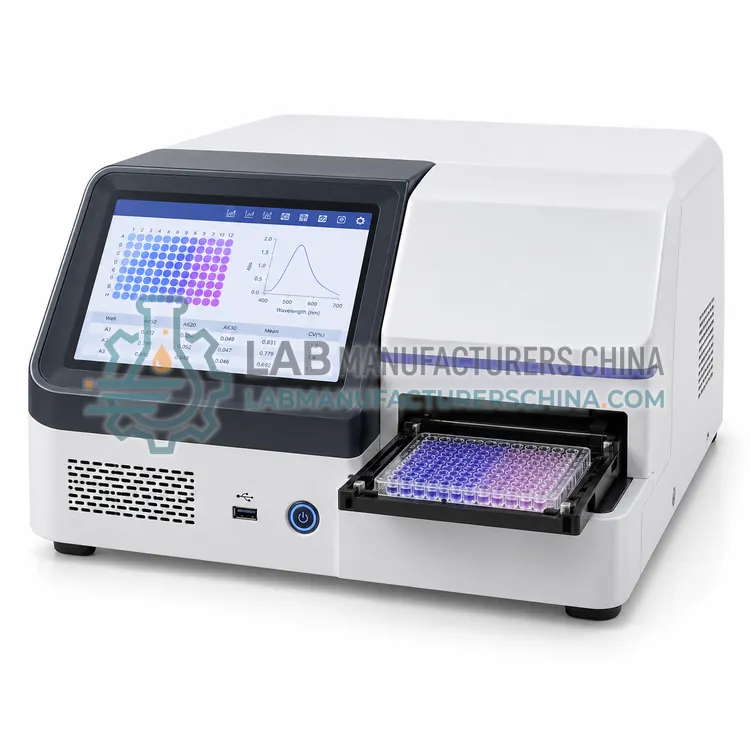
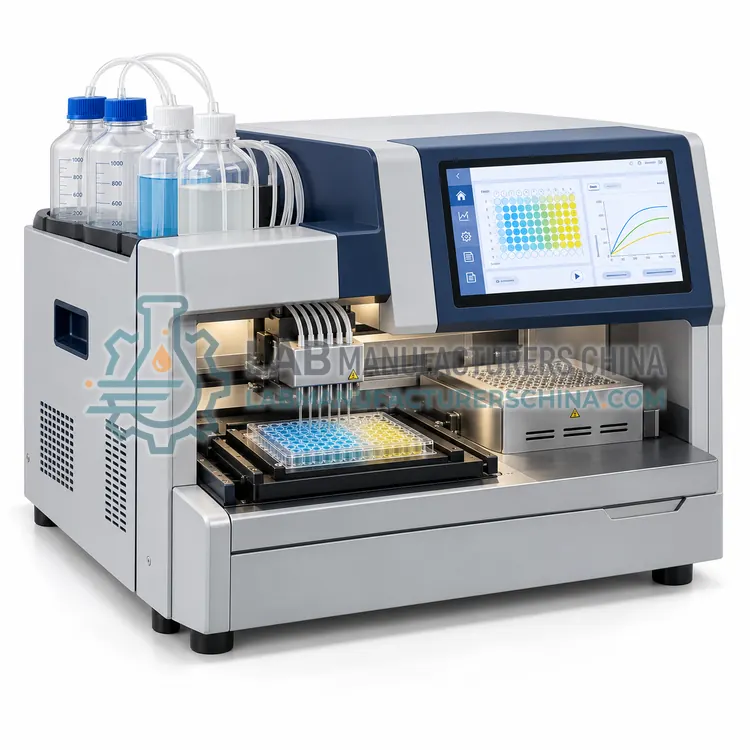
Filter-Based Multimode Microplate Reader
滤光片式多功能酶标仪
- SKU MIR-0002
- Microplate Readers
- CE (to be confirmed)
- ISO 9001 manufacturing (to be confirmed)
- RoHS (to be confirmed)
Price on request — FOB / CIF quoted per order
Prices depend on configuration, quantity and destination port.
Key specifications
| Detection modes | Absorbance, fluorescence intensity, luminescence (TRF/FP optional) |
|---|---|
| Wavelength selection | Interchangeable filters, 340–700 nm |
| Fluorescence sensitivity | ≤ 1 pM fluorescein (384-well, typical) |
| Luminescence dynamic range | Up to 7 decades |
| Absorbance range | 0–4.0 OD |
| Plate formats | 6- to 384-well |
Request a quote Download brochure · to be provided
By Lab Manufacturers China Technical TeamLast reviewed Standards: ANSI/SLAS 1-2004 to 4-2004, IEC 61010-1, IEC 61010-2-081
What is the Filter-Based Multimode Microplate Reader?
A filter-based multimode microplate reader combines absorbance, fluorescence intensity and luminescence detection using interchangeable optical filters. It gives high sensitivity and fast reading for screening, cell-based assays and routine multiplexed plate work in a single compact instrument.
What is the Filter-Based Multimode Microplate Reader?
A filter-based multimode microplate reader combines absorbance, fluorescence intensity and luminescence detection using interchangeable optical filters. It gives high sensitivity and fast reading for screening, cell-based assays and routine multiplexed plate work in a single compact instrument.
Overview
Filter-based multimode readers use xenon flash or LED excitation, filter wheels or slides for excitation and emission, and photomultiplier tubes or photodiodes for detection. Fixed filters transmit a narrow band efficiently, giving better sensitivity than monochromators at common wavelengths. Typical fluorescein sensitivity reaches the low picomolar range in 384-well plates. Top and bottom fluorescence reading, luminescence with high dynamic range and optional time-resolved fluorescence and fluorescence polarization cover most screening assays. Dispenser injectors enable flash luminescence and kinetic reading. Temperature control up to 45 degrees and orbital shaking support cell and enzyme assays. The drawback is wavelength rigidity: new fluorophores need purchased filters, and scanning spectra is not possible. Reading a 384-well plate takes under a minute for fluorescence intensity.
How does it work?
A microplate reader illuminates each well and measures the light that returns. In absorbance mode, a lamp such as a xenon flash source passes light through a filter or monochromator and the well, and a photodiode measures transmitted intensity. Absorbance follows the Beer–Lambert law, so concentration is proportional to optical density. In fluorescence mode, excitation light is directed at the sample and a photomultiplier tube or photodiode measures emission at a longer wavelength through a separate filter path, from the top or bottom of the plate. Luminescence mode uses no excitation and counts photons from chemical or biological light emission. Time-resolved fluorescence adds a delay after excitation to remove short-lived background. Precise plate carriers, path length correction, shaking and temperature control complete the system.
What are the key features?
- Absorbance, fluorescence intensity and luminescence in one instrument
- High sensitivity at fixed wavelengths with interchangeable filter sets
- Top and bottom fluorescence reading for suspension and adherent cells
- Optional reagent injectors for flash luminescence and kinetic assays
- Temperature control to 45 °C and orbital shaking for cell assays
- Supports 6- to 384-well plates with fast read times
What are the technical specifications?
A typical filter-based multimode microplate reader configuration offers detection modes of Absorbance, fluorescence intensity, luminescence (TRF/FP optional), wavelength selection of Interchangeable filters, 340–700 nm, fluorescence sensitivity of ≤ 1 pM fluorescein (384-well, typical), luminescence dynamic range of Up to 7 decades, absorbance range of 0–4.0 OD and plate formats of 6- to 384-well. Values are indicative of the product class; the exact figures for each configuration are confirmed on the quotation and the calibration documents supplied with the instrument.
Which applications is it used for?
The Filter-Based Multimode Microplate Reader is used in cell viability and cytotoxicity screening, luciferase reporter gene assays, fluorescence-based enzyme assays, kinase and GPCR screening and multiplexed immunoassays. Across the wider Microplate Readers class, laboratories also deploy it for ELISA quantification, cell viability and cytotoxicity assays and enzyme kinetics.
Which standards and certifications apply?
Relevant standards and methods include ANSI/SLAS 1-2004 to 4-2004, IEC 61010-1, IEC 61010-2-081, IEC 61326-1, ISO 13485 (IVD use) and 21 CFR Part 11. Certification candidates for this model are CE, ISO 9001 manufacturing and RoHS; each is to be confirmed for the specific configuration before shipment, and certificates are supplied only where they have been issued.
Place the reader on a vibration-free bench away from direct sunlight and strong electromagnetic sources, and allow the lamp and optics to warm up as specified. Verify absorbance accuracy and linearity with certified filters or standard solutions at installation and at least annually, and check fluorescence sensitivity with a fluorescein dilution series. Keep the plate carrier and optics clean, and replace flash lamps according to flash count. Use plates matched to the mode, for example clear for absorbance, black for fluorescence and white for luminescence. Apply software access control and data integrity features where regulated.
How do I select the right Filter-Based Multimode Microplate Reader?
Select this variant when your assays use a defined set of wavelengths and sensitivity and speed are priorities, for example screening and luminescent reporter work. Choose a monochromator model if you need spectral scanning. In an RFQ specify detection modes, filter sets, injectors, plate formats and sensitivity targets such as fluorescein detection limit.
How does it compare with other Microplate Readers variants?
Select a reader by the detection modes you need today and in the next few years. Absorbance-only readers suit routine ELISA and protein assays. Multimode readers add fluorescence, luminescence, time-resolved fluorescence or fluorescence polarization for cell-based and screening assays. Compare sensitivity (for example fluorescein detection limit), dynamic range, and wavelength flexibility between filters and monochromators. Check supported plate formats up to 384 or 1536 wells, read speed per plate, temperature control and shaking for kinetic work, and gas control for live-cell reading. For regulated laboratories, verify software with user management and audit trails. Consider injectors for flash luminescence, imaging readers for cell counting, and whether a stacker interface is needed for automation.
Full specifications
| Detection modes | Absorbance, fluorescence intensity, luminescence (TRF/FP optional) |
|---|---|
| Wavelength selection | Interchangeable filters, 340–700 nm |
| Fluorescence sensitivity | ≤ 1 pM fluorescein (384-well, typical) |
| Luminescence dynamic range | Up to 7 decades |
| Absorbance range | 0–4.0 OD |
| Plate formats | 6- to 384-well |
| Read time (384-well, FI) | < 60 s |
| Temperature control | Ambient +4 to 45 °C |
| Reagent injectors | 1–2 (optional) |
| Shaking | Orbital and linear, adjustable |
| Excitation source | Xenon flash lamp |
Indicative values for this product class. Final specifications are confirmed on the quotation and in the calibration documents supplied with the instrument.
Applications
- Cell viability and cytotoxicity screening
- Luciferase reporter gene assays
- Fluorescence-based enzyme assays
- Kinase and GPCR screening
- Multiplexed immunoassays
Key features
- Absorbance, fluorescence intensity and luminescence in one instrument
- High sensitivity at fixed wavelengths with interchangeable filter sets
- Top and bottom fluorescence reading for suspension and adherent cells
- Optional reagent injectors for flash luminescence and kinetic assays
- Temperature control to 45 °C and orbital shaking for cell assays
- Supports 6- to 384-well plates with fast read times
Frequently asked questions about Filter-Based Multimode Microplate Reader
Interference filters transmit a defined band with high efficiency, often above 80 percent, while monochromators lose more light through gratings and slits. More photons reaching the detector improve detection limits and signal-to-noise at the chosen wavelengths.
Injectors add reagent directly in the reader so signal can be captured immediately. This is essential for flash luminescence, for example luciferase and calcium flux assays, where the signal peaks within seconds of reagent addition.
Top reading suits solution assays and avoids plate bottom interference, while bottom reading places optics under the plate and is better for adherent cell monolayers because the excitation avoids passing through the medium. Bottom reading requires clear-bottom black plates.
A microplate reader measures light from each well of a plate. Depending on the model it records absorbance, fluorescence intensity, luminescence, time-resolved fluorescence or fluorescence polarization, which are converted to concentration, activity or viability with calibration curves.
An ELISA reader typically measures absorbance at a few fixed wavelengths such as 405, 450 and 620 nanometers. A multimode reader adds fluorescence, luminescence and sometimes time-resolved modes, serving cell-based assays and screening in addition to ELISA.
Use clear plates for absorbance, black opaque plates for fluorescence to reduce crosstalk and background, and white opaque plates for luminescence to maximize light reflection. Bottom reading of adherent cells needs black plates with clear, thin optical bottoms.
Related models
Microplate Reader with Incubation and Gas Control for Live-Cell Kinetics
带孵育和气体控制的活细胞动力学酶标仪
- CE (to be confirmed)
- +2