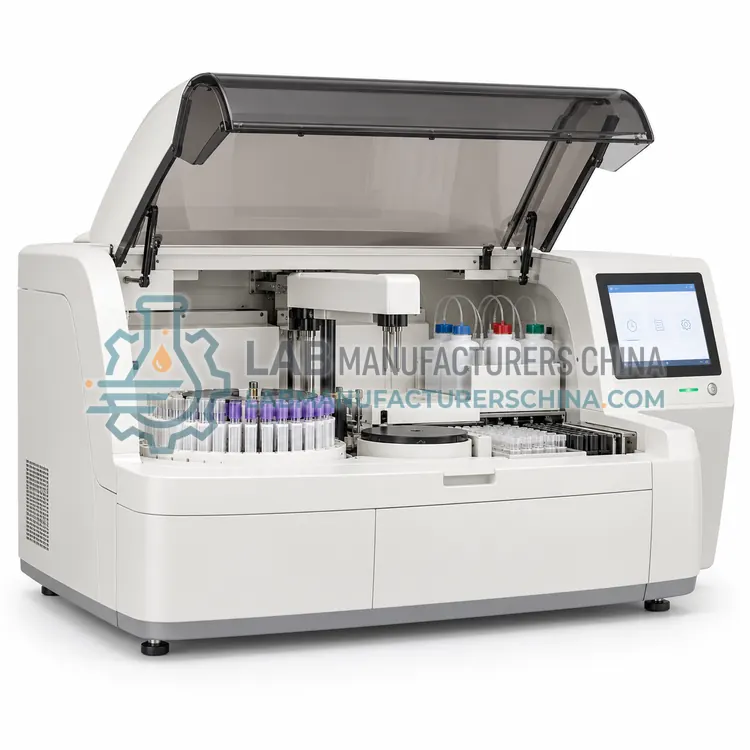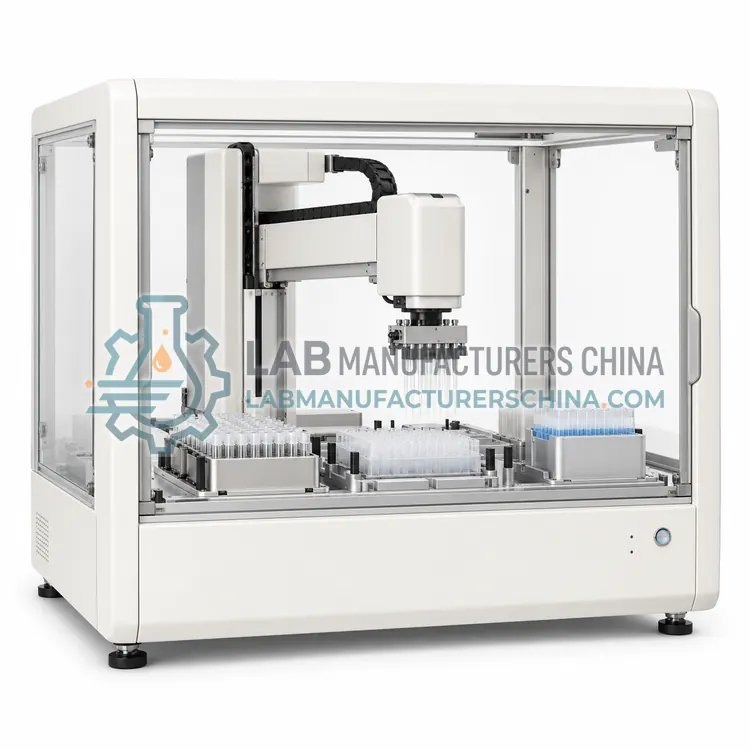
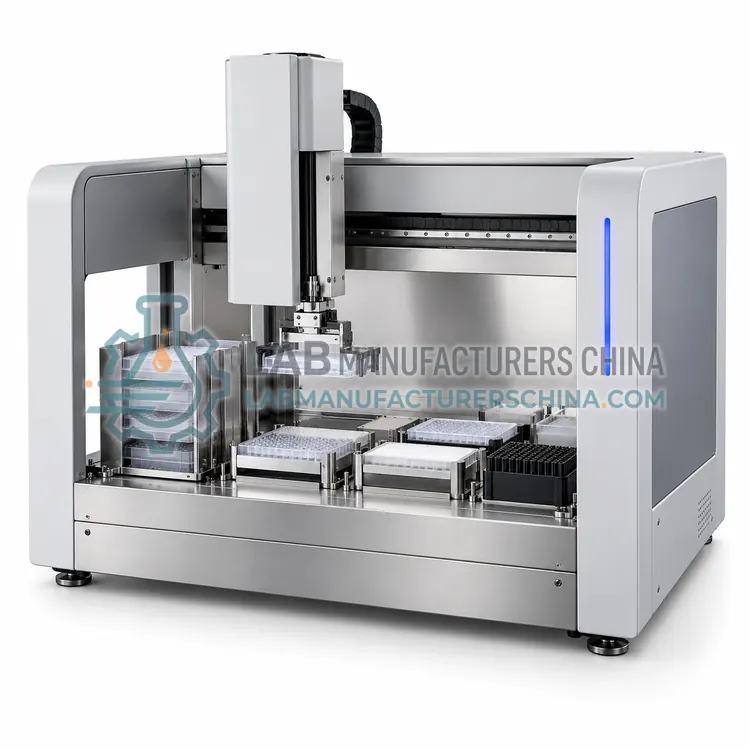
Robotic Microplate Handler
机器人微孔板处理器
- SKU LAR-0005
- Laboratory Robotics
- CE (to be confirmed)
- ISO 9001 manufacturing (to be confirmed)
Price on request — FOB / CIF quoted per order
Prices depend on configuration, quantity and destination port.
Key specifications
| Type | Robotic microplate handler |
|---|---|
| Robot | Plate crane or small arm |
| Plate format | SLAS 96, 384 well |
| Move time | 5–15 s per plate |
| Instrument nests | 4–12 positions |
| Identification | Plate barcode and detection |
Request a quote Download brochure · to be provided
By Lab Manufacturers China Technical TeamLast reviewed Standards: IEC 61010-1 (safety requirements for electrical equipment), ISO 10218 (robots and robotic devices, safety requirements), ISO/TS 15066 (collaborative robots)
What is the Robotic Microplate Handler?
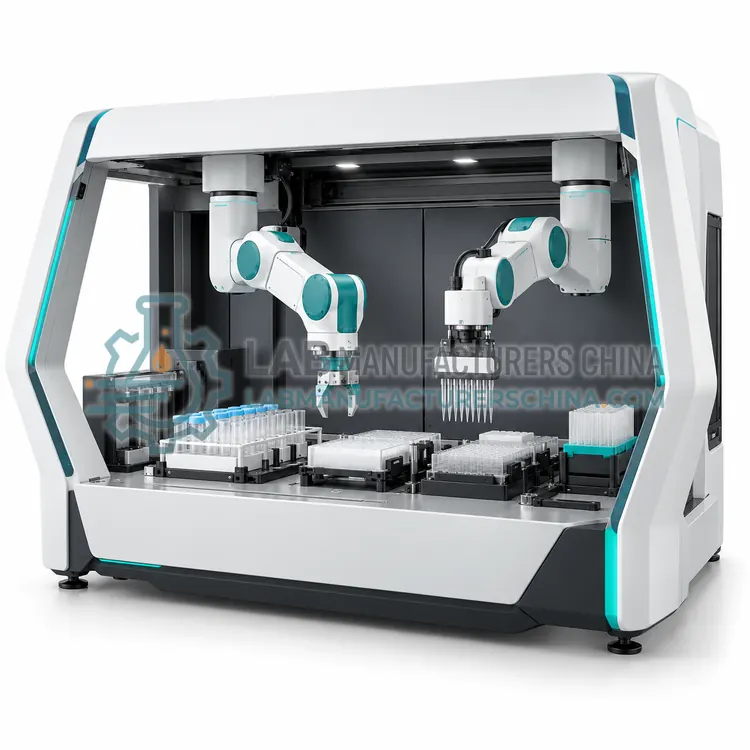
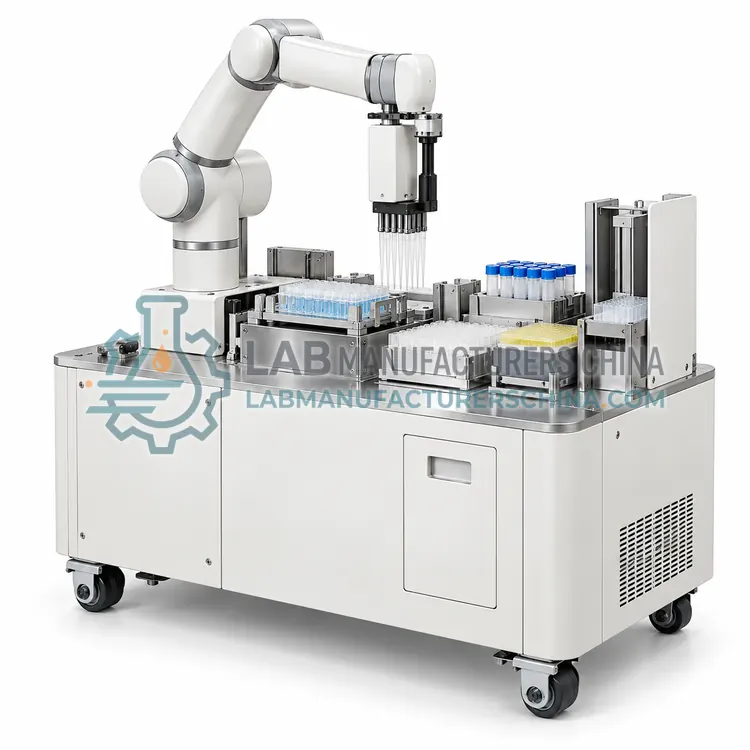
A robotic microplate handler moves plates between readers, washers, dispensers and incubators in a fixed footprint. It is an economical way to link microplate instruments. It links microplate instruments economically in a compact footprint.
What is the Robotic Microplate Handler?
A robotic microplate handler moves plates between readers, washers, dispensers and incubators in a fixed footprint. It is an economical way to link microplate instruments. It links microplate instruments economically in a compact footprint.
Overview
The handler is a compact robot, often a plate crane or a small arm, surrounded by instrument nests that hold plate readers, washers, dispensers, incubators and stackers. It picks and places standard SLAS microplates, with plate detection and barcode reading to confirm identity and orientation. Throughput depends on instrument times rather than the robot, which typically moves a plate in 5–15 seconds. Software builds a workflow from instrument steps, tracks plate positions and status, and records results. The enclosure provides light protection and sometimes a controlled environment. The design suits screening, ELISA and assay workflows where several microplate instruments must operate together without manual plate transfers, and it is far less costly than a full robotic system while removing most manual handling.
How does it work?
A laboratory robot produces precise, repeatable movement so that labware reaches the right place at the right time. A robot arm has joints driven by servomotors, with position feedback from encoders and a gripper that opens to the width of a plate, tube or rack. The controller executes a taught or programmed path with repeatability often better than ± 0.1 mm, and safety systems limit force or stop motion if a person enters the workspace. Mobile robots navigate on a map using laser or camera sensors and carry racks between benches. Storage robots move trays between shelves and a transfer station, retrieving a requested sample by barcode. Plate handlers move microplates between readers, washers and incubators. All are coordinated by scheduling software that knows labware positions, instrument states and the method, so a workflow runs without manual transfers.
What are the key features?
- Compact crane or small arm
- Instrument nests around the robot
- Standard SLAS microplate handling
- Plate detection and barcode reading
- Plate move time 5–15 s
- Workflow software with plate tracking
What are the technical specifications?
A typical robotic microplate handler configuration offers type of Robotic microplate handler, robot of Plate crane or small arm, plate format of SLAS 96, 384 well, move time of 5–15 s per plate, instrument nests of 4–12 positions and identification of Plate barcode and detection. Values are indicative of the product class; the exact figures for each configuration are confirmed on the quotation and the calibration documents supplied with the instrument.
Which applications is it used for?
The Robotic Microplate Handler is used in ELISA automation, screening assays, plate reading and washing and assay incubation workflows. Across the wider Laboratory Robotics class, laboratories also deploy it for linked analytical workflows, sample and compound storage and plate-based screening.
Which standards and certifications apply?
Relevant standards and methods include IEC 61010-1 (safety requirements for electrical equipment), ISO 10218 (robots and robotic devices, safety requirements), ISO/TS 15066 (collaborative robots), ANSI/SLAS microplate standards, 21 CFR Part 11 (electronic records and signatures) and USP <1058> (analytical instrument qualification). Certification candidates for this model are CE and ISO 9001 manufacturing; each is to be confirmed for the specific configuration before shipment, and certificates are supplied only where they have been issued.
Assess risks before installation and apply guarding, light curtains, force limits or collaborative safety functions as required by ISO 10218 and ISO/TS 15066 where applicable. Verify repeatability, payload and gripper alignment on installation and after any collision or service, since small offsets cause missed picks and dropped plates. Keep fixtures, plates and racks within specification, because worn or warped labware defeats a precise gripper. Define and test error recovery so the robot can pause, report and resume rather than lose a run. Maintain a spare-parts and service plan, and train operators to clear jams safely and to know when to call service. Record all changes to taught positions and software, and revalidate after major modifications.
How do I select the right Robotic Microplate Handler?
Choose a plate handler to link microplate instruments economically in a fixed layout. Confirm plate formats, nests and throughput. RFQ: instruments, plate formats, workflow steps, throughput and software needs. Provide the instrument list and workflow steps.
How does it compare with other Laboratory Robotics variants?
Choose the lowest level of robotics that solves the problem. A single arm workstation suits a defined set of steps at one bench, while dual-arm systems handle more complex manipulation, such as handling flexible items. A mobile robot is useful where samples must move between existing instruments that cannot be reconfigured, and a storage robot suits large sample or compound libraries needing fast retrieval. Plate handlers integrate microplate instruments cheaply but handle only plates. Confirm reach, payload, gripper designs and the labware you use, since gripping and positioning are the usual failure points. Check the safety approach, including force limits, guarding or light curtains, and confirm the scheduling software supports your workflows, error recovery and LIMS exchange. Consider service, spare parts and training, because a central robot failure stops everything it feeds.
Full specifications
| Type | Robotic microplate handler |
|---|---|
| Robot | Plate crane or small arm |
| Plate format | SLAS 96, 384 well |
| Move time | 5–15 s per plate |
| Instrument nests | 4–12 positions |
| Identification | Plate barcode and detection |
| Stackers | Input and output, 20–50 plates |
| Enclosure | Light protection |
| Software | Workflow builder, tracking |
| Footprint | Benchtop or stand |
Indicative values for this product class. Final specifications are confirmed on the quotation and in the calibration documents supplied with the instrument.
Applications
- ELISA automation
- Screening assays
- Plate reading and washing
- Assay incubation workflows
Key features
- Compact crane or small arm
- Instrument nests around the robot
- Standard SLAS microplate handling
- Plate detection and barcode reading
- Plate move time 5–15 s
- Workflow software with plate tracking
Frequently asked questions about Robotic Microplate Handler
If all steps use microplate instruments such as readers, washers and incubators, yes. If you also need pipetting, reagents or tube handling, a larger liquid handling or robotic platform may be needed.
Usually the instrument times, not the robot. A plate read or wash may take a minute, while the robot moves a plate in seconds, so the slowest instrument sets the pace.
Yes, with input stackers holding enough plates, reliable instrument handshakes and error handling that pauses rather than aborts a run. Plate status and results are logged for review the next morning.
Often better than ± 0.1 mm for placing plates and tubes accurately, though the useful figure depends on gripper design and labware tolerance. Repeatability should be verified with the actual labware.
ISO 10218 and, for collaborative operation, ISO/TS 15066 cover risk assessment, guarding, force and speed limits and emergency stop. The specific measures depend on whether people work inside the robot's workspace.
Different plates, tubes and racks vary in size and stiffness, so a gripper set for one labware may misplace another. Gripper designs and taught positions must be matched to each labware and verified.
Related models