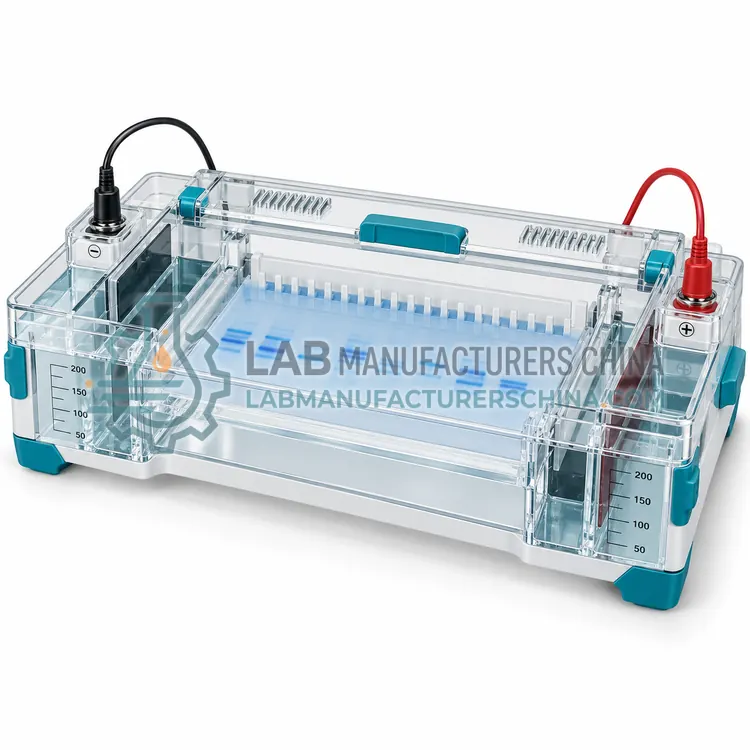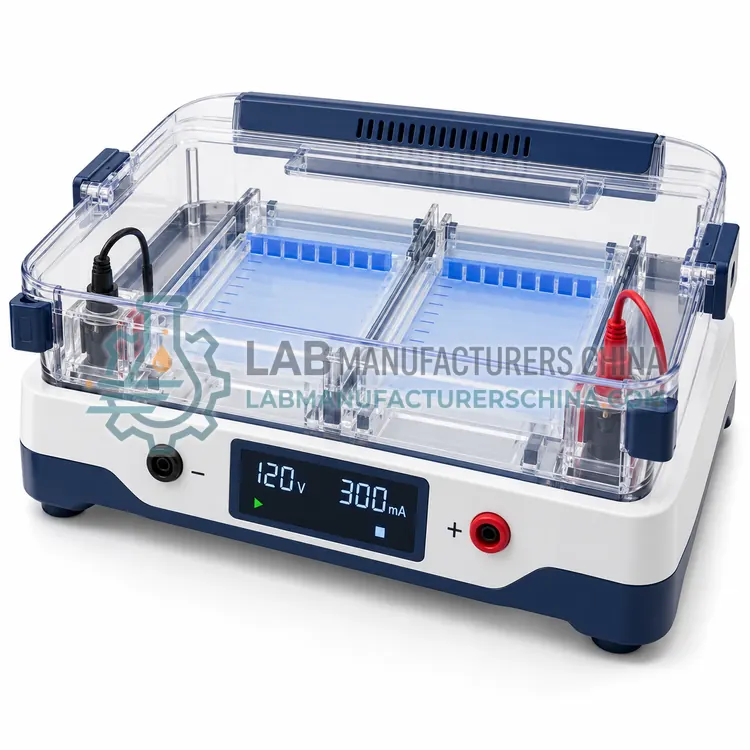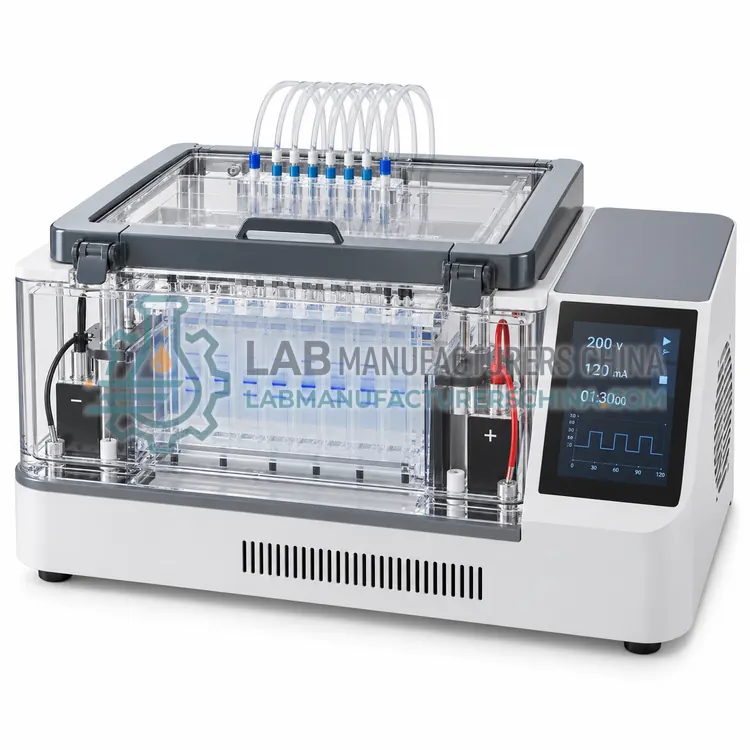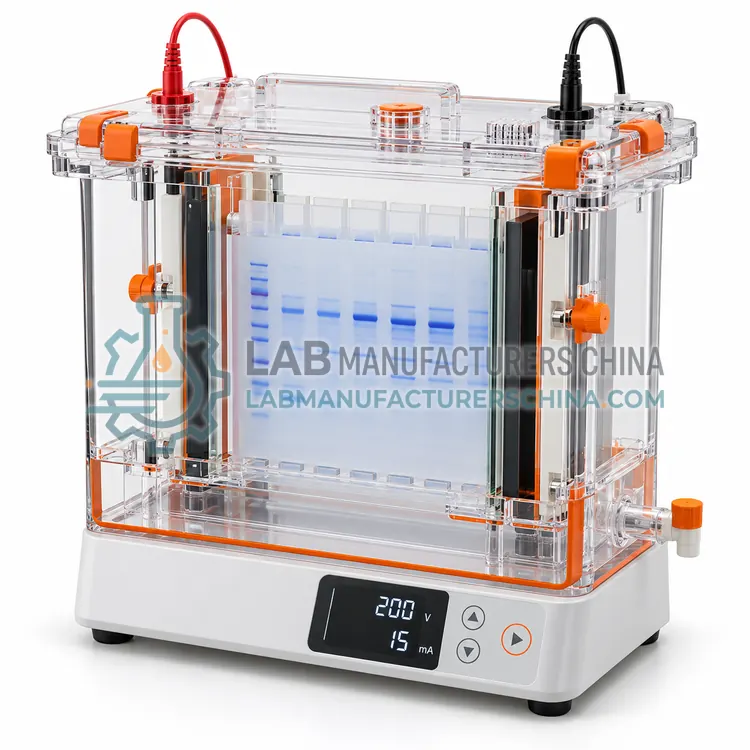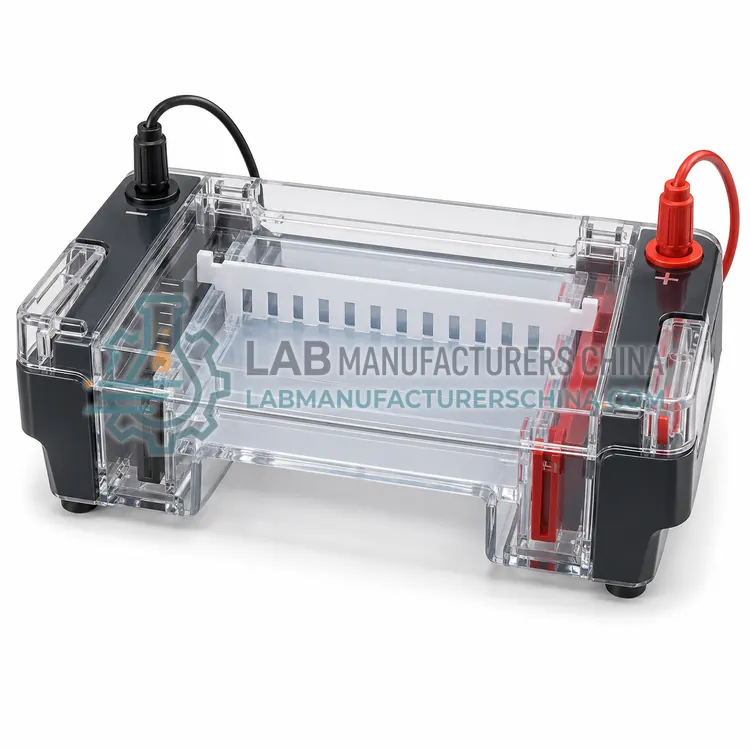
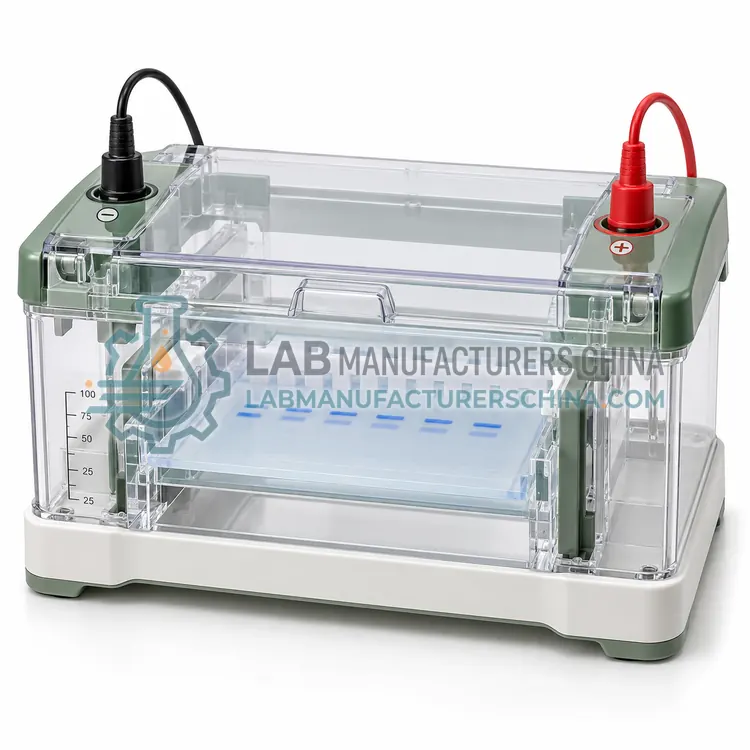
Midi Horizontal Gel Electrophoresis System
中型水平凝胶电泳系统
- SKU HOE-0002
- Horizontal Electrophoresis
- CE (to be confirmed)
- ISO 9001 manufacturing (to be confirmed)
- RoHS (to be confirmed)
Price on request — FOB / CIF quoted per order
Prices depend on configuration, quantity and destination port.
Key specifications
| Gel size (W x L) | 15 x 15 cm |
|---|---|
| Buffer volume | 500–900 mL |
| Electrode spacing | approx. 20 cm |
| Maximum voltage | 300 V DC |
| Sample capacity per gel | 20–40 samples (up to 80 with double-row combs) |
| Typical run time | 45–90 min at 100–150 V |
Request a quote Download brochure · to be provided
By Lab Manufacturers China Technical TeamLast reviewed Standards: IEC 61010-1, IEC 61326-1, ISO 17025
What is the Midi Horizontal Gel Electrophoresis System?
A mid-size horizontal tank for gels of roughly 15 x 15 cm that holds 20–40 samples and gives sharper resolution than mini formats. It suits routine genotyping and restriction mapping where more lanes and longer separation distance are needed.
What is the Midi Horizontal Gel Electrophoresis System?
A mid-size horizontal tank for gels of roughly 15 x 15 cm that holds 20–40 samples and gives sharper resolution than mini formats. It suits routine genotyping and restriction mapping where more lanes and longer separation distance are needed.
Overview
The midi system sits between mini and large tanks. A gel of about 15 x 15 cm offers roughly 15–20 cm of electrode spacing, so fragments that differ by a few percent in length can be separated more clearly than on a mini gel. Comb options of 20, 30 or 40 teeth, and double-sided combs for two rows of samples, raise throughput without changing the footprint much. Buffer volume is typically 500–900 mL. Because runs last 45–90 minutes at 100–150 V, cooling is rarely an issue, and most models accept standard 300 V power supplies. The midi format is widely used for genotyping by fragment length, restriction fragment mapping and screening of clones where a mini gel is too crowded.
How does it work?
In a horizontal system the agarose gel is cast in a tray, placed in a tank and submerged a few millimetres below running buffer, usually TAE or TBE. When voltage is applied between the platinum or stainless-steel electrodes, negatively charged nucleic acids migrate toward the anode through the pores of the agarose. Shorter fragments move faster, so the bands sort by length, and a size ladder allows estimation of fragment size. The buffer carries current and conducts away Joule heat, which is why voltage per centimetre of electrode spacing is limited, typically to 5–10 V/cm. Bands are visualised with intercalating dyes such as ethidium bromide or safer alternatives under UV or blue light. Key components are the tank, gel tray, combs that form wells, electrode leads and a safety lid.
What are the key features?
- Gel area of about 15 x 15 cm gives longer migration distance for closely sized fragments
- Comb set of 20, 30 and 40 teeth plus double-sided combs raises lane count
- Buffer recirculation ports or level marks help keep conductivity uniform across long runs
- Sealed casting gates allow pouring gels in the tank without tape
- Transparent lid with interlock and shrouded leads improves electrical safety
- Removable electrode assemblies simplify cleaning and replacement
What are the technical specifications?
A typical midi horizontal gel electrophoresis system configuration offers gel size (W x L) of 15 x 15 cm, buffer volume of 500–900 mL, electrode spacing of approx. 20 cm, maximum voltage of 300 V DC, sample capacity per gel of 20–40 samples (up to 80 with double-row combs) and typical run time of 45–90 min at 100–150 V. Values are indicative of the product class; the exact figures for each configuration are confirmed on the quotation and the calibration documents supplied with the instrument.
Which applications is it used for?
The Midi Horizontal Gel Electrophoresis System is used in genotyping by fragment length, restriction fragment mapping, clone screening and medium-throughput PCR analysis. Across the wider Horizontal Electrophoresis class, laboratories also deploy it for PCR product verification, restriction digest analysis and RNA integrity checking.
Which standards and certifications apply?
Relevant standards and methods include IEC 61010-1, IEC 61326-1, ISO 17025 and Ph. Eur. 2.2.31. Certification candidates for this model are CE, ISO 9001 manufacturing and RoHS; each is to be confirmed for the specific configuration before shipment, and certificates are supplied only where they have been issued.
Place the tank on a level, vibration-free bench away from sinks and keep the power supply outside the splash zone. Replace running buffer regularly, because ion depletion and pH drift degrade resolution after repeated runs. Clean tanks with mild detergent and rinse with deionised water; avoid solvents that craze acrylic. Inspect electrodes for corrosion and check that lid interlocks and lead insulation remain intact. Handle ethidium bromide and UV sources under local chemical and optical safety rules, or switch to safer stains. Electrical safety should follow IEC 61010-1. Record voltage, time, gel percentage and buffer batch for traceability, and use ladders appropriate to the fragment range.
How do I select the right Midi Horizontal Gel Electrophoresis System?
Select a midi tank when mini gels are too crowded or fragment sizes are too close for a short run, but you do not need 96-well loading. It uses more buffer and time than a mini. Specify gel dimensions, comb teeth, maximum voltage, buffer volume and whether double-sided combs are required.
How does it compare with other Horizontal Electrophoresis variants?
Choose the gel size first, because it fixes run time, sample number and resolution. Mini tanks give fast checks of a few samples, midi and standard formats balance throughput and resolution, and wide-format tanks accommodate multi-channel pipetting for 96-well workflows. Check the maximum voltage and buffer volume, as a larger tank needs a bigger power supply and more buffer. Consider whether dual trays or removable casting systems help speed. Pulsed-field systems are only needed for fragments above roughly 50 kb, such as genomic DNA typing. Also confirm comb thickness and tooth options, electrode material, lid interlock design and chemical resistance of the polycarbonate or acrylic body, and whether replacement trays and combs are easy to source.
Full specifications
| Gel size (W x L) | 15 x 15 cm |
|---|---|
| Buffer volume | 500–900 mL |
| Electrode spacing | approx. 20 cm |
| Maximum voltage | 300 V DC |
| Sample capacity per gel | 20–40 samples (up to 80 with double-row combs) |
| Typical run time | 45–90 min at 100–150 V |
| Tank material | Polycarbonate or acrylic |
| Electrode material | Platinum wire or platinum-coated titanium |
| Comb options | 20, 30, 40 teeth; 1.0–1.5 mm thick |
| Dimensions (W x D x H) | approx. 330 x 200 x 110 mm |
Indicative values for this product class. Final specifications are confirmed on the quotation and in the calibration documents supplied with the instrument.
Applications
- Genotyping by fragment length
- Restriction fragment mapping
- Clone screening
- Medium-throughput PCR analysis
Key features
- Gel area of about 15 x 15 cm gives longer migration distance for closely sized fragments
- Comb set of 20, 30 and 40 teeth plus double-sided combs raises lane count
- Buffer recirculation ports or level marks help keep conductivity uniform across long runs
- Sealed casting gates allow pouring gels in the tank without tape
- Transparent lid with interlock and shrouded leads improves electrical safety
- Removable electrode assemblies simplify cleaning and replacement
Frequently asked questions about Midi Horizontal Gel Electrophoresis System
Move to a midi gel when you regularly need more than about 16 lanes, or when fragments differ by only a few percent in size and need more migration distance. The longer gel trades extra run time and buffer for better resolution.
Most midi tanks run at 100–150 V, so a standard 300 V, 400 mA supply is usually sufficient. Longer electrode spacing needs more voltage to maintain field strength, so confirm the supply covers the voltage and the current at your buffer volume.
Yes, double-sided or two-row combs create two rows of wells so one gel can hold up to 80 samples. The second row runs a shorter distance, so it suits only fragments that separate well over the remaining length.
A horizontal electrophoresis system is a tank in which an agarose gel lies flat and submerged in buffer while voltage moves DNA or RNA fragments through it. Fragments separate by length, so laboratories use it to check PCR products, digests and nucleic acid quality.
A common starting point is 5–8 V per centimetre of distance between electrodes. Higher voltage shortens the run but raises heat and can smear bands or melt the gel. Lower voltage over a longer time gives sharper resolution of large fragments.
Replace running buffer after several runs, or sooner for long or high-voltage runs, because buffering capacity falls and pH drifts. Discoloured buffer, slow migration or distorted bands are signs it should be changed. Never top up with water.
Related models