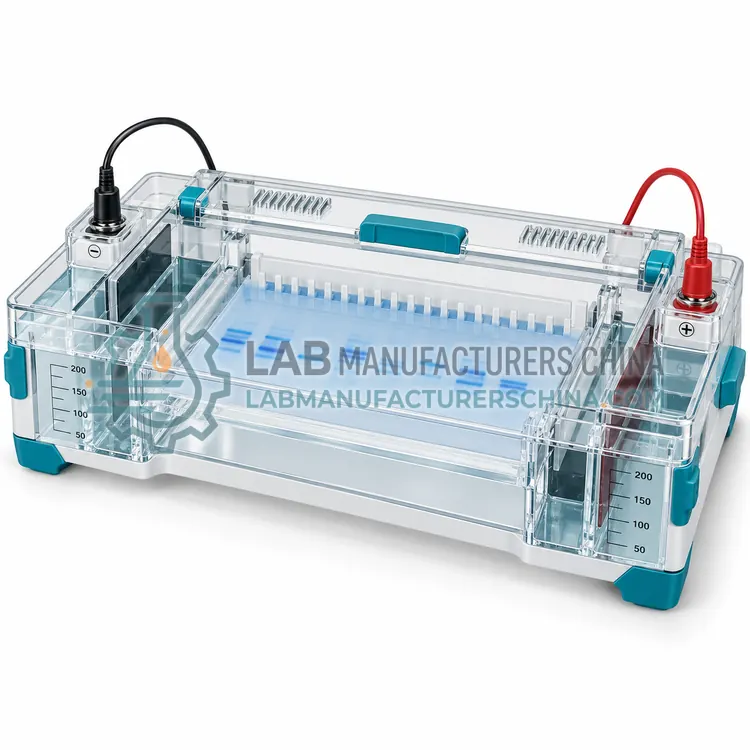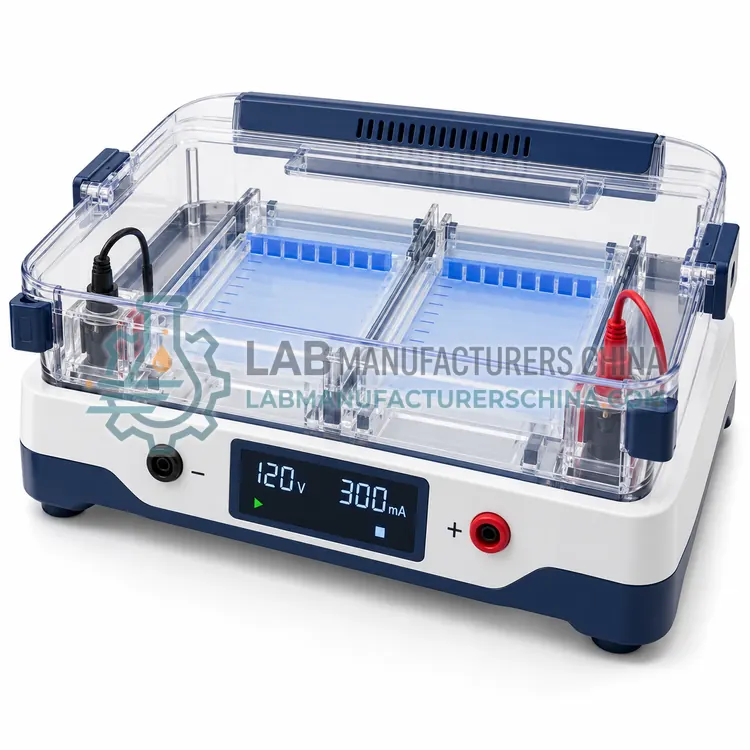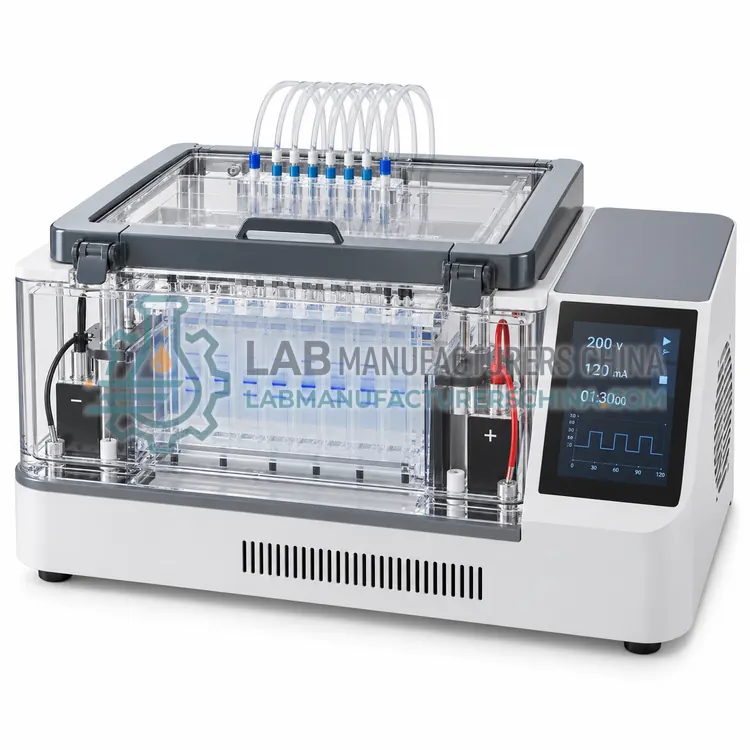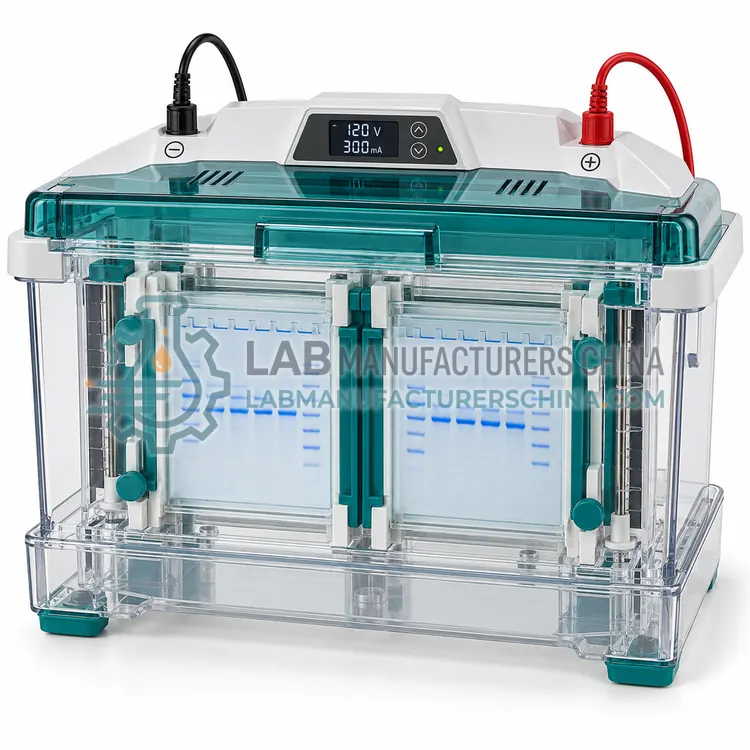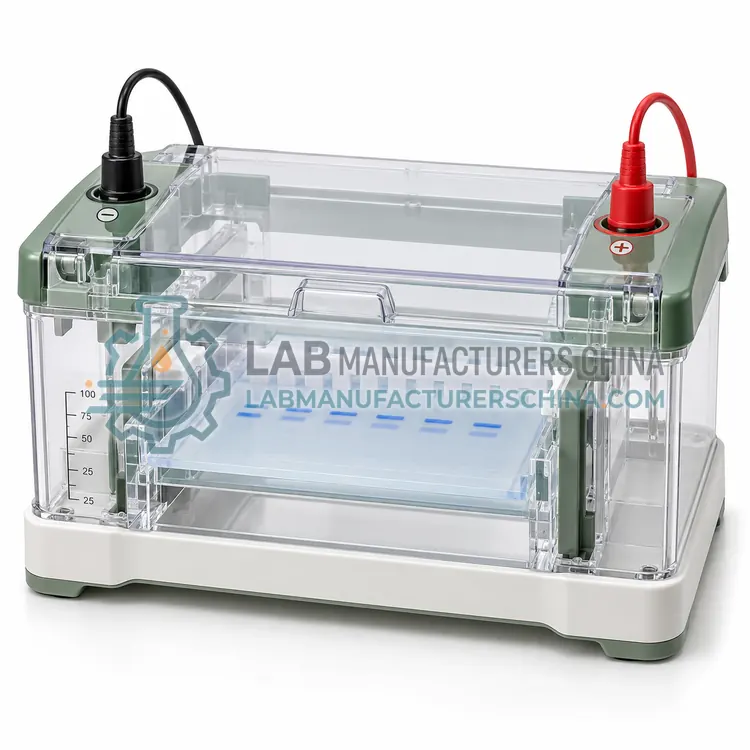
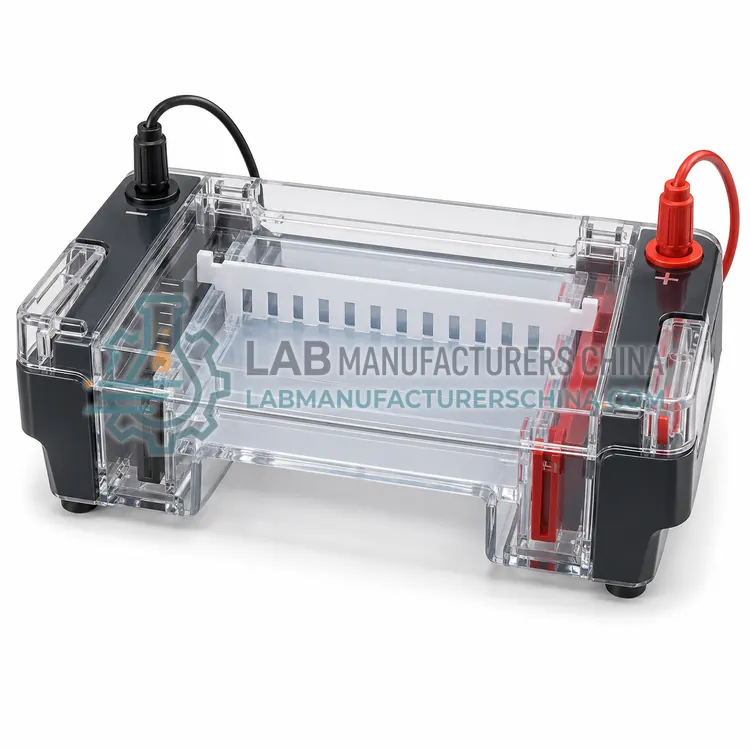
Mini Horizontal Gel Electrophoresis System
微型水平凝胶电泳系统
- SKU HOE-0001
- Horizontal Electrophoresis
- CE (to be confirmed)
- ISO 9001 manufacturing (to be confirmed)
- RoHS (to be confirmed)
Price on request — FOB / CIF quoted per order
Prices depend on configuration, quantity and destination port.
Key specifications
| Gel size (W x L) | 7 x 10 cm |
|---|---|
| Buffer volume | 100–250 mL |
| Electrode spacing | approx. 10–15 cm |
| Maximum voltage | 150 V DC |
| Number of wells per comb | 8–20 |
| Typical run time | 20–40 min at 100 V |
Request a quote Download brochure · to be provided
By Lab Manufacturers China Technical TeamLast reviewed Standards: IEC 61010-1, IEC 61326-1, ISO 17025
What is the Mini Horizontal Gel Electrophoresis System?
A compact horizontal tank for gels around 7 x 10 cm that uses little buffer and finishes runs in 20–40 minutes. It is the usual choice for quick PCR product checks and digest verification of a handful of samples at a time.
What is the Mini Horizontal Gel Electrophoresis System?
A compact horizontal tank for gels around 7 x 10 cm that uses little buffer and finishes runs in 20–40 minutes. It is the usual choice for quick PCR product checks and digest verification of a handful of samples at a time.
Overview
The mini horizontal system is designed for speed and economy. The body is moulded from transparent polycarbonate or acrylic, which lets the operator follow dye fronts without lifting the lid. Gel trays are usually UV-transparent and sealed with end gates or casting dams, so gels can be poured directly in the tank or in a separate casting base. Two to four combs with 8 to 20 teeth fit a single gel, and buffer volume is typically 100–250 mL, which reduces waste. Short electrode spacing of about 10–15 cm allows 100 V runs to finish quickly, which suits amplicon checking, colony PCR screening and plasmid digest confirmation. Resolution is adequate for fragments from about 100 bp to 10 kb, although very similar sizes may need a longer gel.
How does it work?
In a horizontal system the agarose gel is cast in a tray, placed in a tank and submerged a few millimetres below running buffer, usually TAE or TBE. When voltage is applied between the platinum or stainless-steel electrodes, negatively charged nucleic acids migrate toward the anode through the pores of the agarose. Shorter fragments move faster, so the bands sort by length, and a size ladder allows estimation of fragment size. The buffer carries current and conducts away Joule heat, which is why voltage per centimetre of electrode spacing is limited, typically to 5–10 V/cm. Bands are visualised with intercalating dyes such as ethidium bromide or safer alternatives under UV or blue light. Key components are the tank, gel tray, combs that form wells, electrode leads and a safety lid.
What are the key features?
- Transparent polycarbonate tank lets operators monitor dye migration without opening the lid
- UV-transparent gel tray with end gates allows direct casting and transilluminator viewing
- Low buffer volume of roughly 100–250 mL reduces reagent use and disposal
- Interlocked safety lid with recessed banana-plug leads prevents accidental contact
- Multiple comb options support 8 to 20 wells with different thicknesses
- Platinum-coated titanium or stainless-steel electrodes resist corrosion during repeated runs
What are the technical specifications?
A typical mini horizontal gel electrophoresis system configuration offers gel size (W x L) of 7 x 10 cm, buffer volume of 100–250 mL, electrode spacing of approx. 10–15 cm, maximum voltage of 150 V DC, number of wells per comb of 8–20 and typical run time of 20–40 min at 100 V. Values are indicative of the product class; the exact figures for each configuration are confirmed on the quotation and the calibration documents supplied with the instrument.
Which applications is it used for?
The Mini Horizontal Gel Electrophoresis System is used in PCR amplicon checks, colony PCR screening, plasmid digest verification and teaching laboratories. Across the wider Horizontal Electrophoresis class, laboratories also deploy it for PCR product verification, restriction digest analysis and RNA integrity checking.
Which standards and certifications apply?
Relevant standards and methods include IEC 61010-1, IEC 61326-1, ISO 17025 and Ph. Eur. 2.2.31. Certification candidates for this model are CE, ISO 9001 manufacturing and RoHS; each is to be confirmed for the specific configuration before shipment, and certificates are supplied only where they have been issued.
Place the tank on a level, vibration-free bench away from sinks and keep the power supply outside the splash zone. Replace running buffer regularly, because ion depletion and pH drift degrade resolution after repeated runs. Clean tanks with mild detergent and rinse with deionised water; avoid solvents that craze acrylic. Inspect electrodes for corrosion and check that lid interlocks and lead insulation remain intact. Handle ethidium bromide and UV sources under local chemical and optical safety rules, or switch to safer stains. Electrical safety should follow IEC 61010-1. Record voltage, time, gel percentage and buffer batch for traceability, and use ladders appropriate to the fragment range.
How do I select the right Mini Horizontal Gel Electrophoresis System?
Select the mini format when you run a few samples at a time and value fast turnaround and low buffer use. It is weaker than larger tanks on fragment separation and sample number. In an RFQ specify gel size, comb tooth count and thickness, maximum voltage, tank material and whether a casting base or extra trays are included.
How does it compare with other Horizontal Electrophoresis variants?
Choose the gel size first, because it fixes run time, sample number and resolution. Mini tanks give fast checks of a few samples, midi and standard formats balance throughput and resolution, and wide-format tanks accommodate multi-channel pipetting for 96-well workflows. Check the maximum voltage and buffer volume, as a larger tank needs a bigger power supply and more buffer. Consider whether dual trays or removable casting systems help speed. Pulsed-field systems are only needed for fragments above roughly 50 kb, such as genomic DNA typing. Also confirm comb thickness and tooth options, electrode material, lid interlock design and chemical resistance of the polycarbonate or acrylic body, and whether replacement trays and combs are easy to source.
Full specifications
| Gel size (W x L) | 7 x 10 cm |
|---|---|
| Buffer volume | 100–250 mL |
| Electrode spacing | approx. 10–15 cm |
| Maximum voltage | 150 V DC |
| Number of wells per comb | 8–20 |
| Typical run time | 20–40 min at 100 V |
| Tank material | Polycarbonate or acrylic |
| Electrode material | Platinum-coated titanium or stainless steel |
| Comb thickness options | 1.0 mm, 1.5 mm |
| Dimensions (W x D x H) | approx. 160 x 120 x 80 mm |
Indicative values for this product class. Final specifications are confirmed on the quotation and in the calibration documents supplied with the instrument.
Applications
- PCR amplicon checks
- Colony PCR screening
- Plasmid digest verification
- Teaching laboratories
Key features
- Transparent polycarbonate tank lets operators monitor dye migration without opening the lid
- UV-transparent gel tray with end gates allows direct casting and transilluminator viewing
- Low buffer volume of roughly 100–250 mL reduces reagent use and disposal
- Interlocked safety lid with recessed banana-plug leads prevents accidental contact
- Multiple comb options support 8 to 20 wells with different thicknesses
- Platinum-coated titanium or stainless-steel electrodes resist corrosion during repeated runs
Frequently asked questions about Mini Horizontal Gel Electrophoresis System
A typical 1% agarose mini gel takes 20–40 minutes at about 100 V, depending on electrode spacing and fragment size. Running at lower voltage for longer improves separation, while higher voltage saves time but risks heat-related band distortion.
Many mini tanks include end gates or casting dams that seal the tray inside the tank so the gel can be poured in place. Others use a separate casting base. Check which method your model supports and whether the tray is UV-transparent.
A mini gel resolves fragments from roughly 100 bp to 10 kb with suitable agarose concentration, from 2% for small fragments to 0.8% for large ones. Closely sized fragments above that range separate better on longer gels.
A horizontal electrophoresis system is a tank in which an agarose gel lies flat and submerged in buffer while voltage moves DNA or RNA fragments through it. Fragments separate by length, so laboratories use it to check PCR products, digests and nucleic acid quality.
A common starting point is 5–8 V per centimetre of distance between electrodes. Higher voltage shortens the run but raises heat and can smear bands or melt the gel. Lower voltage over a longer time gives sharper resolution of large fragments.
Replace running buffer after several runs, or sooner for long or high-voltage runs, because buffering capacity falls and pH drifts. Discoloured buffer, slow migration or distorted bands are signs it should be changed. Never top up with water.