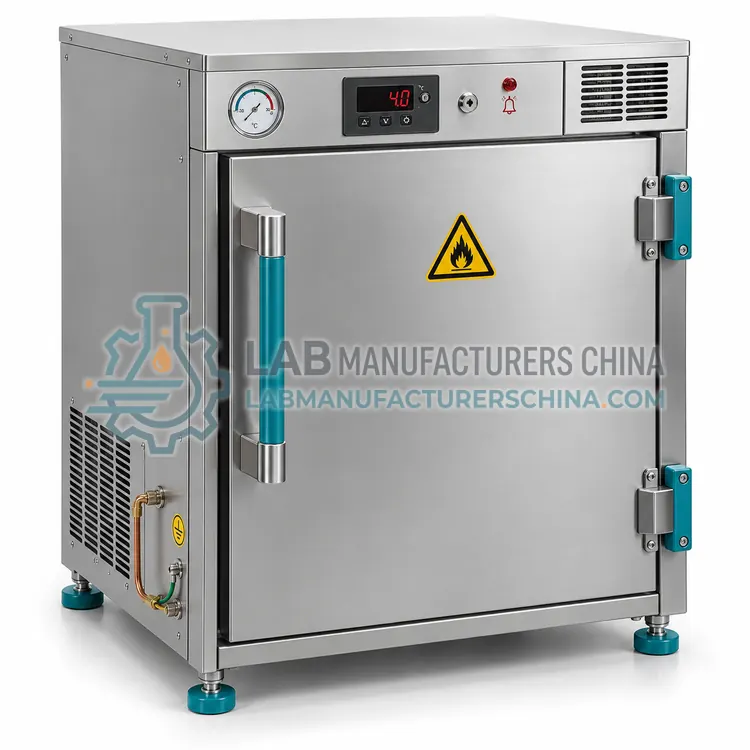
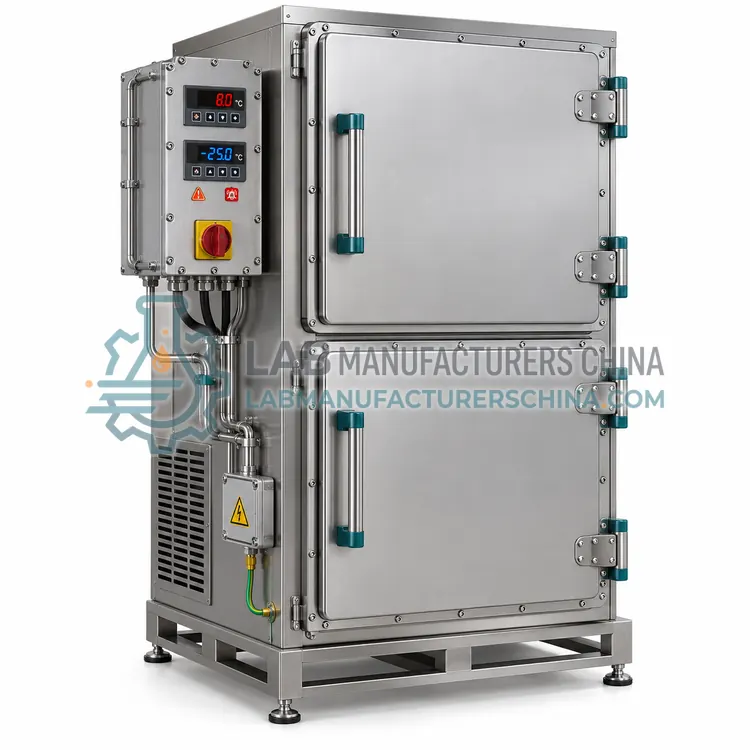
Explosion-Proof Freezer-Refrigerator for –25 °C to 8 °C Storage
防爆冷冻冷藏柜(–25 °C 至 8 °C)
- SKU EPR-0004
- Explosion-Proof Refrigerators
- CE (to be confirmed)
- ISO 9001 manufacturing (to be confirmed)
- ATEX 2014/34/EU (to be confirmed)
- IECEx (to be confirmed)
Price on request — FOB / CIF quoted per order
Prices depend on configuration, quantity and destination port.
Key specifications
| Freezer temperature | –10 to –25 °C |
|---|---|
| Refrigerator temperature | 2–8 °C (dual-zone models) |
| Net volume | 200–500 L |
| Protection type | Ex db eb mb (model-dependent) |
| Gas group and class | IIB T4 |
| Equipment protection level | Gb |
Request a quote Download brochure · to be provided
By Lab Manufacturers China Technical TeamLast reviewed Standards: IEC 60079-0, IEC 60079-1, IEC 60079-17
What is the Explosion-Proof Freezer-Refrigerator for –25 °C to 8 °C Storage?
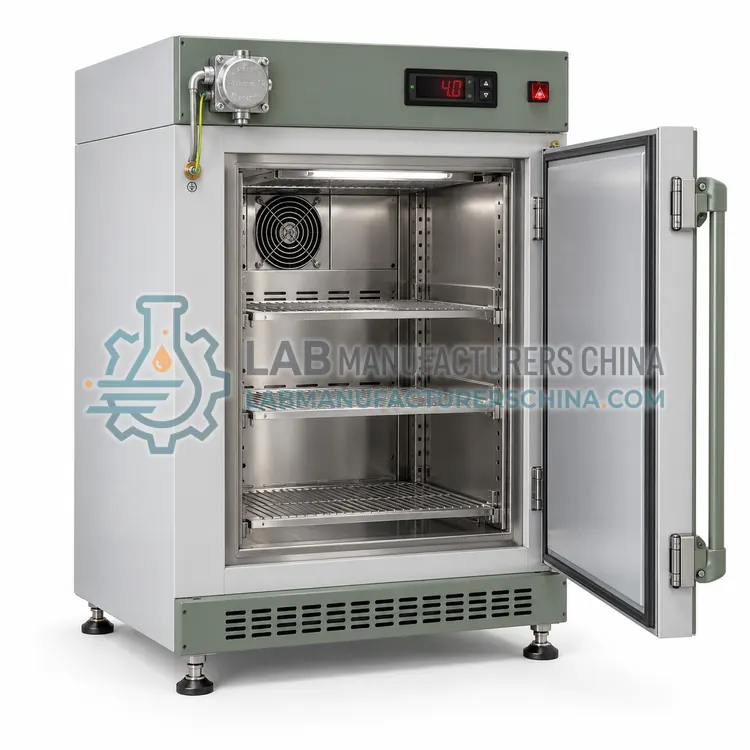
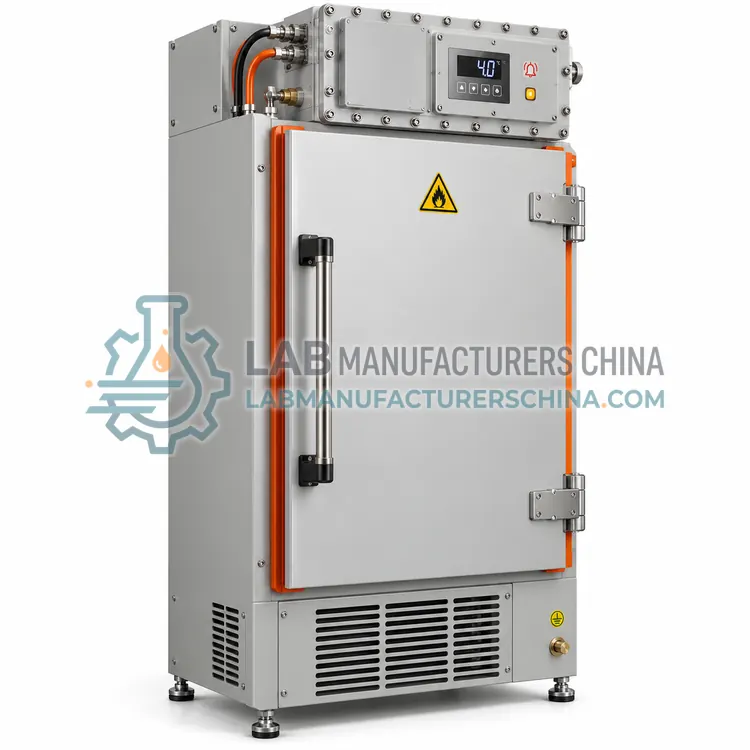
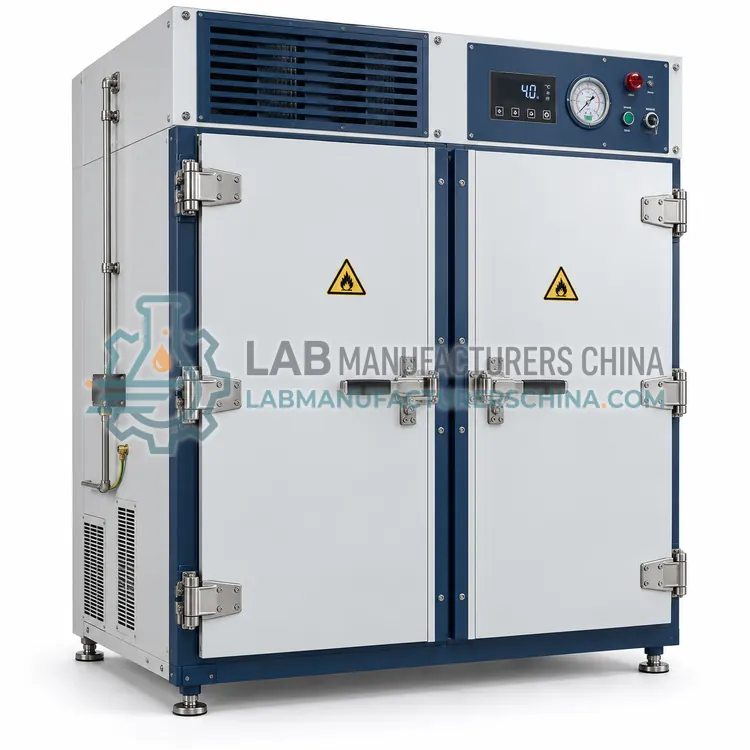
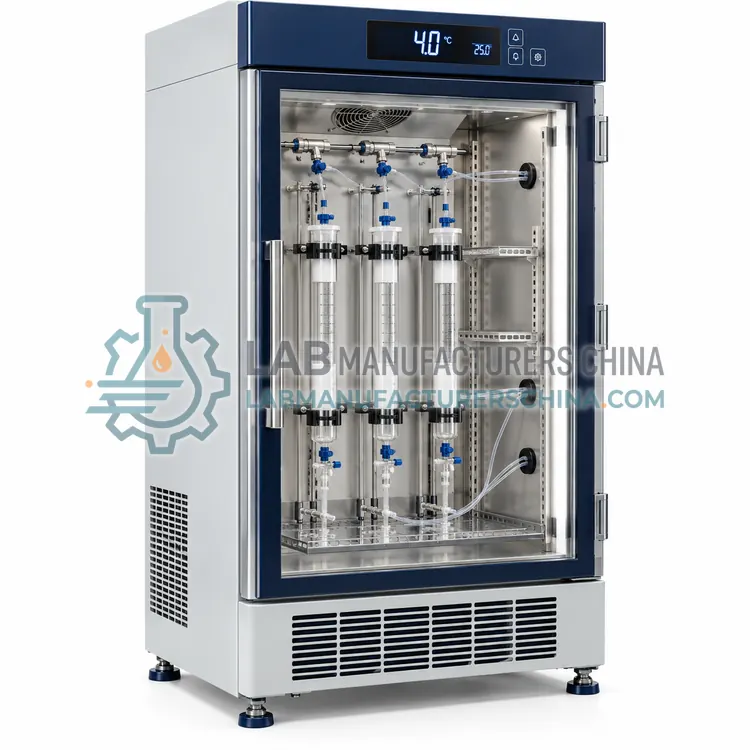
A certified explosion-proof cabinet providing either a –25 °C freezer or a dual-zone arrangement with refrigerated and freezer sections. It stores flammable reagents, initiators and monomers that need sub-zero storage in hazardous areas, where a standard freezer would not be safe.
What is the Explosion-Proof Freezer-Refrigerator for –25 °C to 8 °C Storage?
A certified explosion-proof cabinet providing either a –25 °C freezer or a dual-zone arrangement with refrigerated and freezer sections. It stores flammable reagents, initiators and monomers that need sub-zero storage in hazardous areas, where a standard freezer would not be safe.
Overview
Some flammable reagents, for example peroxide initiators, monomers and certain organometallic precursors, must be held below 0 °C for stability and safety. This variant uses an explosion-proof compressor system and either a single freezer zone at –10 to –25 °C or two sections for 2–8 °C and –25 °C. Temperature sensors, heaters used for defrost and lights are all certified or avoided, and the evaporator is sealed. Volume ranges from 200 to 500 L. Door frames are heated to limit icing, and the cabinet has an over-temperature alarm routed through a certified barrier or a remote panel outside the hazardous area. Because compressor load is higher at low temperatures, the cabinet draws more power and needs adequate ventilation. The marking should match site classification.
How does it work?
Standard refrigerators contain sparking components, such as thermostats, door switches, light bulbs and fan motors, that can ignite vapours from flammable liquids stored inside. Flammable-storage refrigerators relocate or seal these parts outside the storage compartment, preventing an internal ignition. Fully explosion-proof refrigerators go further, using flameproof, increased-safety or encapsulated protection for every electrical component according to IEC 60079 or GB 3836, so neither the interior nor the exterior can ignite a surrounding explosive atmosphere. The cooling process itself is conventional vapour compression, but the compressor, controller and wiring are built to certified standards. Labels show gas group, temperature class and protection level, which must match the site classification.
What are the key features?
- Freezer zone at –10 to –25 °C with optional refrigerated zone
- Explosion-proof compressor, sealed evaporator and certified components
- Heated door frame limits icing at sub-zero temperatures
- Over-temperature alarm routed outside the hazardous area
- Anti-static interior and grounding terminal
What are the technical specifications?
A typical explosion-proof freezer-refrigerator for –25 °c to 8 °c storage configuration offers freezer temperature of –10 to –25 °C, refrigerator temperature of 2–8 °C (dual-zone models), net volume of 200–500 L, protection type of Ex db eb mb (model-dependent), gas group and class of IIB T4 and equipment protection level of Gb. Values are indicative of the product class; the exact figures for each configuration are confirmed on the quotation and the calibration documents supplied with the instrument.
Which applications is it used for?
The Explosion-Proof Freezer-Refrigerator for –25 °C to 8 °C Storage is used in initiator and monomer storage, flammable reagent freezing, polymer research and fine-chemical production laboratories. Across the wider Explosion-Proof Refrigerators class, laboratories also deploy it for flammable solvent storage, hazardous area laboratories and reactive reagent cold storage.
Which standards and certifications apply?
Relevant standards and methods include IEC 60079-0, IEC 60079-1, IEC 60079-17, GB 3836.1, NFPA 45, NFPA 30, ATEX Directive 2014/34/EU and IEC 61010-2-011. Certification candidates for this model are CE, ISO 9001 manufacturing, ATEX 2014/34/EU and IECEx; each is to be confirmed for the specific configuration before shipment, and certificates are supplied only where they have been issued.
Install on a level, load-bearing floor with ventilation clearance, and ground the cabinet as instructed. Keep containers sealed and labelled, use secondary containment, and respect quantity limits from fire codes. Do not add unapproved electrical devices inside. Inspect regularly and record findings, including gasket condition and alarm function. Certified units must be serviced by trained personnel using approved parts, and changes can invalidate the certification. Calibrate temperature displays at least annually, and plan for power-failure response because stored solvents and reagents may be temperature-sensitive.
How do I select the right Explosion-Proof Freezer-Refrigerator for –25 °C to 8 °C Storage?
Choose this cabinet when flammable materials need storage below 0 °C in a classified area. State freezer or dual-zone arrangement, volume, area classification, gas group, temperature class and whether remote alarm signalling is needed. Check your reagent's temperature limits, because some peroxides must not be frozen.
How does it compare with other Explosion-Proof Refrigerators variants?
Start with the hazard. If containers are sealed, quantities are small and the room is not a classified zone, a flammable-storage refrigerator may be adequate. If the area is classified Zone 1 or Zone 2, or large volumes are stored, specify a certified explosion-proof model with the right gas group and temperature class. Decide on capacity, upright or undercounter format, whether sub-zero storage is needed, and the alarm and signalling arrangement. Check the certificate against the area classification, confirm power supply and floor loading, and involve your safety officer. Never convert or modify a standard unit.
Full specifications
| Freezer temperature | –10 to –25 °C |
|---|---|
| Refrigerator temperature | 2–8 °C (dual-zone models) |
| Net volume | 200–500 L |
| Protection type | Ex db eb mb (model-dependent) |
| Gas group and class | IIB T4 |
| Equipment protection level | Gb |
| Defrost | Manual or certified heater |
| Alarm | Over-temperature via barrier or remote panel |
| Refrigerant | R290 or R134a |
| Power supply | 220–240 V or 380 V, 50 Hz |
Indicative values for this product class. Final specifications are confirmed on the quotation and in the calibration documents supplied with the instrument.
Applications
- Initiator and monomer storage
- Flammable reagent freezing
- Polymer research
- Fine-chemical production laboratories
Key features
- Freezer zone at –10 to –25 °C with optional refrigerated zone
- Explosion-proof compressor, sealed evaporator and certified components
- Heated door frame limits icing at sub-zero temperatures
- Over-temperature alarm routed outside the hazardous area
- Anti-static interior and grounding terminal
Frequently asked questions about Explosion-Proof Freezer-Refrigerator for –25 °C to 8 °C Storage
Reagents such as peroxide initiators and reactive monomers decompose or polymerise at higher temperatures, sometimes exothermically. Sub-zero storage slows this process. Follow the supplier's label, because a few materials, such as some peroxides, can crystallise or become more hazardous when frozen.
Field conversion is not recommended. Safety depends on certified design of compressor, controls, evaporator and wiring, and modification can invalidate protection. Use a purpose-built flammable-storage or explosion-proof freezer with documentation.
Signals are routed through an intrinsically safe barrier or a certified relay to a panel outside the classified area, or through certified wiring. Consult the certificate for permitted connections, and do not attach unapproved monitoring equipment inside the cabinet.
It is a refrigerator built so that electrical components cannot ignite flammable vapours. Flammable-storage types only eliminate interior ignition sources, while certified explosion-proof types use approved protection methods so they are safe in classified hazardous areas as well.
Standard refrigerators contain sparking parts such as thermostats, switches and lights inside the cabinet. Flammable vapours can build up in the closed space and be ignited, which has caused laboratory explosions. Use a purpose-built refrigerator.
ATEX refers to European directives for equipment in explosive atmospheres, with a CE-related marking. IECEx is an international certification scheme based on IEC 60079. Both use similar protection concepts, and the required scheme depends on the country where the equipment is installed.
Related models