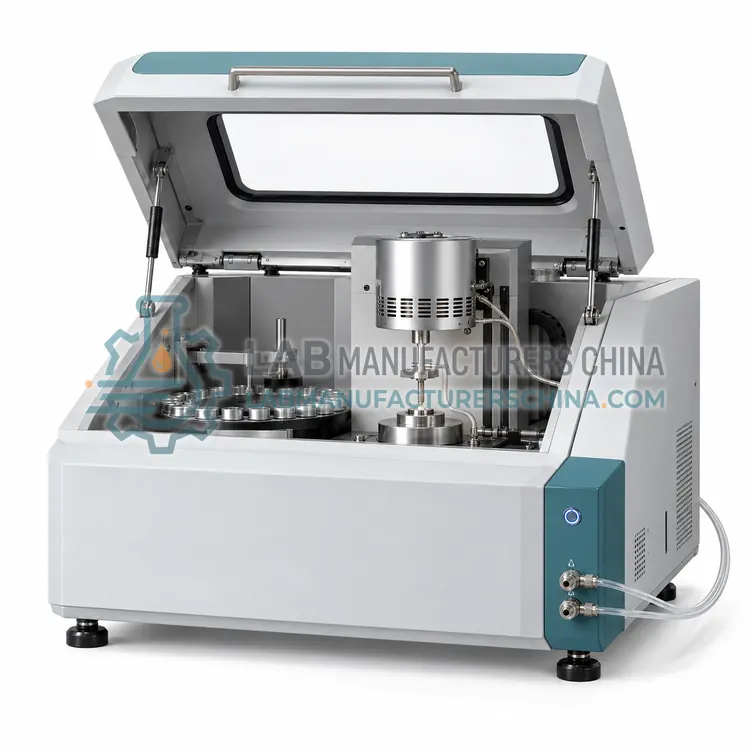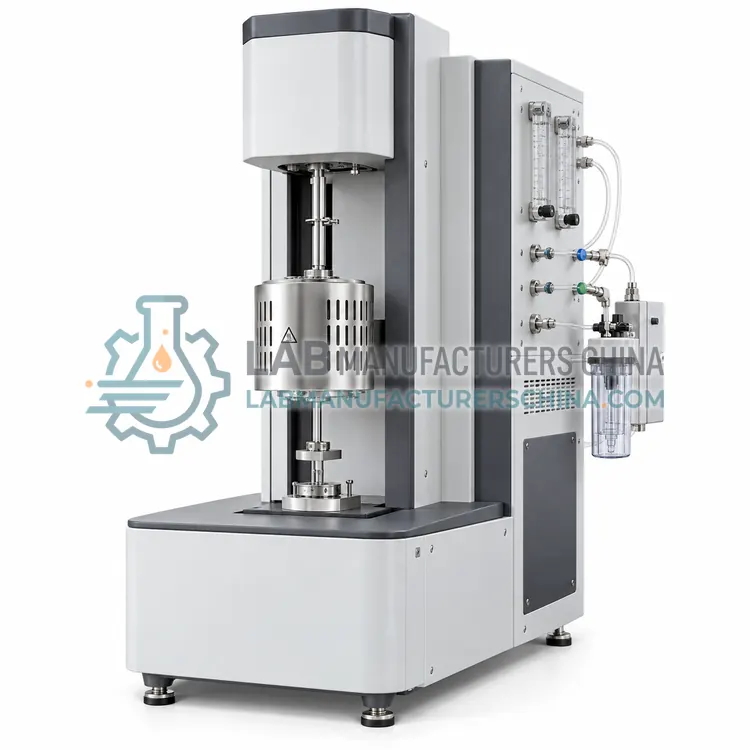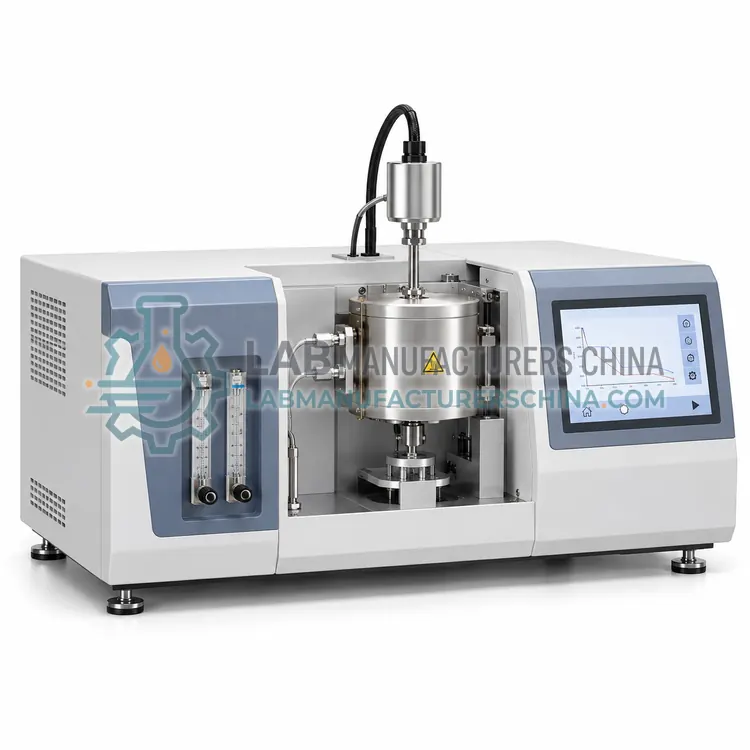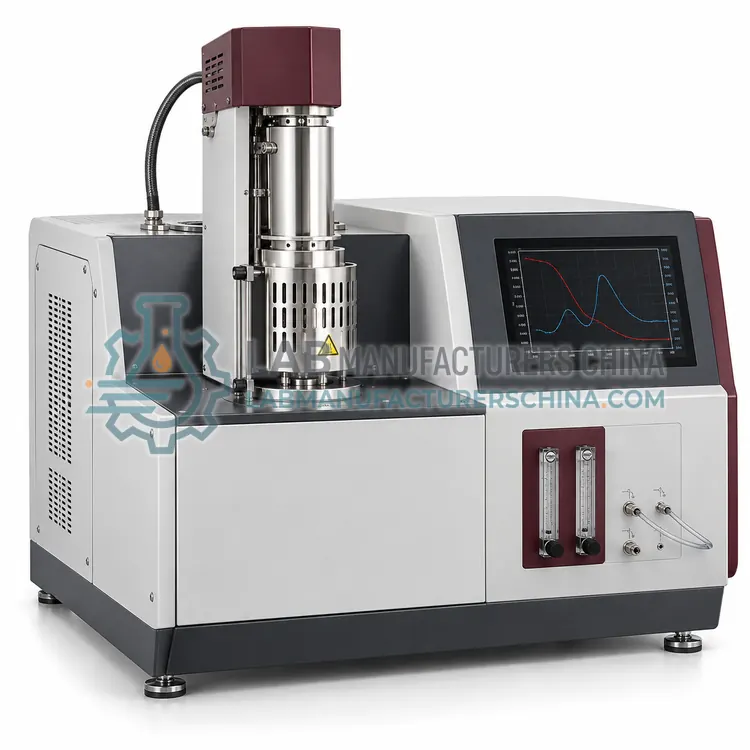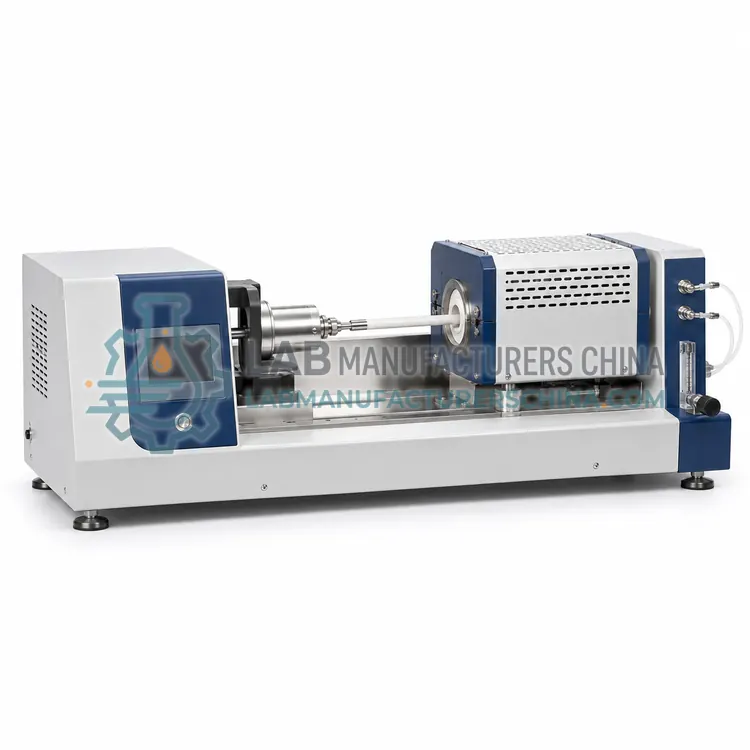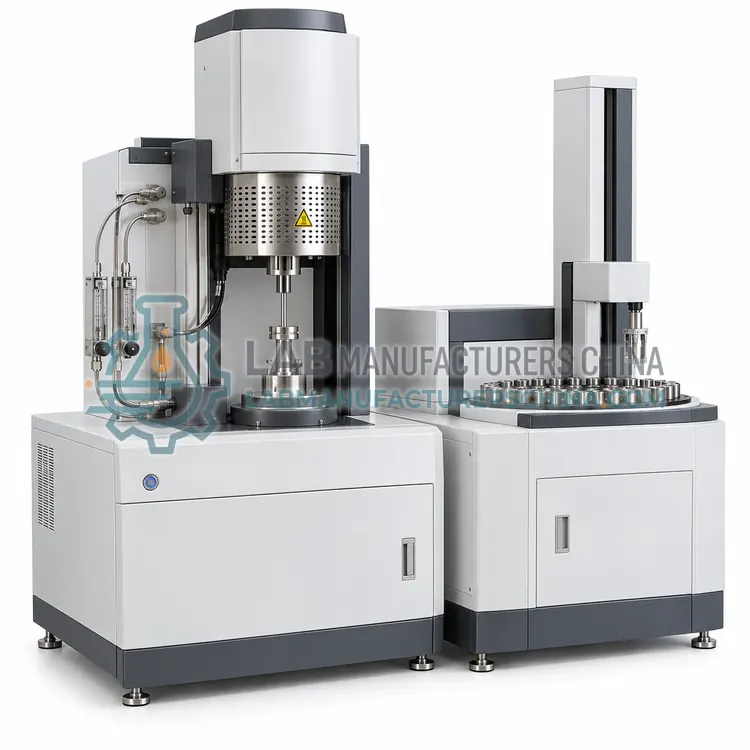
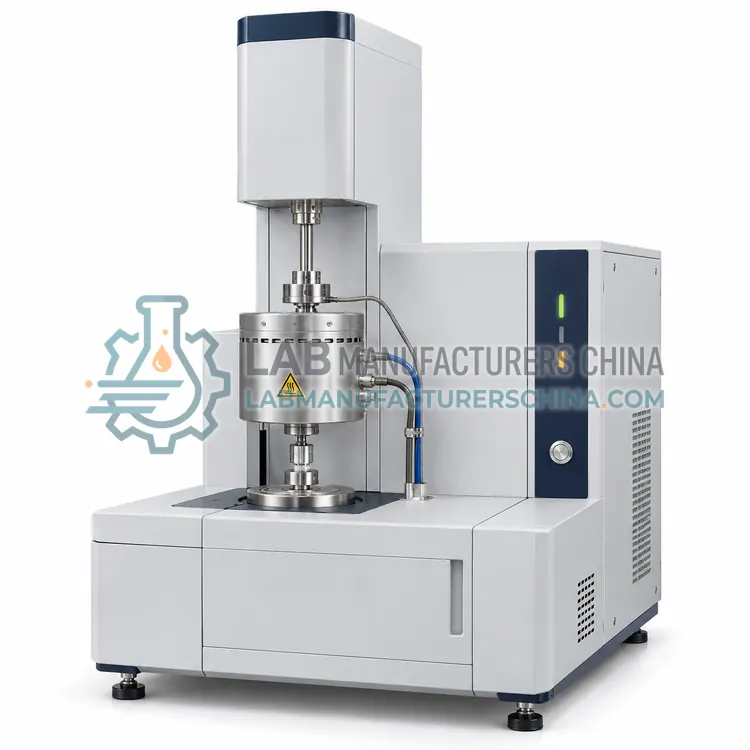
Benchtop Dynamic Mechanical Analyzer
台式动态热机械分析仪
- SKU DMA-0001
- DMA
- CE (to be confirmed)
- IEC 61010-1 safety (to be confirmed)
- ISO 9001 manufacturing (to be confirmed)
Price on request — FOB / CIF quoted per order
Prices depend on configuration, quantity and destination port.
Key specifications
| Force range | 0.001–20 N |
|---|---|
| Displacement resolution | 10 nm |
| Temperature range | −150–600 °C |
| Heating rate | 0.1–20 °C/min |
| Frequency range | 0.01–100 Hz |
| Modulus range | 1 MPa–100 GPa (clamp dependent) |
Request a quote Download brochure · to be provided
By Lab Manufacturers China Technical TeamLast reviewed Standards: ASTM D4065, ASTM D5023, ASTM D5024
What is the Benchtop Dynamic Mechanical Analyzer?
A benchtop dynamic mechanical analyzer applies oscillating loads of up to about 20 newtons across interchangeable clamps, covering bending, tension, compression and shear. It is the general-purpose instrument for viscoelastic characterisation of plastics, composites and rubbers.
What is the Benchtop Dynamic Mechanical Analyzer?
A benchtop dynamic mechanical analyzer applies oscillating loads of up to about 20 newtons across interchangeable clamps, covering bending, tension, compression and shear. It is the general-purpose instrument for viscoelastic characterisation of plastics, composites and rubbers.
Overview
The instrument combines a low-compliance frame, a displacement sensor with resolution of about 10 nanometres and a drive that can apply force in a controlled amplitude or strain mode. Clamps for single and dual cantilever, three-point bending, tension, compression and shear are interchangeable, so one instrument covers specimen types from 0.5 millimetre films to 4 millimetre thick bars. Temperature ramps from minus 150 to 600 degrees Celsius are possible with liquid nitrogen or a mechanical cooler, and the software supports multi-frequency sweeps, strain sweeps to find linearity, and automated generation of master curves. Modulus range from below 1 megapascal for soft rubbers to about 100 gigapascals for stiff composites can be covered by changing clamps and force ranges. Typical repeatability is 2 to 5 percent for modulus, which is sufficient for comparative material selection, quality control and formulation development.
How does it work?
The instrument clamps the specimen in a chosen geometry and applies a sinusoidal stress or strain while measuring the response. Because a viscoelastic material does not respond instantaneously, the strain lags the stress by a phase angle, and the ratio of amplitudes together with that phase angle yields the complex modulus. Its real part is the storage modulus, describing elastic energy stored per cycle; the imaginary part is the loss modulus, describing energy dissipated as heat; and their ratio is the damping factor, tan delta, whose peak defines the glass transition temperature. Measurements are made in single or dual cantilever, three-point bending, tension, compression or shear mode, with the geometry chosen to suit the sample stiffness. Temperature ramps of 0.5 to 5 degrees Celsius per minute, frequency sweeps from 0.01 to 100 hertz, and single or multi-frequency operation allow activation energies, cure profiles and master curves to be derived.
What are the key features?
- Interchangeable clamps for bending, tension, compression and shear
- Force range up to 20 N with 10 nm displacement resolution
- Temperature range from −150 to 600 °C with cooling options
- Multi-frequency sweeps for activation energy determination
- Strain sweep routine to confirm linear viscoelastic range
- Master curve and tan delta evaluation software
What are the technical specifications?
A typical benchtop dynamic mechanical analyzer configuration offers force range of 0.001–20 N, displacement resolution of 10 nm, temperature range of −150–600 °C, heating rate of 0.1–20 °C/min, frequency range of 0.01–100 Hz and modulus range of 1 MPa–100 GPa (clamp dependent). Values are indicative of the product class; the exact figures for each configuration are confirmed on the quotation and the calibration documents supplied with the instrument.
Which applications is it used for?
The Benchtop Dynamic Mechanical Analyzer is used in thermoplastic and composite stiffness curves, rubber compound damping evaluation, thermoset cure profiling, adhesive and coating performance and material selection and substitution studies. Across the wider DMA class, laboratories also deploy it for composite and laminate viscoelastic characterisation, elastomer and rubber compound testing and thermoset cure monitoring.
Which standards and certifications apply?
Relevant standards and methods include ASTM D4065, ASTM D5023, ASTM D5024, ASTM D5026, ASTM E1640 and ISO 6721-1. Certification candidates for this model are CE, IEC 61010-1 safety and ISO 9001 manufacturing; each is to be confirmed for the specific configuration before shipment, and certificates are supplied only where they have been issued.
Specimen geometry must be measured accurately, because modulus depends on the cube of thickness in bending and on cross-sectional area in tension, so a dimensional error is amplified. Clamp the specimen without pre-stress or slippage, verify that the measured stiffness lies in the instrument's reliable range, and check linearity by repeating at a second amplitude. Calibrate the instrument with certified stiffness standards or reference materials and record the geometry, amplitude, frequency and atmosphere for each run. Beware of thermal lag at higher heating rates, which shifts transition temperatures upward, and of clamp expansion that can add apparent strain. For thermosets, run the cure in a multi-frequency mode so gelation and vitrification can be separated. Purge gas is required for measurements above room temperature to avoid oxidation, particularly in elastomers.
How do I select the right Benchtop Dynamic Mechanical Analyzer?
Choose the benchtop instrument for general viscoelastic work on plastics, composites and rubbers across several clamping modes. If the focus is very stiff materials or very thin films, a dedicated high-force or film instrument gives better performance. In an RFQ, specify clamps required, force range, temperature range and frequency coverage.
How does it compare with other DMA variants?
Choose the clamping geometry before anything else, because it determines the specimen dimensions and the usable stiffness range: three-point bending suits stiff bars, single and dual cantilever suit medium-modulus plastics and composites, tension suits films and fibres, and compression or shear suit soft gels and foams. Then match the force range to the material: stiffer samples and composites need higher force and a rigid frame, while thin films and gels need very low force with high displacement resolution. Check the temperature range and the cooling system, since liquid nitrogen is needed for sub-ambient glass transitions. Frequency range, multi-frequency capability and the software for master curve generation matter for research, while a simple temperature sweep with specification limits is enough for quality control. For hydrogels, biological samples or humid environments, ensure the instrument can accept a submersion or humidity accessory.
Full specifications
| Force range | 0.001–20 N |
|---|---|
| Displacement resolution | 10 nm |
| Temperature range | −150–600 °C |
| Heating rate | 0.1–20 °C/min |
| Frequency range | 0.01–100 Hz |
| Modulus range | 1 MPa–100 GPa (clamp dependent) |
| Clamping modes | Single/dual cantilever, 3-point bending, tension, compression, shear |
| Specimen dimensions | 0.5–5 mm thick, up to 30 mm long |
| Modulus repeatability | ±2–5% |
| Atmosphere | Nitrogen or air purge |
Indicative values for this product class. Final specifications are confirmed on the quotation and in the calibration documents supplied with the instrument.
Applications
- Thermoplastic and composite stiffness curves
- Rubber compound damping evaluation
- Thermoset cure profiling
- Adhesive and coating performance
- Material selection and substitution studies
Key features
- Interchangeable clamps for bending, tension, compression and shear
- Force range up to 20 N with 10 nm displacement resolution
- Temperature range from −150 to 600 °C with cooling options
- Multi-frequency sweeps for activation energy determination
- Strain sweep routine to confirm linear viscoelastic range
- Master curve and tan delta evaluation software
Frequently asked questions about Benchtop Dynamic Mechanical Analyzer
Between about 1 and 4 millimetres is typical, because thickness enters the modulus calculation as a cube and thick specimens also develop internal gradients. Thin specimens can be stacked only if the layers are bonded and the stack stiffness is treated correctly.
Every material has a linear viscoelastic region in which modulus is independent of strain amplitude. A strain sweep identifies the upper limit for each temperature, so subsequent measurements are made inside that region and results remain comparable between samples.
Common causes are insufficient stiffness for the chosen clamp, specimen slipping, poor clamping torque and building vibration. Record the raw signal, try a smaller amplitude or a different geometry, and check the instrument's stiffness calibration before investigating the material.
It measures how a material responds to an oscillating force, giving storage modulus, loss modulus and tan delta as functions of temperature, frequency or time. These quantities describe stiffness, damping and the glass transition, which are not accessible from a simple dimensional measurement.
At the glass transition the material passes from glassy to rubbery, energy dissipation peaks and tan delta reaches a maximum. ASTM E1640 defines the temperature of that maximum as the glass transition temperature, which may differ by several degrees from values obtained by DSC.
For rigid plastics and composites, single cantilever or three-point bending is convenient and self-supporting. Films and fibres require tension, and gels, foams or rubbers require compression or shear. The mode must place the measured stiffness within the instrument's range.
Related models