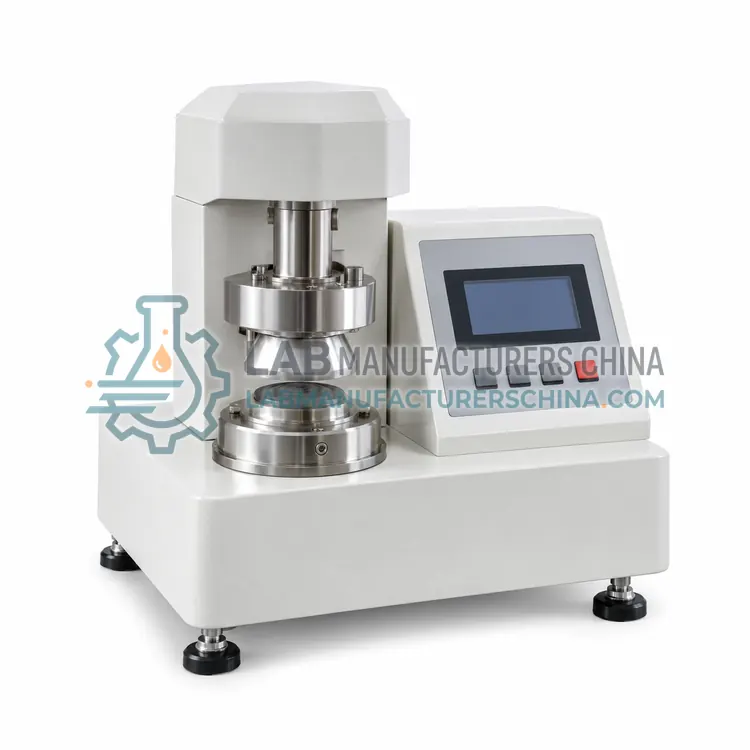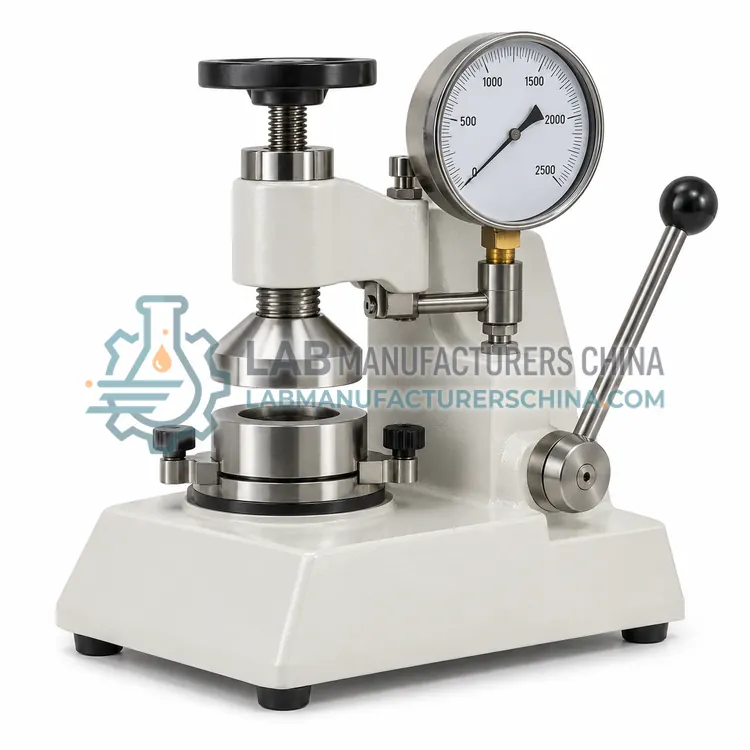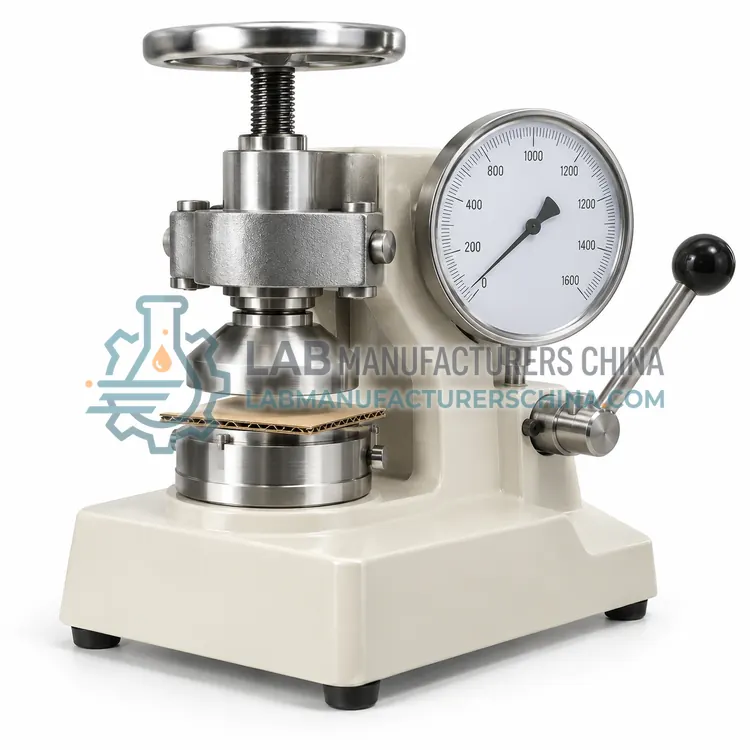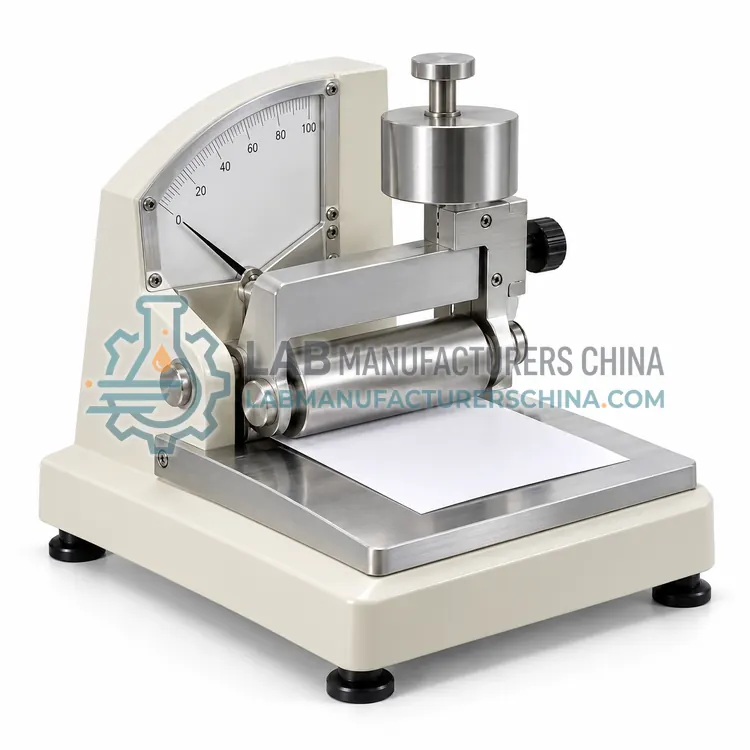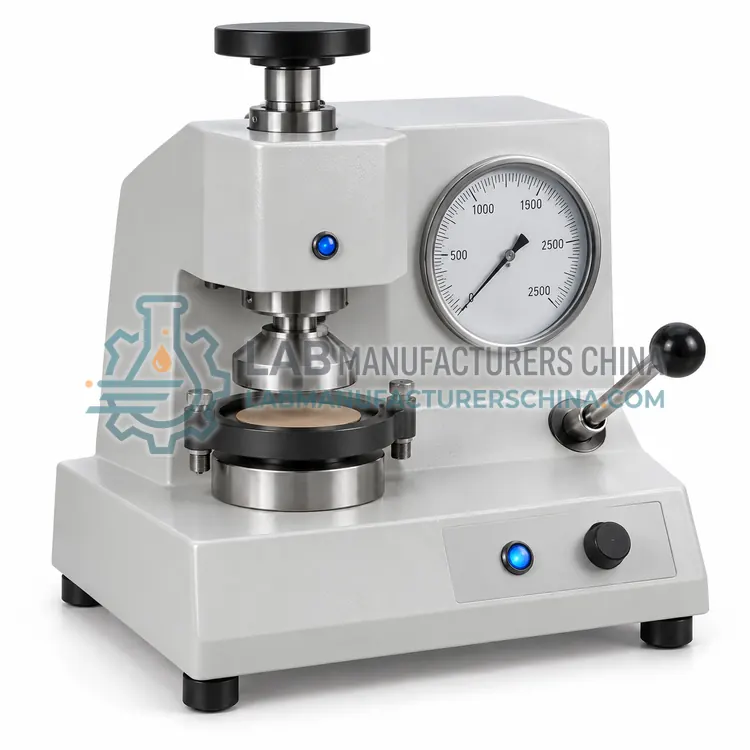
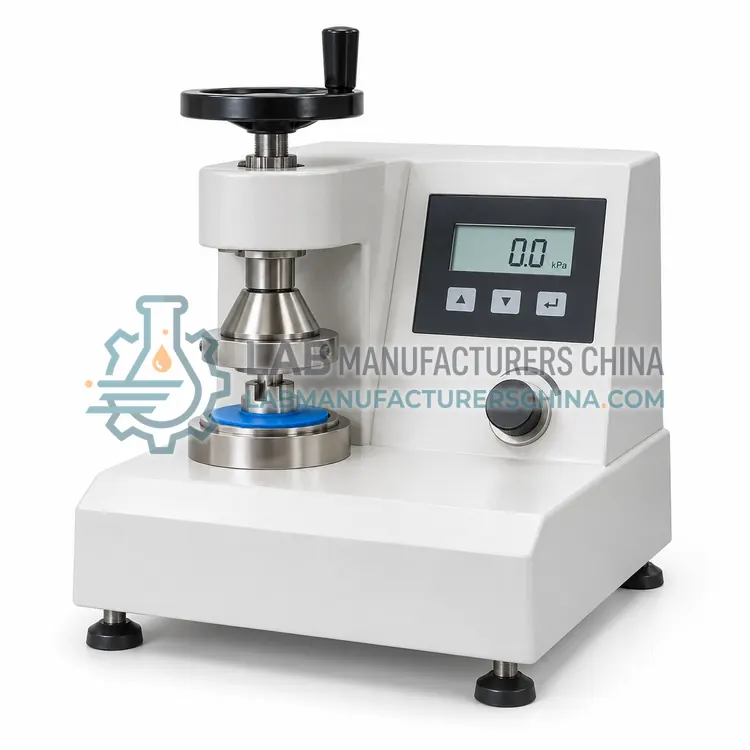
Pneumatic Bursting Strength Tester for Tissue Paper
薄页纸气动耐破度仪
- SKU BUA-0004
- Burst Analysis
- CE (to be confirmed)
- ISO 9001 manufacturing (to be confirmed)
Price on request — FOB / CIF quoted per order
Prices depend on configuration, quantity and destination port.
Key specifications
| Measuring range | 0–600 kPa |
|---|---|
| Resolution | 0.1 kPa |
| Test area diameter | 30 mm typical for tissue |
| Pressure source | Regulated compressed air |
| Pressure rise rate | Controlled per the standard |
| Clamping pressure | Lower than for board, adjustable |
Request a quote Download brochure · to be provided
By Lab Manufacturers China Technical TeamLast reviewed Standards: ISO 2758, ISO 2759, ISO 12625-11
What is the Pneumatic Bursting Strength Tester for Tissue Paper?
A pneumatic bursting strength tester uses compressed air behind the diaphragm to burst light tissue specimens, giving a fast and clean measurement with minimal hydraulic hardware. It is used for tissue, sanitary paper and lightweight grades.
What is the Pneumatic Bursting Strength Tester for Tissue Paper?
A pneumatic bursting strength tester uses compressed air behind the diaphragm to burst light tissue specimens, giving a fast and clean measurement with minimal hydraulic hardware. It is used for tissue, sanitary paper and lightweight grades.
Overview
Compressed air at a regulated and controlled rate replaces the hydraulic fluid, so the apparatus is simpler and easier to maintain, and the risk of fluid leakage near the specimen is removed. Tissue grades are thin, extensible and low in bursting strength, so the pressure range is lower and the resolution requirements are finer than for packaging board, and the clamping force must be gentle enough not to damage the specimen edge. The elastic behaviour of tissue means results are particularly sensitive to the pressure rise rate, so the controlled rate and the diaphragm specification must match the standard, and several specimens should be averaged because the natural variation of tissue is large.
How does it work?
A circular specimen is clamped between two platens under a defined clamping pressure and a rubber diaphragm expands against it as hydraulic or pneumatic pressure increases at a controlled rate. The maximum pressure reached at rupture is recorded as the bursting strength, and the value is affected by clamping pressure, diaphragm condition, the rate of pressure rise and specimen conditioning. Standards define the clamping force, the free test area, the pressure rise rate and the diaphragm material and thickness, so the instrument must be configured exactly as the method specifies. Because the diaphragm stretches with every test, it must be replaced at defined intervals and its condition checked, since a stiff or hardened diaphragm gives high and erratic readings. Corrugated board requires a larger test area and a support plate to prevent local crushing.
What are the key features?
- Compressed air pressure source with regulated rise rate
- Lower pressure range with fine resolution
- Gentle clamping to protect thin specimens
- Quick diaphragm change without fluid handling
- Digital maximum pressure recording
- Statistics over several specimens
What are the technical specifications?
A typical pneumatic bursting strength tester for tissue paper configuration offers measuring range of 0–600 kPa, resolution of 0.1 kPa, test area diameter of 30 mm typical for tissue, pressure source of Regulated compressed air, pressure rise rate of Controlled per the standard and clamping pressure of Lower than for board, adjustable. Values are indicative of the product class; the exact figures for each configuration are confirmed on the quotation and the calibration documents supplied with the instrument.
Which applications is it used for?
The Pneumatic Bursting Strength Tester for Tissue Paper is used in bursting strength of facial and toilet tissue, kitchen towel and napkin grade control, sanitary paper product specification testing and comparison of tissue furnishes and creping conditions. Across the wider Burst Analysis class, laboratories also deploy it for bursting strength of packaging papers and boards, corrugated board quality control and paper bag and sack grade verification.
Which standards and certifications apply?
Relevant standards and methods include ISO 2758, ISO 2759, ISO 12625-11, ASTM D774, TAPPI T403, TAPPI T810 and IEC 61010-1. Certification candidates for this model are CE and ISO 9001 manufacturing; each is to be confirmed for the specific configuration before shipment, and certificates are supplied only where they have been issued.
Condition specimens to the standard atmosphere, since bursting strength changes markedly with moisture content. Clamp each specimen centrally and without creases, since edge positions and wrinkles cause premature rupture and low readings. Replace the diaphragm at the interval stated in the method or whenever it shows hardening, cracking or permanent deformation, and record the replacement in the instrument log. Verify the clamping pressure and the pressure rise rate periodically, and check the pressure gauge or transducer against a reference. After each test, inspect the rupture pattern: an off-centre or irregular burst usually indicates a clamping or centring problem rather than a material fault.
How do I select the right Pneumatic Bursting Strength Tester for Tissue Paper?
Choose a pneumatic configuration when tissue or very light paper is the main product, since the lower pressure range and finer resolution suit these grades and the absence of hydraulic fluid simplifies maintenance. Confirm the test area and rise rate given by ISO 12625-11 or your product standard, and plan for a larger number of replicate specimens.
How does it compare with other Burst Analysis variants?
Choose the instrument from the standard and the product. Paper and tissue use the smaller hydraulic test area, board uses the larger area with a higher pressure range, and corrugated board needs a pneumatic or hydraulic instrument with a support plate and a sufficiently wide clamping ring. Confirm the pressure range covers the expected bursting strength with adequate headroom, since a range that is too low prevents reaching rupture and one that is too wide reduces resolution. Specify automatic clamping if many specimens are tested, and always choose an instrument whose diaphragm and pressure rise rate match the standard edition you follow, because values from different configurations are not interchangeable.
Full specifications
| Measuring range | 0–600 kPa |
|---|---|
| Resolution | 0.1 kPa |
| Test area diameter | 30 mm typical for tissue |
| Pressure source | Regulated compressed air |
| Pressure rise rate | Controlled per the standard |
| Clamping pressure | Lower than for board, adjustable |
| Diaphragm | Thin grade for tissue testing |
| Data output | Digital display with export |
Indicative values for this product class. Final specifications are confirmed on the quotation and in the calibration documents supplied with the instrument.
Applications
- Bursting strength of facial and toilet tissue
- Kitchen towel and napkin grade control
- Sanitary paper product specification testing
- Comparison of tissue furnishes and creping conditions
Key features
- Compressed air pressure source with regulated rise rate
- Lower pressure range with fine resolution
- Gentle clamping to protect thin specimens
- Quick diaphragm change without fluid handling
- Digital maximum pressure recording
- Statistics over several specimens
Frequently asked questions about Pneumatic Bursting Strength Tester for Tissue Paper
Tissue has low bursting strength and a narrow range between weak and strong specimens, so an instrument designed for board would operate near the bottom of its scale where resolution is poorest. A low-range transducer keeps the readings in the part of the scale where differences are resolved reliably.
Tissue varies more than board because of creping, formation and low basis weight, so a larger number of specimens is usually averaged, and the standard or internal procedure should state the number. The mean, range and standard deviation should be reported so that the variation is visible.
They should not be mixed without verification, because the compressibility of air changes the effective pressure rise characteristic compared with hydraulic fluid, and diaphragm behaviour differs. If results from two instrument types must be used together, a correlation study on the same specimens should be performed first.
The rubber stretches with every test and gradually hardens, so it resists expansion more and gives higher, less repeatable readings. Standards specify a maximum number of tests or a time interval for replacement, and also require the diaphragm to be checked for cracking or deformation between replacements.
The clamp prevents the specimen from slipping as the diaphragm expands, so insufficient clamping pressure allows the sheet to move inwards and rupture at a lower force. Excessive pressure can damage the specimen edge. Standards therefore specify a clamping pressure or range, and it must be verified periodically.
Corrugated board contains air spaces that collapse under local pressure, so without a support plate the plate would crush the flutes instead of bursting the combined structure. The plate spreads the load so that the measured value reflects the strength of the board as a whole.
Related models